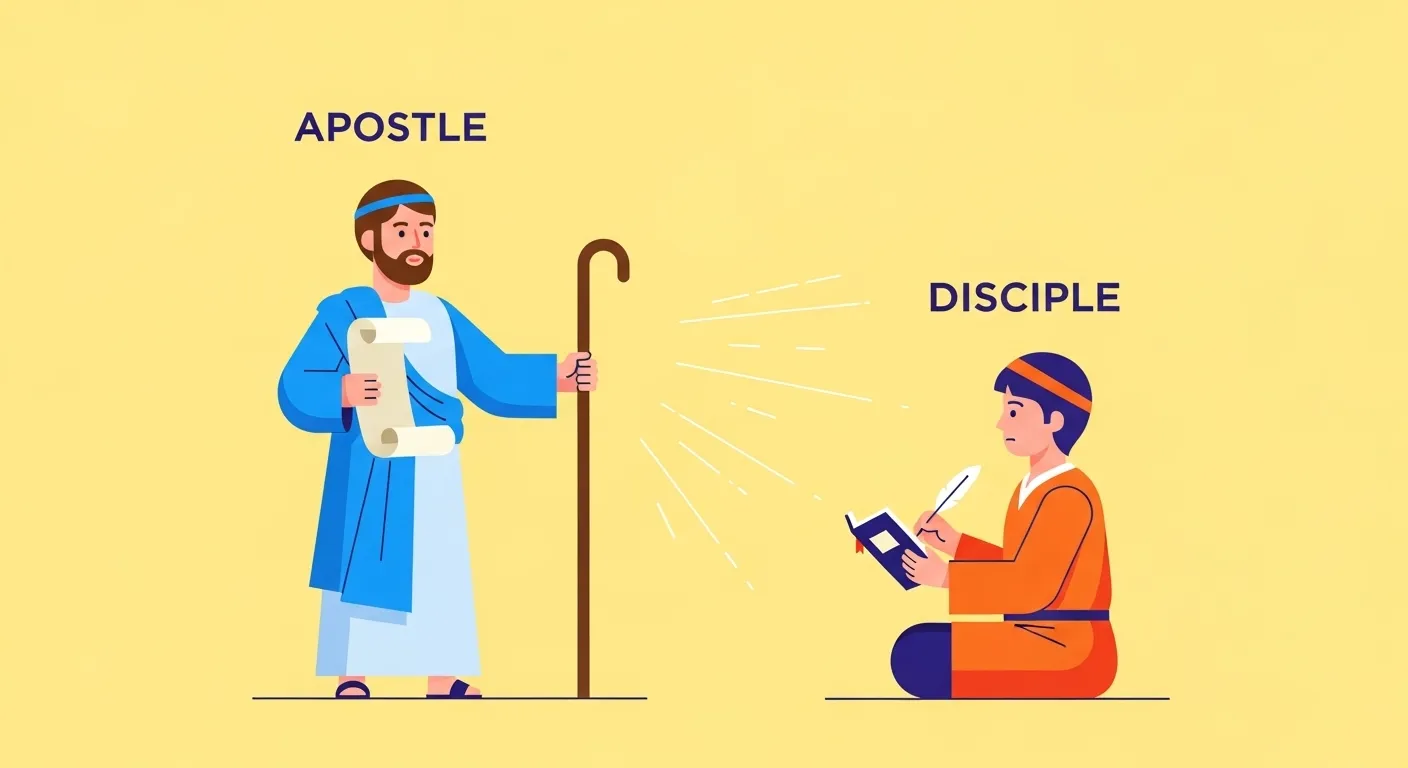
✝️ Apostle = sent messenger of faith, Disciple = learner or follower.
A few years ago, a Sunday school teacher asked her students, “Who followed Jesus?” Some shouted “disciples!” while others said “apostles!”
The kids were confused because they thought both words meant the same. In real life, this happens a lot.
Many people do not know the difference between an apostle and a disciple. Both terms are connected to teaching and following, but their roles are different.
The difference between apostle and disciple is important to understand the Bible correctly. The difference between apostle and disciple helps learners, scholars, and religious leaders teach and interpret stories better.
When you know the difference between apostle and disciple, you understand who taught, who followed, and who spread the message. This knowledge is crucial for students of theology and even general learners who want to understand Christian history.
🔑 Key Difference Between the Both
A disciple is a follower and learner of Jesus, while an apostle is a chosen messenger sent to teach and spread the gospel.
🌍 Why Is Their Difference Necessary to Know for Learners and Experts
Understanding the difference between apostle and disciple helps both learners and experts. For learners, it clarifies the Bible’s stories. For experts, it helps teach accurately. Society benefits when people understand religious history correctly. Knowing who was a disciple and who became an apostle helps respect roles and avoid confusion.
🔊 Pronunciation
- Apostle
- US: “uh-pos-uhl”
- UK: “uh-pos-tl”
- Disciple
- US: “dih-sahy-puhl”
- UK: “dih-sahy-puhl”
🔗 Linking Hook
Now, let’s explore the detailed difference between apostle and disciple so we can understand their roles clearly.
🆚 Difference Between Apostle and Disciple
1. Meaning
- Apostle: A chosen messenger sent by Jesus.
- Example 1: Paul became an apostle to spread Christianity.
- Example 2: Peter was an apostle who led the early church.
- Disciple: A follower who learns from a teacher.
- Example 1: John followed Jesus as a disciple.
- Example 2: Mary Magdalene was a disciple who learned teachings.
2. Role
- Apostle: Sends messages and teaches others.
- Example 1: An apostle travels to spread faith.
- Example 2: Apostles guide early Christian communities.
- Disciple: Learns and follows instructions.
- Example 1: A disciple listens carefully to lessons.
- Example 2: A disciple practices teachings daily.
3. Authority
- Apostle: Has authority to teach and lead.
- Example 1: Apostles baptized new believers.
- Example 2: Apostles made important decisions in the church.
- Disciple: Follows authority, no independent power.
- Example 1: Disciple obeys the teacher’s instructions.
- Example 2: Disciple learns without giving commands.
4. Mission
- Apostle: Mission is to spread the message widely.
- Example 1: Paul traveled to different countries.
- Example 2: Apostles preached in towns and villages.
- Disciple: Mission is to learn and grow spiritually.
- Example 1: A disciple studies teachings.
- Example 2: A disciple prays and follows rituals.
5. Selection
- Apostle: Chosen by Jesus personally.
- Example 1: Peter was chosen as an apostle.
- Example 2: James was chosen for a special mission.
- Disciple: Anyone willing to follow can be a disciple.
- Example 1: Ordinary people became disciples.
- Example 2: Followers joined Jesus voluntarily.
6. Number
- Apostle: Specific number, like twelve apostles.
- Example 1: Twelve apostles led the church.
- Example 2: Matthias replaced Judas as an apostle.
- Disciple: Unlimited, many followers.
- Example 1: Thousands of disciples followed Jesus.
- Example 2: Men and women both became disciples.
7. Teaching Ability
- Apostle: Can teach and interpret scriptures.
- Example 1: Peter explained parables.
- Example 2: Paul wrote letters to churches.
- Disciple: Learns, not authorized to teach widely.
- Example 1: A disciple repeats lessons carefully.
- Example 2: Disciple shares knowledge within small groups.
8. Responsibility
- Apostle: Responsible for spreading gospel.
- Example 1: Apostles traveled far to preach.
- Example 2: Apostles managed church communities.
- Disciple: Responsible for following and personal growth.
- Example 1: Disciple follows teachings faithfully.
- Example 2: Disciple practices ethical life.
9. Leadership
- Apostle: Leader and guide.
- Example 1: Apostles led prayers and ceremonies.
- Example 2: Apostles decided church matters.
- Disciple: Follower, not leader.
- Example 1: Disciple supports leaders.
- Example 2: Disciple attends learning sessions.
10. Duration of Role
- Apostle: Often lifelong mission.
- Example 1: Paul served as apostle for decades.
- Example 2: Peter led until his death.
- Disciple: Period depends on learning phase.
- Example 1: Some disciples followed only briefly.
- Example 2: Others became lifelong learners.
✝️ Nature and Behaviour
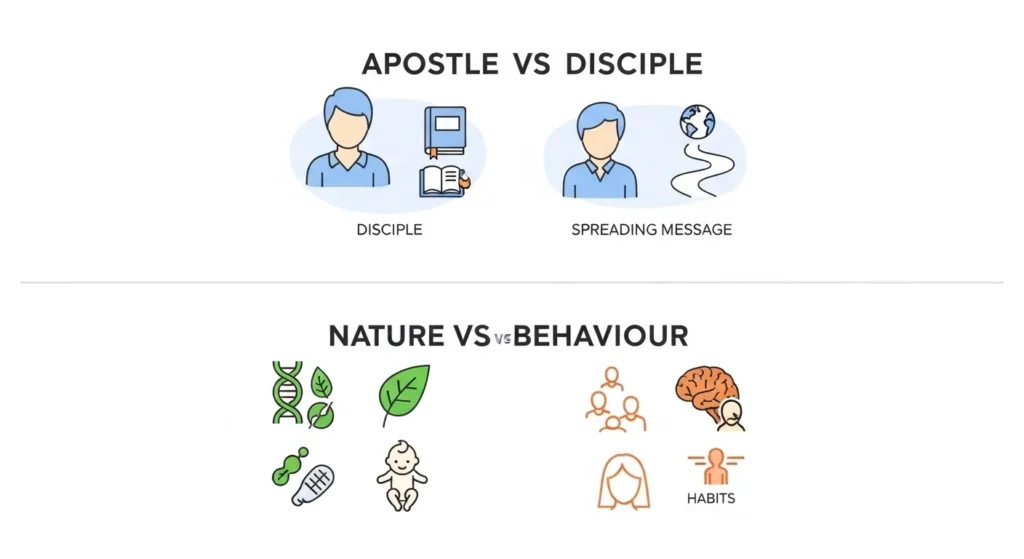
- Apostle: Bold, authoritative, and mission-focused.
- Disciple: Humble, obedient, and learning-focused.
🤔 Why People Get Confused About Their Use
People confuse apostle and disciple because both follow Jesus. Many disciples later became apostles, so roles overlap in stories. The words sound religiously similar, adding to confusion.
Difference and Similarity
| Feature | Apostle | Disciple | Similarity |
| Meaning | Chosen messenger | Follower and learner | Both follow Jesus |
| Role | Teaches and spreads message | Learns and obeys teachings | Both devoted to Jesus |
| Authority | High | Low | Both respect God’s word |
| Mission | Spread gospel | Learn teachings | Both support faith growth |
| Selection | Chosen by Jesus | Anyone willing to follow | Both part of Christian path |
🏆 Which Is Better in What Situation?
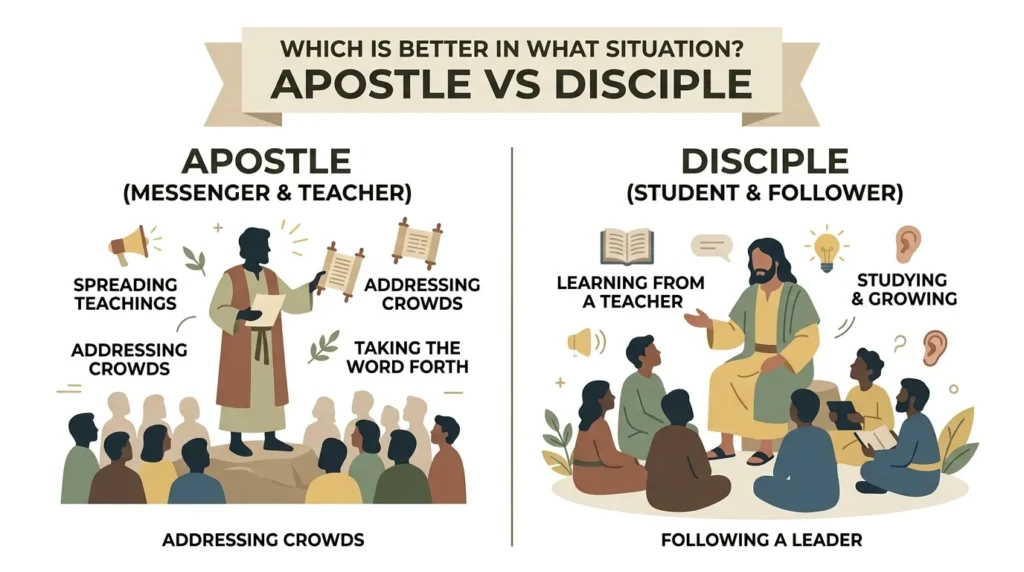
A disciple is better for someone who wants to learn and grow spiritually. Learning, practicing, and following teachings daily improves life and character. Beginners in faith or students of religion benefit most from being disciples.
An apostle is better for someone ready to teach, guide, or spread messages. Apostles inspire others, lead communities, and strengthen faith. Experts, teachers, or leaders in society take apostle-like roles to make a larger impact.
🌟 How Are the Keywords Used in Metaphors and Similes?
- Apostle: Like a lighthouse (guiding others)
- Disciple: Like a sponge (absorbing knowledge)
💬 Connotative Meaning
- Apostle: Positive (leader, guide)
- Example: “She acts like an apostle, teaching others wisely.”
- Disciple: Positive (learner, humble)
- Example: “He follows like a disciple, learning patiently.”
📖 Idioms or Proverbs
- “Lead the way” (apostle)
- Example: Apostles lead the way in faith.
- “Learn by heart” (disciple)
- Example: Disciples learn scriptures by heart.
📚 Works in Literature
- The Apostles’ Acts – Religious history – Luke – 80 AD
- Disciples of Jesus – Christian studies – Unknown author – Modern editions
🎬 Movies
- The Apostle – 1997, USA
- The Young Messiah – 2016, USA (depicts discipleship)
❓ FAQs
1. What is the main difference between apostle and disciple?
A disciple learns; an apostle teaches and spreads the message.
2. Can a disciple become an apostle?
Yes, some disciples were later chosen as apostles.
3. Who has more authority?
An apostle has more authority than a disciple.
4. Are all disciples apostles?
No, only a few disciples are chosen as apostles.
5. Which is more important?
Both are important; one learns, one teaches.
🌱 How Are Both Useful for Surroundings?
Disciples help spread moral teachings by following. Apostles guide communities and inspire action. Together, they build faith, community, and social harmony.
🏁 Final Words
A disciple is humble and learns. An apostle is bold and teaches. Both are vital in religion and society.
✅ Conclusion
Understanding the difference between apostle and disciple helps in studying Christian history. Disciples learn and grow spiritually. Apostles lead, teach, and spread the message. Knowing the roles clearly helps learners, scholars, and religious leaders. Both are important in shaping faith, guiding communities, and maintaining harmony. By knowing the difference, society respects roles and ensures accurate teachings. If learning or teaching, these roles complement each other, forming the foundation of Christian tradition.
Read more about!
Locs vs Dreads – Simple Key Difference Guide
Difference Between Octopus and Squid: Simple Guide

I am James Carter, a professional content writer from the United States. I specialize in writing simple and clear comparison blogs that help students and readers understand difficult topics easily. My writing focuses on everyday language, education, science, and lifestyle topics. I believe that learning should be easy for everyone, so I use simple words and real-life examples in my articles.