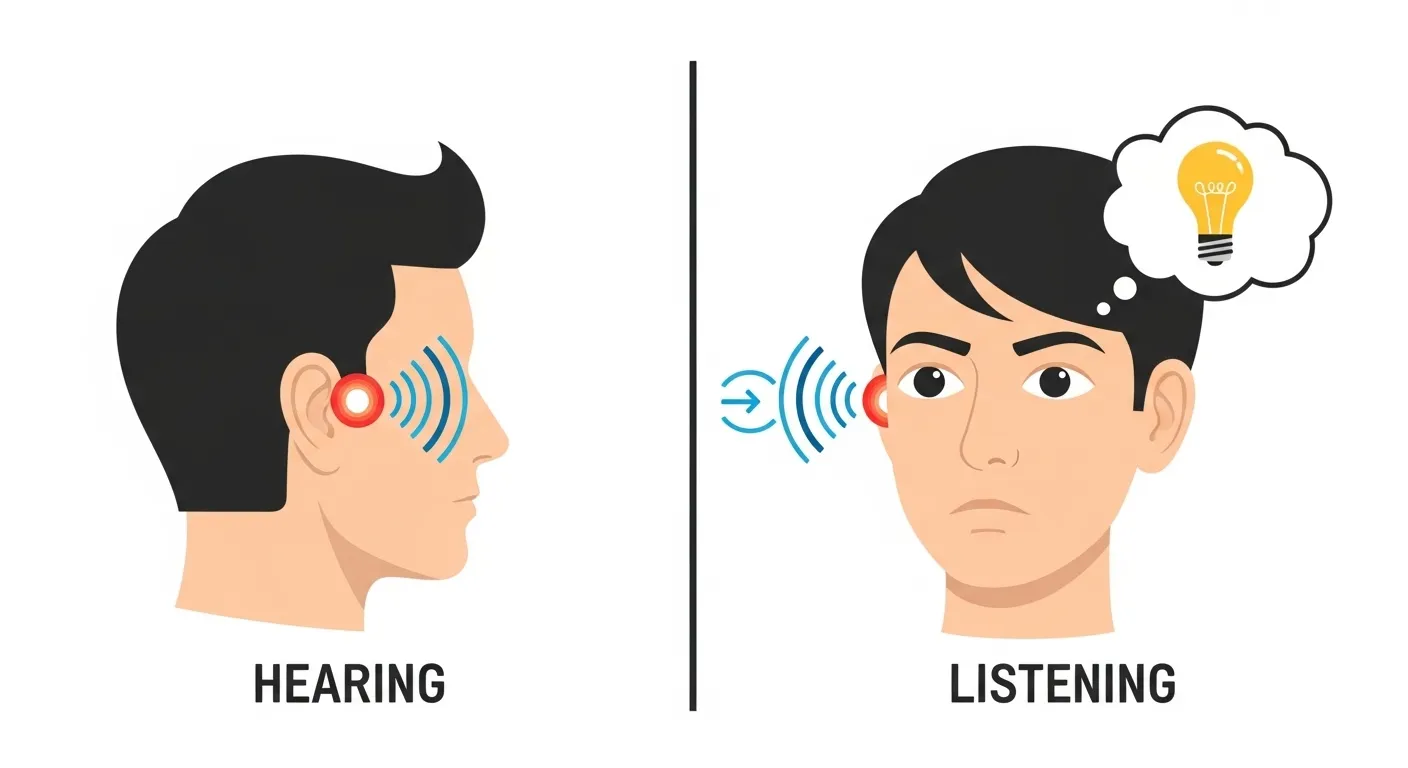
👂 Hearing is noticing sounds; listening is actively understanding them. ✅
Last week, a teacher asked her class to repeat a story. Some students heard the words but could not answer questions. Others listened carefully and gave the right answers.
This simple example shows the difference between hearing and listening. Many people confuse hearing and listening because both involve sounds, but their meaning is different.
Hearing is the physical ability to perceive sound, while listening is understanding and making sense of that sound. Knowing the difference between hearing and listening is important for learners, teachers, and professionals.
The difference between hearing and listening helps people communicate better, avoid misunderstandings, and improve relationships. By understanding the difference between hearing and listening, you can improve your learning, work, and daily life.
🔑 Key Difference Between the Both
Hearing is simply perceiving sound with your ears, while listening involves understanding, interpreting, and responding to that sound.
🌍 Why Is Their Difference Necessary to Know for Learners and Experts
The difference between hearing and listening is critical for learners and experts. Learners need listening to understand lessons, not just hear words. Experts need to listen to communicate, teach, and lead effectively. In society, effective listening improves relationships, reduces mistakes, and enhances cooperation. Understanding the difference between hearing and listening is a step toward better communication skills.
🔊 Pronunciation
- Hearing
- US: “heer-ing”
- UK: “hee-ring”
- Listening
- US: “lis-uh-ning”
- UK: “lis-uh-ning”
🔗 Linking Hook
Let’s now explore the detailed differences between hearing and listening to understand their roles in communication.
🆚 Difference Between Hearing and Listening
1. Definition
- Hearing: The physical ability to perceive sound.
- Example 1: She can hear birds singing outside.
- Example 2: He hears the traffic noise from the street.
- Listening: Actively understanding and interpreting sound.
- Example 1: She listened to her friend’s problem and gave advice.
- Example 2: He listened to the lecture and took notes.
2. Process
- Hearing: Passive process
- Example 1: Hearing background music while working.
- Example 2: Hearing a car horn without paying attention.
- Listening: Active process
- Example 1: Listening to instructions before starting a task.
- Example 2: Listening to a story and remembering details.
3. Purpose
- Hearing: No specific purpose, just perception
- Example 1: Hearing people talking in the park.
- Example 2: Hearing the rain outside.
- Listening: Purposeful understanding
- Example 1: Listening to learn a new skill.
- Example 2: Listening to advice before making a decision.
4. Attention
- Hearing: Minimal attention needed
- Example 1: Hearing sounds while daydreaming.
- Example 2: Hearing someone calling your name from afar.
- Listening: Full attention required
- Example 1: Listening carefully during a meeting.
- Example 2: Listening to a teacher to understand a lesson.
5. Understanding
- Hearing: No understanding required
- Example 1: Hearing a song without knowing the lyrics.
- Example 2: Hearing a conversation but not knowing the context.
- Listening: Understanding is essential
- Example 1: Listening to a friend’s feelings.
- Example 2: Listening to instructions to complete a task correctly.
6. Response
- Hearing: No response needed
- Example 1: Hearing the wind blow.
- Example 2: Hearing a bell ring.
- Listening: Response is expected
- Example 1: Listening to feedback and replying.
- Example 2: Listening to questions and answering correctly.
7. Skills Required
- Hearing: Basic sense of hearing
- Example 1: Having healthy ears to hear sounds.
- Example 2: Detecting a phone ring.
- Listening: Communication and comprehension skills
- Example 1: Understanding tone and emotion in speech.
- Example 2: Summarizing a lecture accurately.
8. Duration
- Hearing: Short or continuous, often unnoticed
- Example 1: Hearing traffic sounds all day.
- Example 2: Hearing birds chirp in the morning.
- Listening: Requires focus and time
- Example 1: Listening to a 30-minute presentation carefully.
- Example 2: Listening to someone explain a story fully.
9. Emotional Connection
- Hearing: No emotional involvement
- Example 1: Hearing a song without feeling it.
- Example 2: Hearing someone talk in the background.
- Listening: Emotional connection is involved
- Example 1: Listening to a friend’s sorrow.
- Example 2: Listening to a motivational speech and feeling inspired.
10. Outcome
- Hearing: Minimal or no outcome
- Example 1: Hearing background noise.
- Example 2: Hearing words but forgetting them.
- Listening: Leads to understanding, learning, or action
- Example 1: Listening to instructions and completing a task.
- Example 2: Listening to advice and making better decisions.
👂 Nature and Behaviour
- Hearing: Passive, automatic, sensory-focused.
- Listening: Active, intentional, understanding-focused.
🤔 Why People Get Confused Between Hearing and Listening
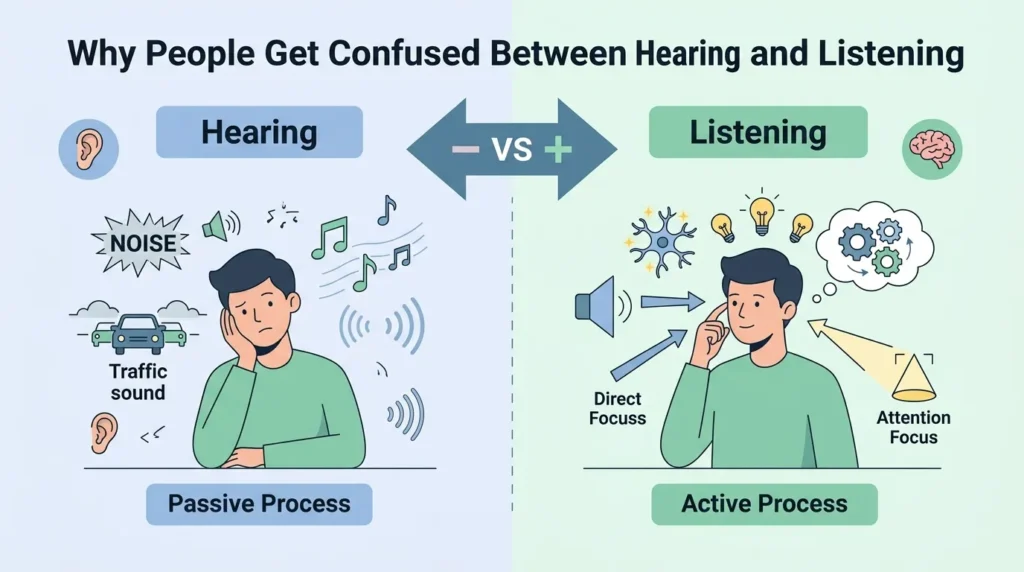
People confuse hearing and listening because both involve sound. Many think hearing is enough to understand. In reality, listening requires focus, comprehension, and response, unlike hearing.
Difference and Similarity
| Feature | Hearing | Listening | Similarity |
| Definition | Perceiving sound | Understanding sound | Both involve ears |
| Process | Passive | Active | Both are auditory skills |
| Purpose | None | To understand | Both happen with sounds |
| Attention | Minimal | High | Both can occur anywhere |
| Outcome | No action | Leads to action or understanding | Both occur naturally |
🏆 Which Is Better in What Situation?
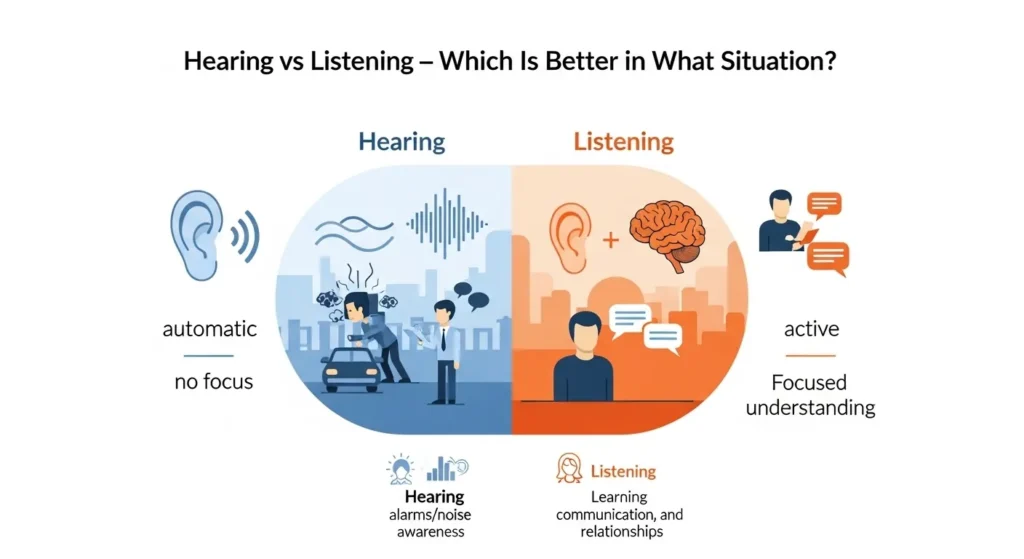
Hearing is enough in casual situations, like noticing background sounds or alarms. It is passive and does not require effort.
Listening is better in learning, teaching, and relationships. It ensures comprehension, reduces mistakes, and improves communication. Professionals, students, and leaders benefit most from listening.
🌟 How Are the Keywords Used in Metaphors and Similes?
- Hearing: Like a radio in the background (perceiving sound without focus)
- Listening: Like a sponge (absorbing knowledge carefully)
💬 Connotative Meaning
- Hearing: Neutral
- Example: “I can hear the music, but I do not know the lyrics.”
- Listening: Positive
- Example: “She listened carefully and understood the problem.”
📖 Idioms or Proverbs
- “In one ear and out the other” (hearing but not listening)
- Example: He hears advice but does not listen.
- “Lend an ear” (listening attentively)
- Example: She lent an ear to her friend’s story.
📚 Works in Literature
- How to Win Friends and Influence People – Self-help – Dale Carnegie – 1936
- The Listening Book – Music and attention – W. A. Mathieu – 1991
- The Art of Listening – Communication guide – Erich Fromm – 1953
🎬 Movies
- Listen – 2020, USA
- Hearing Voices – 2014, UK
- The Listening – 2014, Canada
❓ FAQs
1. What is the main difference between hearing and listening?
Hearing is passive perception; listening is active understanding and response.
2. Can someone hear without listening?
Yes, hearing can occur without focus or understanding.
3. Which is more important for learning?
Listening is more important because it ensures comprehension.
4. Can listening improve relationships?
Yes, listening attentively strengthens communication and trust.
5. Is hearing enough in professional settings?
No, listening is essential to understand tasks, instructions, and feedback.
🌱 How Are Both Useful for Surroundings?
Hearing alerts people to danger or events. Listening fosters learning, empathy, and understanding in society. Both are essential for communication, safety, and education.
🏁 Final Words
Hearing is passive; listening is active. Both involve sound, but only listening leads to understanding and action.
✅ Conclusion
The difference between hearing and listening is simple but vital. Hearing is noticing sound; listening is understanding it. Effective listening improves learning, communication, and relationships. By practicing listening, learners, professionals, and everyday people can reduce mistakes, enhance empathy, and communicate better. Hearing alone is not enough; attention, focus, and comprehension are required to truly understand messages. Both hearing and listening play essential roles, but listening creates impact, builds connections, and allows knowledge to grow.
Read more about!
MLA vs APA – Quick Guide to Key Differences
Difference Between Bourbon and Scotch: Complete Guide
Difference Between Agitator and Impeller: Complete Guide

I am James Carter, a professional content writer from the United States. I specialize in writing simple and clear comparison blogs that help students and readers understand difficult topics easily. My writing focuses on everyday language, education, science, and lifestyle topics. I believe that learning should be easy for everyone, so I use simple words and real-life examples in my articles.