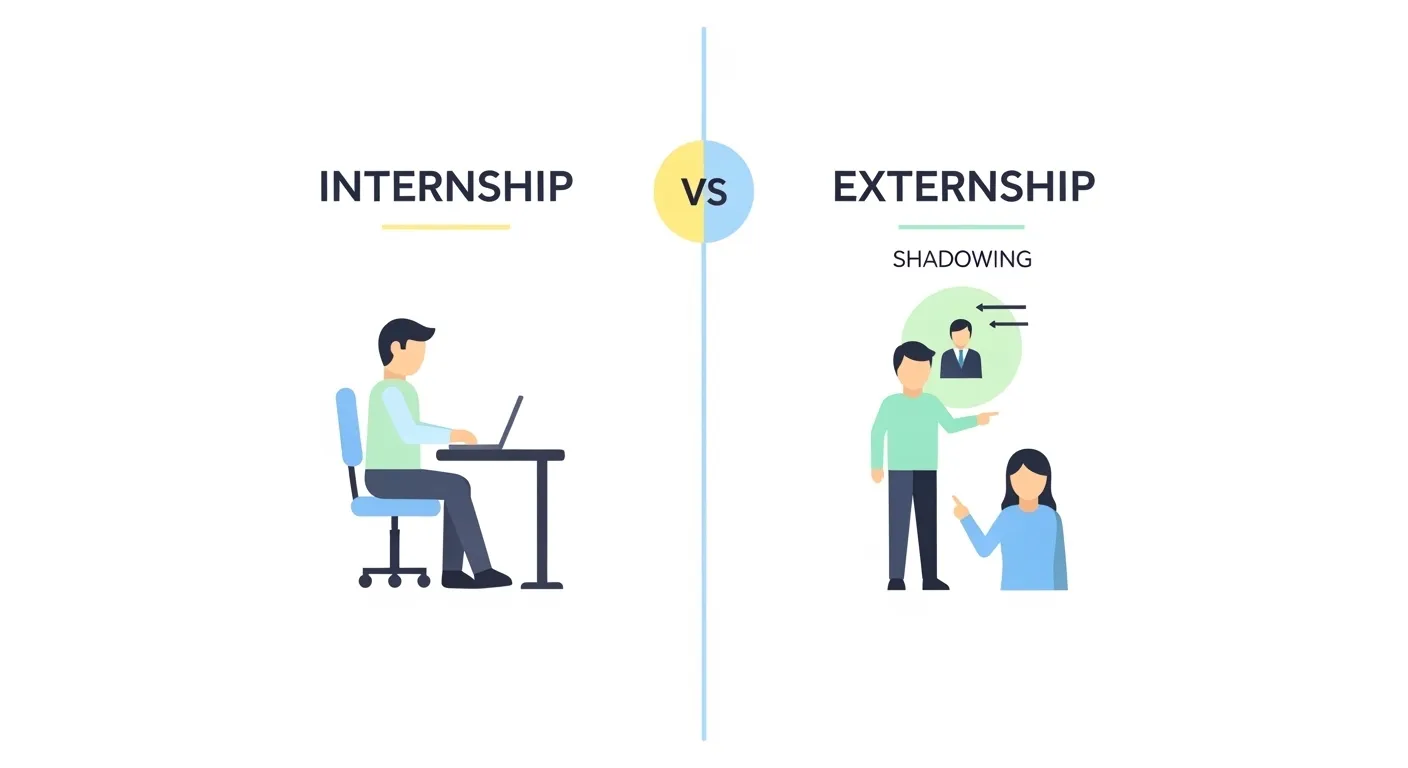
💼 Internship vs Externship: Internship is hands-on work experience, while externship is short-term observational learning.
A university student once visited a career office to ask about job experience programs. The advisor mentioned two options: an internship and an externship.
The student felt confused because both seemed to offer learning opportunities in a workplace. This small moment made the student curious about the difference between internship and externship.
Many students face the same question when planning their careers. At first glance, both programs look similar because they allow students to learn from professionals. However, the difference between internship and externship lies in the duration, depth of work, and level of responsibility.
Understanding the difference between internship and externship helps students choose the right learning opportunity. When people clearly know the difference between internship and externship, they can plan their career path more wisely and gain useful real-world experience
.Externship vs internship are both experiential learning programs, but they differ in structure and depth of involvement.
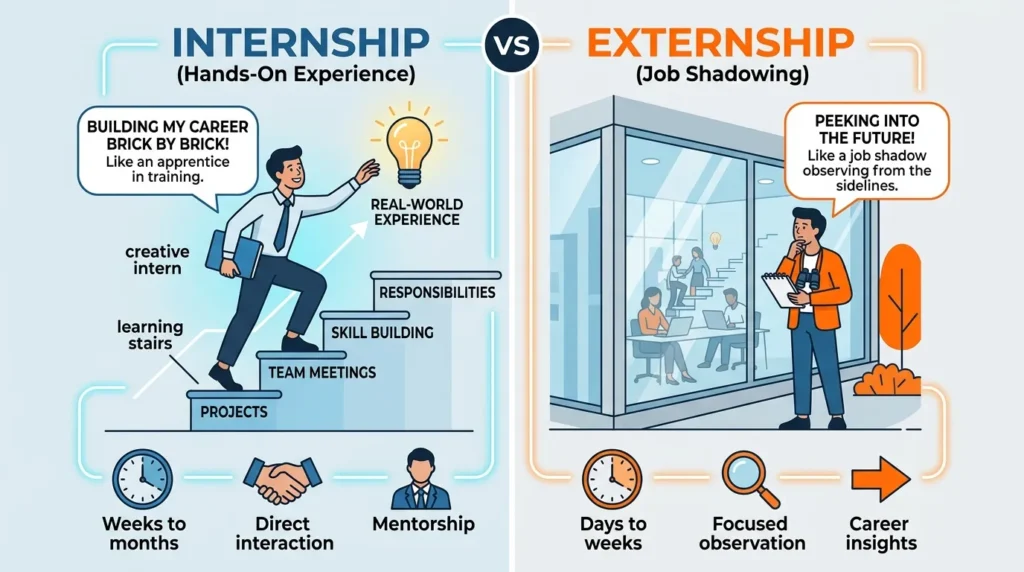
An externship is usually a short-term, observational experience where students shadow professionals to understand workplace environments without heavy hands-on tasks. It helps in career exploration and understanding real-world job roles.
In contrast, an internship is a longer, more practical training program where interns actively participate in real work, complete assigned tasks, and gain industry skills.
An extern is the participant in an externship, while an intern works in an internship program. In simple terms, an externship is more about observation and exposure, whereas an internship focuses on skill development and hands-on experience.
🔑 Key Difference Between the Both
The main difference is the level of work experience. Internships usually involve longer work periods and active job responsibilities, while externships are shorter and mainly focus on observing professionals.
🌍 Why Their Difference Is Important for Learners and Experts
Knowing the difference between internship and externship is important for students, teachers, and employers. Students need to choose the right program based on their career stage and learning goals.
In society, these programs help bridge the gap between education and professional work. Internships and externships allow learners to understand workplace culture, develop skills, and build professional connections. Understanding the difference between internship and externship helps individuals make better career decisions and improves workforce readiness.
🔊 Pronunciation
Internship
- US: /ˈɪntɝːnʃɪp/
- UK: /ˈɪntɜːnʃɪp/
Externship
- US: /ˈekstɝːnʃɪp/
- UK: /ˈekstɜːnʃɪp/
Before exploring deeper, let us clearly understand the difference between internship and externship in detail.
🏢 Difference Between Internship and Externship
1. Duration
Internships usually last longer. Externships are short programs.
Examples of internships:
- A three-month summer internship
- A six-month business internship
Examples of externships:
- A one-week hospital externship
- A two-week legal externship
2. Work Responsibilities
Interns often complete real tasks. Externs mainly observe professionals.
Examples of internships:
- Writing reports for a company
- Helping with marketing projects
Examples of externships:
- Watching a doctor treat patients
- Observing a lawyer in court
3. Learning Style
Internships involve active participation. Externships focus on job shadowing.
Examples of internships:
- Assisting a manager with projects
- Creating presentations for the team
Examples of externships:
- Following a professional during work
- Attending meetings as an observer
4. Payment
Some internships provide payment or stipends. Externships are usually unpaid.
Examples of internships:
- Paid summer internship
- Internship with monthly stipend
Examples of externships:
- Unpaid hospital observation program
- Short legal externship without salary
5. Academic Credit
Many internships offer academic credit. Externships sometimes provide credit but not always.
Examples of internships:
- College internship for course credit
- Business internship with university approval
Examples of externships:
- Medical school externship observation
- Short academic externship program
6. Skill Development
Internships help build strong job skills. Externships mainly introduce the profession.
Examples of internships:
- Learning office software
- Managing small work tasks
Examples of externships:
- Understanding daily work routine
- Learning about workplace environment
7. Level of Responsibility
Interns often have responsibilities. Externs usually do not perform major tasks.
Examples of internships:
- Managing small projects
- Assisting team members
Examples of externships:
- Observing meetings
- Watching professionals work
8. Career Stage
Internships usually happen later in education. Externships often occur earlier.
Examples of internships:
- Final-year college internship
- Graduate internship program
Examples of externships:
- Early university externship
- Introductory career observation program
9. Workplace Involvement
Interns become part of the team. Externs stay mostly as observers.
Examples of internships:
- Working with a department team
- Participating in company projects
Examples of externships:
- Watching daily work activities
- Attending meetings as a guest
10. Goal
Internships focus on practical experience. Externships focus on career exploration.
Examples of internships:
- Preparing for a future job
- Building professional skills
Examples of externships:
- Learning about a profession
- Deciding a career path
Nature and Behaviour of Internship and Externship
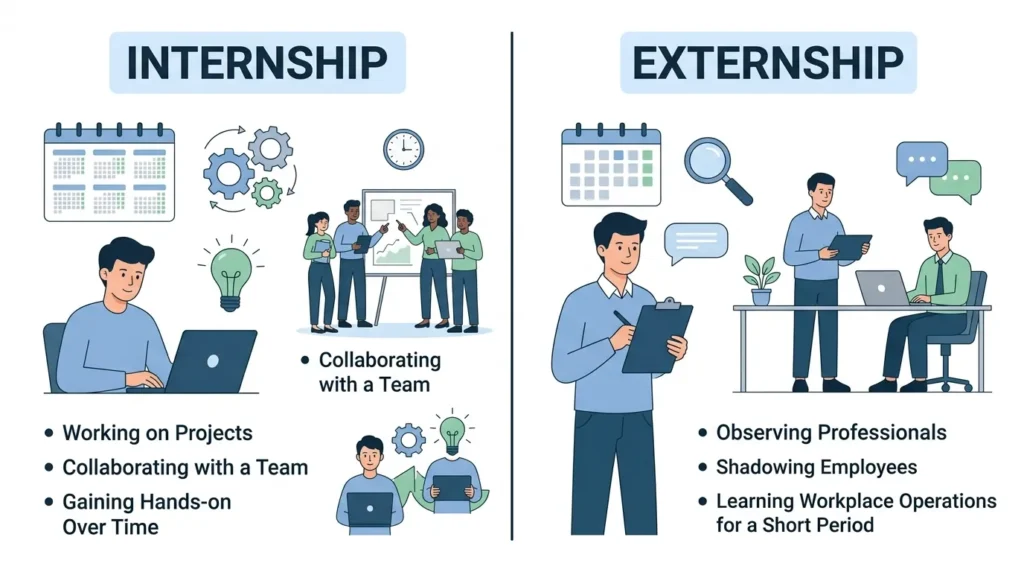
Internship:
An internship is a structured work experience program. Students perform real tasks and gain practical skills in a professional environment.
Externship:
An externship is mainly a short observation program. Students watch professionals work and learn about the job without heavy responsibilities.
🤔 Why People Are Confused About Their Use
People often feel confused because both programs allow students to experience a workplace. Both are also connected to education and career development. The confusion happens because the names sound similar and both involve learning from professionals.
Difference and Similarity
| Feature | Internship | Externship | Similarity |
| Duration | Long period | Short period | Both temporary |
| Work tasks | Active work | Mostly observation | Both learning experiences |
| Payment | Sometimes paid | Usually unpaid | Both educational |
| Responsibility | Higher | Lower | Both career programs |
| Goal | Skill building | Career exploration | Both help students |
💼 Which Is Better in What Situation?
Internship:
An internship is better when a student wants deep experience and practical skills. It allows active participation in projects and helps build a strong resume. Students close to graduation often choose internships because they prepare them for real jobs.
Externship:
An externship is better when someone wants to explore a career quickly. It allows students to observe professionals and understand the work environment without long commitments. Early-stage students often choose externships to discover their interests.
🎭 How Internship and Externship Are Used in Metaphors and Similes
These words sometimes appear in figurative descriptions.
Internship examples
- “His first job felt like an internship for life.”
- “The training was like an internship in leadership.”
Externship examples
- “The program was like an externship into the world of business.”
- “Watching the team felt like a short externship in teamwork.”
Connotative Meaning
Internship
Usually positive. It suggests learning, growth, and career preparation.
Example: “Her internship helped her build confidence.”
Externship
Neutral to positive. It suggests observation and career exploration.
Example: “The externship gave him a clear idea of the profession.”
Idioms or Expressions
There are no common idioms directly using these words, but they appear in everyday expressions.
Examples:
- “She completed an internship before graduation.”
- “He joined an externship to explore medicine.”
📚 Works in Literature
- Intern Nation Non-fiction, Ross Perlin, 2011
- The Internship Bible Career Guide, Mark Oldman & Samer Hamadeh, 2003
🎬 Movies Related to the Words
- The Internship 2013, United States
- The Intern 2015, United States
❓ FAQs
1. What is the main difference between internship and externship?
Internships involve active work experience, while externships focus on observation.
2. Are internships always paid?
No. Some internships are paid, while others are unpaid.
3. Are externships short programs?
Yes. They usually last a few days or weeks.
4. Which is better for beginners?
Externships are often better for beginners exploring careers.
5. Can an externship lead to an internship?
Yes. Sometimes externships help students secure internships later.
Q6: What is an externship?
An externship is a short-term learning program where individuals observe professionals in a workplace to gain industry knowledge and career insight.
Q7: What is the externship definition?
Externship definition refers to a structured learning experience where students shadow professionals to understand real-world job environments without active job responsibilities.
Q8: What is the difference between externship vs internship?
Externships focus on observation and learning, while internships involve hands-on work and active participation in company tasks.
Q9: What is the difference between extern vs intern?
An extern observes and learns in a workplace setting, while an intern works actively and contributes to projects within an organization.
🌍 How Internship and Externship Are Useful for Surroundings
Internships and externships help build a skilled workforce. They allow students to gain real knowledge before entering full-time jobs.
Companies also benefit because they train future employees and discover talented individuals early. These programs strengthen the connection between education and professional industries.
Final Words for Both
Internships and externships both provide valuable career learning opportunities. The main difference lies in the level of participation and duration.
Conclusion
The difference between internship and externship mainly depends on the depth of experience and time commitment. Internships provide longer, hands-on work experience that helps students develop real job skills. Externships are shorter programs that focus on observation and career exploration.
Both opportunities are valuable for students and professionals because they help bridge the gap between education and the workplace. Understanding the difference between internship and externship allows learners to choose the right program for their career goals and personal development.
Read more about!
Difference Between Bourbon and Scotch: Complete Guide
Difference Between Octopus and Squid: Simple Guide

I am James Carter, a professional content writer from the United States. I specialize in writing simple and clear comparison blogs that help students and readers understand difficult topics easily. My writing focuses on everyday language, education, science, and lifestyle topics. I believe that learning should be easy for everyone, so I use simple words and real-life examples in my articles.