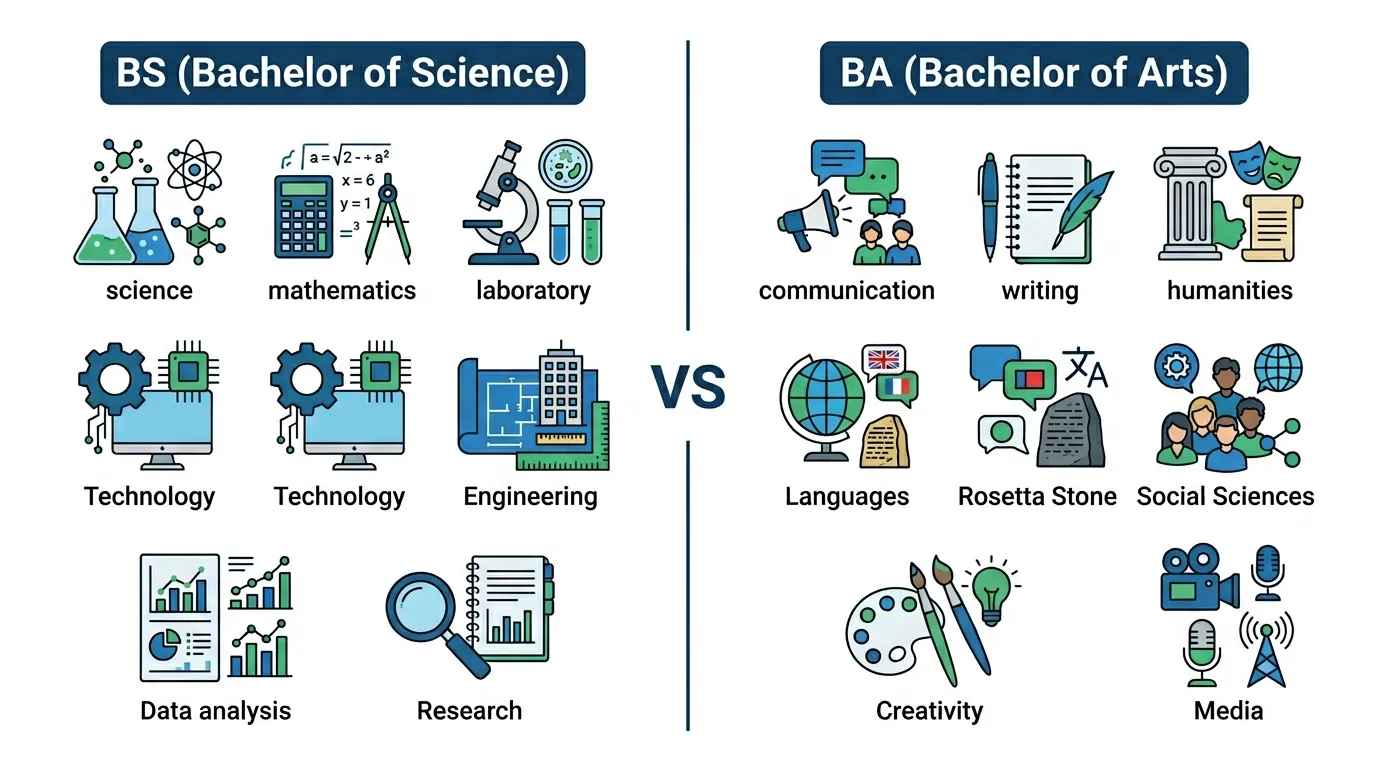
A BS focuses more on science, math, and technical skills, while a BA emphasizes humanities, communication, and broader liberal arts education.
Many students reach a point where they must choose between a Bachelor of Science (BS) and a Bachelor of Arts (BA). At first glance, the two degrees may seem similar because both are undergraduate qualifications offered by colleges and universities.
However, the difference between BS and BA becomes important when you consider coursework, career goals, graduate studies, and skill development.
The difference between BS and BA mainly lies in academic focus. A BS degree emphasizes technical, scientific, and analytical subjects, while a BA degree focuses more on humanities, communication, social sciences, and broader liberal arts education.
Understanding the difference between BS and BA helps students make smarter educational decisions and avoid choosing a degree that does not align with their long-term goals.
In this guide, you will learn what a BS and BA degree mean, how they compare, which careers they support, salary expectations, graduate school opportunities, and which option may be best for you.
Difference Between BS and BA
The difference between BS and BA is that a BS (Bachelor of Science) focuses more on science, mathematics, research, and technical subjects, while a BA (Bachelor of Arts) focuses more on humanities, communication, languages, and social sciences.
For example, a Computer Science student may earn a BS because the field requires technical and analytical skills. A Journalism student may earn a BA because communication and writing are the primary focus.
Definition of BS and BA
- BS (Bachelor of Science): An undergraduate degree focused on scientific, technical, mathematical, or research-based subjects.
- BA (Bachelor of Arts): An undergraduate degree focused on humanities, social sciences, communication, languages, and liberal arts subjects.
Pronunciation
| Degree | US Pronunciation | UK Pronunciation |
| BS | Bee-Ess | Bee-Ess |
| BA | Bee-Ay | Bee-Ay |
Now that you know what these degrees mean, let’s understand the key differences that often cause confusion among students.
Difference Between BS and BA: Quick Comparison
| Feature | BS | BA |
| Main Focus | Science and technical subjects | Arts and humanities |
| Mathematics | Usually extensive | Usually limited |
| Research | Strong emphasis | Moderate emphasis |
| Electives | Fewer electives | More electives |
| Technical Skills | High | Moderate |
| Communication Skills | Moderate | High |
| Career Paths | STEM and technical careers | Creative and communication careers |
| Curriculum Structure | Specialized | Flexible |
Key Differences Explained Between BS and BA
Academic Focus
A BS degree focuses heavily on science, technology, engineering, mathematics, and research. Students spend more time learning technical concepts and analytical methods.
A BA degree focuses on communication, culture, language, history, psychology, and social studies.
Course Requirements
BS programs generally require more major-specific courses.
BA programs allow students to explore subjects outside their major through electives.
Mathematics and Science
Many BS degrees require advanced mathematics, laboratory work, and scientific research.
BA degrees often require fewer science courses and more writing-intensive subjects.
Research Opportunities
BS students often complete research projects involving data analysis and experimentation.
BA students may conduct qualitative research focused on communication, culture, or human behavior.
Career Preparation
BS graduates are often prepared for technical careers.
BA graduates are often prepared for communication, management, media, and creative careers.
Flexibility
BA programs usually provide greater flexibility for double majors and minors.
BS programs typically follow a more structured curriculum.
Graduate Education
Both degrees can lead to graduate school, but preparation may differ depending on the field.
Employer Perception
Most employers care more about skills, internships, experience, and results than if your diploma says BS or BA.
What Is a BS Degree and How Does It Work?
A Bachelor of Science degree is designed to build technical expertise and analytical thinking. Students spend significant time studying scientific methods, quantitative analysis, and specialized coursework.
Common BS Majors
- Computer Science
- Biology
- Chemistry
- Physics
- Engineering
- Nursing
- Mathematics
- Information Technology
- Data Science
Skills Developed in a BS Program
- Problem-solving
- Data analysis
- Research methods
- Technical communication
- Scientific reasoning
Who Should Choose a BS Degree?
A BS degree may be a good choice if you enjoy numbers, experiments, technology, scientific discovery, or structured problem-solving.
What Is a BA Degree and How Does It Work?
A Bachelor of Arts degree emphasizes broad education and critical thinking. Students often study communication, social systems, culture, and human behavior.
Common BA Majors
- English
- History
- Political Science
- Journalism
- Psychology
- Sociology
- International Relations
- Communication Studies
Skills Developed in a BA Program
- Writing
- Communication
- Critical thinking
- Public speaking
- Leadership
Who Should Choose a BA Degree?
Students who enjoy reading, writing, communication, languages, media, or social sciences often thrive in BA programs.
Difference Between BS and BA in Career Opportunities
The difference between BS and BA becomes noticeable when exploring career paths.
BS Career Examples
- Software Developer
- Data Analyst
- Research Scientist
- Engineer
- Cybersecurity Specialist
BA Career Examples
- Journalist
- Marketing Manager
- Public Relations Specialist
- Human Resources Manager
- Content Strategist
Interestingly, many careers today accept both degrees. Modern employers increasingly prioritize practical skills over degree titles.
Difference Between BS and BA Salary Potential
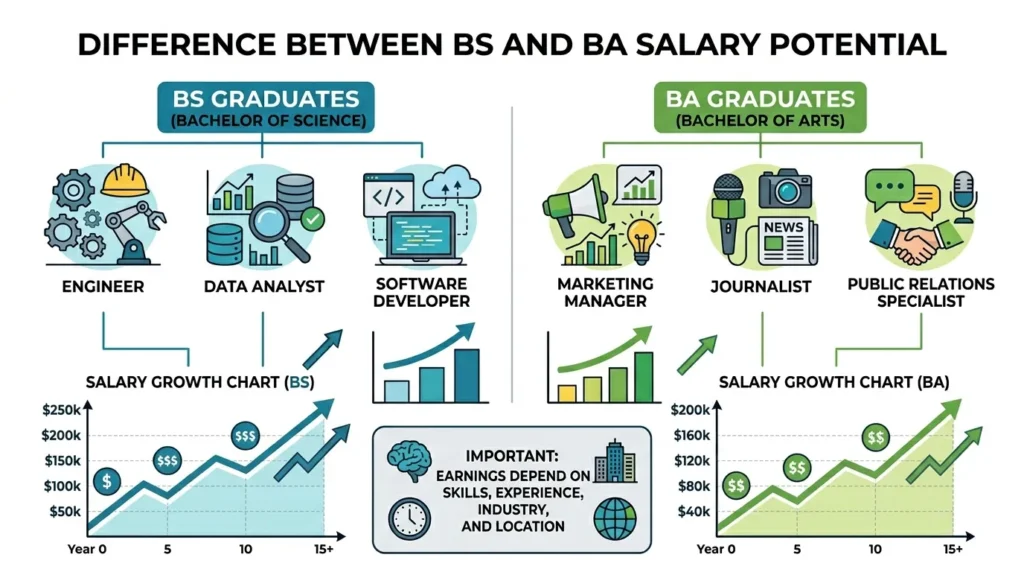
Many users search if a BS pays more than a BA.
The reality is more nuanced.
Salary often depends on:
- Industry
- Location
- Experience
- Certifications
- Job demand
- Performance
Some technical BS careers have higher starting salaries. However, experienced BA graduates in management, law, consulting, or marketing can earn equally competitive incomes.
Is a BS Better Than a BA?
This is one of the most searched questions online.
The answer depends on your goals.
Choose BS If:
- You enjoy science and math.
- You want a technical career.
- You like research and analysis.
- You plan to work in STEM fields.
Choose BA If:
- You enjoy communication and writing.
- You prefer flexibility.
- You want careers involving people, media, or leadership.
- You enjoy humanities and social sciences.
Neither degree is universally better. The best degree is the one aligned with your strengths and career ambitions.
Difference Between BS and BA for Graduate School
Both degrees can qualify students for graduate programs.
BS Graduates Often Pursue
- Master’s in Engineering
- Data Science
- Healthcare Programs
- Scientific Research
BA Graduates Often Pursue
- Law School
- Public Policy
- MBA Programs
- Communication Studies
Admissions committees usually focus on GPA, recommendations, experience, and prerequisites rather than degree title alone.
Difference and Similarity Between BS and BA
| Feature | BS | BA | Similarity |
| Degree Level | Undergraduate | Undergraduate | Both are bachelor’s degrees |
| Duration | Usually 4 years | Usually 4 years | Similar completion time |
| Accreditation | University approved | University approved | Equal academic recognition |
| Career Value | Technical focus | Communication focus | Both support careers |
| Graduate School | Eligible | Eligible | Both qualify for advanced study |
| Skill Building | Analytical | Communication | Both develop professional skills |
| Employment | Wide opportunities | Wide opportunities | Both improve employability |
| Academic Standing | Equal | Equal | Same degree level |
This table clearly shows the difference and similarity between BS and BA for quick understanding.
Real-Life Examples with BS and BA
Example 1: Software Engineer
A student earning a BS in Computer Science develops coding and technical skills needed for software development.
Example 2: Marketing Manager
A BA graduate in Communication Studies may build expertise in branding, messaging, and audience engagement.
Example 3: Business Executive
Many successful executives hold either BS or BA degrees because leadership skills matter more than degree labels.
Example 4: Content Creator
Professionals creating content for platforms like YouTube, Instagram, and Meta often come from BA backgrounds, although many BS graduates enter these fields as well.
Example 5: Data Analyst
A BS graduate may use statistical analysis to help businesses make decisions using data.
When to Use Each: BS vs BA
Choose BS when technical knowledge, scientific expertise, and quantitative analysis are central to your goals.
Choose BA when communication, creativity, leadership, cultural understanding, or flexibility are more important.
Think about the work you want to do every day, not just the degree title.
Common Mistakes with BS and BA
Mistake 1: Assuming BS Is Always Better
Correction: Career success depends on skills and performance.
Mistake 2: Believing BA Has Fewer Opportunities
Correction: Many leadership and management careers value BA graduates.
Mistake 3: Choosing Based Only on Salary
Correction: Long-term satisfaction matters too.
Mistake 4: Ignoring Curriculum Details
Correction: Different universities may structure BS and BA programs differently.
Mistake 5: Following Friends Instead of Personal Goals
Correction: Choose a degree that matches your strengths.
Why People Get Confused Between BS and BA
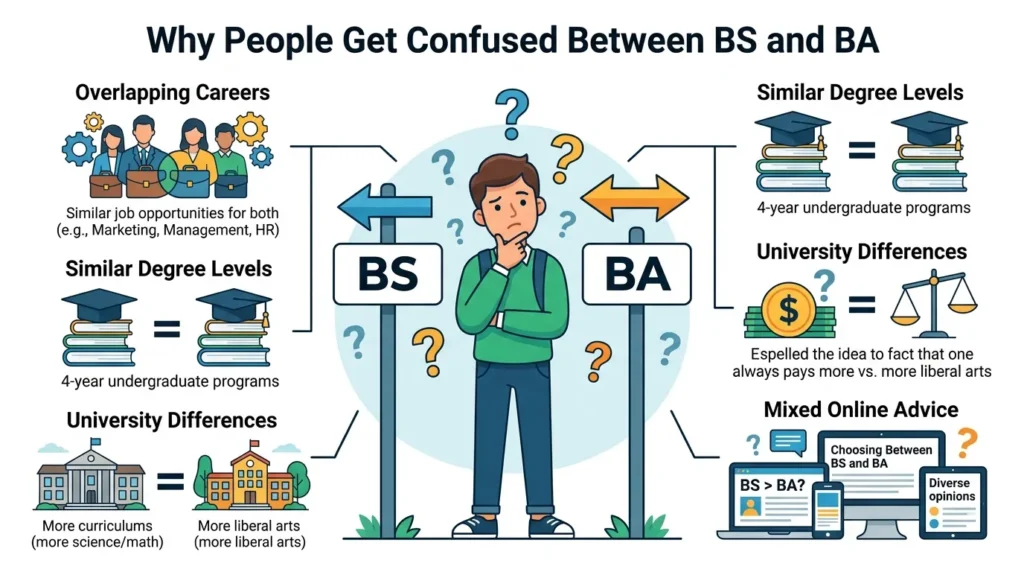
Many users get confused because:
- Both are bachelor’s degrees.
- Career paths often overlap.
- Universities define programs differently.
- Online advice can be contradictory.
- Employers rarely focus solely on degree labels.
In simple words, the distinction is often smaller than people expect.
How Search Engines Understand BS and BA and User Intent
Search engines such as Google analyze queries like “difference between BS and BA” to identify comparison intent.
Users usually want:
- Degree comparisons
- Career outcomes
- Salary information
- Education planning advice
Platforms such as Meta, Instagram, and YouTube indirectly influence this topic because they have created modern careers that value both technical and communication skills.
Search engines prioritize content that answers real questions clearly and completely.
Expert Insight
After reviewing university curricula and hiring trends, one pattern appears consistently.
Employers rarely hire based solely on if a candidate holds a BS or BA. They hire based on demonstrated ability, internships, projects, communication skills, adaptability, and problem-solving capacity.
In real scenarios, a strong portfolio often outweighs the degree label. Most beginners focus too much on BS versus BA and too little on gaining practical experience.
The most successful graduates combine academic knowledge with internships, networking, certifications, and real-world projects.
FAQs
What is the difference between BS and BA?
A BS focuses more on science and technical subjects, while a BA focuses more on humanities and communication.
Is a BS harder than a BA?
Not necessarily. Difficulty depends on your strengths and interests.
Which degree is better for jobs?
Both degrees can lead to excellent careers.
Does a BS pay more than a BA?
Some BS careers have higher starting salaries, but long-term earnings vary greatly.
Can a BA graduate work in technology?
Yes. Many technology roles value communication and management skills.
Is a BA respected by employers?
Absolutely. Employers recognize both degrees.
Which degree is more flexible?
A BA generally offers more elective options.
Can I attend graduate school with either degree?
Yes. Both degrees qualify students for many graduate programs.
Conclusion
Understanding the difference between BS and BA is important because the choice can influence your academic experience, skill development, and career direction. A BS degree generally focuses on science, mathematics, research, and technical expertise, while a BA degree emphasizes communication, critical thinking, humanities, and broader educational flexibility.
However, the most important takeaway is that neither degree is automatically better. The right choice depends on your interests, strengths, career goals, and preferred learning style. In today’s job market, employers increasingly value practical experience, internships, projects, certifications, and demonstrated skills alongside academic qualifications.
If you enjoy analytical thinking, scientific problem-solving, and technical work, a BS may be the better path. If you thrive in communication, creativity, leadership, and social sciences, a BA may be the stronger option. Ultimately, success comes from how effectively you apply what you learn, not simply from the letters printed on your diploma.
Read more about!
Difference Between Zyrtec and Claritin: Complete Guide
Difference Between Racism and Prejudice: Complete Guide

I am James Carter, a professional content writer from the United States. I specialize in writing simple and clear comparison blogs that help students and readers understand difficult topics easily. My writing focuses on everyday language, education, science, and lifestyle topics. I believe that learning should be easy for everyone, so I use simple words and real-life examples in my articles.