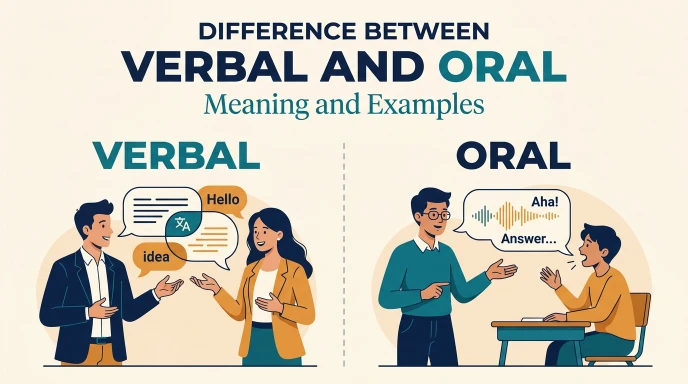
The main difference between verbal and oral is that verbal relates to words, while oral specifically relates to speaking or using the mouth.
In everyday English, verbal often means spoken, but it can also include written words. Oral usually refers to speech or something done by mouth. For example, a verbal agreement may be spoken, while an oral exam requires you to answer questions aloud.
Understanding the difference between verbal and oral helps you choose the right word in school, business, legal settings, and daily conversations. Many people use these terms as if they mean exactly the same thing, but their meanings are not always identical. This guide explains their definitions, pronunciation, common uses, and practical examples so you can use both words correctly.
Quick Answer: Difference Between Verbal and Oral
Verbal relates to words and may refer to spoken or written language, depending on the context. Oral specifically relates to speaking or using the mouth.
- Verbal communication: Sharing information through words, if spoken or written.
- Oral communication: Sharing information by speaking aloud.
Example: A written warning uses words and is verbal, while a spoken presentation is oral.
Definitions of Verbal and Oral
- Verbal: Relating to words or language, especially spoken words in everyday use. In broader usage, it can include written words.
- Oral: Relating to the mouth or to spoken communication rather than writing.
Pronunciation
| Word | US pronunciation | UK pronunciation |
| Verbal | VUR-buhl | VUR-buhl |
| Oral | OR-uhl | OR-uhl |
Pronunciation may vary slightly by accent, but both words are widely understood in American and British English.
Now, let’s compare how these words work in real situations and why choosing the right one can make your meaning clearer.
Difference Between Verbal and Oral: Comparison
| Feature | Verbal | Oral |
| Basic meaning | Related to words or language | Related to the mouth or speaking |
| Main focus | Words and language | Spoken communication |
| Spoken communication | Yes | Yes |
| Written communication | Can include written words | Usually not |
| Common examples | Verbal warning, verbal reasoning | Oral exam, oral presentation |
| Communication style | Spoken or written, depending on context | Spoken aloud |
| Medical use | Verbal response or verbal ability | Oral health or oral examination |
| Formal use | Verbal agreement or verbal instructions | Oral examination or oral report |
The key difference is that verbal can have a broader meaning, while oral usually points specifically to speech or the mouth.
Key Differences Explained Between Verbal and Oral
1. Verbal Can Include Written Words
The word verbal relates to words and language. Although people often use it to mean spoken, it can also describe language-based skills or information expressed through words.
Examples:
- A verbal warning may be given by a manager in a conversation.
- Verbal reasoning tests measure how well someone understands and works with language.
- Verbal instructions can explain how to complete a task.
In some technical and educational contexts, verbal skills may involve understanding written words as well as spoken language.
2. Oral Specifically Relates to Speaking
The word oral usually describes communication delivered through speech rather than writing. It can also refer to the mouth in medical or anatomical contexts.
Examples:
- Students take an oral exam by answering questions aloud.
- An employee gives an oral report during a meeting.
- An oral presentation explains a project to an audience.
When the method of communication is specifically speaking, oral is often the clearer word.
3. Verbal Communication Can Be Broader Than Oral Communication
Verbal communication involves the use of words. Depending on the definition used, those words may be spoken or written. Oral communication involves spoken words.
For example, a written email communicates information through words, so it can be described as verbal communication in the broader sense. A phone conversation is oral communication because the people speak to each other.
One important detail: many communication textbooks use verbal communication specifically for spoken words and contrast it with nonverbal communication. Therefore, the intended meaning can depend on the subject and context.
4. Oral Is Common in Education
Schools, colleges, and universities often use oral to describe tests or activities that require students to speak.
Examples:
- The student has an oral English exam tomorrow.
- Each group must give an oral presentation.
- The teacher asked for an oral explanation of the answer.
A verbal test may assess language or reasoning skills, but an oral exam specifically involves spoken responses.
5. Verbal Is Common in Workplace and Legal Language
In professional settings, verbal frequently appears in phrases such as verbal agreement, verbal warning, and verbal instructions.
Examples:
- The manager gave an employee a verbal warning.
- Both parties discussed a verbal agreement.
- The supervisor provided verbal instructions before the shift.
However, a verbal agreement is not necessarily legally binding in every situation. Enforceability depends on the applicable law, the subject of the agreement, and the evidence available.
6. Oral Can Refer to the Mouth, Not Just Speech
Unlike verbal, oral also has a clear physical meaning related to the mouth.
Examples:
- An oral examination checks the mouth.
- Oral hygiene includes brushing your teeth and caring for your gums.
- Oral medication is taken by mouth.
These examples show why the words are not interchangeable. Saying verbal hygiene instead of oral hygiene would not express the intended meaning.
7. The Right Word Depends on the Context
Sometimes either word can describe a spoken exchange, but one may sound more natural.
For example:
- “The manager gave a verbal warning.” This is a common workplace expression.
- “The student gave an oral answer.” This emphasizes that the student spoke rather than wrote.
The best choice is not always the word with the broadest definition. It is the word that describes the situation most clearly.
Difference and Similarity Between Verbal and Oral
Both words can describe spoken language, but they differ in scope and common use.
| Feature | Verbal | Oral | Similarity |
| Meaning | Related to words or language | Related to speech or the mouth | Both can relate to communication |
| Spoken use | Describes spoken words | Specifically describes speech | Both can describe spoken messages |
| Written use | May include written words | Generally excludes writing as a communication method | Both appear in language discussions |
| Education | Verbal reasoning or verbal skills | Oral exam or oral presentation | Both are used in education |
| Workplace | Verbal warning or instructions | Oral report or briefing | Both describe workplace communication |
| Medical use | Verbal response or language ability | Oral health or oral medication | Both appear in healthcare |
| Main focus | Words and language | Speaking or the mouth | Both describe particular aspects of human communication |
This table clearly shows the difference and similarity between verbal and oral for quick understanding.
What Is Verbal Communication?
Verbal communication is the exchange of information using words. In everyday situations, it often means speaking to another person, but some broader definitions also include written communication.
Examples of Verbal Communication
- Talking to a friend about weekend plans.
- Giving instructions to a new employee.
- Writing a message to explain a change in schedule.
- Discussing a project with colleagues.
The important point is that verbal communication uses words to convey meaning. Gestures, facial expressions, and body posture are generally classified as nonverbal communication.
For example, when a teacher explains a math problem aloud, the spoken explanation is verbal. When the teacher points toward the correct answer without speaking, that gesture is nonverbal.
What Is Oral Communication?
Oral communication is the exchange of information through spoken words. It allows people to explain ideas, ask questions, and respond directly.
Examples of Oral Communication
- A job interview.
- A telephone conversation.
- A classroom discussion.
- A speech at a company meeting.
- A voice message sent to a friend.
Oral communication also includes more than the words themselves in practical situations. Tone, pace, pauses, and emphasis can change how listeners understand a message.
For example, the sentence “That is great” may sound sincere, sarcastic, or doubtful depending on the speaker’s tone. The words remain the same, but the way they are spoken affects their meaning.
When Should You Use Verbal or Oral?
Choose the word based on what you want to emphasize.
Use verbal when the focus is on words or language.
Examples: verbal warning, verbal reasoning, verbal instructions, verbal agreement.
Use oral when the focus is on speaking or the mouth.
Examples: oral exam, oral presentation, oral health, oral medication.
If you are describing a written message, verbal may fit when you mean language expressed through words. If you need to make clear that a person spoke aloud, oral is usually more precise.
Common Mistakes With Verbal and Oral
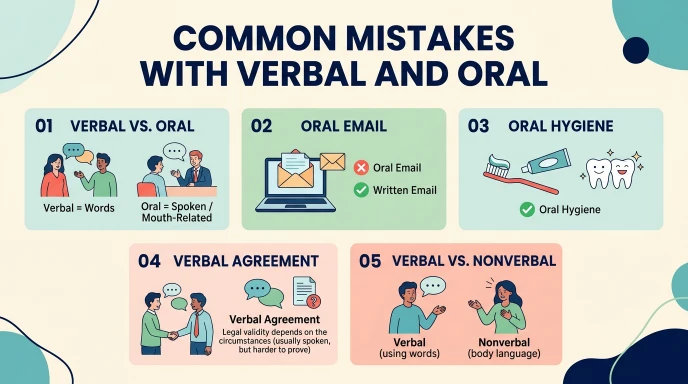
Many learners confuse these words because both can describe spoken communication. Here are five common mistakes and how to correct them.
Mistake 1: Treating Verbal and Oral as Exact Synonyms
Incorrect assumption: Verbal and oral always mean the same thing.
Correction: Both can describe speech, but verbal can also relate to words more broadly, while oral specifically relates to speech or the mouth.
Example: A verbal reasoning test assesses language-based reasoning, while an oral exam requires spoken answers.
Mistake 2: Saying “Oral Email”
Incorrect: The manager sent an oral email.
Better: The manager sent a written email.
An email is a written message. You could describe its contents as verbal in a broad language-based sense, but written email is clearer and more natural.
Mistake 3: Using Verbal Instead of Oral for Medical Care
Incorrect: I need to improve my verbal hygiene.
Correct: I need to improve my oral hygiene.
Oral hygiene refers to caring for your teeth, gums, tongue, and mouth.
Mistake 4: Assuming a Verbal Agreement Is Always Spoken and Legally Valid
A verbal agreement commonly means an agreement made through spoken words. However, the term does not automatically establish if the agreement is legally enforceable.
Better approach: Describe how the agreement was made, and check the relevant legal requirements when its enforceability matters.
Mistake 5: Confusing Verbal and Nonverbal Communication
Incorrect assumption: Every form of communication is verbal.
Correction: Verbal communication uses words, while nonverbal communication includes cues such as gestures, facial expressions, and posture.
For example, saying “I’m fine” is verbal. Smiling or shrugging without speaking is nonverbal.
Real-Life Examples of the Difference Between Verbal and Oral
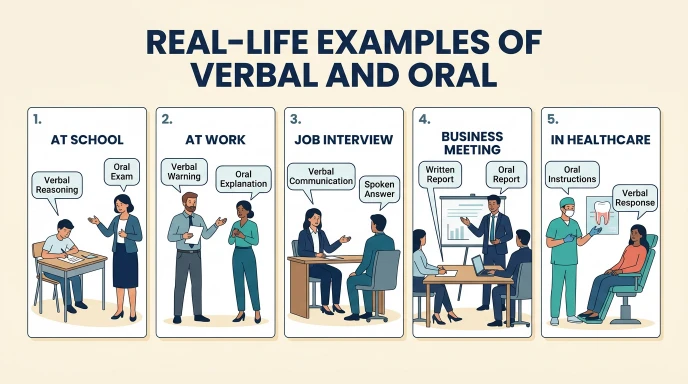
These scenarios show how each word works in personal, educational, professional, and technical settings.
Example 1: At School
Maya is preparing for two different assessments. One tests her ability to understand word relationships, while the other requires her to answer questions in front of her teacher.
- The first assessment measures verbal reasoning.
- The second assessment is an oral exam.
The first focuses on language-based thinking, while the second emphasizes spoken answers.
Example 2: At Work
A supervisor needs to correct an employee’s repeated lateness.
The supervisor speaks privately to the employee and explains the problem.
- The employee receives a verbal warning.
- During a later meeting, the employee gives an oral explanation of the circumstances.
Both situations involve speech, but the terms describe different workplace functions.
Example 3: During a Job Interview
A candidate is asked to explain how they solved a difficult problem.
The candidate answers aloud and explains each step.
The candidate uses verbal communication, and the response is delivered orally. In this situation, both descriptions are correct because the candidate uses words and speaks them aloud.
Example 4: In a Business Meeting
A marketing team reviews a new campaign. One employee shares a written report, while another explains the results to the team.
- The written report communicates information through words.
- The spoken presentation is an oral report.
In a broad definition, both can involve verbal communication, but only the presentation is oral.
Example 5: In Healthcare
A dentist explains how a patient can care for their teeth after treatment.
The dentist gives oral instructions about brushing and flossing. The patient then repeats the instructions to show understanding.
The dentist’s explanation is oral communication, while the patient’s response is verbal. Both involve spoken words, but the surrounding context determines which term is most useful.
Why Do People Get Confused About Verbal and Oral?
Their Meanings Overlap
Both terms can refer to spoken words. If someone says, “We had a verbal discussion,” or “We had an oral discussion,” the intended meaning is usually clear, although the second expression may sound more formal or less natural in some contexts.
Different Subjects Use Different Definitions
In communication studies, verbal is often contrasted with nonverbal. In that context, verbal communication means communication through words, usually spoken words.
In other contexts, such as language testing, verbal ability can refer to understanding, reasoning with, or using language. This broader use helps explain why verbal and oral do not always mean exactly the same thing.
Everyday Speech Favors Shortcuts
People often choose the word that sounds familiar rather than considering its exact meaning. This is usually harmless in casual conversation, but precision matters in formal writing, medical language, legal documents, and academic work.
How Search Engines Understand Verbal and Oral
When someone searches Google for “difference between verbal and oral,” they usually want a direct comparison, simple definitions, and examples of correct usage.
A useful grammar article should address related questions, such as if verbal includes writing, if oral means spoken, and which term belongs in phrases such as oral exam or verbal agreement.
Platforms such as YouTube and Instagram may also feature language lessons explaining these distinctions. However, the platform does not change the meaning of the words. The clearest explanation remains one that defines each term, shows where they overlap, and gives examples that readers can apply.
For content, covering related questions naturally can make an article more useful to readers. Nevertheless, no particular heading structure, keyword frequency, or word count guarantees a top search ranking.
Expert Insight: Which Word Is More Precise?
The most useful distinction is to think about what the word describes, not just if someone is speaking.
Use verbal when you want to emphasize words, language, or language-based ability. Use oral when you want to emphasize spoken delivery or something related to the mouth.
Consider these examples:
- Verbal ability: the ability to understand and use language.
- Oral presentation: a presentation delivered by speaking.
- Verbal agreement: an agreement expressed through words, commonly spoken words.
- Oral health: the health of the mouth and its tissues.
When both terms seem possible, choose the one that gives the reader the clearest picture. In professional writing, that is more valuable than trying to avoid one word simply because the other sounds more formal.
Frequently Asked Questions
Is verbal the same as oral?
Not exactly. Both words can describe spoken communication, but verbal has a broader relationship to words and language. Oral specifically relates to speech or the mouth.
Does verbal mean spoken or written?
It can mean either, depending on the context. In everyday use, verbal often means spoken. In broader language-based contexts, it can also include written words.
Does oral mean spoken?
Yes, when used in communication, oral generally means spoken aloud rather than written. The word can also describe things related to the mouth, such as oral health.
What is an example of verbal communication?
A manager explaining a new work schedule to employees is an example of verbal communication because the manager uses words to share information.
What is an example of oral communication?
A student answering questions aloud during an exam is an example of oral communication because the student speaks directly to the examiner.
Is a verbal agreement the same as an oral agreement?
In common usage, the terms often mean the same thing: an agreement expressed through spoken words. If such an agreement is legally enforceable depends on the circumstances and applicable law.
What is the difference between oral and written communication?
Oral communication uses spoken words, while written communication uses written words, such as those in emails, letters, reports, and text messages.
Which is correct: verbal exam or oral exam?
Oral exam is the standard expression when students answer questions by speaking aloud. Verbal exam may be understood, but it is less conventional in this context.
Conclusion
The difference between verbal and oral comes down to their main focus. Verbal relates to words and language, while oral specifically relates to speaking or the mouth. Although the terms overlap in everyday conversation, they are not interchangeable in every situation.
For example, a verbal warning involves communicating a warning through words, while an oral exam requires a student to answer questions aloud. Verbal can also describe language-based skills, such as verbal reasoning, whereas oral appears in expressions such as oral health and oral medication.
When choosing between verbal and oral, consider what you want to emphasize. If your focus is on words, language, or language ability, verbal is often appropriate. When you mean spoken communication or something related to the mouth, oral is usually more precise.
Understanding this distinction can help you write more clearly in school assignments, workplace documents, professional conversations, and everyday English. The simplest rule to remember is that all oral communication uses words when it is spoken language, but not everything described as verbal must be oral. That is the key to using both terms correctly.
READ MORE ABOUT!
- Difference Between Awhile and A While: Meaning and Usage
- Difference Between Sociology and Psychology: A Clear Guide

I am Emily Johnson, a USA-based content writer who creates easy-to-read blogs on language and daily life topics. I explain complex ideas in simple English for students and beginners so they can understand easily.