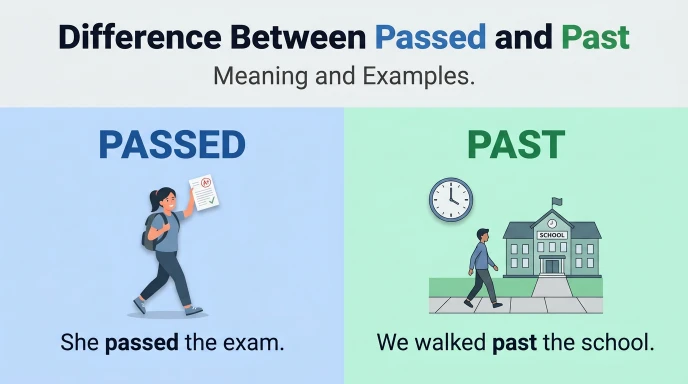
Passed is the past tense of the verb “pass,” while past refers to a time before now or something beyond a point.
Many people confuse passed and past because they sound the same, but they have different meanings and uses. The difference between passed and past becomes easier to understand when you look at the role each word plays in a sentence.
Passed is usually the past tense of the verb pass, while past can refer to an earlier time, a position beyond something, or a period that has already ended. For example, “She passed the test” is correct, but “She walked past the school” uses a different word.
In this guide, you will learn how to spell passed and past correctly, when to use each word, common mistakes to avoid, and simple examples for everyday conversations, schoolwork, emails, and professional writing.
Quick Answer: Difference Between Passed and Past
Passed is a verb that describes an action that happened, such as passing a test or moving by someone. Past refers to an earlier time or something beyond a point.
- Passed: I passed my driving test.
- Past: We walked past the library.
Easy trick: If you mean an action, try passed. If you mean an earlier time or a position beyond something, try past.
Definitions of Passed and Past
- Passed: The past tense and past participle of pass. It can mean succeeded, moved by, handed something over, or allowed time to go by.
- Past: A word that can describe a time before now, a position beyond something, or a period that has ended. It can function as a noun, adjective, preposition, or adverb.
Pronunciation
Both words are pronounced exactly the same: /pæst/, rhyming with last in many common English accents.
| Pronunciation | Passed | Past |
| US English | /pæst/ | /pæst/ |
| UK English | /pɑːst/ in many southern British accents | /pɑːst/ in many southern British accents |
Pronunciation varies by regional accent, but passed and past are homophones in both American and British English. This means you cannot tell which spelling someone means just by hearing the word. You need to understand the sentence.
Let’s look at how their grammar and meanings differ in everyday use.
Comparison
| Feature | Passed | Past |
| Main meaning | An action involving passing | An earlier time or position beyond a point |
| Part of speech | Verb form | Noun, adjective, preposition, or adverb |
| Action | Describes something that happened | Usually describes time, position, or a previous period |
| Test result | “I passed the exam.” | “The exam is in the past.” |
| Movement | “The car passed us.” | “The car drove past us.” |
| Time expressions | “Time passed quickly.” | “In the past, we lived here.” |
| Grammar clue | Often follows a subject as the main verb | Often appears before a noun or after a linking verb |
| Common phrases | Passed away, passed the test | Past few days, past experience, walk past |
The key difference is that passed usually describes an action, while past usually describes time, position, or something earlier.
Key Differences Explained Between Passed and Past
1. Passed Is a Verb, While Past Has Several Grammatical Roles
The most important difference between passed and past is their grammatical function. Passed describes an action, while past can describe time, position, or a previous period.
Example:
- The teacher passed my assignment.
- My teacher talked about a past assignment.
In the first sentence, passed describes an action. In the second, past describes an assignment from an earlier time.
2. Passed Can Mean Succeeded
When someone succeeds in a test, examination, inspection, or driving assessment, use passed.
Examples:
- She passed her English exam.
- He passed his driving test on the first attempt.
- The building passed its safety inspection.
Using past in these sentences would be incorrect because the sentences describe successful results.
3. Past Can Refer to an Earlier Time
Use past when talking about something that happened before now.
Examples:
- I learned a lot from my past mistakes.
- We have discussed this in the past.
- The past few weeks have been busy.
Here, past identifies an earlier time or experience rather than an action of passing.
4. Passed Can Describe Movement
The verb passed can describe moving beyond a person, place, or object.
Example: The bus passed our house at noon.
You can also say, “The bus drove past our house.” Both sentences describe the same event, but the grammar changes.
- The bus passed our house: passed is the verb.
- The bus drove past our house: past describes the bus’s movement in relation to the house.
5. Past Can Mean Beyond a Point
When describing movement beyond a location, past often follows a verb such as walked, drove, ran, or went.
Examples:
- Walk past the main entrance.
- She ran past the finish line.
- We drove past the shopping center.
A useful clue is to check if another verb already describes the movement. In “walk past the store,” the verb is walk, so past describes the direction or position.
6. Passed Can Describe Time Moving Forward
The word passed can also describe time that has gone by.
Examples:
- Two hours passed before the doctor arrived.
- Several days passed without a reply.
- Time passed quickly during the holiday.
Notice the difference between “Time passed quickly” and “the past few days.” The first describes time going by; the second identifies a period before now.
7. Passed and Past Are Not Interchangeable in Fixed Expressions
Some common phrases use only one spelling.
| Correct phrase | Example |
| Passed away | Her grandfather passed away peacefully. |
| Passed the test | I passed the final test. |
| In the past | We were neighbors in the past. |
| Past experience | My past experience helped me. |
| Walk past | Walk past the reception desk. |
Learning these common expressions helps you avoid spelling mistakes in messages, essays, and professional documents.
How Do You Use Passed and Past in a Sentence?
Understanding the difference between passed and past becomes easier when you look at complete sentences instead of memorizing definitions alone.
When Passed Is the Correct Word
Use passed when the sentence describes an action that has already happened.
Passing an exam: “Mia passed her science exam.”
Moving by something: “The cyclist passed the parked car.”
Handing something over: “Daniel passed me the salt.”
Time going by: “A month passed before they met again.”
A formal decision: “The council passed a new rule.”
In each example, passed is a form of the verb pass. The action may involve movement, success, transfer, time, or approval.
When Past Is the Correct Word
Use past when referring to a previous time, a period that has ended, or a location beyond a point.
Earlier time: “I remember my past experiences.”
A time expression: “We have been friends for the past five years.”
A direction: “Go past the bank and turn left.”
A previous condition: “Her past behavior worried the team.”
A completed period: “That difficult chapter is in the past.”
The word past does not usually describe the action itself. Instead, it gives information about when something happened or where something is located.
Difference Between Passed and Past in Everyday English
These words appear in many everyday situations, including texting, education, workplace communication, and travel directions.
In Text Messages and Social Media
People often type quickly in WhatsApp messages, Instagram comments, and other social platforms. Because passed and past sound alike, spelling errors can easily go unnoticed.
- Correct: “I passed my exam today!”
- Correct: “That happened in the past.”
- Correct: “I walked past your house.”
Google Search and other search tools may interpret the intended meaning from the surrounding words, but readers should not have to guess what you mean. Correct spelling makes messages clearer.
In School and College
Students regularly use passed when discussing grades and past when writing about history or previous experiences.
- “I passed my mathematics exam.”
- “We studied the past of ancient civilizations.”
- “The teacher passed out the worksheets.” (In American English, this can mean distributed them.)
Choosing the correct word is particularly important in essays and grammar tests because the two spellings have distinct grammatical roles.
In Business and Professional Writing
Both words are useful in emails, reports, and workplace discussions.
- “The board passed the proposal.”
- “Please review our past performance.”
- “The deadline has passed.”
These sentences communicate three different ideas: approving a proposal, describing earlier performance, and stating that a deadline has gone by.
In Travel and Directions
Past is common when giving directions, while passed describes movement that occurred.
- Direction: “Walk past the pharmacy.”
- Completed action: “We passed the pharmacy ten minutes ago.”
The first tells someone where to go. The second reports what happened.
Difference and Similarity Between Passed and Past
The following table compares the words by meaning, grammar, context, and everyday use.
| Feature | Passed | Past | Similarity |
| Meaning | Describes an action | Refers to earlier time or a position beyond a point | Both relate to the idea of passing or time |
| Grammar | Verb form | Noun, adjective, preposition, or adverb | Both are English words |
| Pronunciation | Sounds like /pæst/ in many US accents | Sounds like /pæst/ in many US accents | They are homophones |
| Time | Describes time going by | Identifies a previous time or period | Both can appear in time-related sentences |
| Movement | Can describe an action of moving by | Can describe being beyond a location | Both can describe movement in context |
| Exams | “She passed the exam.” | “The exam is in the past.” | Both can appear when discussing exams |
| Writing style | Used in everyday and formal writing | Used in everyday and formal writing | Both are standard English |
| Spelling | Ends in -ed | Does not end in -ed | Context determines the correct choice |
This table clearly shows the difference and similarity between passed and past for quick understanding.
Common Mistakes With Passed and Past
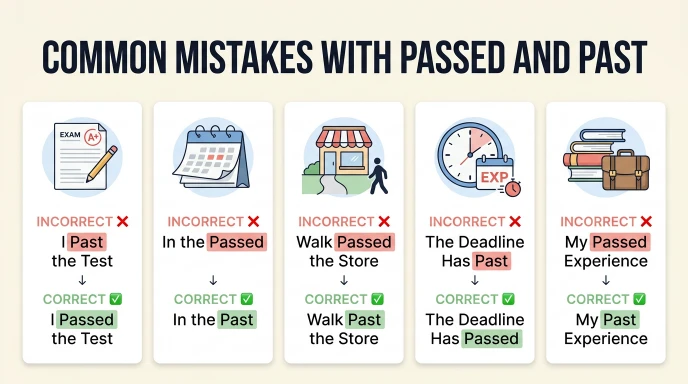
Even fluent English speakers can confuse these words because they sound identical. Here are five common mistakes and how to correct them.
Mistake 1: Writing “I Past the Test”
Incorrect: “I past the test.”
Correct: “I passed the test.”
Why? Passing a test is an action. The past tense of pass is passed.
Fix: When discussing exam results, use passed for success.
Mistake 2: Writing “In the Passed”
Incorrect: “We lived there in the passed.”
Correct: “We lived there in the past.”
Why? The phrase in the past refers to an earlier period.
Fix: Remember that past is used in phrases such as “in the past,” “past experience,” and “past events.”
Mistake 3: Confusing “Passed the Store” With “Past the Store”
Incorrect for a direction: “Walk passed the store.”
Correct: “Walk past the store.”
Why? In this sentence, walk is already the verb. Past describes where to walk.
However, “We passed the store” is also correct because passed is the main verb.
Fix: Check if the sentence already has a verb describing the movement.
Mistake 4: Writing “The Deadline Has Past”
Incorrect: “The deadline has past.”
Correct: “The deadline has passed.”
Why? The sentence needs the past participle of the verb pass after has. That form is passed.
Fix: Use has passed, had passed, and will have passed when the sentence requires the verb pass.
Mistake 5: Assuming Both Words Have the Same Meaning
Incorrect: “My passed experience helped me.”
Correct: “My past experience helped me.”
Why? The sentence describes earlier experience, not an action.
Fix: Ask if you mean something that happened before now or an action that took place. Earlier experience is past experience.
Real-Life Examples of Passed and Past
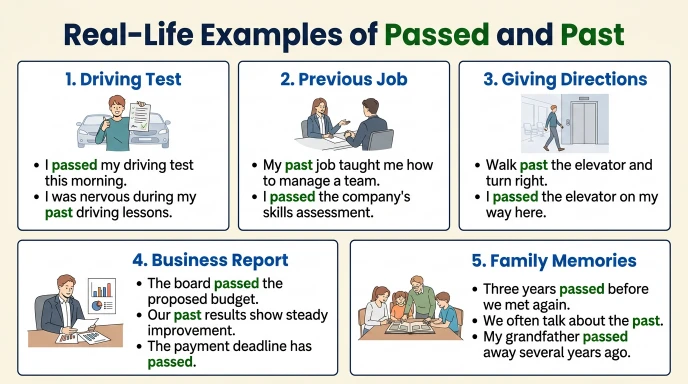
These practical examples show how to choose the correct word in different situations.
Example 1: Taking a Driving Test
A student receives the result of a driving test.
- “I passed my driving test this morning.”
- “I was nervous during my past driving lessons.”
The first sentence describes success. The second refers to earlier lessons.
Example 2: Talking About a Previous Job
During a job interview, an applicant discusses work experience.
- “My past job taught me how to manage a team.”
- “I passed the company’s skills assessment.”
Use past to describe the previous job and passed to describe the completed assessment.
Example 3: Giving Directions to a Visitor
A receptionist explains how to find an office.
- “Walk past the elevator and turn right.”
- “I passed the elevator on my way here.”
The first sentence gives directions. The second reports a completed action.
Example 4: Writing a Business Report
A manager describes a project and its results.
- “The board passed the proposed budget.”
- “Our past results show steady improvement.”
- “The payment deadline has passed.”
Each sentence uses the correct word for its particular meaning.
Example 5: Remembering a Family Event
Someone talks about a family gathering.
- “Three years passed before we met again.”
- “We often talk about the past.”
- “My grandfather passed away several years ago.”
These examples demonstrate three different uses: time going by, an earlier period, and the expression passed away, meaning died.
When Should You Use Passed or Past?
The best way to choose between passed and past is to identify what the sentence is trying to communicate.
Use passed when…
- Someone succeeded in a test or assessment.
- Something moved beyond a person or place.
- A person handed something to someone else.
- Time went by.
- A rule, law, or proposal was approved.
Use past when…
- You refer to an earlier time.
- You describe previous experiences or events.
- You give directions beyond a location.
- You talk about a period that has ended.
- You describe something that happened before the present.
A Simple Decision-Making Trick
Try replacing the word with a more specific expression.
- If you mean succeeded, use passed: “She passed the exam.”
- If you mean went by, use passed: “The hours passed quickly.”
- If you mean earlier, use past: “My past experience.”
- If you mean beyond, use past: “Walk past the gate.”
If the replacement makes sense, you have probably found the right spelling.
Why Do People Get Confused Between Passed and Past?
There are three main reasons people mix up these words.
1. They Sound the Same
Passed and past are homophones. In many English accents, their pronunciation is identical, even though their spellings and grammatical roles differ.
This means listening alone cannot help you identify the correct spelling. You need to consider the sentence.
2. Both Words Can Relate to Time and Movement
The confusion becomes stronger because both words can appear in sentences about time or movement.
Compare:
- “The car passed the house.”
- “The car drove past the house.”
Both describe a car moving by a house, but the first uses passed as the verb, while the second uses past after the verb drove.
Likewise, “Time passed quickly” describes time going by, while “the past year” identifies a period before now.
3. Fast Typing Can Hide Grammar Mistakes
Autocorrect and predictive text may suggest a word that sounds right but does not fit the sentence. Social media posts and informal messages can spread these mistakes, especially when people focus on speed instead of proofreading.
A simple review before sending an important email or submitting an assignment can prevent these errors.
How Search Engines Understand Passed and Past
Search engines such as Google use language and context to understand what a person is looking for. The words surrounding passed or past help establish the intended meaning.
For example, a search for “how to pass a driving test” is about succeeding at an assessment. A search for “past tense examples” is about grammar. Although the words sound alike, the surrounding terms establish different search intents.
This is why a useful grammar article should explain definitions, sentence structure, common errors, and examples rather than simply repeat the two words.
Instagram, YouTube, and other platforms can expose people to informal writing, captions, and spoken English, but they do not change the standard grammatical distinction. For readers creating educational content, clear definitions and natural examples help answer the actual question.
There is no special search-engine trick that guarantees a grammar article will rank first. The practical goal is to give readers a correct answer, organize the explanation clearly, and address the common situations in which they need to choose between the two spellings.
Expert Insight: The Fastest Way to Remember Passed vs. Past
A reliable grammar check is to identify the job each word performs in the sentence.
Passed is a form of the verb pass. It changes according to the sentence’s tense and grammatical structure:
- Present: “I pass the school every day.”
- Past: “I passed the school yesterday.”
- Present perfect: “I have passed the school several times.”
In contrast, past appears in expressions such as “past events,” “in the past,” and “walk past the school.”
One important detail is that past is not always about time. It can also describe a position beyond something. Similarly, passed does not always mean succeeded. It can describe movement, transferring an object, or time going by.
Instead of relying on a single memory trick, check the complete sentence. This approach works in school assignments, professional emails, creative writing, and everyday conversations.
Frequently Asked Questions
How Do You Use Past and Passed?
Past refers to an earlier time or a position beyond something, while passed is the past tense of the verb “pass.”
- Past: We walked past the school.
- Passed: She passed the driving test.
Is It Past or Passed My Bedtime?
“Past my bedtime” is correct because it means later than your usual bedtime.
Example: It is already past my bedtime, so I need to sleep.
Is It “I Walked Passed” or “I Walked Past”?
“I walked past” is correct because past describes moving beyond a person or place.
Example: I walked past the grocery store on my way home.
Is “Pass 7” or “Past 7” Correct?
“Past 7” is correct when referring to a time later than 7 o’clock.
Example: We arrived at 10 past 7.
Is It Correct to Say “I Passed”?
Yes, “I passed” is correct when the context makes the meaning clear, such as passing an exam, a test, or another person.
Example: I studied hard, and I passed!
Is It Passed or Past an Exam?
“Passed an exam” is correct because passed is the verb meaning you achieved a successful result.
Example: She passed her English exam with a high score.
Conclusion
The difference between passed and past comes down to meaning and grammar. Although these words sound the same, they are not interchangeable. Passed is the past tense and past participle of pass. It can describe succeeding in a test, moving past something, handing an object to someone, or time going by. Past, on the other hand, refers to an earlier time, a previous experience, or a position beyond a particular point.
For example, “I passed my exam” describes an achievement, while “I learned from my past mistakes” refers to earlier experiences. Similarly, “We passed the library” reports an action, but “Walk past the library” gives a direction.
When you are unsure which spelling to use, examine the whole sentence rather than relying on pronunciation. Ask yourself if you are describing an action, an earlier time, or a position beyond something. This simple habit will help you choose the correct word in schoolwork, text messages, emails, and professional writing.
Once you understand how each word functions, choosing between passed and past becomes much easier.
READ MORE ABOUT!
- Difference Between Pardon and Commutation: A Clear Guide
- Difference Between Among and Between: Easy Grammar Guide

I am James Carter, a professional content writer from the United States. I specialize in writing simple and clear comparison blogs that help students and readers understand difficult topics easily. My writing focuses on everyday language, education, science, and lifestyle topics. I believe that learning should be easy for everyone, so I use simple words and real-life examples in my articles.