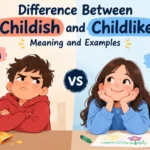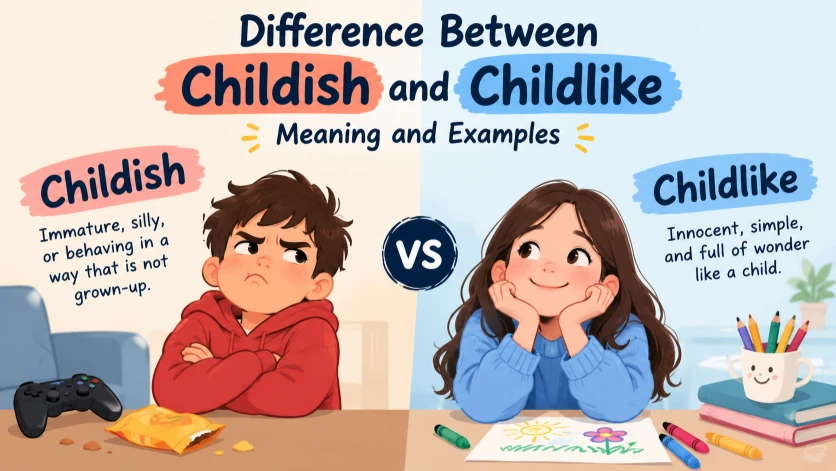
The difference between childish and childlike is mainly about how a behavior is viewed. Childish usually describes immature behavior, while childlike describes positive qualities such as curiosity, joy, and innocence.
For example, an adult who throws a tantrum over a small problem may act childish, but an adult who feels excited about a simple surprise may show a childlike spirit. Many people confuse these words because both relate to children.
This guide explains their meanings, pronunciation, grammar, and everyday use, with practical examples to help you choose the right word in conversations, writing, and professional settings.
Quick Answer: Difference Between Childish and Childlike
Childish usually means immature, silly, or unsuitable for someone’s age. Childlike usually means having positive qualities associated with children, such as wonder, honesty, or curiosity.
- Childish: He acted childish when he refused to share the toys.
- Childlike: She had a childlike sense of wonder when she saw the stars.
The key difference is the feeling each word creates: childish is usually negative, while childlike is usually positive.
Definitions of Childish and Childlike
- Childish: Behaving in an immature or silly way, especially when more mature behavior is expected.
- Childlike: Having qualities often associated with children, such as innocence, curiosity, openness, or enthusiasm.
Pronunciation
| Word | US pronunciation | UK pronunciation |
| Childish | CHYLD-ish | CHYLD-ish |
| Childlike | CHYLD-lyke | CHYLD-lyke |
The pronunciation is very similar in American and British English. The main difference is the ending: -ish in childish and -like in childlike.
Now, let’s compare their meanings more closely so you can understand why these two similar words create very different impressions.
Difference Between Childish and Childlike: Comparison
| Feature | Childish | Childlike |
| Meaning | Immature or silly behavior | Qualities associated with children |
| Usual tone | Negative | Positive |
| Main focus | Lack of maturity | Innocence, wonder, or openness |
| Emotional response | Often causes frustration | Often creates warmth or admiration |
| Common behavior | Throwing a tantrum over a small issue | Getting excited about a new experience |
| Adult use | Suggests someone should act more maturely | Suggests someone has kept a sense of wonder |
| Professional setting | May criticize someone’s conduct | May praise creativity or enthusiasm |
| Example | His childish argument annoyed everyone. | Her childlike curiosity helped her learn. |
Key Differences Explained Between Childish and Childlike
1. Childish Usually Has a Negative Meaning
When someone calls an adult childish, they often mean that the person is acting less maturely than expected.
For example, a coworker may become angry because a colleague receives praise. Instead of discussing the situation calmly, the coworker refuses to speak to anyone.
You might describe this behavior as childish because it shows poor emotional control.
Example: “Stop being childish and talk about the problem.”
This sentence suggests that the person should handle the situation more maturely.
2. Childlike Usually Has a Positive Meaning
The word childlike often describes qualities that adults admire in children, such as curiosity, excitement, imagination, and openness.
Imagine an adult visiting a science museum for the first time. They ask questions, explore every display, and feel amazed by simple discoveries.
Example: “His childlike curiosity made the museum visit enjoyable.”
Here, childlike is a compliment. It suggests that the person is eager to learn and experience the world.
3. Childish Focuses on Immaturity, While Childlike Focuses on Qualities
These words do not simply describe age. They describe the nature of a person’s behavior or personality.
- Childish: Mia blamed everyone else after losing a game.
- Childlike: Mia showed childlike excitement when she opened her birthday gift.
Both sentences describe reactions that people may associate with children. However, the first highlights poor behavior, while the second highlights happiness and wonder.
4. Childish Can Damage Someone’s Image
Calling someone childish can sound like a personal criticism. It may suggest that the person cannot manage emotions, accept responsibility, or resolve disagreements appropriately.
For example, a manager who insults employees after receiving feedback may be described as childish.
A more constructive way to describe the same behavior is to say, “The manager reacted immaturely to the feedback.”
This wording focuses on the behavior rather than labeling the whole person.
5. Childlike Can Describe Creativity and Imagination
Artists, writers, teachers, and designers may benefit from a childlike approach to ideas. They may ask unusual questions, explore possibilities, and stay open to new experiences.
For example, a designer who experiments with unexpected shapes may have a childlike sense of curiosity.
This does not mean the designer lacks professional skills. It means they approach creative work with openness and wonder.
6. Both Words Can Describe Adults and Children
Although the words contain child, they are not limited to describing children.
- Childish: The adult made a childish excuse for missing the meeting.
- Childlike: The elderly man maintained a childlike enthusiasm for learning.
The important factor is the quality being described, not the person’s age.
What Is the Difference Between Childish and Childlike in Real Life?
The distinction becomes clearer when you consider the situation and the speaker’s intention.
In Friendships and Relationships
A childish response may involve refusing to apologize, giving someone the silent treatment to punish them, or starting an argument over a minor issue.
A childlike response may involve laughing freely, expressing affection openly, or feeling delighted by a thoughtful gift.
For example:
- “His childish reaction made the disagreement worse.”
- “Her childlike excitement made their anniversary feel special.”
The first describes behavior that creates a problem. The second describes an enjoyable emotional response.
At School or Work
In a classroom, a student who interrupts others and refuses to accept correction may behave childishly. A student who asks many questions because they genuinely want to understand a subject may show childlike curiosity.
At work, these distinctions matter because the words communicate different judgments. Calling a colleague childish can sound insulting, while describing their enthusiasm as childlike can be positive.
Still, context matters. A phrase such as childlike judgment may imply a lack of mature understanding, depending on how it is used.
In Art, Stories, and Entertainment
Books, films, and social media often use childlike qualities to suggest innocence, imagination, or a fresh view of the world.
A character who believes that every problem can be solved through kindness may have a childlike outlook.
By contrast, a character who constantly sulks whenever things do not go their way may be described as childish.
On platforms such as Instagram and YouTube, creators might use childlike wonder to describe a joyful reaction or childish behavior to criticize an argument. These are examples of how context shapes meaning, not special rules created by social media.
Difference and Similarity Between Childish and Childlike
| Feature | Childish | Childlike | Similarity |
| Core meaning | Immature behavior | Qualities associated with children | Both relate to childhood |
| Tone | Usually negative | Usually positive | Both describe personal qualities |
| Emotional expression | May suggest poor self-control | May suggest open excitement | Both can describe emotions |
| Common setting | Arguments and conflicts | Creativity and discovery | Both occur in daily life |
| Age | Can describe adults or children | Can describe adults or children | Neither is limited to one age |
| Personality | Suggests immaturity | Suggests innocence or curiosity | Both can describe someone’s manner |
| Figurative use | Criticizes behavior | Often praises a quality | Both can be used figuratively |
This table clearly shows the difference and similarity between childish and childlike for quick understanding.
Common Mistakes With Childish and Childlike
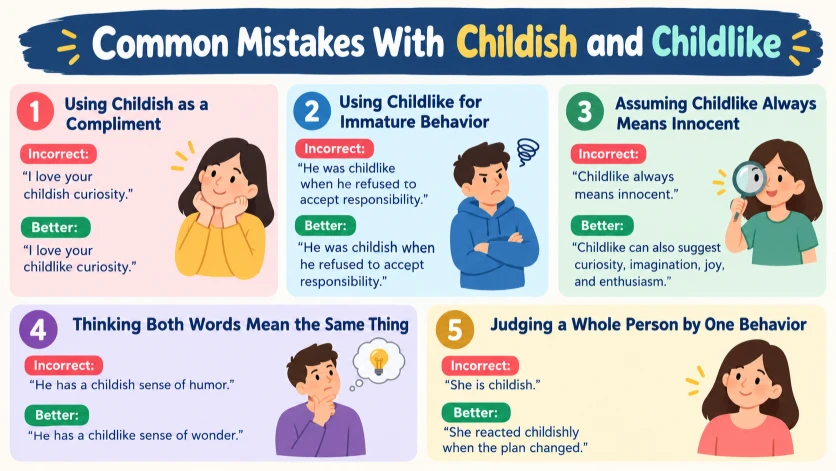
Even fluent English speakers can choose the wrong word when they focus only on the fact that both words relate to children.
Mistake 1: Using Childish as a Compliment
Incorrect: “I love your childish curiosity.”
Better: “I love your childlike curiosity.”
Childish curiosity may sound like criticism, while childlike curiosity clearly expresses admiration.
Mistake 2: Using Childlike for Immature Behavior
Incorrect for the intended meaning: “He was childlike when he refused to accept responsibility.”
Better: “He was childish when he refused to accept responsibility.”
Use childish when you want to emphasize immature conduct.
Mistake 3: Assuming Childlike Always Means Innocent
Childlike often suggests innocence, but it can also describe curiosity, imagination, joy, and enthusiasm. The exact meaning depends on the sentence.
For example, “She approached the experiment with childlike curiosity” emphasizes her desire to explore, not necessarily her innocence.
Mistake 4: Thinking Both Words Mean the Same Thing
Although the words share a root, they do not usually communicate the same message.
Compare:
- “He has a childish sense of humor.” This may suggest silly or immature humor.
- “He has a childlike sense of wonder.” This suggests genuine amazement and curiosity.
Choose the word that matches the quality you want to express.
Mistake 5: Judging a Whole Person by One Behavior
Calling someone childish may sound like a judgment of their entire personality. Often, it is more accurate to describe a specific action.
Instead of saying, “She is childish,” you could say, “She reacted childishly when the plan changed.”
This distinction helps you communicate more fairly and clearly.
Real-Life Examples of Childish and Childlike
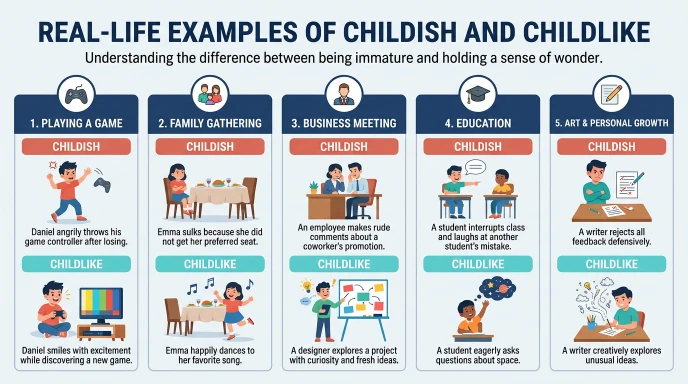
Here are five practical situations showing how these words work in everyday English.
Example 1: Playing a Game
Childish: Daniel threw his controller after losing a video game.
His reaction was immature because he could not handle losing calmly.
Childlike: Daniel showed childlike excitement when he discovered a new game.
His enthusiasm was positive and genuine.
Example 2: Family Gathering
Childish: Emma refused to speak to her sister because she did not get the seat she wanted.
Childlike: Emma danced with childlike joy when her favorite song started playing.
The first example describes a petty reaction. The second expresses happiness.
Example 3: Business Meeting
Childish: A team member made rude comments after another employee received a promotion.
Childlike: A designer approached a new project with childlike curiosity and fresh ideas.
In the workplace, the first word criticizes conduct, while the second can praise creativity.
Example 4: Education
Childish: The student interrupted the lesson and laughed whenever another student made a mistake.
Childlike: The student asked questions with childlike wonder while learning about space.
The difference is between disruptive immaturity and a positive desire to learn.
Example 5: Art and Personal Growth
Childish: A writer rejected every suggestion because they did not want anyone to criticize their work.
Childlike: The writer explored unusual ideas with childlike imagination.
The second example shows that an open, playful mindset can exist alongside adult responsibility and professional skill.
When Should You Use Childish or Childlike?
Choose the word that best matches your intended meaning.
Use childish when criticizing immaturity
- Someone refuses to accept responsibility.
- A person throws a tantrum over a small problem.
- Someone acts petty during a disagreement.
- A response seems unsuitable for the situation or person’s expected maturity.
Use childlike when describing positive qualities
- Someone feels amazed by nature.
- An adult enjoys imaginative play.
- A learner asks questions with genuine curiosity.
- Someone expresses happiness without embarrassment.
A practical writing tip: Before choosing either word, ask yourself if you want to criticize someone’s maturity or describe a quality you admire. This question often makes the choice obvious.
Why Do People Get Confused About Childish and Childlike?
Both Words Come From the Same Root
Both words are built from child, which explains why they seem similar. However, their endings create different meanings.
- -ish can suggest a quality or behavior associated with something. In childish, it commonly carries the idea of immaturity.
- -like means resembling or having the qualities of something. In childlike, it points to qualities associated with children.
These endings do not always have a positive or negative meaning in every English word, but they help explain this particular contrast.
Childhood Has Both Positive and Negative Associations
People may associate childhood with curiosity, innocence, playfulness, and imagination. They may also associate immature behavior with tantrums, selfishness, or difficulty managing emotions.
Childlike usually highlights the first group of qualities. Childish usually highlights the second.
Context Can Change the Impression
Consider the sentence, “He has a childlike personality.”
It may mean he is cheerful, imaginative, and curious. In another context, however, a reader might interpret it as a suggestion that he lacks maturity.
The surrounding words help clarify the intended meaning. When precision matters, use a more specific phrase such as playful and curious or emotionally immature.
Informal Media Can Blur the Difference
In memes, comments, and casual conversations, people sometimes use these words loosely. A creator might call an adult’s excitement childish when they actually mean playful, or describe immature conduct as childlike.
That informal usage does not erase the usual distinction. In careful writing, childish is generally negative and childlike is generally positive.
How Search Engines Understand Childish and Childlike
When someone searches Google for “difference between childish and childlike,” they are usually looking for a vocabulary comparison, clear definitions, and example sentences.
A useful explanation should therefore answer the main question early and show how the words differ in tone and context. Comparison tables, short definitions, and real-life examples make the distinction easier to understand.
The same principle applies to educational content shared on Instagram, YouTube, or other platforms. A short example such as “childish tantrum versus childlike wonder” communicates the contrast more clearly than a long definition alone.
For an educational website, the goal should be to satisfy the reader’s question accurately. Natural keyword use and helpful formatting can support that goal, but no specific article structure or keyword frequency guarantees a top search ranking.
Expert Insight: Can an Adult Be Childlike Without Being Childish?
Absolutely. An adult can be responsible, emotionally mature, and dependable while still having a childlike sense of wonder.
For example, a teacher may manage a classroom effectively while showing genuine excitement about a new discovery. A parent may handle difficult family decisions responsibly while enjoying imaginative games with their children.
These behaviors are not signs of immaturity. They show that maturity and playfulness can exist together.
The reverse is also true: someone may have advanced skills and considerable life experience yet still behave childishly during conflict. Age and intelligence do not automatically guarantee emotional maturity.
When writing or speaking, focus on the specific behavior rather than assuming that one word defines a person’s entire character. This approach makes your language more precise and less judgmental.
Frequently Asked Questions
What Does “Childlike” Mean?
“Childlike” describes qualities associated with children, such as innocence, curiosity, playfulness, and wonder.
Is Childlike Positive or Negative?
Childlike is usually positive because it describes qualities like curiosity, openness, and innocence. However, the meaning depends on the context.
What Does It Mean If Someone Is Childlike?
If someone is childlike, they may be curious, playful, imaginative, or easily excited by simple things. For example, a childlike adult might enjoy exploring new places with enthusiasm.
Is Being Called Childish an Insult?
Yes, being called childish can be an insult because it often suggests that someone is immature, irresponsible, or behaving inappropriately for their age.
What Is Childlike vs. Childish?
Childlike usually describes positive qualities, such as innocence and curiosity, while childish usually describes negative behavior, such as immaturity or temper tantrums.
Can an Adult Be Childlike?
Yes, an adult can be childlike by showing curiosity, imagination, playfulness, and a sense of wonder while still behaving maturely and responsibly.
Conclusion
The difference between childish and childlike lies in the qualities these words describe and the feelings they create. Childish usually means immature, petty, or silly, while childlike usually means innocent, curious, playful, or full of wonder.
For example, an adult who refuses to accept defeat and throws a tantrum is acting childish. An adult who feels amazed by a beautiful sunset or eagerly explores a new hobby shows childlike wonder.
Both words can describe adults and children, but they communicate different ideas. The first often criticizes behavior, while the second usually highlights a positive quality. Context still matters, so consider the exact meaning you want to express before choosing a word.
A helpful way to remember the distinction is to connect childish with immaturity and childlike with wonder. You can be mature and responsible while keeping a playful, curious outlook on life.
If you are writing an essay, having a conversation, or describing someone’s personality, using the correct word makes your message clearer and more accurate.
READ MORE ABOUT!
- Difference Between Borrow and Lend: Simple Guide
- Difference Between Estar and Ser: Easy Spanish Guide

I am Emily Johnson, a USA-based content writer who creates easy-to-read blogs on language and daily life topics. I explain complex ideas in simple English for students and beginners so they can understand easily.