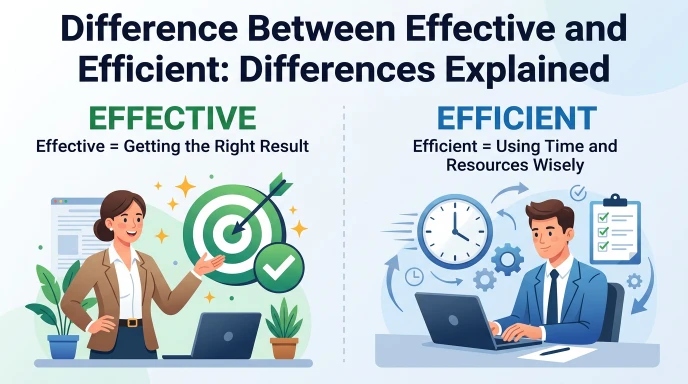
Have you ever finished a task quickly but realized that it did not produce the result you wanted? Or spent hours getting the perfect result when a simpler method could have worked? These situations explain the difference between effective and efficient. Effective means achieving the desired result, while efficient means achieving it with minimal time, effort, or resources.
Understanding the difference between effective and efficient helps you make better decisions at work, school, and home. Although many people use these words interchangeably, they describe two different aspects of performance.
One focuses on success, while the other focuses on how well you use your resources. In this guide, you will learn their meanings, pronunciation, examples, common mistakes, and practical ways to choose the right word.
Quick Answer: Difference Between Effective and Efficient
Effective means doing something that achieves the intended goal. Efficient means doing something with little wasted time, effort, money, or resources.
Example: A teacher is effective when students understand a lesson. The teacher is efficient when students learn it well in less time without wasting resources.
Definitions of Effective and Efficient
- Effective: Producing the result you want or successfully achieving a specific goal.
- Efficient: Achieving a result while using time, energy, money, or other resources wisely.
Both words describe good performance, but they measure different things. Effectiveness asks if the method works. Efficiency asks how economically the method works.
Pronunciation
| Word | US pronunciation | UK pronunciation |
| Effective | ih-FEK-tiv | ih-FEK-tiv |
| Efficient | ih-FISH-unt | ih-FISH-unt |
The pronunciation is broadly similar in American and British English. The main difference is in the middle sound: effective has a “fek” sound, while efficient has a “fish” sound.
Now that you know how to say both words, let’s explore how their meanings differ in everyday situations.
Difference Between Effective and Efficient: Comparison
| Feature | Effective | Efficient |
| Main meaning | Produces the intended result | Uses resources wisely |
| Main focus | Success and outcomes | Time, effort, and resources |
| Key question | Does it work? | Does it work with minimal waste? |
| Time | May take longer | Usually aims to save time |
| Resources | May require more resources | Tries to reduce resource use |
| Performance | Measures goal achievement | Measures resource use relative to results |
| Quality | Focuses on reaching the goal | Focuses on achieving results with less waste |
| Workplace example | A campaign increases sales | A campaign increases sales at a lower cost |
| Possible weakness | Success may come at a high cost | Saving resources may not achieve the right goal |
The main difference is that effectiveness measures if you reach your goal, while efficiency measures how well you use resources to reach it.
Key Differences Explained Between Effective and Efficient
1. Effective Focuses on Results, While Efficient Focuses on Resources
An effective action produces the outcome you want. An efficient action uses a practical amount of time, money, or effort to produce that outcome.
Example: A student studies for three hours and earns a high score. The study method is effective. Another student earns the same score after two focused hours using a well-organized revision plan. That method is both effective and more efficient, assuming the results are comparable.
2. An Effective Method May Not Be Efficient
Sometimes, a method works perfectly but requires too many resources.
Example: A business owner increases sales by paying for expensive advertisements. The campaign is effective because sales rise, but it may not be efficient if the advertising costs consume most of the profit.
The lesson is simple: getting the desired result does not automatically mean you got it economically.
3. An Efficient Method Is Not Always Effective
Saving time does not matter much if you fail to achieve the actual goal.
Example: A customer service team answers every complaint within one minute but gives incorrect information. The team is fast, but its process is not effective because customers’ problems remain unresolved.
Efficiency should support success, not replace it.
4. Effective Measures Success, While Efficient Measures Resource Use
Effectiveness can be measured through outcomes, such as completed projects, customer satisfaction, or improved test scores. Efficiency can be measured through output per hour, cost per unit, or the resources needed to complete a task.
Example: A factory produces 1,000 safe products that meet quality standards. Its effectiveness depends on if it meets the required production goals. Its efficiency depends on how much labor, energy, time, and material it uses to produce those products.
5. Effective and Efficient Can Work Together
The best approach is usually both effective and efficient. First, identify the result you need. Then improve the process without lowering quality.
Example: A doctor chooses a treatment that addresses a patient’s condition. An effective treatment helps achieve the intended health outcome. An efficient process might also reduce unnecessary appointments, paperwork, and waiting time without compromising care.
In healthcare, however, speed and low cost must never replace patient safety or appropriate treatment.
6. Effectiveness Comes Before Efficiency in Many Situations
Before improving a process, make sure it is worth doing.
Example: A marketing team spends hours making social media posts quickly. However, the posts attract little interest from the intended audience. Improving the posting speed will not solve the central problem. The team first needs an effective content strategy.
Once the strategy produces useful results, the team can automate repetitive tasks and improve efficiency.
What Does Effective Mean in Everyday English?
The word effective describes something that works as intended or produces a desired result. It is commonly used for methods, treatments, communication, strategies, tools, and decisions.
Examples include:
- An effective study plan helps students understand and remember information.
- An effective password policy helps protect accounts.
- Effective communication helps people understand instructions and avoid confusion.
- An effective workout plan supports a person’s fitness goals.
- An effective marketing campaign reaches its intended audience and encourages useful action.
Notice that effectiveness depends on the goal. A social media post might be effective at increasing views but ineffective at generating sales. Therefore, you should define what success means before judging the result.
What Does Efficient Mean in Everyday English?
The word efficient describes a process that achieves useful results while avoiding unnecessary waste. It often refers to systems, people, machines, workflows, and methods.
Examples include:
- An efficient dishwasher cleans dishes while using water and energy wisely.
- An efficient employee completes important tasks with minimal unnecessary effort.
- An efficient meeting reaches decisions without wasting participants’ time.
- An efficient delivery system transports orders using well-planned routes.
- An efficient computer program performs its work without using excessive processing power.
Efficiency does not always mean being the fastest. A process that saves five minutes but creates costly errors may not be genuinely efficient. Good efficiency considers the quality of the output as well as the resources used.
Difference Between Effective and Efficient in the Workplace
Businesses need both effectiveness and efficiency to achieve strong results. The two concepts help managers evaluate if a team is reaching its goals and if it is using its resources sensibly.
Consider a sales team with a monthly target of 100 new customers.
- Effective team: Gains 100 or more new customers.
- Efficient team: Gains customers while keeping acquisition costs and staff time under control.
- Effective and efficient team: Meets its customer target while using a reasonable budget and avoiding unnecessary work.
A company should not reward speed alone. Employees who rush through tasks may create mistakes that other team members must fix. Likewise, a team that produces excellent work at an unsustainable cost may need a better process.
Managers can evaluate effectiveness through goal completion, customer satisfaction, and quality. Efficiency can be assessed through cost per result, time per task, and output per employee, with appropriate attention to working conditions.
Why Do People Confuse Effective and Efficient?
People often confuse these words because both describe positive qualities. They also appear together in business reports, advertisements, education, and everyday conversations.
1. Both Words Suggest Good Performance
Calling a person effective or efficient usually expresses approval. However, the reason for that approval is different.
An effective employee achieves important goals. An efficient employee manages resources well. A person can be one without being the other.
2. Speed Is Often Mistaken for Success
Many people assume that completing a task quickly means doing it well. Yet a quick result can be incorrect, incomplete, or unsuitable.
For example, a website developer who launches a website in one day may be efficient with time, but the website is not effective if visitors cannot use its main features.
3. Business Language Often Combines Both Terms
Managers frequently discuss effective and efficient systems together because organizations need both. This can make the words sound interchangeable.
They are related, but each describes a separate performance measure.
4. Different Goals Change the Meaning
An action can be effective for one purpose but not another. Similarly, a process may be efficient under one set of conditions and wasteful under another.
A delivery route that minimizes fuel use might be inefficient during heavy traffic. A marketing strategy that increases brand awareness might not be effective at generating immediate sales.
The goal and the conditions determine how well each word applies.
Common Mistakes With Effective and Efficient
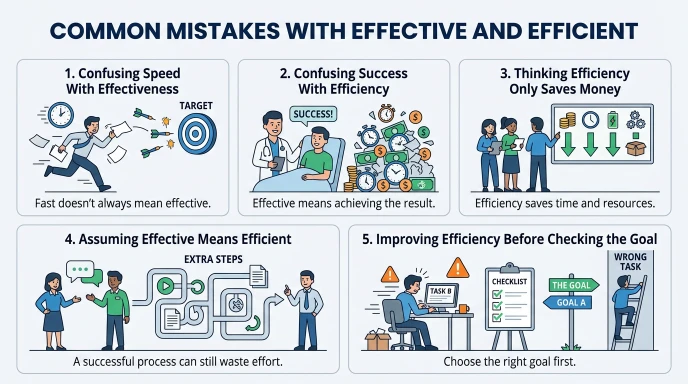
Mistake 1: Using Effective When You Mean Fast
Incorrect idea: An employee who finishes first is automatically effective.
Correction: Finishing quickly shows speed. Effectiveness depends on if the employee achieves the intended result.
Mistake 2: Using Efficient When You Mean Successful
Incorrect idea: The new treatment was efficient because it cured the problem.
Better: The new treatment was effective because it addressed the problem.
Use efficient when you want to emphasize resource use, not simply a successful outcome.
Mistake 3: Assuming Efficiency Always Saves Money
Efficiency often reduces costs, but it can also involve better use of time, materials, energy, or labor.
Example: A team becomes more efficient by completing the same amount of high-quality work in fewer hours, even if its total spending stays the same.
Mistake 4: Assuming an Effective Process Must Be Efficient
A process can achieve the correct result while requiring too much effort.
Example: A company successfully resolves customer complaints, but each case takes several unnecessary steps. The service is effective, yet its workflow could be more efficient.
Mistake 5: Improving Efficiency Before Checking the Goal
Reducing the time needed for an unhelpful task does not create meaningful value.
Correction: Confirm that the task contributes to the intended result. Then remove unnecessary steps and improve the process.
Real-Life Examples of Effective and Efficient
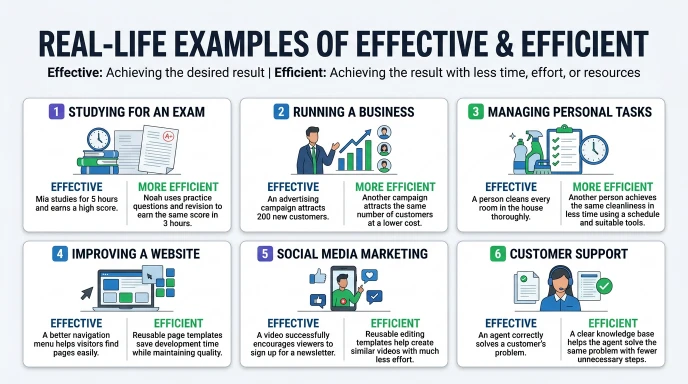
These practical scenarios show how the difference between effective and efficient applies to personal life, education, business, and technology.
Example 1: Studying for an Exam
Mia reads her textbook for five hours and earns a high score. Her study method is effective because it helps her reach her goal.
Noah uses practice questions and spaced revision for three hours and earns the same score. His method is both effective and more efficient because it achieves a comparable result with less study time.
The comparison assumes both students have similar learning goals and that their results are measured fairly.
Example 2: Running a Business
A small business launches an advertising campaign that attracts 200 new customers. The campaign is effective if acquiring those customers meets the business’s goals.
If another campaign attracts the same number of customers at a lower cost without reducing customer quality, it is more efficient.
Business owners should measure profit, customer value, and long-term results rather than clicks alone.
Example 3: Managing Personal Tasks
A person spends the entire morning cleaning the house and gets every room spotless. The cleaning method is effective.
Another person follows a clear cleaning schedule, uses suitable tools, and achieves the same standard in less time. That approach is more efficient.
The best method depends on the desired level of cleanliness and the time available.
Example 4: Improving a Website
A website owner changes the navigation menu so visitors can find important pages more easily. The change is effective if it improves navigation and helps visitors complete their intended tasks.
The owner also uses a reusable page template to reduce repetitive development work. This improves efficiency by saving time during future updates.
Tools such as Google Analytics can help measure user behavior and outcomes, while workflow tools can help reduce repetitive tasks. The tools themselves do not guarantee success; the results must be evaluated against clear goals.
Example 5: Social Media Marketing
A creator posts a video that reaches the intended audience and encourages people to sign up for a newsletter. The content is effective for generating sign-ups.
The creator then uses a planned content calendar and reusable editing templates to produce similar videos with less effort. That makes the workflow more efficient.
Platforms such as Instagram and YouTube provide performance data that can help creators assess views, audience engagement, and conversions. The right metric depends on the campaign’s objective.
Example 6: Customer Support
A support agent solves a customer’s problem correctly. That is effective service.
Another agent solves the same type of problem correctly using a clear knowledge base and fewer unnecessary steps. That process is more efficient.
The goal should be to resolve issues correctly while maintaining an appropriate level of care, not to minimize conversation time at any cost.
When Should You Use Effective or Efficient?
Choose the word that matches the point you want to communicate.
Use Effective When You Mean Something Works
Use effective when discussing:
- Methods that achieve a goal.
- Strategies that produce desired outcomes.
- Communication that gets a message across.
- Treatments or interventions that provide the intended benefit.
- Policies that address a problem.
Example: “The new training program is effective because employees make fewer mistakes.”
The sentence focuses on the result of the training.
Use Efficient When You Mean Something Avoids Waste
Use efficient when discussing:
- Processes that save time.
- Machines that use less energy for a given output.
- Workflows that reduce unnecessary steps.
- Systems that manage resources carefully.
- Methods that deliver comparable results with less effort.
Example: “The new training platform is efficient because employees can complete the lessons in less time.”
The sentence focuses on the resources needed to complete the training.
Use Both When You Want to Describe Overall Performance
Sometimes, the clearest description includes both words.
Example: “The new inventory system is effective because it prevents stock errors and efficient because it reduces the time employees spend checking supplies.”
This sentence describes successful results and better use of resources.
How Can You Become More Effective and Efficient?
You can improve both qualities by separating the result you want from the process you use to achieve it.
Step 1: Define the Goal
Decide what success looks like before starting. A vague goal such as “improve the website” is harder to measure than “help visitors find product information more easily.”
Step 2: Measure the Outcome
Choose a suitable measure of effectiveness. Depending on the task, this could be accuracy, completed goals, customer satisfaction, or the number of problems resolved.
Step 3: Examine Resource Use
Once the process produces the desired result, review how much time, money, energy, and effort it requires.
Step 4: Remove Unnecessary Work
Automate repetitive tasks where appropriate, simplify instructions, and reduce avoidable steps. Keep safeguards that protect quality and accuracy.
Step 5: Check That Quality Remains High
After changing a process, compare the new results with the old ones. A method is not an improvement if it saves time but causes more errors or fails to meet users’ needs.
This approach works in school, business, personal planning, software development, and many other areas.
How Search Engines Understand Effective and Efficient
The words effective and efficient also appear in discussions of search engine optimization, digital marketing, and website performance. Their meanings remain distinct in these fields.
An effective content strategy helps a website achieve its intended goals, such as attracting relevant visitors, answering search queries, or generating qualified leads. An efficient content workflow helps a team complete research, content updates, and technical checks without wasting resources.
For example, a website owner might use Google Search Console to review search impressions, clicks, and query performance. These metrics help evaluate if a page is reaching its intended audience, although they do not independently prove that the entire content strategy is effective.
The owner could then improve efficiency by creating a repeatable content review process or prioritizing pages with clear improvement opportunities.
Similarly, Instagram and YouTube provide analytics that creators can use to understand content performance. A creator should select metrics that match the objective: views may indicate reach, while sign-ups or sales may better measure a conversion goal.
The key principle is to evaluate the result first and the resources used second. No platform, tool, or automated workflow guarantees effectiveness simply because it operates quickly.
Expert Insight: Is It Better to Be Effective or Efficient?
Neither quality is universally better. The right priority depends on the task, its risks, and the result you need.
When accuracy, safety, or customer outcomes matter, effectiveness should come first. A rushed medical decision, poorly tested software release, or inaccurate financial report can create serious problems even if it saves time.
Once the desired result is consistently achieved, efficiency becomes an important next step. Teams can then reduce repetitive work, improve scheduling, or simplify processes without sacrificing quality.
A useful way to assess performance is to ask three questions:
- Did we achieve the intended goal? This measures effectiveness.
- How much time, effort, and money did we use? This helps assess efficiency.
- Did our improvements preserve quality? This checks if the process is genuinely better.
For example, a company should not judge a customer service team only by how quickly agents close cases. It should also consider if customers’ problems were resolved correctly and if the process used resources sensibly.
This balanced approach avoids a common management mistake: optimizing what is easy to measure instead of what actually matters.
Difference and Similarity Between Effective and Efficient
| Feature | Effective | Efficient | Similarity |
| Meaning | Achieves the desired result | Minimizes wasted resources | Both describe performance |
| Main goal | Success | Better resource use | Both support improvement |
| Measurement | Results and goal completion | Time, cost, effort, and output | Both can be measured |
| Time | May require more time | Often aims to save time | Both involve a process |
| Quality | Checks if the result meets the goal | Must consider output quality | Both should support useful results |
| Common use | Strategies, treatments, and communication | Workflows, machines, and systems | Both apply across many fields |
| Limitation | Success may come at a high cost | Resource savings may not achieve the goal | Neither guarantees overall success alone |
This table clearly shows the difference and similarity between effective and efficient for quick understanding.
Frequently Asked Questions
What’s the Difference Between Being Effective and Being Efficient?
Being effective means achieving the desired result, while being efficient means achieving it with minimal time, effort, or resources.
Is Efficient the Same as Effective?
No, efficient and effective are not the same. Efficiency focuses on how well resources are used, while effectiveness focuses on if the goal is achieved.
What’s the Difference Between Effective and Effective?
There is no difference because both words are identical. You may mean effective vs. efficient: effective means producing the intended result, while efficient means using resources wisely.
What Is the Difference Between Effectiveness and Efficiency?
Effectiveness measures how successfully a goal is achieved, whereas efficiency measures how economically time, effort, and resources are used to achieve it.
What Is the Difference Between “Efficient” and “Effective”?
Efficient describes doing something with minimal waste, while effective describes doing something that produces the intended outcome. For example, an efficient worker finishes quickly, while an effective worker gets the right results.
Can You Be Efficient but Not Effective?
Yes, you can be efficient but not effective. For example, a worker might complete a report quickly with little effort, but if the report contains the wrong information, the work is efficient but not effective.
Conclusion
The difference between effective and efficient comes down to two questions: Did you achieve the result you wanted, and did you use your resources wisely?
Effective describes a method, action, or strategy that produces the intended outcome. Efficient describes a process that avoids unnecessary waste of time, effort, money, or other resources. A method can be effective without being efficient, and an efficient process can still fail to achieve its goal.
For example, a student who earns a high score has used an effective study method. A student who earns the same score in less time through focused revision may have used a more efficient method. When both students achieve the desired result while using resources wisely, their methods are effective and efficient.
In most situations, the best approach is to establish effectiveness first and then improve efficiency. This is especially important when quality, accuracy, safety, or customer satisfaction matters.
Remember this simple rule: effectiveness is about achieving the right result, while efficiency is about achieving it with minimal waste. Understanding both terms helps you communicate clearly, make better decisions, and improve performance in everyday life, education, and business.
READ MORE ABOUT!
- Difference Between Pardon and Commutation: A Clear Guide
- Difference Between Among and Between: Easy Grammar Guide

I am James Carter, a professional content writer from the United States. I specialize in writing simple and clear comparison blogs that help students and readers understand difficult topics easily. My writing focuses on everyday language, education, science, and lifestyle topics. I believe that learning should be easy for everyone, so I use simple words and real-life examples in my articles.