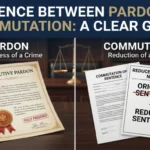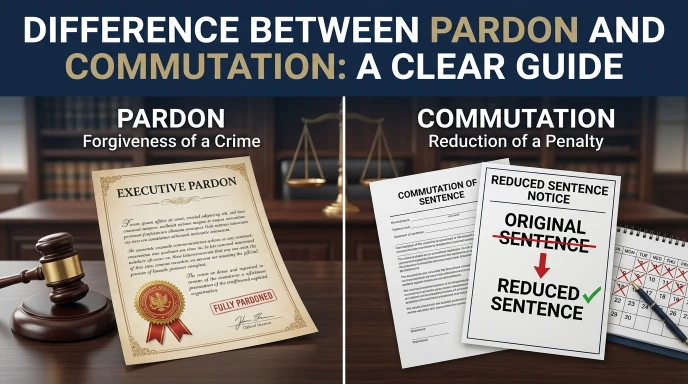
The difference between pardon and commutation is how each affects a criminal sentence and its legal consequences. A pardon is an act of forgiveness that may provide legal relief, while a commutation reduces a person’s punishment without erasing the conviction.
People often confuse these terms because both involve executive clemency. Understanding the difference between pardon and commutation helps you see how criminal justice systems handle forgiveness, punishment, and rehabilitation.
Although the exact rules depend on the country and the authority granting relief, the basic distinction is simple: a pardon may forgive an offense, while a commutation changes the sentence. Let’s explore their meanings, legal effects, examples, and common misconceptions.
Quick Answer: Difference Between Pardon and Commutation
A pardon forgives an offense or provides legal relief from some of its consequences, depending on the law. A commutation reduces a criminal sentence without automatically erasing the conviction.
Example: A person who receives a pardon may gain relief from certain legal consequences of a conviction. Someone whose life sentence is commuted to 25 years receives a reduced punishment but still has the conviction.
Definition of Pardon and Commutation
- Pardon: An official act of clemency that forgives an offense or provides specified legal relief to a convicted person.
- Commutation: An official reduction or alteration of a criminal sentence, such as changing a life sentence to a fixed prison term.
Both are forms of executive clemency, but they serve different purposes and do not necessarily have identical effects in every jurisdiction.
Pronunciation
| Word | US pronunciation | UK pronunciation |
| Pardon | PAR-dən | PAA-dən |
| Commutation | kom-yoo-TAY-shən | kom-yoo-TAY-shən |
The pronunciations are broadly similar in American and British English. Now that the terms are clear, let’s compare how they work in practice.
Comparison: Pardon vs. Commutation
| Feature | Pardon | Commutation |
| Main purpose | Provides forgiveness or legal relief | Reduces or changes punishment |
| Conviction | Does not automatically erase the record | Generally leaves the conviction in place |
| Sentence | May remove remaining legal punishment | Reduces a sentence or changes its terms |
| Prison release | May provide relief from remaining punishment | May shorten imprisonment or result in release |
| Civil rights | May restore certain rights | Does not automatically restore rights |
| Innocence | Does not automatically prove innocence | Does not establish innocence |
| Typical use | Seeking forgiveness or relief after conviction | Seeking a shorter or less severe sentence |
| Legal effect | Depends on the pardon and applicable law | Depends on the terms of the commutation and applicable law |
These distinctions are especially clear in the United States federal system, where the Department of Justice explains that a commutation reduces a sentence without changing the conviction, while a pardon provides a different form of relief.
Key Differences Explained Between Pardon and Commutation
1. Meaning and Purpose
A pardon focuses on forgiveness and relief from the consequences of a criminal offense. A commutation focuses on making the punishment less severe.
For example, a person who has completed a prison sentence might seek a pardon to obtain relief from certain consequences of a conviction. Someone serving a very long prison term might seek a commutation to reduce the remaining time.
The key point: A pardon concerns forgiveness and legal relief, while a commutation concerns punishment.
2. Effect on a Criminal Conviction
A pardon does not always erase a criminal record or prove that the person was innocent. Its effect depends on the governing law and the terms of the pardon.
A commutation generally leaves the conviction intact. The person remains convicted, even if the original punishment is reduced.
For instance, someone convicted of fraud who receives a commutation may serve fewer years in prison but still have the fraud conviction.
3. Effect on Prison Time
A commutation can directly shorten a prison sentence. In some cases, a sentence may be reduced to time already served, allowing the person to be released from prison.
A pardon can also provide relief from unserved punishment, depending on the applicable legal system and the terms granted. However, it is not simply another word for a sentence reduction.
4. Restoration of Civil Rights
A pardon may restore certain rights or remove some legal restrictions connected to a conviction. These can include eligibility for particular licenses or the restoration of certain civil rights.
A commutation does not automatically restore those rights because the conviction generally remains in place. The exact consequences depend on the jurisdiction and the type of right involved.
5. Timing and Eligibility
In the US federal system, pardon applications are generally intended for people who have completed their sentences. Commutation applications are generally used by people seeking relief from a sentence they are serving.
These are general federal guidelines, not universal rules. State laws and other countries may have different requirements.
6. Does Either One Prove Innocence?
Neither a pardon nor a commutation automatically establishes that a person was innocent.
A pardon is an act of clemency, not necessarily a finding that the conviction was wrong. A commutation changes the punishment, not the underlying finding of guilt.
A person who wants to challenge a wrongful conviction may need to pursue a separate legal process, depending on the available remedies.
7. Who Grants a Pardon or Commutation?
In the United States, the President can grant clemency for federal offenses, while governors and other authorized state institutions may exercise clemency powers under state law.
In other countries, the relevant authority might be a head of state, monarch, president, governor, or another official specified by law.
The important distinction is that the authority, process, and legal effects vary by jurisdiction.
What Is Executive Clemency, and How Does It Work?
Executive clemency is a broad term for official relief from criminal punishment or certain consequences of an offense. Pardons and commutations are two forms of clemency.
Clemency exists because a justice system may need a way to address circumstances that ordinary sentencing does not fully resolve. These may include rehabilitation, an unusually severe sentence, serious illness, or other exceptional considerations.
In the US federal system, the process can involve an application, a review by the Department of Justice, and a final decision by the President. The review process and eligibility rules depend on the type of relief requested.
Why Does the Legal System Need Both?
Imagine two people who have been convicted of crimes.
- Person A has completed a sentence and has demonstrated years of good conduct. This person wants relief from certain consequences of the conviction.
- Person B is still serving a lengthy prison sentence that may be considered excessive in light of relevant circumstances. This person wants a reduction in punishment.
A pardon may be relevant to Person A, while a commutation may be relevant to Person B.
This distinction allows authorities to consider forgiveness and sentence reduction as separate forms of relief rather than treating every case in the same way.
Difference Between Pardon and Commutation in Real-Life Situations
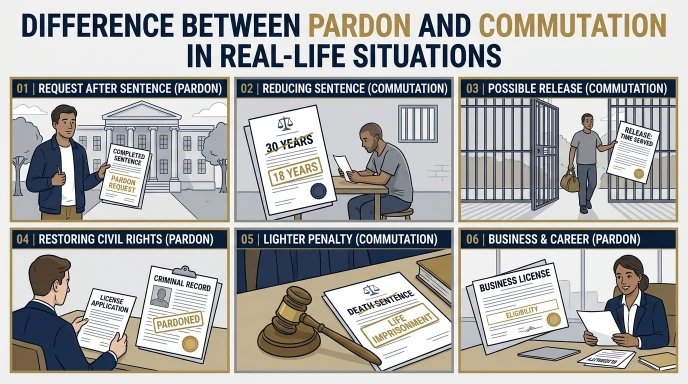
The following examples are hypothetical and illustrate the general distinction. Actual outcomes depend on the applicable law and the terms of the clemency decision.
Example 1: A Person Who Has Completed a Sentence
Jordan was convicted of a nonviolent offense several years ago and has since completed the sentence. Since then, Jordan has maintained a good record and is now seeking relief from certain legal consequences of the conviction.
Jordan now seeks official relief from certain legal consequences of the conviction.
A pardon may be relevant because the request concerns forgiveness and the continuing consequences of the offense, rather than a shorter prison term.
Example 2: A Person Serving a Long Prison Sentence
Maria is serving a 30-year prison sentence. After reviewing her circumstances, the authorized clemency authority decides to reduce the sentence to 18 years.
This is a commutation. Maria’s punishment has been reduced, but the commutation does not automatically erase her conviction.
Example 3: A Sentence Reduced to Time Served
David has served 15 years of a lengthy sentence. The authorized authority commutes the sentence to time served.
David may qualify for release under the terms of the decision and any applicable release requirements. However, release does not necessarily mean the conviction has disappeared.
Example 4: A Conviction Affecting Employment
A person with an old conviction wants to apply for a professional license. The person seeks legal relief from restrictions connected to the conviction.
A pardon might help, depending on the jurisdiction and licensing rules. It does not guarantee that every employer or licensing body must disregard the conviction.
Example 5: A Death Sentence Changed to Life Imprisonment
A person receives a death sentence. The authorized clemency authority changes the punishment to life imprisonment.
This is an example of commutation because the original punishment has been replaced with a less severe one. The conviction remains in place.
Example 6: A Business Owner Seeking to Understand Legal Consequences
A business owner is researching if a past conviction still affects professional eligibility, licensing, or other legal obligations.
The owner should not assume that a commutation and a pardon have identical effects. The actual decision, relevant legislation, and applicable licensing rules must be reviewed.
These examples show why the distinction matters beyond legal vocabulary. It can affect release from prison, civil rights, professional opportunities, and a person’s understanding of their legal status.
Difference and Similarity Between Pardon and Commutation
| Feature | Pardon | Commutation | Similarity |
| Legal meaning | Forgiveness or specified legal relief | Reduction or alteration of punishment | Both provide clemency |
| Main goal | Address consequences of an offense | Make a sentence less severe | Both offer relief |
| Conviction status | Does not necessarily erase the record | Generally remains unchanged | Neither automatically proves innocence |
| Prison sentence | May relieve remaining punishment | Can shorten the sentence | Both can affect punishment |
| Civil rights | May restore certain rights | Does not automatically restore rights | Legal effects depend on the law |
| Typical applicant | Often someone who has completed a sentence in the US federal system | Often someone serving a sentence | Both may involve a clemency application |
| Decision authority | Depends on the legal system | Depends on the legal system | Both require an authorized decision |
| Possible conditions | May be granted with lawful conditions | May be granted with lawful conditions | Terms can affect the outcome |
This table clearly shows the difference and similarity between pardon and commutation for quick understanding.
Common Mistakes With Pardon and Commutation
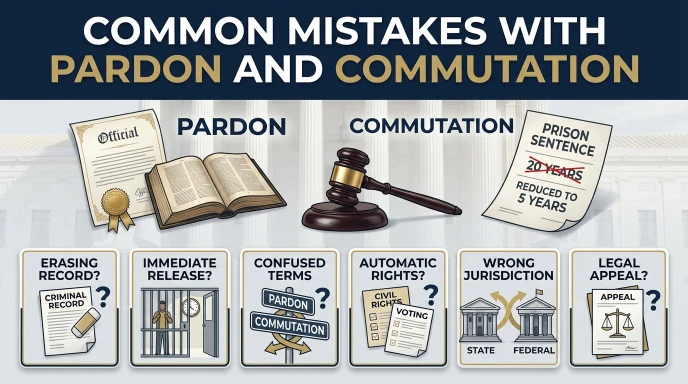
Mistake 1: Assuming a Pardon Erases Every Criminal Record
A pardon does not automatically expunge or erase a criminal record. It may provide legal relief, but record-sealing and expungement are separate legal concepts.
Fix: Check what the specific pardon changes under the applicable law.
Mistake 2: Thinking Commutation Means Innocence
A commutation does not mean the person was wrongly convicted. It reduces or changes the punishment.
Fix: Separate the question of guilt from the question of sentence severity.
Mistake 3: Using Pardon and Commutation as Synonyms
Both involve clemency, but they are not interchangeable. A pardon generally concerns forgiveness or legal relief, whereas a commutation concerns punishment.
Fix: Remember the simple distinction: pardon means forgiveness; commutation means a changed sentence.
Mistake 4: Assuming a Commutation Automatically Restores Civil Rights
A shorter sentence does not automatically remove every legal restriction associated with a conviction.
Fix: Review the laws governing voting, licensing, employment, and other relevant rights.
Mistake 5: Believing the Same Rules Apply Everywhere
The powers of presidents, governors, monarchs, and other authorities differ across legal systems.
Fix: Identify the country and if the conviction is federal, state, or under another jurisdiction before interpreting the decision.
Mistake 6: Confusing Clemency With an Appeal
An appeal or another post-conviction legal challenge may seek to overturn a conviction or correct a legal error. Clemency generally asks an authorized authority to grant relief.
Fix: Determine if the goal is to challenge the conviction itself or to request forgiveness or a reduced sentence.
When Should You Use Each Term?
Choosing the correct word depends on what you are describing.
Use “pardon” when discussing forgiveness or legal relief
Use this term when an authorized official forgives an offense or grants relief from certain consequences of a conviction.
Example: “She applied for a pardon after completing her sentence.”
Use “commutation” when discussing a reduced sentence
Use this term when a punishment is shortened or changed to a less severe one.
Example: “The governor approved a commutation that reduced his prison term.”
In legal writing, the difference is important because the words describe different outcomes. In everyday conversation, you can explain them in simple terms, but avoid claiming that a person has been pardoned when the official decision only reduced their sentence.
Why Do People Get Confused About Pardon and Commutation?
Several factors make these terms easy to mix up.
1. Both involve mercy. A pardon and a commutation are forms of clemency. News reports may discuss them together, making it seem as though they have the same meaning.
2. Both can affect punishment. A pardon may remove certain remaining punishments, while a commutation directly changes a sentence. The results can overlap in some situations, even though the legal mechanisms differ.
3. Headlines simplify legal decisions. A headline might say that an official “showed mercy” without explaining if the action forgave an offense or reduced a sentence.
4. Laws differ across jurisdictions. A pardon’s effect on criminal records, civil rights, or other consequences may vary. People who read about one country may incorrectly apply those rules elsewhere.
5. Everyday meanings are broader than legal meanings. In ordinary English, pardon can mean forgiving someone for a mistake or asking someone to repeat something. Commutation, in criminal law, refers to changing a punishment. Context is essential.
The best way to avoid confusion is to ask one question: Did the authority grant forgiveness or legal relief, or did it reduce the punishment?
How Search Engines Understand the Difference Between Pardon and Commutation
Search engines such as Google try to match a query with information that answers the searcher’s underlying question. Someone searching for “difference between pardon and commutation” likely wants a direct comparison, not a lengthy discussion of every form of criminal clemency.
A useful article therefore needs to explain several related concepts:
- Definitions: What a pardon and commutation mean.
- Legal consequences: What happens to the sentence and conviction.
- Examples: How the two forms of relief work in realistic situations.
- Related terms: Clemency, reprieve, expungement, appeal, and sentence reduction.
- Jurisdiction: Which country’s laws determine the outcome.
Clear headings, concise definitions, and accurate comparison tables help readers locate the answer. They can also make the information easier for search systems to interpret.
However, including unrelated brand names such as Instagram, Meta, or YouTube would not make this legal article more authoritative. Those entities do not explain the legal distinction. Google rankings also depend on many factors beyond article structure, so no writing format can guarantee the first position.
The goal should be to answer the question accurately, explain important limitations, and help readers understand what they should verify next.
Expert Insight: What Matters Most in a Clemency Decision?
The most useful way to understand clemency is to separate the person’s conviction, the punishment imposed, and the continuing consequences of that conviction.
These are related but distinct legal issues. A commutation primarily addresses the punishment. A pardon may provide broader relief from certain consequences, depending on the applicable law.
For example, reducing a sentence from 20 years to 12 years changes the punishment. It does not, by itself, mean the conviction has been overturned or that every legal restriction has disappeared.
Similarly, a pardon should not automatically be described as an expungement or proof of innocence. Each term has a different legal meaning.
For the US federal system, the Department of Justice’s Office of the Pardon Attorney provides official information about applications, eligibility, and the effects of different forms of clemency. Its guidance is a useful starting point for understanding federal cases.
For an actual case, the relevant country’s laws and the precise wording of the decision matter more than a general definition. A qualified lawyer can explain if the relief affects imprisonment, civil rights, licensing, immigration, or other legal consequences.
FAQs
What Is the Difference Between a Commutation and a Pardon?
A pardon forgives a federal offense and may restore certain rights, while a commutation reduces a criminal sentence without erasing the conviction. Both are forms of clemency, but they have different legal effects.
Who Has Trump Pardoned and Commuted?
Donald Trump has granted pardons and commutations to various people, including political allies, individuals convicted of federal crimes, and people involved in high-profile cases. A pardon provides forgiveness for an offense, while a commutation reduces a sentence. The recipients and totals vary by presidential term, so current official records are the best source for a complete list.
Which Is Better, Pardon or Clemency?
Clemency is the general term for mercy granted to someone facing criminal penalties, and it includes pardons and commutations. A pardon may be more beneficial for someone seeking forgiveness for a federal offense, while a commutation may be more helpful to someone who wants a shorter prison sentence. The better option depends on the person’s circumstances.
How Many Biden Pardons and Commutations?
According to the U.S. Department of Justice, President Joe Biden granted 4,165 commutations and 80 pardons during his 2021–2025 administration. His commutations included large groups of people serving sentences for federal offenses, while his pardons covered individuals convicted of various crimes.
What Does Commutation Mean?
A commutation is the reduction or ending of a criminal sentence by an authorized government official. For example, a person sentenced to 20 years in prison might have the sentence reduced to 10 years. A commutation does not erase the conviction or declare the person innocent.
Who Can Grant a Pardon?
In the United States, the president can grant pardons for federal offenses under Article II, Section 2 of the U.S. Constitution, except in cases of impeachment. State governors or other authorized state officials can grant pardons for state crimes, depending on the state’s laws. A presidential pardon generally does not cover state offenses.
Conclusion
The difference between pardon and commutation comes down to forgiveness and punishment. A pardon generally provides forgiveness or legal relief from certain consequences of a criminal offense. A commutation reduces or changes the punishment imposed by a court without automatically removing the conviction.
For example, a person may seek a pardon after completing a sentence to obtain relief from certain legal restrictions. Another person serving a lengthy prison term may seek a commutation to reduce the remaining years of imprisonment. Both forms of clemency can offer relief, but they do not have identical legal effects.
It is also important to remember that a pardon does not automatically prove innocence or erase a criminal record. Likewise, a commutation does not automatically restore civil rights or remove other consequences of a conviction.
Ultimately, understanding the difference between pardon and commutation requires looking at the purpose of the decision, the punishment involved, and the laws that apply. If you are researching an actual case, consult the relevant official clemency authority or a qualified legal professional before drawing conclusions about someone’s rights or legal status.
READ MORE ABOUT!
- Difference Between Endothermic and Exothermic: Easy Guide
- Difference Between Broccoli and Broccolini: A Simple Guide

I am James Carter, a professional content writer from the United States. I specialize in writing simple and clear comparison blogs that help students and readers understand difficult topics easily. My writing focuses on everyday language, education, science, and lifestyle topics. I believe that learning should be easy for everyone, so I use simple words and real-life examples in my articles.