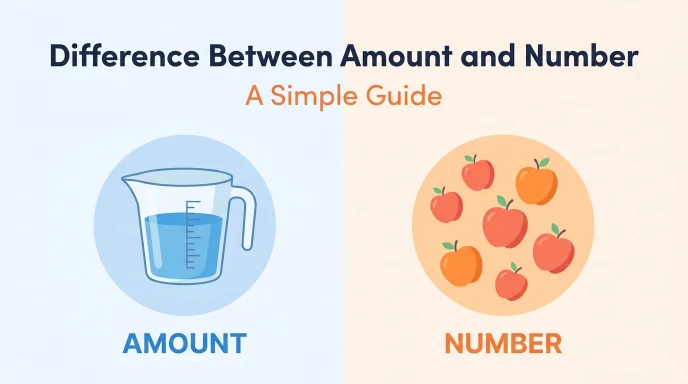
Amount is used for uncountable things, while number is used for countable things.
The difference between amount and number is simple: use “amount” for things you measure and “number” for things you count. For example, you can talk about the amount of water in a bottle or the number of bottles on a shelf. Many learners confuse these words because both describe quantity.
This guide explains when to use amount and number, how they work with singular and plural nouns, and which word sounds correct in everyday English, business writing, and schoolwork. You will also learn common mistakes, practical examples, and easy rules to help you choose the right word with confidence.
Quick Answer: Difference Between Amount and Number
Amount refers to how much of something there is, while number refers to how many individual things there are.
- Amount: The amount of sugar in the recipe is too high.
- Number: The number of cookies in the box is twelve.
Remember: How much? Amount. How many? Number.
Definitions of Amount and Number
- Amount: The quantity or total of something, especially something measured or treated as a whole. Example: the amount of milk in a glass.
- Number: A quantity expressed by counting individual people, animals, objects, or other countable things. Example: the number of students in a class.
Pronunciation
| Word | US pronunciation | UK pronunciation |
| Amount | uh-MOWNT | uh-MOWNT |
| Number | NUM-ber | NUM-buh |
The pronunciations are broadly similar in American and British English, although accents can affect the final sound.
Now that you know what each word means, let’s look at how to use them correctly in sentences.
Difference Between Amount and Number: Comparison
| Feature | Amount | Number |
| Basic meaning | How much of something exists | How many individual things exist |
| Main question | How much? | How many? |
| Common noun type | Uncountable nouns | Countable nouns |
| Examples | Water, money, sugar | Books, people, cars |
| Measurement | Often refers to a quantity measured as a whole | Often refers to a count or total |
| Singular or plural | Usually followed by an uncountable noun | Usually followed by a plural countable noun |
| Formal writing | Used for quantities and measurements | Used for counts and totals |
| Everyday use | The amount of rice we need | The number of bags we need |
The main rule is straightforward: use amount for uncountable quantities and number for countable items.
Key Differences Explained Between Amount and Number
1. Amount Is Used for Uncountable Nouns
Use amount when something is not normally counted as separate units. Instead, you measure it or think of it as a whole.
Examples:
- The amount of rain this month was unusual.
- We need a small amount of butter.
- She spent a large amount of money.
You do not normally count rain, butter, or money as individual items in these sentences. You measure their quantity.
2. Number Is Used for Countable Nouns
Use number when you can count separate people, animals, objects, or other individual units.
Examples:
- The number of visitors increased.
- I have a large number of books.
- A small number of students arrived late.
You can count visitors, books, and students one by one. That is why number is the correct choice.
3. Amount and Number Follow Different Grammar Patterns
The noun after each word often helps you decide which one to use.
- Correct: The amount of information is useful.
- Correct: The number of messages is surprising.
- Incorrect in standard formal English: The amount of messages is surprising.
Information is uncountable, but messages are countable. This distinction is especially useful when checking your writing.
4. Both Words Can Describe Something Large or Small
Neither word automatically means a high or low quantity. The noun determines which word fits.
Examples:
- A small amount of flour remained.
- A small number of chairs remained.
- A huge amount of work is waiting.
- A huge number of tasks are waiting.
You can use adjectives such as small, large, huge, and significant with both words.
5. Amount Can Refer to Money
Money can be counted in dollars or coins, but it is often treated as a single quantity.
Examples:
- The amount of money in my account has changed.
- The number of coins in my wallet is ten.
The first sentence focuses on the total value. The second focuses on individual coins.
6. Number Is Often Used for Statistics and Reports
When a report gives a count of separate items, number is usually the natural choice.
Examples:
- The number of customers grew by 15%.
- The number of website visitors reached 8,000.
- The number of complaints fell last month.
This is common in business reports, school records, surveys, and website analytics.
7. Amount Can Describe Abstract Ideas
Some things cannot be counted as separate units in ordinary usage, even though they are real and important.
Examples:
- The amount of stress she felt was overwhelming.
- He showed a great amount of patience.
- The amount of effort required was considerable.
However, when the noun is countable, number may be more appropriate. For example, “a number of challenges” means several challenges.
How Do You Know If to Use Amount or Number?
The easiest method is to look at the noun that follows the word.
Can you count it as separate items?
If no, amount is usually the right choice.
Examples: water, sand, traffic, information
Can you count individual units?
If yes, number is usually the right choice.
Examples: cars, questions, employees, tickets
For example, you can measure the amount of sand in a bucket, but you can count the number of buckets. The same logic works for food, money, schoolwork, and everyday conversations.
Keep in mind that some nouns can be countable or uncountable depending on their meaning. In “I drank a little water,” water is uncountable. In “We ordered two waters,” the word waters can refer to two servings or bottles.
Difference Between Amount and Number in Everyday English
These words appear in many situations, from shopping to online communication. Understanding the context makes the choice easier.
At Home and in Daily Life
Use amount for ingredients or materials measured in bulk.
- Add a small amount of salt.
- We have enough flour for the cake.
Use number for separate objects.
- Count the number of eggs in the carton.
- The number of plates on the table is eight.
At Work and in Business
Business writing often uses both terms, depending on the information being reported.
- The amount of revenue increased this quarter.
- The number of employees rose from 40 to 48.
- We reduced the amount of waste produced.
- The number of customer complaints declined.
The distinction matters because a total value and a count tell readers different things.
On Websites and Social Media
Digital platforms such as Instagram, YouTube, and Meta’s business tools display many kinds of statistics. The correct word depends on the metric.
- The number of followers increased.
- The number of comments reached 500.
- The amount of time viewers spent watching videos increased.
- The amount of data used by the application was high.
For website analytics, say number of visitors when referring to individual visitors, and amount of time when referring to a measured duration. The platform does not change the underlying grammar rule.
Difference and Similarity Between Amount and Number
Although amount and number have different uses, both words describe quantity. They help explain how much or how many of something exists.
| Feature | Amount | Number | Similarity |
| Meaning | A quantity or total | A count of individual units | Both describe quantity |
| Main question | How much? | How many? | Both answer quantity questions |
| Typical nouns | Water, time, money | Books, hours, people | Both work with nouns |
| Measurement | Often measured | Often counted | Both can express totals |
| Grammar | Usually used with uncountable nouns | Usually used with countable nouns | Both follow standard grammar patterns |
| Formal writing | Describes quantities | Describes counts | Both suit professional writing |
| Everyday speech | Amount of food | Number of meals | Both are common in conversation |
This table clearly shows the difference and similarity between amount and number for quick understanding.
Common Mistakes With Amount and Number
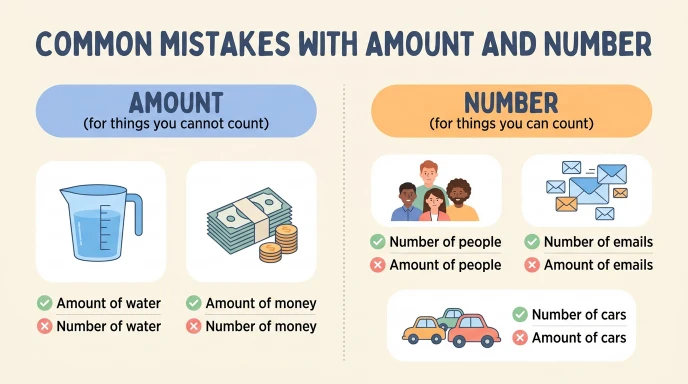
Many learners understand the basic rule but still make mistakes when speaking quickly or writing formal sentences. Here are five common errors and their corrections.
Mistake 1: Saying “Amount of People”
Incorrect: The amount of people at the concert was surprising.
Correct: The number of people at the concert was surprising.
People refers to countable individuals, so number is the standard choice.
Mistake 2: Saying “Number of Water”
Incorrect: The number of water in the tank is low.
Correct: The amount of water in the tank is low.
Water is generally uncountable when referring to a quantity of liquid.
Mistake 3: Confusing Money With Coins
Incorrect: The number of money I earned was impressive.
Correct: The amount of money I earned was impressive.
Money is usually treated as an uncountable noun. If you mean individual coins or banknotes, use number.
Mistake 4: Using Amount With Countable Items in Formal Writing
Incorrect in standard formal English: A large amount of emails arrived today.
Better: A large number of emails arrived today.
Emails are separate, countable items. In casual speech, amount is sometimes used more broadly, but number is the safer choice in formal writing.
Mistake 5: Thinking That a Large Quantity Always Takes Amount
Incorrect: A large amount of cars filled the parking lot.
Correct: A large number of cars filled the parking lot.
Both amount and number can describe a large quantity. The noun determines which one you should choose, not the size of the quantity.
Real-Life Examples of Amount and Number
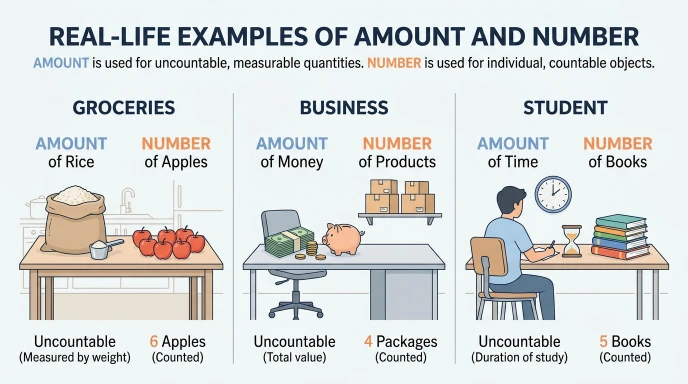
These examples show how the difference between amount and number works in everyday situations.
Example 1: Shopping for Groceries
You visit a supermarket to buy ingredients for dinner.
- The amount of rice in the bag is enough for the family.
- The number of apples in the basket is six.
Rice is treated as a quantity, while apples are counted individually.
Example 2: Managing a Business
A shop owner reviews the week’s sales.
- The amount of money earned this week was higher than expected.
- The number of products sold increased by 20%.
The amount describes the financial total, while the number describes individual products.
Example 3: Studying for an Exam
A student prepares for a difficult test.
- The amount of time available for revision is limited.
- The number of chapters to review is eight.
Time is measured, but chapters can be counted.
Example 4: Running a Website
A website owner checks performance data.
- The number of visitors increased this month.
- The amount of time visitors spent reading articles also increased.
The first sentence refers to a count. The second refers to a measured duration.
Example 5: Working in a Factory
A factory manager checks production and material use.
- The amount of plastic used per day has decreased.
- The number of products manufactured per day has increased.
These two measurements answer different questions: how much material was used and how many products were made.
When Should You Use Amount or Number?
Use this quick guide when you are unsure which word fits your sentence.
| Situation | Correct choice | Example |
| Liquids | Amount | The amount of juice is low. |
| Money as a total | Amount | The amount of money was unexpected. |
| Time as a duration | Amount | The amount of time needed is two hours. |
| Individual people | Number | The number of guests is twenty. |
| Objects | Number | The number of boxes is ten. |
| Questions or tasks | Number | The number of questions was manageable. |
| Uncountable information | Amount | The amount of information was overwhelming. |
| Countable measurements or units | Number | The number of hours worked was eight. |
One useful reminder: hours are countable, so you say “the number of hours.” But you say “the amount of time” when you mean the duration as a whole.
Why Do People Get Confused About Amount and Number?
There are several reasons these words are easy to mix up.
Both Words Describe Quantity
In everyday conversation, people often focus on if a quantity is large or small rather than on the grammar of the noun. That can make the two words seem interchangeable.
For example, “a large amount of work” and “a large number of tasks” both describe a lot of work, but the nouns have different grammatical forms.
Some Nouns Can Be Countable or Uncountable
English nouns do not always behave the same way in every context.
- Amount of coffee: the liquid as a whole.
- Number of coffees: individual cups or servings.
Similarly, paper can refer to material, as in “the amount of paper used,” or individual documents, as in “the number of papers submitted.”
Casual Speech Is Less Strict
In informal conversation, you may hear amount used with countable nouns. However, standard edited English generally favors number with countable plural nouns.
For school assignments, exams, and professional writing, following the traditional distinction is the clearest option.
How Search Engines Understand Amount and Number
Search engines such as Google aim to interpret the meaning of a search query, not simply match individual words. Someone searching for “difference between amount and number” is likely looking for a grammar explanation, correct usage, and examples.
A helpful article should therefore explain:
- The core rule: amount for uncountable quantities and number for countable items.
- Common questions, such as “Is it amount of people or number of people?”
- Examples that show how the rule works in real sentences.
- Exceptions and context-dependent uses, such as “two coffees” or “a number of people.”
The same principle applies when people look up grammar advice through social media or video platforms such as Instagram and YouTube. Clear examples can help readers understand and remember a rule.
However, using the right keywords or adding examples does not guarantee a top Google ranking. Content quality, relevance, usefulness, and many other factors affect search performance.
Expert Insight: A Simple Way to Remember the Rule
The most reliable way to choose between amount and number is to identify what you are describing before writing the sentence.
Ask yourself two questions:
- Am I talking about a quantity measured as a whole? Use amount in most cases.
- Am I counting separate people, objects, or units? Use number in most cases.
For example, “the amount of traffic” describes traffic as a whole, while “the number of cars” counts individual vehicles.
There is one important detail: grammar depends on meaning, not just the noun itself. Time is usually uncountable in “the amount of time,” but hours are countable in “the number of hours.” Likewise, chicken can mean meat or individual animals, depending on the sentence.
This approach is more useful than memorizing a long list of words because it helps you apply the rule to unfamiliar examples.
Frequently Asked Questions
When to Use “Number Of” and “Amount Of”?
Use “number of” with countable things, such as books or people, and “amount of” with uncountable things, such as water or sugar.
Can I Use “Amount” for Money?
Yes, you can use “amount” for money because it refers to a sum of money. For example, “I spent a large amount of money.”
What Is Another Word for “Number” or “Amount”?
Synonyms for “number” include count, total, and quantity. Synonyms for “amount” include quantity, sum, and total, depending on the context.
What Is an Example of “Amount”?
An example is “The amount of water in the bottle is low.” Here, “amount” refers to the quantity of water.
Where to Use “Amount”?
Use “amount” with uncountable nouns, such as time, money, water, and information. For example, “She spent a small amount of time studying.”
Which Is Correct, “Amount of People” or “Number of People”?
“Number of people” is correct in standard English because people are countable. For example, “A large number of people attended the event.”
Conclusion
The difference between amount and number comes down to one simple rule: amount tells you how much, while number tells you how many. Use amount for uncountable quantities such as water, money, information, and time. Use number for countable things such as people, books, cars, and questions.
For example, you might describe the amount of water in a bottle and the number of bottles on a shelf. Both expressions describe quantity, but they focus on different things.
When deciding which word to use, look at the noun and consider its meaning in the sentence. Some nouns, such as coffee, paper, and chicken, can be countable or uncountable depending on the context. Understanding this difference will help you choose the right expression even in unfamiliar situations.
If you are writing an email, completing a school assignment, preparing a business report, or having a casual conversation, this rule can make your English clearer and more accurate. When in doubt, ask yourself: “How much?” or “How many?” That small question will usually lead you to the correct choice.
READ MORE ABOUT!
- Difference Between Passed and Past: Meaning and Examples
- Difference Between Elicit and Illicit: Meaning and Usage

I am James Carter, a professional content writer from the United States. I specialize in writing simple and clear comparison blogs that help students and readers understand difficult topics easily. My writing focuses on everyday language, education, science, and lifestyle topics. I believe that learning should be easy for everyone, so I use simple words and real-life examples in my articles.