Many people get confused about the difference between borrow and lend, especially when talking about money, books, clothes, or other things.
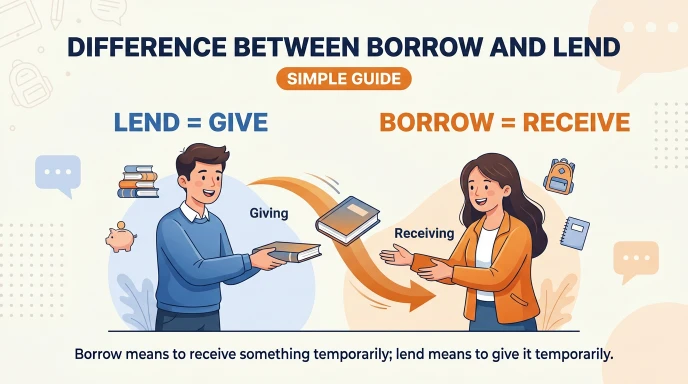
The easiest way to remember it is this: borrow means you receive something temporarily, while lend means you give something temporarily. In other words, the person who takes something borrows it, and the person who gives it lends it.
This guide explains the difference between borrow and lend, how to use each word correctly, and common mistakes to avoid.
Quick Answer: Difference Between Borrow and Lend
Borrow means to take or receive something from someone with the intention of returning it. Lend means to give something to someone temporarily, expecting it back.
Example: “Can I borrow your pen?” → You receive the pen. “I can lend you my pen.” → You give the pen.
Definition of Borrow and Lend
- Borrow: To receive or take something from another person temporarily and plan to return it.
- Lend: To give something to another person temporarily with the expectation that it will be returned.
A simple memory trick is:
Borrow = take temporarily.
Lend = give temporarily.
Pronunciation of Borrow and Lend
Borrow
- US: BAIR-oh /ˈbɑːroʊ/
- UK: BOR-oh /ˈbɒrəʊ/
Lend
- US: lend /lend/
- UK: lend /lend/
Now that the basic definitions are clear, the easiest way to understand the difference is to look at the direction of the action.
What Is the Difference Between Borrow and Lend?
The main difference between borrow and lend is the direction in which something moves.
When you borrow, something comes to you from another person. When you lend, something goes from you to another person.
Think about a library book:
- You borrow a book from the library.
- The library lends the book to you.
The same situation can use both words because two people are involved in the same exchange.
Simple Rule
Person receiving → borrows
Person giving → lends
For example:
Sarah borrowed $20 from Mike.
Sarah received the money, so she borrowed it.
Mike lent Sarah $20.
Mike gave the money, so he lent it.
This is the key distinction behind almost every use of these words.
Borrow vs. Lend: Comparison
| Feature | Borrow | Lend |
| Basic meaning | Receive something temporarily | Give something temporarily |
| Direction | Something comes to you | Something goes from you |
| Person involved | The receiver | The giver |
| Expected action | You return the item | You expect the item back |
| Common example | “Can I borrow your phone?” | “Can I lend you my phone?” |
| Money | Take money temporarily | Give money temporarily |
| Objects | Receive books, clothes, tools, etc. | Give books, clothes, tools, etc. |
| Grammar focus | Usually followed by from | Usually followed by to |
| Past tense | Borrowed | Lent |
This table clearly shows the difference and similarity between borrow and lend for quick understanding.
Key Differences Explained Between Borrow and Lend
1. Borrow Means Receive
Use borrow when you are the person receiving something temporarily.
For example:
“Can I borrow your charger?”
The speaker wants to receive the charger and use it temporarily.
Another example:
“I borrowed a book from my friend.”
The speaker received the book from the friend.
So, when asking yourself “Am I getting something from someone?”, the answer will usually be borrow.
2. Lend Means Give
Use lend when you are the person giving something temporarily.
For example:
“I can lend you my charger.”
The speaker owns or has the charger and is offering it to someone else temporarily.
Another example:
“She lent me her notes.”
She gave her notes to the speaker for temporary use.
A useful question is:
“Am I giving something to someone?”
If yes, lend is usually the correct word.
3. Borrow Usually Points Toward the Receiver
Borrow describes the action from the receiver’s perspective.
Consider this situation:
David borrowed a laptop from Emma.
David is the receiver.
Emma is the person who provided the laptop.
You can also describe the same event from Emma’s perspective:
Emma lent David a laptop.
Nothing about the actual exchange changed. Only the point of view changed.
This is one of the most useful ways to understand the difference between borrow and lend.
4. Lend Usually Points Toward the Giver
Lend focuses on the person who provides something.
For example:
“Can you lend me $10?”
The person asking is requesting that someone give them $10 temporarily.
The same event can be described as:
“Can I borrow $10 from you?”
Both sentences describe the same basic exchange.
The difference is perspective:
Borrow → receiver’s perspective
Lend → giver’s perspective
5. Borrow Commonly Uses “From”
A common sentence pattern is:
borrow + something + from + person
Examples:
- I borrowed a pen from Jake.
- She borrowed money from her brother.
- We borrowed a car from our neighbor.
- He borrowed a book from the library.
This structure makes the relationship easier to remember.
6. Lend Commonly Uses “To”
A common sentence pattern is:
lend + something + to + person
Examples:
- I lent my pen to Jake.
- She lent money to her brother.
- We lent our car to our neighbor.
- He lent a book to his friend.
You can also say:
“I lent Jake my pen.”
The word to is understood even though it is not written.
Borrow and Lend Grammar: How Do You Use Them Correctly?
The words have different grammatical roles even though they describe the same temporary exchange.
Borrow in a Sentence
The basic pattern is:
Subject + borrow + object + from + person
Example:
“I borrowed a jacket from Tom.”
Here:
- I = receiver
- borrowed = action
- a jacket = object
- from Tom = source
Lend in a Sentence
The basic pattern is:
Subject + lend + object + to + person
Example:
“Tom lent a jacket to me.”
Here:
- Tom = giver
- lent = action
- a jacket = object
- to me = receiver
You can also use:
“Tom lent me a jacket.”
Both forms are correct.
What Are the Past Tenses of Borrow and Lend?
This is another area where beginners sometimes make mistakes.
Borrow → borrowed
Examples:
- I borrow books.
- I borrowed a book yesterday.
- She has borrowed my notes.
Lend → lent
Examples:
- I lend books to my friends.
- I lent him my notes yesterday.
- She has lent me her laptop.
Do not use lended as the standard past tense of lend.
The correct past tense is lent.
Easy Grammar Reminder
Borrow → borrowed
Lend → lent
The forms are different, so memorizing one example for each can help.
Can You Borrow Money and Lend Money?
Yes. Both words are commonly used with money.
The important thing is who receives the money and who gives it.
“I borrowed $50 from Alex.”
You received $50.
“Alex lent me $50.”
Alex gave you $50.
These sentences describe the same financial exchange from different perspectives.
The same principle applies to larger financial situations, although formal financial agreements may use words such as loan, borrower, and lender.
Borrower vs. Lender
A borrower is the person or organization receiving money temporarily.
A lender is the person or organization providing the money.
For example, in a formal loan:
- The borrower receives the money.
- The lender provides the money.
- The borrower generally has an obligation to repay according to the agreement.
This is why the words borrower and lender follow the same basic distinction as borrow and lend.
Can You Borrow and Lend Objects?
Yes. These words are not limited to money.
You can borrow or lend:
- Books
- Pens
- Phones
- Chargers
- Cars
- Clothes
- Tools
- Laptops
- Games
- Notes
- Equipment
For example:
“Can I borrow your headphones?”
The speaker wants to receive the headphones temporarily.
The owner could respond:
“Sure, I can lend them to you.”
Both words fit naturally into the same conversation.
Borrow vs. Loan: Are They the Same?
Borrow and loan are related, but they do not work exactly the same way in every sentence.
As a verb, loan can mean to give something temporarily:
“The bank loaned him money.”
However, borrow describes receiving something:
“He borrowed money from the bank.”
For everyday English, borrow and lend are the clearest pair to remember.
Think of the relationship this way:
Borrower receives → lender gives
This also explains why borrow and lend are often taught together.
Borrow, Lend, and Loan: Quick Comparison
| Word | Basic role | Example |
| Borrow | Receive temporarily | “I borrowed her book.” |
| Lend | Give temporarily | “She lent me her book.” |
| Loan | Give something temporarily, especially money | “The bank loaned him money.” |
The exact choice can depend on sentence structure and style, but the receiver-versus-giver distinction remains the most important idea.
Common Mistakes With Borrow and Lend
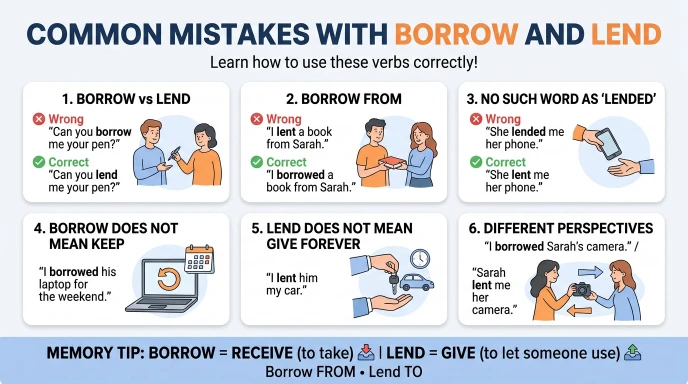
Many beginners understand the definitions but still switch the words when speaking or writing. Here are the most common mistakes.
Mistake 1: “Can You Borrow Me Your Pen?”
This is incorrect in standard English.
A better sentence is:
“Can you lend me your pen?”
Or:
“Can I borrow your pen?”
The first sentence focuses on the person giving the pen. The second focuses on the person receiving it.
Mistake 2: “I Lent a Book From Sarah”
This sentence uses the wrong preposition.
Use:
“I borrowed a book from Sarah.”
Or, from Sarah’s perspective:
“Sarah lent a book to me.”
Remember:
Borrow from
Lend to
Mistake 3: Saying “Lended”
The standard past tense of lend is lent.
Incorrect:
“She lended me her phone.”
Correct:
“She lent me her phone.”
Mistake 4: Thinking Borrow Means Keep
Borrowing something does not normally mean you permanently keep it.
For example:
“I borrowed his laptop for the weekend.”
The natural meaning is that you plan to return it.
If something is given permanently, words such as give, gift, or sell may be more appropriate.
Mistake 5: Thinking Lend Means Give Forever
Lend normally implies temporary use.
“I lent him my car.”
This suggests that he will eventually return it.
If you permanently transfer ownership, lend is usually not the right word.
Mistake 6: Confusing the Point of View
The same event can be described in two ways:
“I borrowed Sarah’s camera.”
or:
“Sarah lent me her camera.”
Both can be correct.
The trick is to identify whose action you are describing.
Real-Life Examples of the Difference Between Borrow and Lend
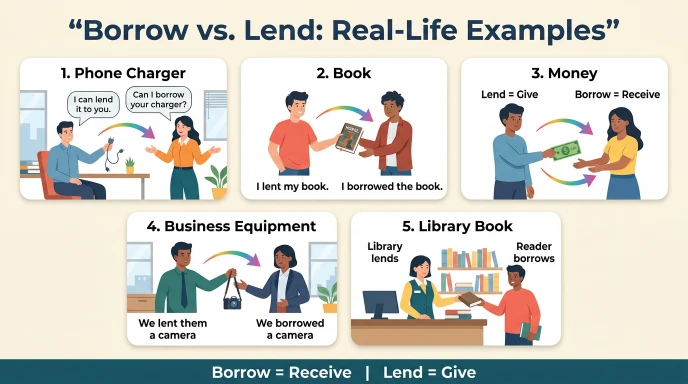
Example 1: Borrowing a Phone Charger
Your phone is almost out of battery, so you ask a coworker:
“Can I borrow your charger?”
You are receiving the charger temporarily.
The coworker might say:
“Sure, I can lend it to you.”
Same situation. Two perspectives.
Example 2: Borrowing a Book
You want to read a friend’s novel.
“I borrowed the book from Maya.”
Maya could describe the same event:
“I lent my book to him.”
The book moves from Maya to the reader temporarily.
Example 3: Borrowing Money From a Friend
You need $20 and ask your friend:
“Can I borrow $20?”
Your friend gives you the money.
Later, your friend might say:
“I lent you $20 yesterday.”
Again, borrow describes receiving, while lend describes giving.
Example 4: Business Equipment
A small business needs a camera for a short project.
Another company temporarily provides one.
The business might say:
“We borrowed a camera from another company.”
The other company could say:
“We lent them a camera for the project.”
This shows that the distinction works in professional situations too.
Example 5: Library Books
A library user receives a book for temporary use.
The user borrows the book.
The library lends the book.
This is one of the easiest real-world examples because the temporary exchange is very clear.
When Should You Use Borrow?
Use borrow when you are talking about receiving something temporarily.
Ask yourself:
“Am I taking or receiving this from someone and planning to return it?”
If yes, borrow is probably correct.
Examples:
- Can I borrow your pen?
- I borrowed her notes.
- He borrowed my car.
- We borrowed some money.
- She borrowed a book from the library.
When Should You Use Lend?
Use lend when you are talking about giving something temporarily.
Ask yourself:
“Am I giving this to someone and expecting it back?”
If yes, use lend.
Examples:
- Can you lend me your phone?
- I lent him my jacket.
- She lent her friend some money.
- They lent us their car.
- The library lent me a book.
Why Do People Get Confused About Borrow and Lend?
The confusion happens because borrow and lend describe opposite sides of the same action.
Imagine a book moving from Person A to Person B.
Person A says:
“I lent my book to B.”
Person B says:
“I borrowed the book from A.”
The physical event is identical.
Only the speaker’s perspective changes.
Regional English can also contribute to confusion. Informal speech sometimes uses these words incorrectly, especially in casual conversations or online communication. Social media platforms such as Instagram, YouTube, and messaging apps can spread informal language quickly, but standard written English still follows the normal distinction.
The safest approach is to focus on the direction of the exchange rather than trying to memorize complicated rules.
A Simple Memory Trick for Borrow vs. Lend
Use this two-step trick:
BORROW = BRING IT TO ME
You receive something.
“I borrowed a book from Anna.”
LEND = LET IT GO
You give something.
“I lent a book to Anna.”
Another quick formula is:
Borrow → receive
Lend → give
And for prepositions:
borrow from
lend to
These three connections solve most borrow-and-lend questions.
How Does Context Change the Meaning?
Context can make the correct word obvious.
Consider:
“Can you ___ me your umbrella?”
The person is asking someone else to give them the umbrella. Therefore:
“Can you lend me your umbrella?”
Now consider:
“Can I ___ your umbrella?”
The speaker wants to receive the umbrella. Therefore:
“Can I borrow your umbrella?”
The object is the same. The difference comes from the role of the speaker.
This is why looking at the entire sentence is more useful than memorizing isolated vocabulary.
How Search Engines Understand “Difference Between Borrow and Lend”
A search such as “difference between borrow and lend” usually has clear comparison intent. The person is not simply asking for a dictionary definition. They want to understand when each word should be used.
A useful answer therefore needs to cover more than:
Borrow means take. Lend means give.
A complete explanation should also address:
- Borrow vs. lend meaning
- Borrow and lend examples
- Borrow from vs. lend to
- Borrowed vs. lent
- Borrowing money
- Lending money
- Common grammar mistakes
- Borrower vs. lender
- Real-world sentence examples
Search systems such as Google can connect these related concepts because they commonly appear together around the same language question. The strongest user-focused approach is therefore to answer the underlying confusion rather than repeat the exact keyword unnecessarily.
Expert Insight: The Fastest Way to Choose the Correct Word
When helping someone with English vocabulary, the most reliable approach is to identify the role of the subject before choosing the verb.
Ask one question:
Who is getting the thing?
If the subject is getting it:
“I borrowed the laptop.”
If the subject is giving it:
“I lent the laptop.”
This method works better than trying to memorize dozens of separate examples.
It also works with money:
“I borrowed $100.”
versus:
“I lent him $100.”
And it works with objects:
“She borrowed my jacket.”
versus:
“I lent her my jacket.”
The grammar becomes much easier once the direction of the exchange is clear.
Difference and Similarity Between Borrow and Lend
| Feature | Borrow | Lend | Similarity |
| Meaning | Receive temporarily | Give temporarily | Both describe a temporary exchange |
| Direction | Toward the receiver | Toward the giver | Both involve two sides |
| Main person | Borrower | Lender | Both identify a person’s role |
| Common preposition | From | To | Both can identify the other person |
| Money | Receive money temporarily | Give money temporarily | Both are common in financial situations |
| Objects | Receive books, tools, phones, etc. | Give books, tools, phones, etc. | Both can describe physical items |
| Past tense | Borrowed | Lent | Both have distinct past-tense forms |
| Return | Borrower normally returns it | Lender normally receives it back | Both imply temporary possession |
This table clearly shows the difference and similarity between borrow and lend for quick understanding.
FAQs
Is it borrow or lend?
It depends on who is receiving the item. Borrow means receive something temporarily, while lend means give something temporarily.
Can I say “borrow me your book”?
In standard English, say “lend me your book” or “let me borrow your book.” “Borrow me” is not the standard construction.
What is the difference between borrow and lend with money?
If you receive money, you borrow it. If you give money temporarily, you lend it.
For example:
“I borrowed $50 from John.”
“John lent me $50.”
What is the past tense of lend?
The past tense of lend is lent, not “lended.”
Example:
“She lent me her laptop yesterday.”
Is “borrow from” correct?
Yes. Borrow from is a common and correct structure.
Example:
“I borrowed a book from my friend.”
Is “lend to” correct?
Yes. Lend to is a common structure.
Example:
“I lent my book to my friend.”
What is the easiest way to remember borrow and lend?
Remember:
Borrow = receive.
Lend = give.
You can also remember:
Borrow from someone.
Lend something to someone.
Are borrow and lend opposites?
They describe opposite sides of the same temporary exchange. The borrower receives something, while the lender gives it.
What is the difference between a borrower and a lender?
A borrower receives money or another item temporarily. A lender provides it temporarily and generally expects it to be returned.
Conclusion
The difference between borrow and lend becomes simple once you focus on the direction of the action. Borrow means to receive or take something temporarily from another person, while lend means to give something temporarily to another person. The borrower normally plans to return the item, while the lender expects to get it back.
For example, if you say, “I borrowed a laptop from Sarah,” you are the person receiving the laptop. Sarah can describe the same situation by saying, “I lent my laptop to him.” Both sentences describe the same exchange from different perspectives.
The easiest memory rule is borrow = receive and lend = give. Also remember the common patterns borrow from and lend to. Once you identify who is receiving the item and who is giving it, choosing the correct word becomes much easier.
If you are talking about money, books, clothes, tools, or everyday objects, this simple receiver-versus-giver rule will help you use borrow and lend correctly in both conversation and writing.
READ MORE ABOUT!
- Difference Between Among and Between: Easy Grammar Guide
- Difference Between Broccoli and Broccolini: A Simple Guide

I am James Carter, a professional content writer from the United States. I specialize in writing simple and clear comparison blogs that help students and readers understand difficult topics easily. My writing focuses on everyday language, education, science, and lifestyle topics. I believe that learning should be easy for everyone, so I use simple words and real-life examples in my articles.