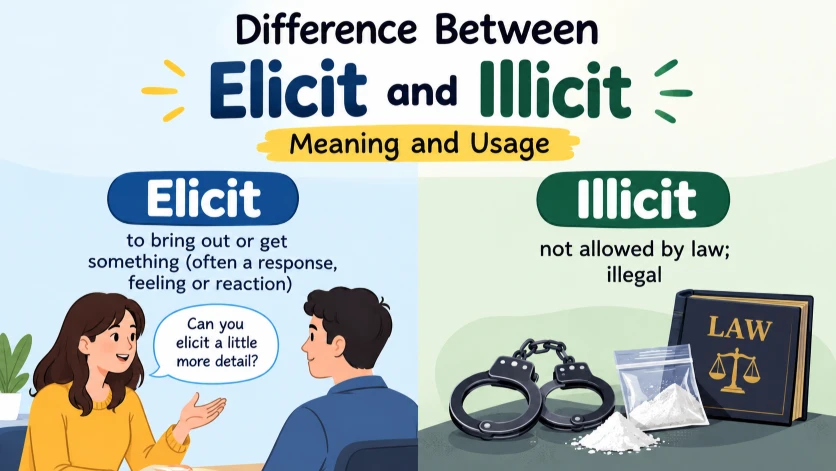
The difference between elicit and illicit comes down to meaning and usage. Elicit is a verb that means to draw out a response, feeling, or piece of information. Illicit is an adjective that describes something illegal or forbidden. Although the words sound alike, they have very different meanings.
Many writers confuse these words because they share a similar pronunciation. For example, a teacher might elicit answers from students, while a business might face penalties for illicit activity.
Understanding the difference between elicit and illicit helps you choose the correct word in emails, essays, reports, and everyday conversations. In this guide, you will learn their definitions, pronunciation, key differences, common mistakes, and practical examples so you can use both words with confidence.
Quick Answer: Difference Between Elicit and Illicit
Elicit means to bring out a response, reaction, or information. Illicit means illegal, unlawful, or not allowed.
- Elicit: The question elicited an honest answer.
- Illicit: The police investigated an illicit business.
Remember: you elicit a response, but you can describe an activity as illicit.
Definition of Elicit and Illicit
- Elicit: To draw out or obtain a response, information, emotion, or reaction from someone or something.
- Illicit: Forbidden by law, rules, or accepted regulations; often used to describe illegal activities or prohibited behavior.
These definitions provide the simplest way to understand what each word means.
Pronunciation
Both words sound very similar, which is why people often mix them up when writing.
| Word | US pronunciation | UK pronunciation | Part of speech |
| Elicit | ih-LISS-it | ih-LISS-it | Verb |
| Illicit | ih-LISS-it | ih-LISS-it | Adjective |
The pronunciation is generally the same in both American and British English. The difference becomes clear through spelling, grammar, and context rather than sound.
Now, let’s compare how these words work in real sentences and why choosing the right one matters.
Comparison
The easiest way to understand the difference between elicit and illicit is to compare their meanings, grammar, and everyday uses.
| Feature | Elicit | Illicit |
| Meaning | To draw out a response or information | Illegal or forbidden |
| Part of speech | Verb | Adjective |
| Main purpose | Describes an action | Describes a person, act, or thing |
| Common context | Interviews, teaching, research | Law, crime, business regulations |
| Typical word partners | Elicit a response, reaction, or answer | Illicit drugs, trade, or activity |
| Sentence role | Shows what someone causes or obtains | Describes something prohibited |
| Example | The teacher elicited questions. | The company investigated illicit trade. |
| Similarity | Both are English vocabulary words | Both are English vocabulary words |
This comparison shows that elicit describes an action, while illicit describes something forbidden or unlawful.
Key Differences Explained Between Elicit and Illicit
1. Elicit Is a Verb, While Illicit Is an Adjective
The most important difference between elicit and illicit is their grammatical role.
Elicit describes an action. Someone elicits information, a response, or a reaction from another person.
Illicit describes a noun. It tells you that an activity, product, or arrangement is illegal or prohibited.
Examples:
- The journalist tried to elicit the truth from the witness.
- Investigators discovered an illicit payment.
Quick tip: If you need a word for obtaining a response, use elicit. If you need to describe something forbidden, use illicit.
2. Elicit Focuses on Getting Something Out
The word elicit often appears when a person asks questions, conducts research, or tries to understand another person’s thoughts.
For example, a doctor may ask questions to elicit details about a patient’s symptoms. A teacher may use an open-ended question to elicit ideas from students.
In both cases, the person is trying to bring out information that might not otherwise be shared.
3. Illicit Focuses on Rules and Restrictions
The adjective illicit describes something that breaks a law or violates a rule or restriction.
For example, authorities may investigate illicit drug sales, while a company may report illicit financial transactions.
The exact meaning depends on the context. Some conduct is illegal under the law, while other conduct may be prohibited by a particular rule or regulation.
4. Elicit Commonly Appears in Professional Communication
You will often see elicit in education, psychology, journalism, research, and business.
- A researcher elicits feedback from participants.
- A manager elicits suggestions from employees.
- A psychologist may use questions to elicit information about a person’s experiences.
These examples show how the word describes a deliberate effort to obtain a response or information.
5. Illicit Commonly Appears in Legal and Regulatory Contexts
The word illicit is especially common in discussions of crime, financial misconduct, prohibited trade, and restricted substances.
For example, a report might describe illicit financial flows or an illicit market. A news story might discuss an investigation into illicit goods.
Unlike elicit, this word does not describe the act of asking or obtaining information. It identifies something that is unlawful or prohibited.
6. Their Similar Sounds Do Not Make Them Interchangeable
Both words are pronounced almost identically in standard American and British English. However, their spelling and meanings are different.
Compare these sentences:
- The question helped elicit a useful response.
- The authorities uncovered an illicit operation.
Replacing one word with the other changes the sentence’s meaning and may also make it grammatically incorrect.
7. Their Word Forms Can Help You Remember Them
Understanding related words can make the distinction easier.
- Elicit: elicits, elicited, eliciting.
- Illicit: illicit activity, illicitly (an adverb meaning in an unlawful or prohibited manner).
For example, you can say, “The survey elicited useful feedback,” or “The goods were sold illicitly.”
There is no need to memorize long definitions. Learning a few common word combinations is often more useful.
What Is the Difference Between Elicit and Illicit in Everyday English?
In everyday English, the difference depends on what you want to express.
Use elicit when someone causes a response, draws out information, or brings a feeling to the surface. Use illicit when describing something prohibited or unlawful.
Consider a workplace example. A supervisor may elicit honest feedback during a meeting. An investigation, however, may uncover illicit payments made to influence a decision.
The same distinction applies in school, journalism, research, and personal communication. One word describes an action; the other describes the nature of something.
This is also why spelling matters in professional writing. A sentence such as “The interviewer used questions to illicit a response” is incorrect because the writer needs the verb elicit.
How Do You Use Elicit in a Sentence?
Use elicit when the subject of the sentence brings out information, a response, or a reaction.
Here are several common examples:
- Education: The teacher asked a question to elicit different opinions.
- Business: The manager’s survey elicited valuable customer feedback.
- Journalism: The reporter tried to elicit more details from the witness.
- Research: The interview elicited information about participants’ experiences.
- Everyday life: Her unexpected gift elicited a smile.
Notice that elicit usually connects an action to something that follows from it. The question elicits an answer, the survey elicits feedback, and the gift elicits a reaction.
What Words Commonly Go With Elicit?
Common word combinations include:
- Elicit a response
- Elicit an answer
- Elicit information
- Elicit feedback
- Elicit a reaction
- Elicit sympathy
- Elicit laughter
- Elicit a confession
These combinations can help you recognize the correct word when writing or editing a sentence.
How Do You Use Illicit in a Sentence?
Use illicit before a noun to describe an illegal or prohibited activity, object, or arrangement.
Examples include:
- Law enforcement: Police investigated an illicit drug operation.
- Business: The audit uncovered illicit financial transactions.
- Trade: Officials seized goods linked to illicit trade.
- News: The report examined an illicit arms network.
- Everyday context: The organization prohibited illicit use of its resources.
What Words Commonly Go With Illicit?
You will often find illicit in these expressions:
- Illicit drugs
- Illicit trade
- Illicit activity
- Illicit payments
- Illicit financial flows
- Illicit dealings
- Illicit substances
- Illicit relationships
The meaning of illicit can extend beyond criminal activity. It may describe conduct forbidden by a particular law, policy, or accepted restriction. The surrounding context determines exactly what is prohibited.
Difference and Similarity Between Elicit and Illicit
Although elicit and illicit have different meanings, they share a few characteristics. This table highlights both their differences and their similarities.
| Feature | Elicit | Illicit | Similarity |
| Meaning | Draw out a response | Illegal or forbidden | Both have distinct meanings |
| Grammar | Verb | Adjective | Both are parts of speech |
| Pronunciation | Usually ih-LISS-it | Usually ih-LISS-it | They sound alike |
| Usage | Describes an action | Describes a condition or quality | Both appear in written English |
| Context | Questions, research, feedback | Laws, rules, prohibited activities | Both appear in formal writing |
| Example | Elicit an answer | Illicit trade | Both fit naturally into sentences |
| Related form | Elicited | Illicitly | Both have related word forms |
This table clearly shows the difference and similarity between elicit and illicit for quick understanding.
Common Mistakes With Elicit and Illicit
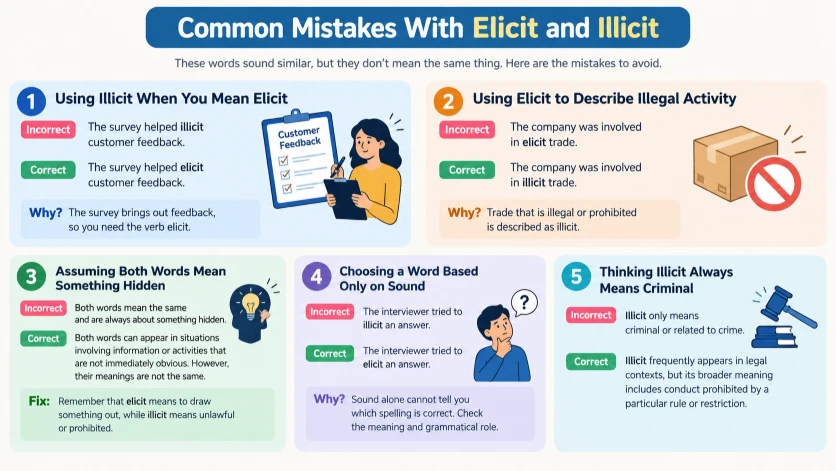
Many beginners confuse these words because their pronunciation is nearly identical. Here are the mistakes to avoid.
Mistake 1: Using Illicit When You Mean Elicit
Incorrect: The survey helped illicit customer feedback.
Correct: The survey helped elicit customer feedback.
Why? The survey brings out feedback, so you need the verb elicit.
Mistake 2: Using Elicit to Describe Illegal Activity
Incorrect: The company was involved in elicit trade.
Correct: The company was involved in illicit trade.
Why? Trade that is illegal or prohibited is described as illicit.
Mistake 3: Assuming Both Words Mean Something Hidden
Both words can appear in situations involving information or activities that are not immediately obvious. However, their meanings are not the same.
Fix: Remember that elicit means to draw something out, while illicit means unlawful or prohibited.
Mistake 4: Choosing a Word Based Only on Sound
Incorrect: The interviewer tried to illicit an answer.
Correct: The interviewer tried to elicit an answer.
Why? Sound alone cannot tell you which spelling is correct. Check the meaning and grammatical role.
Mistake 5: Thinking Illicit Always Means Criminal
Illicit frequently appears in legal contexts, but its broader meaning includes conduct prohibited by a particular rule or restriction.
Fix: Check what makes the activity prohibited instead of automatically assuming that every use refers to a criminal offense.
Real-Life Examples of Elicit and Illicit
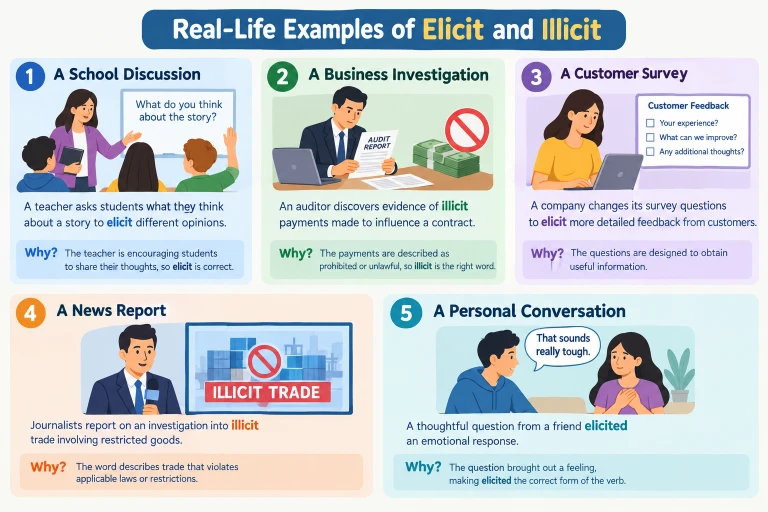
These practical situations show how the words work in different settings.
Example 1: A School Discussion
A teacher asks students what they think about a story to elicit different opinions.
The teacher is encouraging students to share their thoughts, so elicit is correct.
Example 2: A Business Investigation
An auditor discovers evidence of illicit payments made to influence a contract.
The payments are described as prohibited or unlawful, so illicit is the right word.
Example 3: A Customer Survey
A company changes its survey questions to elicit more detailed feedback from customers.
The questions are designed to obtain useful information.
Example 4: A News Report
Journalists report on an investigation into illicit trade involving restricted goods.
The word describes trade that violates applicable laws or restrictions.
Example 5: A Personal Conversation
A thoughtful question from a friend elicited an emotional response.
The question brought out a feeling, making elicited the correct form of the verb.
When Should You Use Elicit or Illicit?
Choosing between these words becomes easier when you identify the purpose of your sentence.
Use elicit when:
- You are asking questions to obtain information.
- You want to describe a reaction caused by an event.
- You are discussing interviews, surveys, or research.
- You want to explain how someone draws out an answer or feeling.
Use illicit when:
- You are describing unlawful activity.
- You are writing about prohibited goods or substances.
- You are discussing financial misconduct or illegal trade.
- You need an adjective to describe something forbidden.
A simple memory trick: You elicit an answer; you describe an activity as illicit.
Why Do People Get Confused About Elicit and Illicit?
There are three main reasons people mix up these words.
1. Similar pronunciation: Both words are pronounced almost identically in standard English. When people hear them in conversation, they may not know which spelling the speaker intends.
2. Unfamiliar spelling: Neither word appears as frequently in everyday conversation as simpler alternatives such as get, draw out, illegal, or forbidden. Writers may remember the sound but forget the spelling.
3. Different levels of formality: Both words are common in formal writing, but they appear in different contexts. Elicit is often used in research and professional communication, while illicit appears frequently in legal, regulatory, and news writing.
The best solution is to remember a complete phrase rather than an isolated word: elicit a response and illicit activity.
How Do Search Engines Understand Elicit and Illicit?
Search engines such as Google aim to understand the meaning and purpose of a search query, not just match individual words.
Someone searching for the difference between elicit and illicit is usually looking for a spelling and vocabulary explanation. A helpful page should therefore define both terms, compare their grammatical roles, and provide examples that show how they work in context.
Search intent also explains why comparison tables, clear definitions, and short answers are useful. They help readers quickly find the information they need.
The same principle applies to educational content shared through platforms such as Instagram and YouTube. A short vocabulary lesson can explain the difference, but readers still benefit from complete sentence examples and practical guidance.
Search rankings cannot be guaranteed by adding keywords or following a fixed article structure. Accuracy, relevance, clear explanations, and usefulness are more important than repeating the target phrase unnecessarily.
Expert Insight: The Easiest Way to Remember the Difference
A practical way to learn confusing words is to connect each one to a familiar phrase.
For elicit, remember a question that elicits an answer. For illicit, remember illicit trade or illicit payments.
This method works because you learn how the word functions in a sentence rather than memorizing a definition alone. It also helps you recognize grammatical patterns when reading books, reports, news articles, or workplace emails.
When proofreading, ask yourself two questions:
- Am I describing an action that brings out a response or information?
- Am I describing something illegal or prohibited?
The first usually calls for elicit. The second calls for illicit. If the sentence still feels unclear, replace the word temporarily with a simple phrase such as draw out or forbidden to check if the meaning makes sense.
Frequently Asked Questions
What Does Elicit Mean in Simple Terms?
Elicit means to draw out or get a response, answer, or reaction from someone.
Example: The teacher’s question elicited several interesting answers from the students.
Does “Illicit” Mean Unlawful?
Yes, illicit means illegal or not allowed by law or rules.
Example: The police investigated the sale of illicit drugs.
What Does Illicit Mean in Simple Terms?
Illicit means something that is forbidden, illegal, or against the rules.
Example: He was involved in illicit activities.
What Is an Example of Illicit?
An example of illicit is selling illegal drugs or secretly trading stolen goods.
Example: The authorities discovered an illicit trade in stolen jewelry.
What Is the Difference Between Illicit and Elicit?
Illicit describes something illegal or forbidden, while elicit means to draw out a response or reaction.
Example: The reporter tried to elicit the truth about the illicit business.
What’s a Synonym for Elicit?
Common synonyms for elicit include draw out, evoke, prompt, obtain, and provoke. The best synonym depends on the context.
Example: Her question prompted an honest response from her friend.
Conclusion
The difference between elicit and illicit is simple once you understand their meanings and grammatical roles. Elicit is a verb that means to draw out a response, reaction, or piece of information. Illicit is an adjective that describes something illegal or prohibited.
For example, a teacher might elicit answers from students, while investigators might uncover illicit activity. Both words sound alike, but they cannot be used interchangeably.
When deciding which word to use, focus on the meaning of your sentence rather than pronunciation alone. If you are describing an action that brings out a response or information, choose elicit. If you are describing an activity or object that is unlawful or forbidden, choose illicit.
Remembering common phrases such as elicit feedback, elicit a reaction, and illicit trade will help you use both words correctly in essays, professional emails, reports, and everyday writing. With a little practice, choosing the right word becomes much easier.
READ MORE ABOUT!
- Difference Between Endothermic and Exothermic: Easy Guide
- Difference Between Broccoli and Broccolini: A Simple Guide

I am Emily Johnson, a USA-based content writer who creates easy-to-read blogs on language and daily life topics. I explain complex ideas in simple English for students and beginners so they can understand easily.