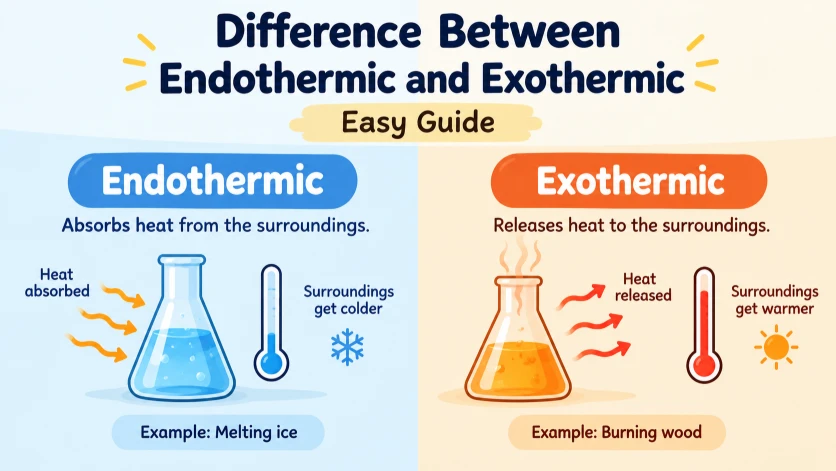
Endothermic reactions absorb heat from their surroundings, while exothermic reactions release heat into their surroundings.
Many beginners get confused when a reaction either takes in heat or gives heat off. The difference between endothermic and exothermic reactions comes down to how energy moves between the reaction and its surroundings.
An endothermic process absorbs heat, while an exothermic process releases heat. Understanding this difference makes chemistry, temperature changes, and energy diagrams much easier to understand.
In this guide, we will explain what each term means, how these reactions work, where they appear in real life, and how to identify them quickly.
Quick Answer: Difference Between Endothermic and Exothermic
The main difference between endothermic and exothermic reactions is energy transfer.
- Endothermic: absorbs heat from the surroundings.
- Exothermic: releases heat into the surroundings.
For example, melting ice is endothermic because it needs heat, while burning wood is exothermic because it releases heat.
Definition of Endothermic and Exothermic
- Endothermic: A process or reaction that absorbs heat energy from its surroundings. The surroundings often become cooler.
- Exothermic: A process or reaction that releases heat energy into its surroundings. The surroundings often become warmer.
A useful memory trick is endo = energy enters and exo = energy exits.
Pronunciation
Endothermic
- US: en-doh-THER-mik
- UK: en-doh-THER-mik
Exothermic
- US: ek-soh-THER-mik
- UK: ek-soh-THER-mik
The words sound complicated, but their meanings are simple once you focus on the direction of heat transfer. Let’s look at that difference more closely.
What Is an Endothermic Reaction?
An endothermic reaction absorbs energy from its surroundings. Heat moves into the system because the reaction needs energy to proceed.
As the system takes in heat, the nearby surroundings can feel colder. This does not mean every endothermic process automatically makes the entire environment cold; it means energy is transferred from the surroundings into the system.
Examples of Endothermic Processes
Common examples include:
- Melting ice
- Evaporation of water
- Photosynthesis
- Thermal decomposition of some compounds
- Dissolving certain substances in water
Consider melting ice. Ice must absorb energy before its particles can move from a solid structure into a liquid state. The absorbed energy does not simply make the ice “hot.” Much of it is used to change the state of matter.
How Can You Recognize an Endothermic Reaction?
Look for signs that energy is being absorbed.
A simple clue is:
Surroundings → heat → system
An energy diagram for an endothermic reaction shows the products at a higher energy level than the reactants.
The enthalpy change is positive:
ΔH > 0
That positive value indicates that the system gained energy.
What Is an Exothermic Reaction?
An exothermic reaction releases energy into the surroundings, usually as heat. Because energy leaves the system, the surrounding environment can become warmer.
Combustion is one of the easiest examples to understand. When wood, gasoline, natural gas, or another fuel burns, chemical energy is converted into other forms of energy, including heat and often light.
Examples of Exothermic Processes
Common examples include:
- Burning fuel
- Combustion of wood
- Many acid-base neutralization reactions
- Respiration
- Freezing water
- Condensation of water vapor
When water freezes, it releases energy as its particles form a more ordered solid structure. That is why freezing is classified as an exothermic phase change.
How Can You Recognize an Exothermic Reaction?
Look for energy leaving the system.
The basic idea is:
System → heat → surroundings
On an energy diagram, the products have less energy than the reactants.
The enthalpy change is negative:
ΔH < 0
The negative value shows that energy was released by the system.
Difference Between Endothermic and Exothermic: Key Comparison
| Feature | Endothermic | Exothermic |
| Heat transfer | Absorbs heat | Releases heat |
| Energy direction | Surroundings → system | System → surroundings |
| ΔH value | Positive | Negative |
| Product energy | Higher than reactants | Lower than reactants |
| Surroundings | Often become cooler | Often become warmer |
| Energy requirement | Requires energy input | Gives off energy |
| Common example | Melting ice | Burning fuel |
| Memory clue | Energy enters | Energy exits |
The key point is not simply if something feels hot or cold. The scientific definition depends on the direction of energy transfer.
Key Differences Explained Between Endothermic and Exothermic
1. Heat Moves in Opposite Directions
The biggest difference is the direction in which heat moves.
An endothermic process takes heat into the system. An exothermic process sends heat out of the system.
For example, an instant cold pack works through an endothermic process. When the chemicals inside dissolve or react, they absorb energy from the surroundings, making the pack feel cold.
A hand warmer works differently. Its chemical reaction releases energy, making the pack warm.
2. Their Enthalpy Changes Have Different Signs
Chemists often use ΔH, or change in enthalpy, to describe heat changes at constant pressure.
For an endothermic reaction:
ΔH is positive (+)
For an exothermic reaction:
ΔH is negative (−)
This is one of the fastest ways to identify the two types in a chemistry problem.
3. Their Energy Diagrams Look Different
An endothermic reaction finishes at a higher energy level than where it started.
An exothermic reaction finishes at a lower energy level.
Think of it like climbing versus going downhill:
- Endothermic: energy level goes up.
- Exothermic: energy level goes down.
The difference in energy between reactants and products relates to the reaction’s enthalpy change.
4. They Affect Their Surroundings Differently
An endothermic process draws thermal energy from its surroundings, so the nearby environment may cool.
An exothermic process transfers thermal energy outward, so the surroundings may warm.
This is why temperature can provide a useful clue during a practical experiment. However, temperature alone is not always enough to identify the exact process.
5. Bond Energy Helps Explain the Difference
Chemical reactions involve breaking old bonds and forming new ones.
Breaking chemical bonds requires energy. Forming chemical bonds releases energy.
A reaction is generally exothermic when the energy released by forming new bonds is greater than the energy required to break the original bonds.
A reaction is generally endothermic when more energy is required to break bonds than is released when new bonds form.
This gives a deeper explanation of where the energy difference comes from.
6. Phase Changes Can Also Be Endothermic or Exothermic
The terms are not limited to chemical reactions.
Some physical changes are also classified as endothermic or exothermic.
Endothermic phase changes:
- Melting
- Evaporation
- Sublimation
Exothermic phase changes:
- Freezing
- Condensation
- Deposition
For example, liquid water absorbing energy and becoming water vapor is endothermic. Water vapor losing energy and becoming liquid water is exothermic.
7. Everyday Applications Are Everywhere
You do not need a chemistry laboratory to encounter these processes.
Cooking, refrigeration, weather, fuel combustion, instant cold packs, hand warmers, and even biological processes involve energy transfer.
That makes the endothermic-versus-exothermic distinction more than a classroom definition.
Are Endothermic and Exothermic Reactions Opposites?
In terms of heat transfer, they represent opposite directions of energy movement.
An endothermic process absorbs heat, while an exothermic process releases heat.
However, this does not mean every other property of the two reactions is simply reversed. Reaction speed, activation energy, equilibrium, and other chemical properties depend on additional factors.
For example, an exothermic reaction can be slow, and an endothermic reaction can be fast. Heat transfer and reaction rate are related concepts, but they are not the same thing.
What Is the Difference Between Endothermic and Exothermic Phase Changes?
Phase changes provide some of the easiest examples.
When a substance changes from a more ordered state to a less ordered state, it generally requires energy.
For example:
Solid → liquid → gas
These changes are generally endothermic.
The reverse direction releases energy:
Gas → liquid → solid
These changes are generally exothermic.
So:
- Melting = endothermic
- Evaporation = endothermic
- Sublimation = endothermic
- Freezing = exothermic
- Condensation = exothermic
- Deposition = exothermic
A simple way to remember this is that moving toward a gas generally requires energy, while moving toward a solid generally releases energy.
Difference and Similarity Between Endothermic and Exothermic
| Feature | Endothermic | Exothermic | Similarity |
| Heat | Absorbs heat | Releases heat | Both involve energy transfer |
| ΔH | Positive | Negative | Both can be described using enthalpy |
| Energy direction | Into the system | Out of the system | Both transfer energy between system and surroundings |
| Surroundings | May cool | May warm | Temperature can change around both |
| Chemical reactions | Can occur in reactions | Can occur in reactions | Both can involve bond breaking and formation |
| Physical changes | Melting and evaporation | Freezing and condensation | Both can describe phase changes |
| Energy diagram | Products are higher | Products are lower | Both can be represented graphically |
| Everyday examples | Ice melting, cold packs | Combustion, hand warmers | Both occur in daily life |
This table clearly shows the difference and similarity between endothermic and exothermic for quick understanding.
Common Mistakes With Endothermic and Exothermic
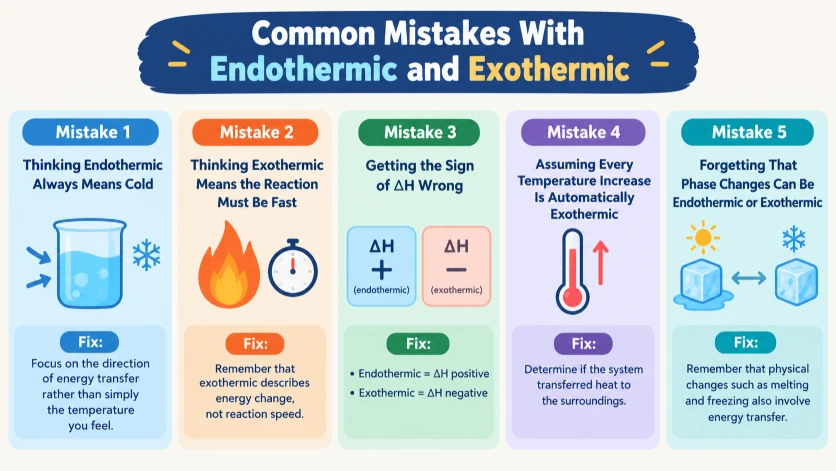
Mistake 1: Thinking Endothermic Always Means Cold
An endothermic process absorbs heat, but that does not mean the reaction itself must always feel cold.
Fix: Focus on the direction of energy transfer rather than simply the temperature you feel.
Mistake 2: Thinking Exothermic Means the Reaction Must Be Fast
An exothermic reaction can be slow. Releasing energy and reacting quickly are two different concepts.
Fix: Remember that exothermic describes energy change, not reaction speed.
Mistake 3: Getting the Sign of ΔH Wrong
Many students mix up positive and negative enthalpy changes.
Fix:
- Endothermic = ΔH positive
- Exothermic = ΔH negative
Mistake 4: Assuming Every Temperature Increase Is Automatically Exothermic
A temperature increase may have several causes, and experimental conditions matter.
Fix: Determine if the system transferred heat to the surroundings.
Mistake 5: Forgetting That Phase Changes Can Be Endothermic or Exothermic
Some people only associate these terms with chemical reactions.
Fix: Remember that physical changes such as melting and freezing also involve energy transfer.
Real-Life Examples of Endothermic and Exothermic Processes
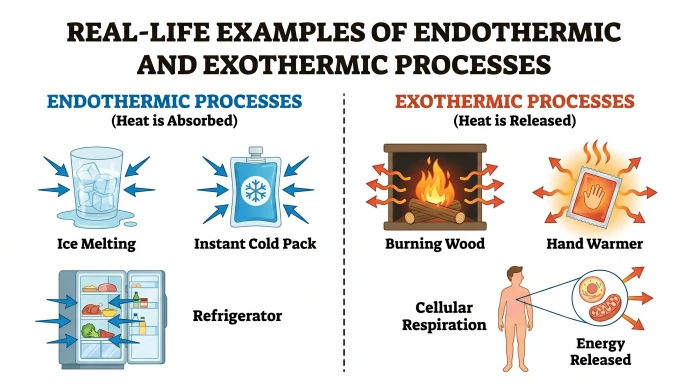
Example 1: Ice Melting
A glass contains ice on a warm day. The ice absorbs thermal energy from its surroundings and changes from solid water into liquid water.
This is endothermic.
Example 2: Burning Wood
A piece of wood burns in a fireplace. Chemical energy stored in the fuel is converted into heat and light.
The surroundings receive energy, so combustion is exothermic.
Example 3: Instant Cold Pack
An instant cold pack becomes cold after its contents are mixed. The process absorbs energy from the surrounding area.
This is an example of an endothermic process.
Example 4: Hand Warmer
A disposable hand warmer uses a chemical process that releases thermal energy.
This is exothermic, which is why the pack becomes warm.
Example 5: Human Respiration
Cells obtain usable energy through metabolic reactions involving food molecules. Overall, cellular respiration releases energy that can ultimately support biological work and heat production.
This is commonly described as an exothermic metabolic process.
Example 6: Refrigeration
A refrigerator moves thermal energy from inside the cold compartment to the surrounding environment. The cooling system involves several thermodynamic processes, so it is more complicated than simply calling the entire refrigerator “endothermic.”
This is a useful advanced example because it shows why system boundaries matter.
When Should You Use Each Term?
Use endothermic when the system is absorbing heat from its surroundings.
Use exothermic when the system is releasing heat to its surroundings.
For a chemistry exam, ask yourself:
Where is the heat going?
If heat goes into the system, think endothermic.
If heat goes out of the system, think exothermic.
This simple question can solve many basic problems without memorizing long definitions.
Why Do People Get Confused About Endothermic and Exothermic?
The confusion usually comes from looking at temperature instead of energy flow.
For example, imagine touching an instant cold pack. It feels cold, so it is tempting to think “cold reaction.” But the scientific explanation is more precise: the process absorbs thermal energy from the surrounding environment.
Language can also make things confusing. Words such as “heat,” “energy,” “temperature,” and “reaction” are often used casually in everyday conversation, but chemistry gives each one a specific meaning.
Another source of confusion is the system boundary. A reaction can release energy while the surroundings receive that energy. If we call the process exothermic depends on which part is defined as the system.
How Do Energy Diagrams Show the Difference Between Endothermic and Exothermic?
Energy diagrams provide a visual way to compare reactants and products.
For an endothermic reaction, the products sit at a higher energy level than the reactants.
For an exothermic reaction, the products sit at a lower energy level than the reactants.
The vertical difference represents the overall energy change.
It is important not to confuse this with activation energy. Activation energy is the energy barrier that must be overcome for a reaction to begin. A reaction can be exothermic while still having a substantial activation energy.
That distinction is especially important when studying reaction mechanisms.
What Role Does Activation Energy Play?
Activation energy is the minimum energy needed for a reaction to get started.
Both endothermic and exothermic reactions can have activation energy.
Imagine a match. Burning the match is exothermic, but you still need to provide an initial spark or enough heat to start the process.
Once the reaction begins, it can release more energy than was required to initiate it.
This explains why exothermic does not mean “no energy is needed.”
Likewise, an endothermic reaction may require continuous energy input to proceed.
How Do Scientists Measure Endothermic and Exothermic Changes?
Scientists can measure heat transfer using techniques such as calorimetry.
A calorimeter helps determine how much thermal energy is absorbed or released during a process.
For example, in a laboratory experiment, researchers may measure the temperature change of a known quantity of water surrounding a reaction. Using the temperature change, mass, and specific heat capacity, they can estimate the amount of heat transferred.
This turns the simple idea of “it got warmer” or “it got colder” into a measurable scientific quantity.
Where Are Endothermic and Exothermic Processes Used?
These energy changes have practical uses across many fields.
Chemistry and Manufacturing
Industrial chemical reactions must be controlled for temperature and energy requirements. Engineers need to know if a reaction absorbs or releases significant heat.
Food and Cooking
Cooking involves many energy changes, including melting, evaporation, chemical reactions, and changes in molecular structure.
Refrigeration
Cooling systems depend on controlled heat transfer and thermodynamic cycles.
Medicine and Healthcare
Cold packs can help cool injured areas, while controlled heating products can provide warmth.
Engineering
Engineers consider heat release in combustion engines, industrial reactors, batteries, and other energy systems.
Biology
Metabolism involves many chemical reactions in which energy is transferred, stored, and used.
How Search Engines Understand “Difference Between Endothermic and Exothermic”
A search such as “difference between endothermic and exothermic” usually indicates comparison and educational intent.
A useful answer therefore needs more than two dictionary definitions. A reader may also want to know:
- What does endothermic mean?
- What does exothermic mean?
- Which one absorbs heat?
- Which one releases heat?
- Is melting endothermic?
- Is freezing exothermic?
- What does ΔH mean?
- How can I identify one in an experiment?
- What are real-world examples?
Google’s search systems are designed to understand related concepts and the meaning behind queries rather than relying only on exact keyword repetition. That is why a strong educational page should answer connected questions naturally instead of repeating the same phrase in every paragraph.
Instagram, YouTube, and other platforms can also expose people to simplified chemistry explanations, but short-form content can leave out important details such as system boundaries, enthalpy, and activation energy. A complete guide needs to put those ideas into the correct scientific context.
Expert Insight: The Most Useful Way to Remember the Difference
In practical use, the easiest question is:
“Does the system gain heat or lose heat?”
If it gains heat, the process is endothermic.
If it loses heat, the process is exothermic.
Then use ΔH as your mathematical check:
Endothermic → ΔH > 0
Exothermic → ΔH < 0
For more advanced chemistry, remember that this discussion normally refers to enthalpy change under appropriate conditions, especially constant pressure. Also, “system” and “surroundings” must be clearly defined before interpreting the direction of energy transfer.
That small detail prevents many common misunderstandings.
Frequently Asked Questions
What is the difference between endothermic and ectothermic?
Endothermic animals, such as humans, maintain their body temperature internally, while ectothermic animals, such as reptiles, rely more on external heat sources.
How to remember exo and endothermic?
Remember “Endo = Enter” (absorbs heat) and “Exo = Exit” (releases heat).
What is an example of an endothermic and exothermic reaction?
An endothermic example is the thermal decomposition of calcium carbonate, while an exothermic example is the combustion of wood.
What does exothermic mean simple?
Exothermic means a reaction releases heat into its surroundings.
What is the difference between endothermic and exothermic?
Endothermic reactions absorb heat from their surroundings, while exothermic reactions release heat into their surroundings.
Are humans endothermic or exothermic?
Humans are endothermic animals because they produce internal heat and regulate their body temperature.
Conclusion
The difference between endothermic and exothermic is mainly about the direction of energy transfer. An endothermic process absorbs heat from its surroundings, while an exothermic process releases heat into its surroundings. This difference is reflected in enthalpy: endothermic reactions have a positive ΔH, while exothermic reactions have a negative ΔH.
The easiest way to remember the concept is endo = energy enters and exo = energy exits. Melting ice, evaporation, and many cold-pack processes are examples of endothermic changes. Burning fuel, freezing water, condensation, and many hand-warming processes are examples of exothermic changes.
Once you understand where the energy goes, the terminology becomes much easier. If you are studying a chemistry lesson, interpreting an energy diagram, or looking at a real-world process, always start with one question: Does the system absorb energy or release it? That gives you the core answer.
READ MORE ABOUT!
- Difference Between Broccoli and Broccolini: A Simple Guide
- Difference Between Sociology and Psychology: A Clear Guide

I am James Carter, a professional content writer from the United States. I specialize in writing simple and clear comparison blogs that help students and readers understand difficult topics easily. My writing focuses on everyday language, education, science, and lifestyle topics. I believe that learning should be easy for everyone, so I use simple words and real-life examples in my articles.