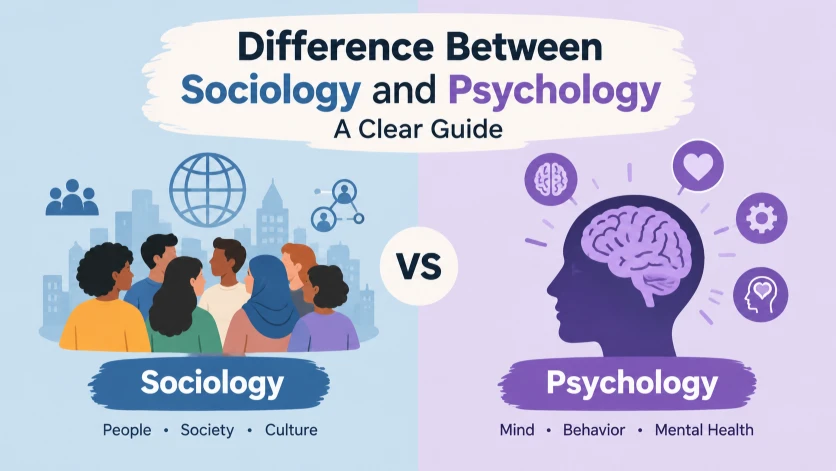
Sociology studies society, groups, and social behavior, while psychology focuses on the mind, emotions, and individual behavior.
Many people get confused about the difference between sociology and psychology because both subjects study people and human behavior.
The key difference is simple: psychology mainly studies individuals, while sociology studies people in groups, communities, and society. Understanding this difference helps students choose the right subject, understand careers, and know what each field actually studies.
In this guide, we will explain the difference between sociology and psychology, their similarities, real-world uses, and when each field is most useful.
Quick Answer: Difference Between Sociology and Psychology
Psychology focuses mainly on how an individual thinks, feels, and behaves. Sociology focuses on how groups, communities, institutions, and society influence people.
Example: A psychologist may study why one person feels anxious, while a sociologist may study why anxiety is becoming common in a particular community or social group.
Definition of Difference Between Sociology and Psychology
- Psychology: The scientific study of the mind, emotions, thoughts, and behavior of individuals.
- Sociology: The study of society, social relationships, groups, institutions, and patterns of human behavior.
In simple words, psychology looks more closely at the person, while sociology looks more closely at the social world around that person.
Pronunciation
- Sociology
- US: soh-see-OL-uh-jee
- UK: səʊ-si-OL-uh-jee
- Psychology
- US: sai-KOL-uh-jee
- UK: sai-KOL-uh-jee
The pronunciation is different, but the bigger difference is what each field tries to understand. Let’s look at that distinction more clearly.
What Is the Main Difference Between Sociology and Psychology?
The easiest way to remember the difference is to think about focus.
Psychology asks questions such as:
- Why does this person behave this way?
- How does memory work?
- Why do people experience certain emotions?
- How do thoughts affect behavior?
- What influences individual decision-making?
Sociology asks questions such as:
- Why do people behave differently in different groups?
- How does society influence behavior?
- Why do social trends spread?
- How do family, education, religion, work, or government affect people?
- Why do certain social problems affect some communities more than others?
So, psychology often moves from individual to behavior, while sociology often moves from society to social behavior.
A Simple Example
Imagine a teenager spends five hours every day on Instagram.
A psychologist might investigate:
How does social media use affect the teenager’s attention, emotions, self-image, or behavior?
A sociologist might investigate:
Why has heavy social media use become common among teenagers, and how do peer groups and social expectations influence it?
Both are studying the same situation, but they are asking different questions.
Difference Between Sociology and Psychology: Comparison
| Feature | Sociology | Psychology |
| Main focus | Society and social groups | Individual mind and behavior |
| Studies | Groups, communities, institutions | Thoughts, emotions, behavior |
| Main question | How does society influence people? | Why does an individual behave this way? |
| Common subjects | Culture, class, family, inequality | Memory, emotions, personality |
| Level of study | Social and group level | Individual level |
| Examples | Social media trends and communities | Effects of social media on one person’s emotions |
| Common research | Surveys, interviews, population studies | Experiments, assessments, observations |
| Career areas | Social research, policy, education | Counseling, research, mental health |
This comparison makes one thing clear: the two fields overlap, but their main level of analysis is different.
What Does Sociology Study?
Sociology examines how people live together and how social structures shape everyday life.
A sociologist may study:
- Families
- Schools
- Workplaces
- Social classes
- Communities
- Culture
- Religion
- Gender roles
- Social inequality
- Crime
- Education
- Politics
- Population changes
- Social movements
- Online communities
For example, suppose a company notices that employees from different social backgrounds have different experiences at work. A sociologist may study workplace culture, social class, organizational structure, and group relationships to understand the pattern.
This is why sociology is useful when the question involves groups, systems, communities, or society.
Sociology in Everyday Life
Sociology is not limited to universities. It can help explain why certain fashion trends become popular, why online communities develop their own language, or why people behave differently in different social settings.
Even platforms such as Instagram, YouTube, and other social networks can become subjects of sociological research because they create large social communities and influence how people interact.
What Does Psychology Study?
Psychology focuses more closely on the individual.
Psychologists study areas such as:
- Memory
- Learning
- Emotions
- Personality
- Motivation
- Perception
- Decision-making
- Human development
- Stress
- Mental processes
- Social behavior
- Individual differences
For example, imagine two students receive the same exam result. One feels motivated to work harder, while the other becomes discouraged.
A psychologist might ask why the same event produces different emotional and behavioral responses.
Psychology can also study how people learn, make decisions, form habits, interact with others, and respond to their surroundings.
Psychology in Everyday Life
Psychological ideas appear in education, workplaces, healthcare, sports, marketing, technology, and many other areas.
For instance, an app may use principles related to attention and user behavior when designing notifications. A teacher may use learning and memory principles to improve lessons.
The important point is that psychology does not only mean therapy. Mental processes and behavior are much broader than mental health alone.
Key Differences Explained Between Sociology and Psychology
1. Individual vs Society
This is the most important distinction.
Psychology usually focuses on the individual. Sociology usually focuses on groups and society.
Example:
Psychology may study why one employee feels stressed. Sociology may study why workplace stress is widespread across an industry.
2. Mind and Behavior vs Social Relationships
Psychology is strongly concerned with mental processes and individual behavior.
Sociology is strongly concerned with relationships between people and social structures.
Example:
A psychologist may study why a person avoids social situations. A sociologist may examine how social expectations influence participation in those situations.
3. Personal Experience vs Social Patterns
Psychology can examine personal experiences in detail.
Sociology looks for patterns across larger groups.
Example:
If one student drops out of college, psychology may explore personal motivation or emotional factors. If thousands of students from a particular background have higher dropout rates, sociology may investigate social and economic factors.
4. Internal Factors vs Social Factors
Psychology often examines factors such as thoughts, emotions, personality, and learning.
Sociology examines factors such as culture, social class, family structure, institutions, and community.
Neither approach is automatically better. They simply answer different questions.
5. Individual Decisions vs Group Behavior
Psychology can explain why an individual makes a particular decision.
Sociology can explore how social pressure, group norms, or cultural expectations influence decisions across a group.
6. Research Perspective
Psychological research may use experiments, assessments, observations, and controlled studies.
Sociological research may use surveys, interviews, demographic information, field research, and analysis of social patterns.
In real research, however, the methods can overlap. Neither field is limited to one research method.
7. Career Applications
Psychology can lead toward careers involving psychological research, counseling-related fields, education, organizational behavior, and human development.
Sociology can be useful in social research, public policy, community work, education, social services, and organizational research.
Career requirements vary by country and profession, so a degree title alone does not determine what someone is legally qualified to do.
What Are the Similarities Between Sociology and Psychology?
Although sociology and psychology are different, they share an important goal: understanding human behavior.
Both fields can:
- Study why people behave in certain ways.
- Use scientific research methods.
- Examine social behavior.
- Study how environments influence people.
- Use surveys and interviews.
- Help organizations understand people.
- Contribute to education and public policy.
- Explain patterns in human behavior.
Difference and Similarity Between Sociology and Psychology
| Feature | Sociology | Psychology | Similarity |
| Main focus | Society and groups | Individuals and mental processes | Both study people |
| Behavior | Social behavior and patterns | Individual behavior | Both explain behavior |
| Environment | Social environment | Personal and physical environment | Both consider surroundings |
| Research | Social research and population studies | Behavioral and psychological research | Both use research |
| Relationships | Groups and social structures | Individual relationships and behavior | Both examine interaction |
| Culture | Cultural patterns and norms | Cultural effects on individuals | Both recognize cultural influence |
| Real-world use | Society, policy, communities | Education, behavior, organizations | Both solve practical problems |
| Main perspective | Social level | Individual level | Both help explain human life |
This table clearly shows the difference and similarity between difference between sociology and psychology for quick understanding.
Can Sociology and Psychology Overlap?
Yes. In fact, some questions are difficult to understand using only one field.
Consider bullying.
A psychologist might study:
- Why does a student bully others?
- How does bullying affect the victim emotionally?
- What personality or behavioral factors are involved?
A sociologist might study:
- How does school culture affect bullying?
- How do peer groups encourage or discourage bullying?
- Why are bullying patterns different between communities?
Both perspectives provide useful information.
This overlap is especially important in areas such as social psychology, which examines how people’s thoughts and behavior are influenced by other people and social situations.
Why Do People Get Confused About Sociology and Psychology?
The confusion is understandable because both subjects use words such as behavior, society, relationships, culture, and human interaction.
Another reason is that everyday conversations often use “psychology” to describe almost anything related to people. At the same time, sociology is sometimes incorrectly reduced to simply “the study of society.”
The real distinction is more useful:
Psychology asks what is happening within or around an individual and how it affects behavior. Sociology asks how social relationships, groups, institutions, and structures shape behavior and society.
Media can also blur the difference. A YouTube video about personality might discuss social behavior, while an Instagram discussion about social trends might touch on psychological ideas.
The subjects overlap, but their central questions remain different.
Common Mistakes With Sociology and Psychology
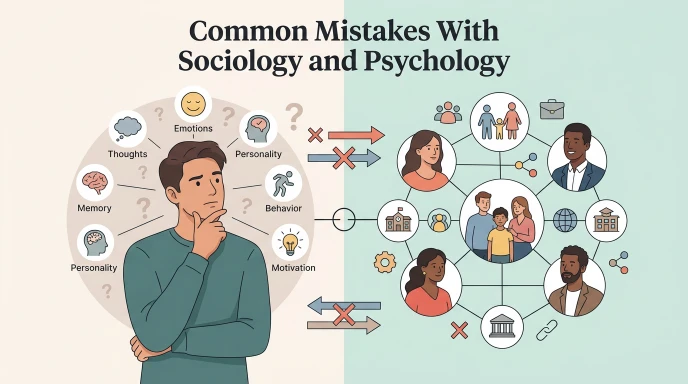
Mistake 1: Thinking Psychology Only Means Mental Health
Psychology includes mental health, but it also covers learning, memory, motivation, personality, perception, development, and behavior.
Fix: Think of psychology as the broader scientific study of mind and behavior.
Mistake 2: Thinking Sociology Only Studies Society in a General Way
Sociology examines specific social relationships, institutions, groups, patterns, and structures.
Fix: Look for the social forces behind individual and group behavior.
Mistake 3: Assuming Sociology and Psychology Are Opposites
They are not opposites.
Fix: Remember that they often study the same human problem from different levels.
Mistake 4: Assuming One Field Is More Scientific
Both can use systematic research methods and evidence.
Fix: Judge a study by its research design and evidence rather than the subject name alone.
Mistake 5: Thinking Every Personal Problem Is Psychological
Personal experiences can also be shaped by family, culture, economic conditions, education, workplace systems, and wider society.
Fix: Consider both individual and social factors when appropriate.
Real-Life Examples of Sociology and Psychology
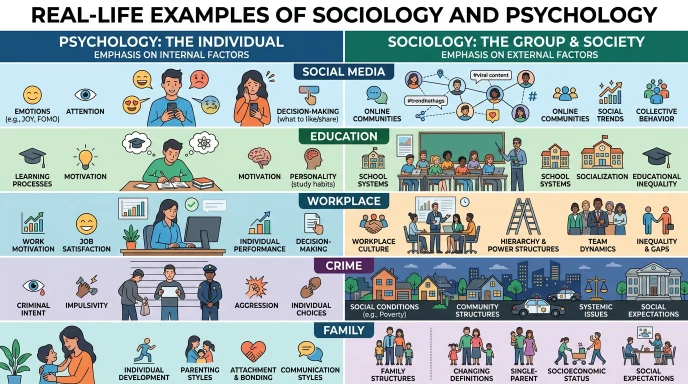
Example 1: Social Media
A psychologist may examine how scrolling affects attention, emotions, self-image, or individual behavior.
A sociologist may examine how social media creates communities, spreads trends, and changes social interaction.
Example 2: Education
Psychology can help explain how students learn, remember information, and stay motivated.
Sociology can examine how family background, school systems, social class, and educational inequality affect students.
Example 3: Workplace
Psychology may explore employee motivation, personality, stress, or decision-making.
Sociology may examine workplace culture, organizational hierarchy, teamwork, and inequality.
Example 4: Crime
Psychology may study individual behavior, decision-making, or behavioral factors related to crime.
Sociology may investigate poverty, social conditions, communities, institutions, and patterns of crime.
Example 5: Family
Psychology can explore attachment, development, communication, and individual emotions.
Sociology can study family structures, changing family roles, marriage patterns, and social expectations.
When Should You Use Sociology or Psychology?
A simple decision rule can help.
Choose Psychology When Your Question Is:
- Why does this person behave this way?
- How does memory work?
- Why does someone feel a certain emotion?
- How does personality affect behavior?
- How do people learn?
- How do thoughts influence decisions?
Choose Sociology When Your Question Is:
- Why does this happen across a group?
- How does society influence behavior?
- Why are social trends changing?
- How do institutions affect people?
- How does culture influence communities?
- Why does inequality exist between social groups?
Use Both When:
The problem involves both individual behavior and social conditions.
For example, unemployment can affect a person’s stress and motivation, which can be examined psychologically. At the same time, unemployment rates can be influenced by economic structures, education systems, and social conditions, which can be examined sociologically.
How Search Engines Understand Sociology and Psychology Queries
When someone searches Google for “difference between sociology and psychology,” the underlying intent is usually comparative and informational.
The searcher wants more than two dictionary definitions. They may also want to know:
- Which subject is easier?
- What is the difference between the two degrees?
- What careers can each subject lead to?
- Are sociology and psychology related?
- Which subject should a student choose?
- Can both subjects be studied together?
A useful page therefore needs to answer the core comparison first and then cover related questions naturally.
The same principle applies to searches on other platforms. Someone searching YouTube or Instagram may want a short visual explanation, while a student searching Google may need a detailed comparison for a course or assignment.
The important lesson is simple: answer the user’s real question, not just repeat the keyword.
Which Is Better: Sociology or Psychology?
There is no universal winner.
The better subject depends on what you want to understand.
Psychology may be a better fit if you are interested in individual behavior, mental processes, emotions, learning, personality, or human development.
Sociology may be a better fit if you are interested in society, culture, communities, social inequality, institutions, social change, or group behavior.
If you enjoy both, the subjects can complement each other extremely well.
A Quick Decision Trick
Ask yourself:
“Am I more interested in why one person behaves this way, or why many people behave this way within society?”
The first question points more toward psychology.
The second points more toward sociology.
Expert Insight: The Most Useful Way to Think About the Difference
A common beginner mistake is trying to memorize a single sentence such as “psychology studies individuals and sociology studies society.”
That sentence is useful, but it is not the whole story.
A stronger way to understand the difference is to think about levels of explanation.
Human behavior rarely has only one cause.
A person may feel stressed because of personal thoughts and coping patterns. At the same time, their stress may be connected to family expectations, workplace conditions, economic pressure, or cultural norms.
Psychology can help explain the individual side.
Sociology can help explain the social side.
In practical use, the strongest understanding often comes from asking both questions rather than forcing a complex human problem into one category.
Frequently Asked Questions
Which One Is Better, Psychology or Sociology?
Neither is automatically better. Psychology may be better if you are interested in the mind, emotions, and individual behavior, while sociology is a better fit if you want to study society, groups, culture, and social issues.
Who Gets Paid More, Sociology or Psychology?
Pay depends on the job, education, experience, and location. Psychology can lead to higher-paying specialized careers, especially with advanced qualifications, while sociology can also lead to well-paying careers in research, government, education, and social services.
Should I Take Psychology or Sociology First?
You can start with either subject. Choose psychology first if you are more interested in individual behavior and mental processes. Choose sociology first if you are more interested in society, culture, communities, and social structures.
Which Major Is Harder, Psychology or Sociology?
Both can be challenging in different ways. Psychology may involve research methods, statistics, and scientific study of behavior, while sociology often requires understanding theories, research, social patterns, and complex social issues.
Which Is More Easy, Sociology or Psychology?
Neither subject is universally easier. Sociology may feel easier for students who enjoy reading, writing, and discussing social issues, while psychology may feel easier for students who prefer studying individual behavior, experiments, and the mind.
What Jobs Can Sociology Get You?
A sociology degree can lead to jobs in social research, community services, government, education, human resources, public policy, nonprofit organizations, and market research. Some careers may require additional training or a graduate degree.
Conclusion
The difference between sociology and psychology becomes much easier to understand when you look at the level of focus. Psychology mainly examines the individual mind, emotions, mental processes, and behavior. Sociology mainly examines groups, social relationships, institutions, culture, and society.
The two fields are different, but they are closely connected. A person’s behavior can be influenced by personal thoughts and emotions while also being shaped by family, culture, economic conditions, education, and social expectations.
For a simple rule, remember this:
Psychology asks, “Why does this person behave this way?” Sociology asks, “How does society influence the way people behave?”
That distinction can help you understand academic subjects, choose courses, explore career options, and make sense of real-world behavior. When a problem involves both an individual and the society around them, using ideas from both fields can provide a much clearer picture.
READ MORE ABOUT!
- Difference Between Awhile and A While: Meaning and Usage
- Difference Between Sleet and Hail: A Simple Guide

I am Emily Johnson, a USA-based content writer who creates easy-to-read blogs on language and daily life topics. I explain complex ideas in simple English for students and beginners so they can understand easily.