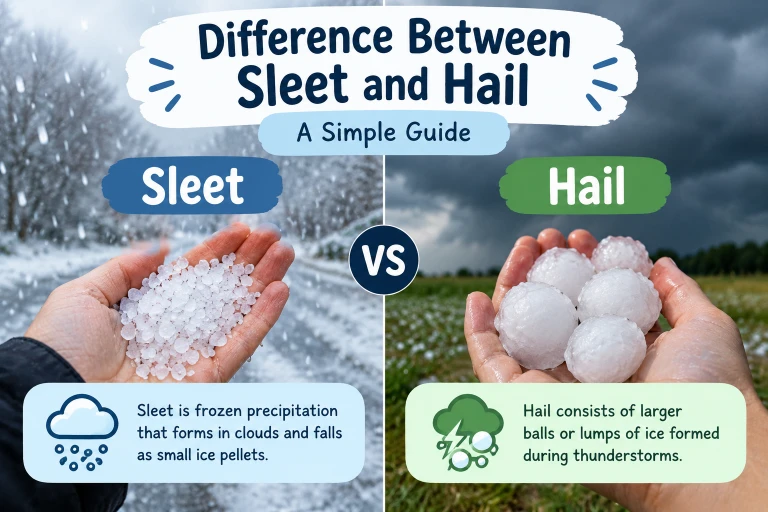
Sleet is frozen precipitation that forms in clouds and falls as small ice pellets, while hail consists of larger balls or lumps of ice formed during thunderstorms.
Have you ever looked outside during a storm and wondered if the small pieces of ice falling from the sky are sleet or hail? The difference between sleet and hail mainly comes down to how they form, where they develop in the atmosphere, and what they look like when they reach the ground.
In simple terms, sleet is usually made of small frozen or refrozen precipitation particles, while hail forms inside strong thunderstorms and grows into larger balls or lumps of ice.
Understanding the difference between sleet and hail can help you identify winter precipitation and severe weather more accurately. Let’s look at how each one forms, when it occurs, and why people often confuse them.
Quick Answer: Difference Between Sleet and Hail
Sleet is generally made of small ice pellets that form when falling precipitation freezes or refreezes before reaching the ground. Hail forms inside strong thunderstorms when powerful updrafts carry water droplets upward, allowing layers of ice to build around them.
Example: Tiny hard ice pellets falling during a winter storm are usually sleet, while larger chunks of ice falling during a summer thunderstorm are usually hail.
Important: The word sleet is used differently in different countries. In the United States, it usually means ice pellets. In the United Kingdom, sleet commonly refers to a mixture of rain and snow.
Definition of Difference Between Sleet and Hail
- Sleet: In U.S. weather terminology, sleet is small ice pellets produced when liquid precipitation freezes or refreezes before reaching the ground.
- Hail: Hail is solid ice that develops inside strong thunderstorms as water droplets are carried upward and freeze in layers.
The easiest way to remember it is: sleet is usually associated with cold winter weather, while hail is strongly associated with thunderstorms.
How Do You Pronounce Sleet and Hail?
The pronunciation is almost the same in both American and British English:
- Sleet: US /sliːt/ sounds like “sleet”
- Sleet: UK /sliːt/ sounds like “sleet”
- Hail: US /heɪl/ sounds like “hayl”
- Hail: UK /heɪl/ sounds like “hayl”
There is no major pronunciation difference between U.S. and U.K. English for these two words. The bigger difference is how sleet itself is defined, which is where many readers get confused.
What Is Sleet and How Does It Form?
Sleet is a type of frozen precipitation. In U.S. weather reports, it normally means small, hard ice pellets that reach the ground.
Sleet often begins as snow high in the atmosphere. As it falls, it can pass through a warmer layer of air and partially or completely melt. If it then enters a deeper layer of freezing air near the ground, the water refreezes into small ice pellets.
So the basic process looks like this:
Snow → warmer air → melting → freezing air → ice pellets → sleet
Sleet is usually small. The pellets can bounce when they hit roads, sidewalks, roofs, or cars.
Why Does Sleet Happen?
Sleet develops when the atmosphere contains different temperature layers. There needs to be enough warm air to melt falling snow, followed by cold air that allows the precipitation to freeze again before it reaches the surface.
This is why sleet is commonly associated with winter storms, freezing weather, and changing temperatures.
A useful clue is timing. If a winter storm changes from snow to rain and then produces tiny ice pellets, sleet may be involved.
What Is Hail and How Does It Form?
Hail is also made of ice, but its formation is very different.
Hail develops inside strong thunderstorms. These storms contain powerful upward-moving air called updrafts. The updraft can carry water droplets high into the storm where temperatures are below freezing.
The droplets freeze, and additional water can collect around the growing piece of ice. Strong updrafts can keep the developing hailstone suspended inside the storm long enough for it to grow.
The simplified process is:
Thunderstorm → strong updraft → water droplets rise → freezing → ice layers build → hail falls
Some hailstones are tiny, while severe thunderstorms can produce much larger stones.
This is why hail can sometimes damage cars, roofs, windows, crops, and other property.
Difference Between Sleet and Hail: Main Comparison
| Feature | Sleet | Hail |
| Basic meaning | Small frozen or refrozen precipitation pellets | Larger pieces or balls of ice formed in thunderstorms |
| Typical season | Mostly winter or cold-weather events | Most common during thunderstorms, often in warmer seasons |
| Main location of formation | Develops as precipitation moves through different air-temperature layers | Develops inside strong thunderstorm clouds |
| Main process | Snow or rain freezes or refreezes before reaching the ground | Ice grows through repeated freezing inside a thunderstorm |
| Typical size | Usually small ice pellets | Can range from small pieces to very large stones |
| Weather system | Winter storms and mixed-precipitation events | Strong thunderstorms |
| Appearance | Small, hard, often translucent or whitish pellets | Irregular or rounded chunks of layered ice |
| Can it bounce? | Yes | Yes |
| Main concern | Slippery roads and difficult travel | Property, crop, vehicle, and injury risks |
| Temperature pattern | Usually associated with freezing conditions near the surface | Can occur when the surface is warm |
The key difference is where and how the ice forms. Sleet develops through temperature changes in the atmosphere, while hail grows inside powerful thunderstorms.
Key Differences Explained Between Sleet and Hail
1. They Form in Different Ways
The biggest difference between sleet and hail is their formation process.
Sleet happens when precipitation freezes or refreezes while falling through layers of cold and warm air. Hail grows inside a thunderstorm as strong updrafts repeatedly lift water and ice.
Real-life example: A winter storm passing over a cold region may produce sleet. A hot afternoon followed by a severe thunderstorm may produce hail.
2. Sleet Is Usually Much Smaller
Sleet usually appears as small ice pellets. Hail can become much larger because the thunderstorm’s updraft can keep the developing ice suspended inside the cloud.
This gives hail more time to collect additional frozen layers.
Easy rule: Tiny ice pellets during a winter storm are more likely to be sleet. Larger chunks of ice during a thunderstorm are more likely to be hail.
3. Hail Needs a Strong Thunderstorm
Hail is closely connected with cumulonimbus thunderstorms and strong updrafts.
Sleet does not require a thunderstorm. It can happen during an ordinary winter precipitation system when the temperature profile is right.
This is one of the easiest ways to tell them apart.
4. They Usually Occur in Different Weather Conditions
Sleet is most often associated with cold-weather precipitation.
Hail is generally associated with thunderstorms, which can occur during relatively warm or hot weather.
That means you should not assume every piece of falling ice is the same type of precipitation.
5. Their Appearance Is Different
Sleet often looks like small, hard pellets. It may be clear, cloudy, or whitish.
Hail often looks like irregular balls or lumps of ice. Larger hailstones can show visible layers, cracks, or a rough surface.
A freshly fallen hailstone may also look very different from a small sleet pellet.
6. Their Weather Risks Are Different
Sleet’s biggest practical problem is often travel safety. A layer of ice pellets can make roads, sidewalks, and bridges slippery.
Hail can create more direct physical damage. Large hail can break windows, damage roofs, harm crops, and dent vehicles.
So the weather warning matters for different reasons.
7. They Have Different Atmospheric Requirements
Sleet depends heavily on the temperature structure between the cloud and the ground.
Hail depends heavily on the strength of a thunderstorm’s updrafts and the availability of supercooled water inside the storm.
This is the deeper scientific difference that is easy to miss in a basic definition.
8. Sleet and Hail Are Not Simply “Small Hail” and “Big Hail”
This is a common misunderstanding.
Sleet is not simply tiny hail. The two particles form through different atmospheric processes.
Even if they look similar after reaching the ground, their origins are different.
Sleet vs. Hail: Similarities and Differences
| Feature | Sleet | Hail | Similarity |
| Made of ice | Small ice pellets | Solid ice stones or chunks | Both contain frozen water |
| Falls from clouds | Yes | Yes | Both are forms of precipitation |
| Can bounce | Often | Often | Both can bounce on hard surfaces |
| Can be white or clear | Yes | Yes | Their appearance can overlap |
| Can affect travel | Yes | Sometimes | Both can create hazardous conditions |
| Can accumulate | Yes | Yes | Both may build up on the ground |
| Related to freezing | Yes | Yes | Both involve water freezing |
| Formation process | Refreezing or freezing precipitation | Growth inside thunderstorms | Both require ice formation |
This table clearly shows the difference and similarity between sleet and hail for quick understanding.
Is Sleet the Same as Hail?
No. Sleet and hail are not the same type of precipitation.
The confusion happens because both can look like small pieces of ice and both can bounce after hitting the ground.
The important distinction is their origin. In U.S. meteorology, sleet forms when precipitation freezes or refreezes while falling through suitable temperature layers. Hail develops inside thunderstorms and grows through repeated freezing and collection of water.
So even when they look similar, they are produced by different weather processes.
What Is the Difference Between Sleet, Hail, and Freezing Rain?
These three forms of precipitation are often confused.
- Sleet: Falls as small ice pellets.
- Hail: Falls as larger pieces of ice formed inside thunderstorms.
- Freezing rain: Falls as liquid rain but freezes when it touches a surface that is at or below freezing.
The easiest way to remember them is:
Sleet freezes before reaching the ground.
Freezing rain freezes when it reaches the ground.
Hail grows inside a thunderstorm.
This distinction is especially useful when reading winter weather forecasts.
Why Does Sleet Happen During Winter Storms?
Sleet happens because the atmosphere is not always the same temperature from the cloud to the ground.
Imagine several invisible layers:
- Snow begins high in a cold cloud.
- It falls into warmer air.
- Some or all of it melts.
- It then enters colder air.
- The melted precipitation freezes again.
- Small ice pellets reach the ground.
This temperature layering is the key.
A storm can therefore produce snow in one location, sleet in another, and rain farther away.
That is why winter precipitation can change quickly over relatively short distances.
Why Does Hail Fall During Thunderstorms?
Hail forms when a thunderstorm has strong enough upward-moving air to keep water droplets and ice particles suspended.
Inside the storm, water can remain liquid even when the surrounding temperature is below freezing. These droplets can freeze onto existing ice particles.
As the hailstone moves through different parts of the cloud, additional layers can form.
Eventually, the hailstone becomes too heavy for the updraft to support it and falls toward the ground.
This explains why hail is often associated with strong or severe thunderstorms rather than ordinary rain showers.
What Does Sleet Look Like?
Sleet usually looks like:
- Tiny ice pellets
- Small white or translucent grains
- Hard particles that bounce when they hit surfaces
- Ice pieces that can accumulate on roads and sidewalks
Sleet is generally much smaller than the type of hail that people notice during severe thunderstorms.
However, visual identification is not always perfect. Weather conditions and lighting can make different types of precipitation look surprisingly similar.
What Does Hail Look Like?
Hail can appear as:
- Round or irregular ice stones
- White or translucent chunks
- Layered pieces of ice
- Small pellets during weak storms
- Large stones during powerful thunderstorms
Some large hailstones have visible rings or layers when cut open. These layers reflect repeated growth inside the storm.
Common Mistakes With Difference Between Sleet and Hail
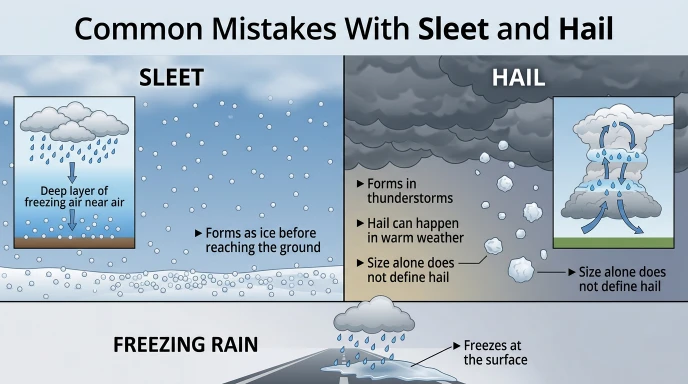
Mistake 1: Calling Every Ice Pellet Hail
Not every piece of ice falling from the sky is hail.
Fix: Consider the weather system. Winter precipitation with tiny pellets is more likely to be sleet, while ice falling from a thunderstorm is more likely to be hail.
Mistake 2: Thinking Sleet Is Frozen Rain in Every Country
Weather terminology changes by region.
Fix: Check the local definition. In the U.S., sleet usually means ice pellets. In the U.K., sleet commonly describes a mixture of rain and snow.
Mistake 3: Assuming Hail Only Happens in Winter
Hail is strongly associated with thunderstorms and can occur during warm seasons.
Fix: Look at the storm type rather than simply the temperature outside.
Mistake 4: Thinking Big Sleet Is Hail
Size alone is not enough to determine how the ice formed.
Fix: Consider both the particle’s appearance and the weather conditions that produced it.
Mistake 5: Confusing Sleet With Freezing Rain
Freezing rain is liquid when it falls and freezes when it contacts a cold surface.
Fix: Remember where the freezing occurs: before reaching the ground for sleet, and at the surface for freezing rain.
Real-Life Examples of Sleet and Hail
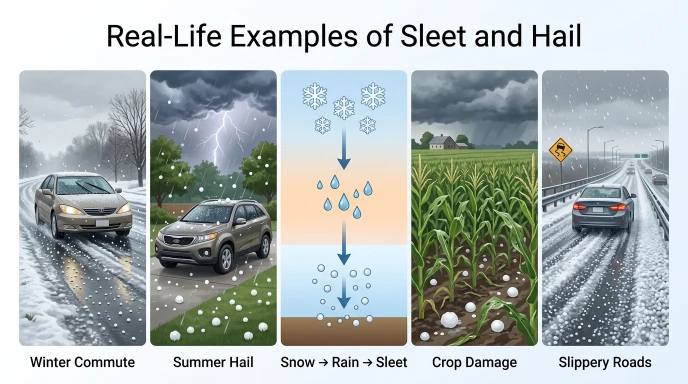
Example 1: A Winter Commute
You are driving during a winter storm. Instead of snowflakes, small hard pellets begin hitting the windshield and bouncing off the road.
That is likely sleet in U.S. terminology.
The main concern is slippery road conditions.
Example 2: A Summer Thunderstorm
It is a warm afternoon. Dark storm clouds develop, thunder begins, and pieces of ice start falling from the sky.
That is likely hail.
The main concern may include damage to vehicles, windows, roofs, and crops.
Example 3: Changing Winter Precipitation
A forecast starts with snow, changes to rain, and later produces ice pellets.
This can happen when the temperature layers in the atmosphere change during the storm.
The precipitation type can change even though the storm itself continues.
Example 4: Agricultural Damage
A strong thunderstorm produces large hail over farmland. The ice damages leaves, fruit, and other crops.
This is one reason hail is important to farmers and weather forecasters.
Example 5: Road Safety
A winter storm produces sleet that accumulates on bridges and roads.
Even though the ice pellets are small, they can create dangerous driving conditions.
This shows why particle size does not always determine the seriousness of a weather event.
When Should You Expect Sleet?
Sleet is more likely when:
- Temperatures are close to freezing.
- A winter storm is moving through the area.
- Snow melts in a warm layer and refreezes below it.
- Weather conditions are changing between snow and rain.
- A forecast calls for mixed winter precipitation.
If you see small ice pellets during a cold-weather storm, sleet is a strong possibility.
When Should You Expect Hail?
Hail is more likely when:
- A strong thunderstorm develops.
- There are powerful updrafts.
- Thunderstorm clouds become highly developed.
- Weather conditions support severe convection.
- A weather service issues a hail or severe thunderstorm warning.
Hail does not require freezing temperatures at the ground. The important freezing processes happen inside the storm cloud.
Why Do People Get Confused About Sleet and Hail?
There are several reasons.
First, both are made of ice. Second, both can bounce when they hit the ground. Third, small hail and sleet can look surprisingly similar.
Language also adds another layer of confusion.
The word sleet does not mean exactly the same thing everywhere. American weather terminology generally uses sleet for ice pellets. British English commonly uses sleet for a mixture of rain and snow.
Media reports, weather apps, international websites, and social media can expose readers to both definitions.
So when comparing the difference between sleet and hail, always consider the regional weather terminology being used.
How Search Engines Understand “Difference Between Sleet and Hail”
Search engines such as Google interpret comparison queries by looking beyond the exact words typed into the search box.
Someone searching for “difference between sleet and hail” usually wants several related answers:
- What is sleet?
- What is hail?
- How does sleet form?
- How does hail form?
- Is sleet the same as hail?
- Which one occurs during thunderstorms?
- What is the difference between sleet and freezing rain?
- Why do they look similar?
That means a useful comparison page should not simply provide a two-sentence definition.
It should explain the formation process, appearance, temperature conditions, weather systems, risks, and real-world examples.
The same principle applies to Google results, weather websites, and weather apps. Users want an answer that resolves their confusion quickly and then provides enough detail to understand the science.
Expert Insight: The Best Way to Tell Sleet and Hail Apart
A practical way to distinguish them is to look at the weather situation first, not just the ice itself.
If small ice pellets are falling during a winter storm, sleet is a reasonable explanation in U.S. terminology.
If ice is falling from a strong thunderstorm during warm weather, hail is much more likely.
The deeper scientific clue is the formation process. Sleet depends on the vertical temperature structure of the atmosphere. Hail depends on strong thunderstorm dynamics, especially powerful updrafts and freezing processes inside the storm.
Another important expert-level point is that surface temperature alone cannot identify hail. A warm day can still produce hail because hail forms high inside the thunderstorm where temperatures are much colder.
For beginners, the simplest memory trick is:
Sleet = winter ice pellets.
Hail = thunderstorm ice.
That shortcut is not a complete meteorological explanation, but it works well for everyday identification.
Frequently Asked Questions
Is Sleet Snow or Hail?
Sleet is not hail. It is made of small ice pellets that form when raindrops or melted snow refreeze before reaching the ground. Hail forms inside thunderstorms and usually grows larger in strong updrafts.
Is Sleet Frozen Rain?
Yes, sleet can be described as frozen rain, although it can also form from partially melted snow that refreezes. Sleet reaches the ground as small, hard ice pellets.
Can It Hail in the Winter?
Yes, hail can occur in winter if thunderstorms and the right atmospheric conditions develop. Hail is not limited to warm seasons.
Which Is Bigger, Hail or Sleet?
Hail is usually much bigger than sleet. Sleet is generally small, while hail can range from pea-sized pieces to much larger chunks of ice.
Are Hail and Sleet the Same?
No. Sleet is small ice pellets that fall from winter clouds, while hail is larger ice that forms inside thunderstorms. Their formation and typical size are different.
What Is a Mix of Snow and Hail Called?
A mixture of snow and hail does not have one universal name. Depending on the weather conditions, people may describe it as wintry precipitation, snow pellets, or graupel. Graupel is soft, small ice formed when supercooled water freezes onto snowflakes.
Conclusion
The difference between sleet and hail is mainly about how and where the ice forms. Sleet, in U.S. weather terminology, consists of small ice pellets that form when precipitation freezes or refreezes while falling through different temperature layers. Hail forms inside strong thunderstorms, where powerful updrafts carry water droplets and ice upward and allow layers of ice to build.
Sleet is most commonly associated with winter storms and mixed precipitation, while hail is associated with thunderstorms and can occur even when the weather feels warm at ground level. Hail can also become much larger than sleet and may damage cars, roofs, windows, and crops.
The confusion is understandable because both types of precipitation contain ice and can bounce after hitting the ground. Regional language makes it even trickier because sleet has a different common meaning in the U.K. than it does in the U.S.
In simple words: sleet is usually small ice pellets from cold-weather precipitation, while hail is thunderstorm-grown ice. Once you understand their formation, telling the two apart becomes much easier.
READ MORE ABOUT!
- Difference Between Therapist and Counselor: Easy Guide
- Difference Between Aspirin and Ibuprofen: Uses and Risks

I am Emily Johnson, a USA-based content writer who creates easy-to-read blogs on language and daily life topics. I explain complex ideas in simple English for students and beginners so they can understand easily.