Many users get confused about the difference between bring and take because both words describe moving something or someone from one place to another.
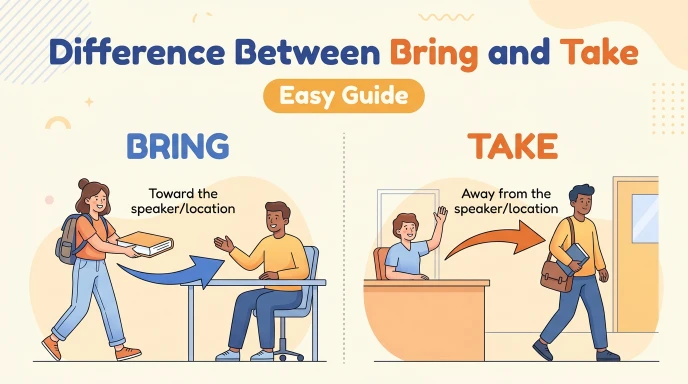
The key is direction: bring usually means moving something toward the speaker, listener, or a specific destination, while take means moving it away.
This guide explains how to use bring and take correctly, with simple examples, common mistakes, and real-life situations.
Quick Answer: Difference Between Bring and Take
Bring means to move something toward a person or place. Take means to move something away from the current speaker or reference point.
Example: “Bring your laptop to the meeting” means carry it to the meeting. “Take your laptop home” means carry it away from the meeting.
Definition of Difference Between Bring and Take
- Bring: To carry, move, or accompany someone or something toward the speaker, listener, or another relevant destination.
- Take: To carry, move, or accompany someone or something away from the speaker or current reference point.
In simple words: bring = move here/there toward the relevant point; take = move away from the relevant point.
Pronunciation
- Bring
- US: /brɪŋ/
- UK: /brɪŋ/
- Take
- US: /teɪk/
- UK: /teɪk/
The pronunciation is the same in American and British English, so the real challenge is not how these words sound. It is understanding which direction the action moves.
What Is the Difference Between Bring and Take?
The easiest way to understand the difference is to imagine a reference point.
When something moves toward that point, use bring. When it moves away from that point, use take.
| Situation | Correct Word | Example |
| Moving something toward you | Bring | “Bring me a glass of water.” |
| Moving something toward another person | Bring | “Bring the documents to Sarah.” |
| Moving something away from you | Take | “Take these books to the library.” |
| Carrying something somewhere else | Take | “Take your bag upstairs.” |
| Asking someone to come with something | Bring | “Bring your camera to the party.” |
| Asking someone to leave with something | Take | “Take your umbrella with you.” |
| Moving an object to a destination | Depends on reference point | “Bring it to my office” / “Take it to the office.” |
| Moving a person toward a place connected to the speaker | Bring | “Bring your brother to dinner.” |
The important point is that bring and take are not simply synonyms for “carry.” Their meaning depends on the direction of movement.
Bring vs. Take: How Does Direction Change the Meaning?
Think about where the speaker is mentally standing.
Bring = Toward the Reference Point
Suppose you are at home and your friend is going to a store.
You might say:
“Can you bring me some milk?”
The milk is moving toward you, so bring works.
Take = Away From the Reference Point
Now imagine you are holding a package and asking your friend to deliver it somewhere else.
You might say:
“Please take this package to the post office.”
The package is moving away from you, so take is correct.
A Simple Memory Trick
Bring = come with it.
Take = go with it.
This is not a perfect rule for every sentence, but it works well for everyday conversations.
Difference Between Bring and Take in Everyday English
The words become much easier when you see them in normal conversations.
At Home
“Please bring me my phone.”
You are asking someone to move the phone toward you.
“Please take these dishes to the kitchen.”
The dishes are moving away from the current location.
At Work
“Can you bring the report to my office?”
The report is coming toward the speaker.
“Can you take these documents to the manager?”
The documents are leaving the speaker’s current location.
At School
“Please bring your textbook tomorrow.”
The student should have the textbook with them when arriving at school.
“Please take your books home.”
The books are moving from school to home.
Bring or Take to a Party?
This is a common point of confusion.
If you are inviting someone to your party, you might say:
“Please bring a dessert.”
The dessert is coming to the party, which is the destination you are focusing on.
But if you are already at the party and tell someone:
“You can take the leftovers home.”
The leftovers are moving away from the party.
So the same object can use bring or take depending on the direction.
Bring vs. Take: Similarities and Differences
| Feature | Bring | Take | Similarity |
| Basic meaning | Move something toward a reference point | Move something away from a reference point | Both describe movement |
| Direction | Toward | Away | Both involve carrying or moving |
| Common use | “Bring it here.” | “Take it there.” | Both are common everyday verbs |
| People | “Bring your friend.” | “Take your friend home.” | Both can describe moving people |
| Objects | “Bring your bag.” | “Take your bag.” | Both can describe objects |
| Destination | Focuses on arrival at a relevant point | Focuses on departure or movement elsewhere | Both can involve destinations |
| Conversation | Often connected to coming | Often connected to going | Both depend on context |
| Past tense | Brought | Took | Both are irregular verbs |
This table clearly shows the difference and similarity between bring and take for quick understanding.
Key Differences Explained Between Bring and Take
1. Bring Usually Means Movement Toward a Reference Point
Use bring when something or someone is moving toward the person, place, or situation being treated as the reference point.
Example:
“Bring your notes to my office.”
The notes are coming toward the speaker’s office.
This is why bring commonly appears with phrases such as “here,” “to me,” “to us,” or a destination connected to the speaker.
2. Take Usually Means Movement Away
Use take when something or someone moves away from the speaker or another reference point.
Example:
“Take these files to the accounting department.”
The files are leaving the speaker’s current location.
The important question is not simply “Where is the object going?” Ask instead:
“Where is the object going in relation to the reference point?”
3. The Same Object Can Use Both Words
This is one of the most useful ways to understand the difference.
Imagine a laptop.
At home:
“Take your laptop to work.”
At work:
“Bring your laptop to the meeting.”
The laptop has not changed. The reference point has changed.
That is why memorizing fixed rules such as “bring means here and take means there” can sometimes create confusion.
4. Bring Can Refer to a Person
Bring is not only for physical objects.
You can say:
“Bring your sister to dinner.”
This means your sister should come to the dinner with you.
You can also say:
“Please bring your manager to the meeting.”
The person is being moved or accompanied toward the relevant event or location.
5. Take Can Also Refer to People
Take works naturally when someone accompanies or transports another person away from the current point.
“I’ll take my son to school.”
The speaker will go with the child from the current location toward school.
Another example:
“Can you take Grandma home?”
The person is being accompanied or transported toward another destination.
How Do You Know If to Use Bring or Take?
When you are unsure, use this three-step test:
Step 1: Find the Reference Point
Ask:
Where is the important person or place in this conversation?
It might be the speaker, listener, home, office, party, or another destination.
Step 2: Check the Direction
Is the person or object moving toward that point?
Use bring.
Is it moving away from that point?
Use take.
Step 3: Read the Whole Situation
Sometimes the destination changes the natural choice.
Compare:
“Bring the documents to me.”
and
“Take the documents to John.”
The first focuses on movement toward the speaker. The second focuses on moving the documents elsewhere.
Common Mistakes With Bring and Take
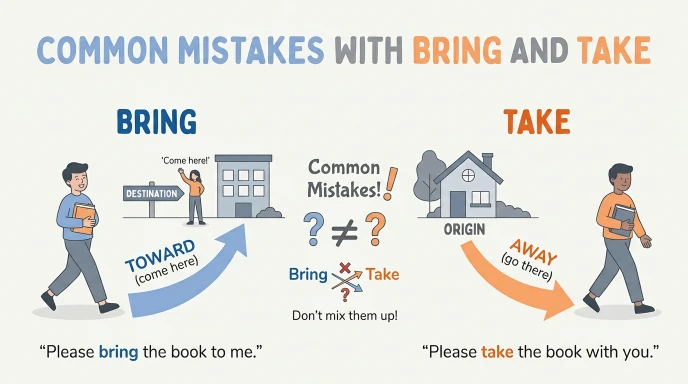
Many beginners understand the basic definitions but still make mistakes in conversation.
Mistake 1: Treating Bring and Take as Exact Synonyms
Incorrect thinking:
“They both mean carry, so either word is fine.”
They both can involve carrying, but the direction differs.
Fix: Identify the reference point before choosing the verb.
Mistake 2: Always Thinking Bring Means “Here”
“Here” is a useful shortcut, but it does not explain every situation.
For example:
“Bring your documents to the meeting.”
The speaker may not personally be at the meeting. The meeting itself is the relevant destination.
Fix: Think about the broader context, not only physical distance.
Mistake 3: Always Using Take for a Destination
A destination does not automatically require take.
“Bring your ID to the appointment.”
This is completely natural because the appointment is the relevant destination.
Mistake 4: Confusing the Speaker’s Location With the Important Destination
The speaker is not always the reference point.
For example:
“Please bring your passport to the interview.”
The interview is the important destination.
Fix: Consider what event or place the conversation is centered around.
Mistake 5: Changing the Verb Without Changing the Context
Compare:
“Bring the book to the library.”
and
“Take the book to the library.”
Both can be possible depending on the speaker’s perspective.
The surrounding context determines which sounds natural.
Real-Life Examples of Bring and Take
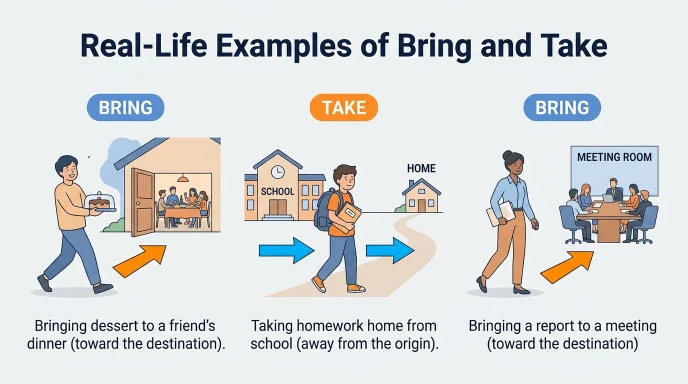
Example 1: Visiting a Friend
Your friend is hosting dinner.
You text:
“What should I bring?”
Here, bring means carry something to the friend’s place.
Your friend might reply:
“Bring some dessert.”
The dessert is coming to the gathering.
Example 2: Leaving the Office
You are leaving work and your coworker says:
“Take these files with you.”
The files are leaving the office with you.
So take is appropriate.
Example 3: Going to School
A parent says:
“Bring your homework tomorrow.”
The student should arrive with the homework.
Later, the teacher might say:
“Take your homework home.”
The homework is moving away from school.
Example 4: Business Meeting
A manager tells an employee:
“Bring the sales report to the meeting.”
The report needs to arrive at the meeting.
Afterward:
“Take these documents back to your department.”
The documents are leaving the meeting.
Example 5: Going on Vacation
Someone says:
“Don’t forget to bring your passport.”
The passport needs to be with the traveler at the relevant destination.
At the airport, someone might say:
“Take your boarding pass with you.”
The boarding pass travels with the person.
When Should You Use Bring and Take?
Use bring when:
- Something is coming toward the speaker.
- Something is coming toward the listener.
- Something is being carried to an important event.
- Someone is asked to arrive with an object.
- A person is being accompanied toward the relevant destination.
Example:
“Bring your ID to the appointment.”
Use take when:
- Something is moving away from the speaker.
- Someone is carrying something somewhere else.
- A person is accompanying another person to another destination.
- An object is being removed from the current location.
Example:
“Take these boxes to the garage.”
Why Do People Get Confused About Bring and Take?
The confusion exists because English does not always describe movement from a fixed physical location.
The reference point can change.
Imagine three people:
- You are at home.
- Your friend is at work.
- Your brother is going to the airport.
You might tell your brother:
“Take your suitcase to the airport.”
But if you are already at the airport and your brother is coming there, you could say:
“Bring your suitcase.”
The suitcase is identical. The destination may even be identical. What changes is the perspective of the speaker and the conversation.
This is why native speakers often choose bring or take based on context rather than following a single mechanical rule.
Is “Bring” More Common Than “Take”?
Neither word is simply the “correct” or more useful choice. Both are common English verbs with different directional meanings.
You will encounter them in:
- Everyday conversation
- Text messages
- Workplace communication
- School instructions
- Travel conversations
- Customer service
- Social media posts
- Instructions and announcements
Platforms such as Instagram, YouTube, and Meta’s social products may contain informal examples of both words, but the grammatical distinction remains the same. Social media does not create a different basic rule for bring and take.
How Do Search Engines Understand Bring and Take?
Search engines such as Google can connect a query like “difference between bring and take” with related searches such as:
- bring vs take
- bring or take
- when to use bring and take
- bring and take examples
- bring vs take grammar
- what is the difference between bring and take
- how to use bring and take correctly
These searches have the same broad informational intent: the reader wants to understand direction, context, and correct usage.
That is why a useful explanation should do more than give dictionary definitions. Real examples show how the verbs work in actual conversations.
Expert Insight: The Reference Point Matters More Than “Here” and “There”
A useful way to teach this distinction is to stop thinking only in terms of here versus there.
Instead, think about the reference point.
That point can be:
- The speaker
- The listener
- A home
- An office
- A meeting
- A party
- A future event
- Another person
This explains why both of these sentences can be natural:
“Bring your laptop to the conference.”
“Take your laptop to the conference.”
The first can treat the conference as the relevant destination or shared event. The second can emphasize moving the laptop away from the current location.
In practical use, context often matters more than a memorized one-word rule.
Bring and Take in American and British English
The basic distinction between bring and take exists in both American and British English.
British English may have different vocabulary choices in some situations, but the core directional distinction remains familiar.
For example:
“Bring it here.”
and
“Take it there.”
work naturally in both varieties.
Regional differences can affect individual expressions, but they do not remove the basic meaning of these two verbs.
Frequently Asked Questions
How to Correctly Use Bring and Take?
Use bring when something moves toward the speaker or the destination being discussed. Use take when something moves away from the speaker or to another place.
- Bring: Please bring your book to class.
- Take: Please take this book to the library.
Is It “Take Me Home” or “Bring Me Home”?
“Take me home” is the usual expression when asking someone to accompany you home. “Bring me home” can also be correct when the speaker focuses on arriving home as the destination, especially from the perspective of someone already there.
- Take me home: I am in a car and ask the driver to take me home.
- Bring me home: Someone at home asks another person to bring me home.
Where Do We Use Bring?
Use bring when moving something or someone toward the speaker, listener, or a specific destination that is the focus of the conversation.
- Please bring your laptop to the meeting.
- Can you bring me a glass of water?
- She brought her friend to my house.
When Should You Use Take in a Sentence?
Use take when carrying, moving, or accompanying someone or something away from the current place or toward another destination.
- Please take these bags upstairs.
- I take my children to school every morning.
- He took his dog to the park.
Why Do Americans Say Bring Instead of Take?
Americans use both bring and take. The choice depends on the speaker’s point of view and the destination. For example, someone hosting a party might say, “Bring a dessert,” because the food is coming to the party. Someone leaving the party might say, “Take some dessert home,” because the food is going away with the guest.
Conclusion
The difference between bring and take becomes much easier when you focus on direction and context. Bring generally describes movement toward a person, listener, place, event, or other relevant reference point. Take generally describes movement away from that reference point.
For example, “Bring your documents to the meeting” focuses on getting the documents to the meeting, while “Take these documents home” focuses on moving them away from the current location.
The biggest mistake is trying to memorize bring = here and take = there as an absolute rule. Those shortcuts help beginners, but real English depends on the reference point and the situation. Once you ask, “Is this moving toward or away from the important point?”, choosing the correct verb becomes much more natural.
READ MORE ABOUT!
- Difference Between Borrow and Lend: Simple Guide
- Difference Between Estar and Ser: Easy Spanish Guide

I am Emily Johnson, a USA-based content writer who creates easy-to-read blogs on language and daily life topics. I explain complex ideas in simple English for students and beginners so they can understand easily.