Between is usually used for two people or things considered individually, while among is used for people or things within a group.
Many English learners get confused about the difference between among and between because both words describe relationships or positions involving people or things.Between is usually used for two people or things considered individually, while among is used for people or things within a group.
Many English learners get confused about the difference between among and between because both words describe relationships or positions involving people or things.
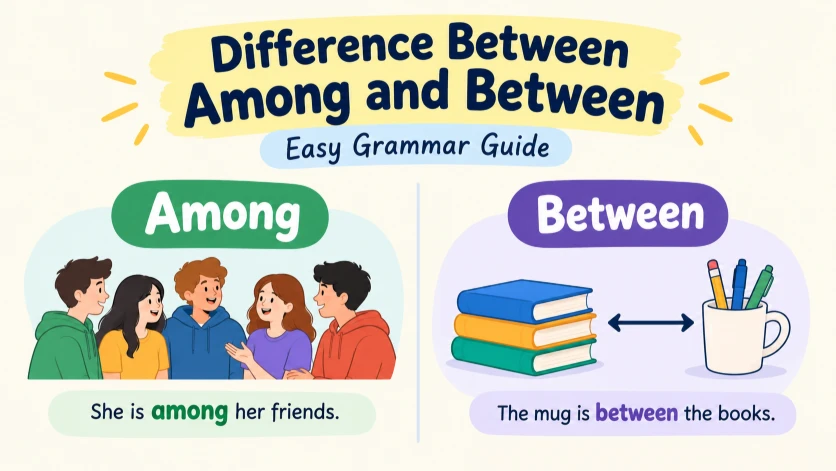
In simple terms, between usually focuses on separate people or things, while among describes someone or something within a group. Understanding this difference between among and between makes everyday English much clearer.
This guide explains what each word means, how to use it, when to choose one over the other, and the common mistakes to avoid.
Quick Answer: Difference Between Among and Between
Between is commonly used when talking about separate people, places, or things, especially when their individual relationships matter. Among is generally used when someone or something is surrounded by, included in, or part of a group.
Example:
- The agreement was between Sarah and John.
- Sarah was standing among her friends.
Definition of Among and Between
- Between: Used to describe a relationship, position, or choice involving separate people or things.
- Among: Used when someone or something is within, surrounded by, or part of a group.
For example, “The secret stayed between the two friends,” but “She felt comfortable among her classmates.”
Pronunciation
Among
- US: /ə-MUNG/
- UK: /ə-MUNG/
Between
- US: /bih-TWEEN/
- UK: /bih-TWEEN/
The pronunciation is fairly similar in American and British English, so the real challenge is not saying these words. It is knowing which word fits the relationship you want to describe.
What Is the Main Difference Between Among and Between?
The easiest way to understand the difference between among and between is to look at focus.
Between often highlights distinct individuals, objects, locations, or choices. It makes the relationship between those separate elements clear.
Among focuses more on a group or surrounding environment. The individual members may not be the main point.
Compare these sentences:
- The money was divided between Anna and Lisa.
- Anna was sitting among her classmates.
In the first sentence, two specific people are involved. In the second, Anna is part of a larger group.
However, there is an important grammar detail: between is not limited to exactly two things. It can also be used with three or more clearly identified people or things when the relationship between the individual items matters.
For example:
The negotiations took place between the United States, Canada, and Mexico.
Here, each participant has a distinct relationship with the others.
So the old rule “between = two, among = three or more” is useful for beginners, but it is not always accurate.
Among vs. Between: Comparison
| Feature | Between | Among | Similarity |
| Basic meaning | Shows a relationship between separate elements | Shows something within or surrounded by a group | Both describe relationships or positions |
| Typical focus | Individual people or things | A group or collection | Both connect one thing with others |
| Number | Often two, but can be more | Usually three or more in a group | Number alone does not always decide usage |
| Common context | Choices, agreements, comparisons, locations | Groups, crowds, communities, surroundings | Both are common in everyday English |
| Example | Choose between tea and coffee | She sat among her friends | Both can describe choices or positions |
| Style | Often more specific | Often more collective | Both work in formal and informal English |
| Relationship | Individual relationships are important | Group membership is important | Both show how things relate |
| Key question | “What separate things are involved?” | “What group is this within?” | Both require attention to context |
This table clearly shows the difference and similarity between among and between for quick understanding.
1. Does Between Always Mean Two?
No. This is one of the most common grammar myths.
Many beginners learn this rule:
Between = two
Among = three or more
That rule works for many simple examples, but it does not cover all correct English usage.
Between can refer to more than two distinct people or things when they are considered individually.
Example
The competition was between three major companies.
The companies are separate participants, so between works naturally.
Another example:
The agreement was negotiated between France, Germany, and Italy.
Each country is a distinct participant in the relationship.
Simple rule
Use between when the separate relationships or individual participants are important.
2. When Should You Use Among?
Use among when something is located within a group or surrounded by several people or things.
Examples
- She was walking among the trees.
- He found his wallet among the clothes.
- The teacher moved among the students.
- There was excitement among the crowd.
The focus is not on a specific relationship between individual members. Instead, the person or object is within the group.
Think of among as having a “within the group” feeling.
Easy test
Ask:
“Is something surrounded by or included in a group?”
If yes, among may be the natural choice.
3. When Should You Use Between?
Use between when you want to identify a relationship involving distinct people, objects, places, or choices.
Examples
- The discussion was between two managers.
- The road runs between the two buildings.
- You must choose between these options.
- There is a strong connection between exercise and sleep.
Notice how the individual elements remain clear.
This is why between is common in comparisons, negotiations, choices, agreements, and relationships.
4. How Do You Use Among and Between in Real Sentences?
Context makes the difference much easier to see.
People
The conversation was between James and Maria.
The two people are clearly identified.
Maria felt relaxed among her friends.
The focus is Maria’s place within a group.
Objects
The store is between the bank and the library.
Two distinct locations are identified.
A small café was hidden among the old buildings.
The café is surrounded by a collection of buildings.
Choices
I had to choose between three job offers.
The individual offers are clearly separate choices.
You could also say:
The decision was made among the team members.
Here, among focuses on the group involved in the decision.
5. Why Do People Get Confused About Among and Between?
The confusion mostly comes from oversimplified grammar rules.
Students often memorize:
two = between
three or more = among
This shortcut is helpful when learning basic English, but English usage depends on meaning and relationship, not simply counting nouns.
Compare:
The money was divided between the three children.
This can be correct because the three children are being treated as separate recipients.
Now compare:
The children were playing among the trees.
Here, the children are located within a surrounding group of trees.
The number of nouns is not the main issue. The relationship is.
That is the key insight that helps advanced learners use these words naturally.
6. Difference Between Among and Between in Formal English
Both words are completely normal in formal English.
You may see between in:
- Business agreements
- Academic writing
- Legal documents
- Scientific discussions
- Comparisons
- Negotiations
Examples:
The contract was signed between the two companies.
Researchers examined the relationship between diet and sleep.
Among is also common in professional and academic writing:
The survey found differences among age groups.
The report identified disagreement among the committee members.
The choice depends on the relationship being described, not on if the writing is formal.
7. Between vs. Among for Groups
This is where the distinction becomes especially useful.
Between a Group’s Individual Members
Use between when the members are being treated as separate participants.
The disagreement was between three department heads.
Each department head is a distinct participant.
Within a Group
Use among when the group itself is the main focus.
There was disagreement among the department heads.
The sentence emphasizes disagreement existing inside the group.
These sentences can describe a similar situation, but their focus is slightly different.
Between makes the individual relationships more visible.
Among emphasizes the group as a whole.
8. Between or Among: Which One Should You Use?
Use this quick decision process.
Choose Between When:
- You are identifying separate participants.
- You are comparing distinct things.
- You are describing a relationship.
- You are talking about a choice.
- You are describing a position separating specific objects.
- The individual elements matter.
Example:
There is a big difference between these two plans.
Choose Among When:
- Something is inside a group.
- Someone is surrounded by several people or things.
- The group is the main focus.
- You are describing group membership.
- The individual relationships are less important.
Example:
She felt comfortable among her new classmates.
Quick memory trick
Between = separate relationships
Among = within a group
This is not a perfect rule for every sentence, but it is an excellent starting point.
9. Key Differences Explained Between Among and Between
Difference 1: Individual Focus vs. Group Focus
Between often focuses on individual elements.
The deal was between the three companies.
Among focuses more on the group.
The deal created excitement among investors.
The first sentence identifies participants. The second describes a reaction within a group.
Difference 2: Relationships vs. Surroundings
Between often describes a relationship or position separating distinct things.
The house is between two tall buildings.
Among often describes something surrounded by a collection.
The house is hidden among tall buildings.
The wording is similar, but the mental picture changes.
Difference 3: Choices
Between is commonly used for distinct choices.
I cannot decide between these three laptops.
Each laptop is a separate option.
Difference 4: Group Membership
Among is natural when something belongs within a group.
She was popular among her classmates.
The sentence describes her position within the larger group.
Difference 5: Communication
Between is often used when communication or information passes from one distinct person or group to another.
Keep this information between you and me.
Difference 6: Distribution
Both words can sometimes appear with distribution, but the meaning can differ.
The money was divided between the three partners.
This treats the partners as distinct recipients.
The information spread among the employees.
Here, the information moves through a group.
Difference 7: Physical Location
Between often places something in relation to specific objects.
The pharmacy is between the bank and the supermarket.
Among places something within a surrounding collection.
The pharmacy is hidden among several small shops.
Common Mistakes With Among and Between
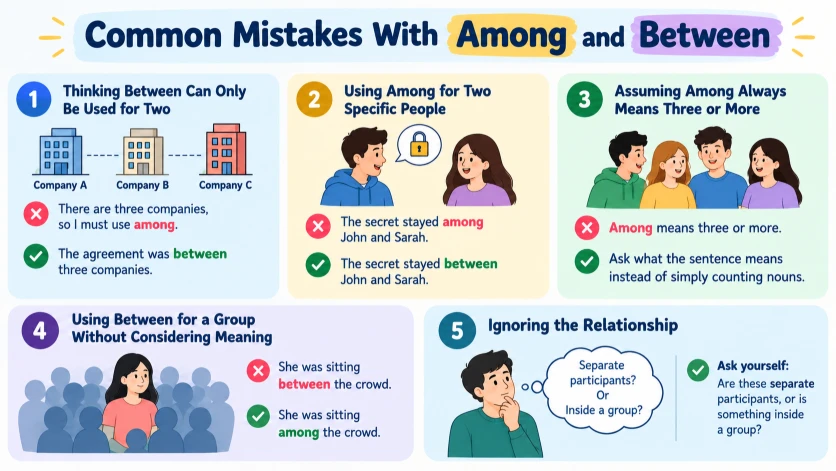
Mistake 1: Thinking Between Can Only Be Used for Two
This is probably the most common error.
Incorrect thinking:
“There are three companies, so I must use among.”
Not necessarily.
The agreement was between three companies.
This can be correct when the companies are treated as distinct participants.
Mistake 2: Using Among for Two Specific People
A sentence such as:
The secret stayed among John and Sarah.
is generally unnatural when only two specific people are involved.
A better choice is:
The secret stayed between John and Sarah.
Mistake 3: Assuming Among Always Means Three or More
The number rule is not enough.
Ask what the sentence means rather than simply counting nouns.
Mistake 4: Using Between for a Group Without Considering Meaning
For example:
She was sitting between the crowd.
This is usually not the natural expression if the meaning is that she was surrounded by a group.
Better:
She was sitting among the crowd.
Mistake 5: Ignoring the Relationship
Many learners choose the word based only on the number of nouns.
Instead, ask:
Are these separate participants, or is something inside a group?
That question usually gives you the answer.
Real-Life Examples of the Difference Between Among and Between
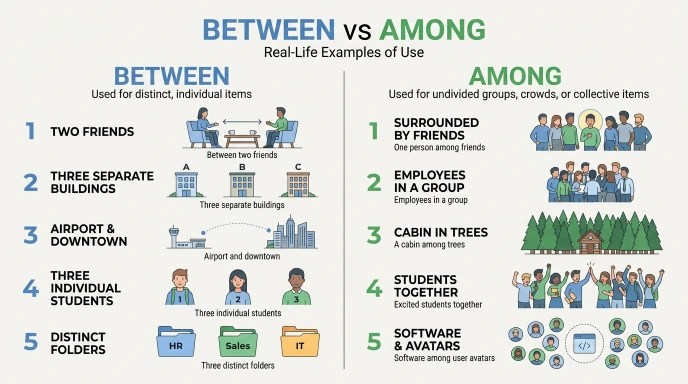
Example 1: Friends
The decision was between Alex and Daniel.
Two specific people are involved.
Alex felt comfortable among his friends.
Alex is part of a group.
Example 2: Business
The contract was negotiated between three companies.
The companies are individual participants.
The new policy caused debate among employees.
Employees are viewed as a group.
Example 3: Travel
The hotel is located between the airport and downtown.
Two specific locations define its position.
The cabin is hidden among the trees.
The cabin is surrounded by a collection of trees.
Example 4: School
The teacher divided the responsibility between the three students.
The students are treated as individual recipients.
The teacher noticed excitement among the students.
The students are considered as a group.
Example 5: Technology
The file was shared between the three departments.
The departments are distinct participants.
The new software became popular among users.
Users are treated as a broad group.
Among vs. Between in Modern Online English
You can also see this distinction in everyday digital communication.
On platforms such as Instagram, YouTube, and other social networks, users often discuss relationships, communities, and groups.
For example:
There is a debate between two creators.
This highlights two distinct participants.
The trend became popular among younger users.
This focuses on a user group.
Google search results may also contain both words in similar-looking queries, which can make the distinction confusing for beginners. The correct choice still depends on the intended grammatical relationship, not on which word appears more frequently online.
The same principle applies to comments, captions, business posts, academic writing, and everyday messages.
How Search Engines Understand “Difference Between Among and Between” and User Intent
When someone searches “difference between among and between,” the likely intent is grammatical and informational. The user usually wants a quick explanation, examples, and a rule that can be applied immediately.
A useful answer therefore needs to do more than define both words.
It should explain:
- What between means
- What among means
- Why the two are confused
- If between can describe more than two things
- How group relationships affect the choice
- Real examples
- Common mistakes
Search engines such as Google are designed to understand related language and questions around a topic. That means a useful grammar article should naturally answer related searches such as:
- What is the difference between among and between?
- When should I use among?
- When should I use between?
- Can between be used for three things?
- Is among used only for groups?
- What is the difference between among and between in a sentence?
The goal should not be repeating the exact keyword. It should be answering the underlying question completely.
When to Use Each: A Simple Decision Guide
When you are unsure, use these questions.
Ask 1: Are the things separate and clearly identified?
Use between.
The discussion was between the manager, the designer, and the developer.
Ask 2: Is something located within a group?
Use among.
The designer was sitting among the other employees.
Ask 3: Is it a choice between distinct options?
Usually use between.
She had to choose between three universities.
Ask 4: Is the sentence about a group reaction?
Usually use among.
The announcement created excitement among students.
Ask 5: Are you describing a physical position?
Use between for specific boundaries:
The café is between the bookstore and the bank.
Use among for a surrounding collection:
The café is among several old buildings.
Why “Between Two, Among Three” Is Not Enough
This traditional rule is worth remembering, but it should not become a rigid grammar formula.
English is concerned with relationships and meaning.
Consider:
The responsibility was shared between four managers.
The managers are separate people who each have a defined role.
Now:
The announcement caused confusion among the managers.
The managers are treated collectively as a group.
Both sentences mention four managers. Yet the correct preposition changes because the relationship changes.
That is why learning the meaning behind the preposition is more useful than memorizing a number.
Mini Summary
Between asks you to notice the individual connections.
Among asks you to notice the surrounding group.
Expert Insight: The Best Way to Remember Among vs. Between
A practical way to remember the distinction is to visualize the sentence.
Imagine three students: Emma, Liam, and Noah.
If you say:
The conversation was between Emma, Liam, and Noah.
You are picturing three identifiable participants in a relationship.
Now imagine a large classroom.
Emma was sitting among the students.
You are picturing Emma inside a group.
This mental-image method is often more useful than memorizing grammar terminology.
In real writing, experienced speakers do not usually stop and count nouns before choosing among or between. They focus on what relationship they want the reader to understand.
That is the deeper grammar principle.
Frequently Asked Questions
What Is the Difference Between Among and Between With Examples?
Between usually refers to two or more clearly identified people or things, while among refers to people or things considered as part of a group. Example: “The secret is between Ali and Sara” and “She felt happy among her friends.”
Where Can We Use Among?
Use among when talking about someone or something within a group or surrounded by several people or things. Example: “He was sitting among his classmates.”
What Is the Difference Between In and Among?
In means inside a place, area, or space, while among means surrounded by or included in a group. Example: “She is in the room” and “She is among her friends.”
What Is the Difference Between “By and Between” and “By and Among”?
By and between is often used in legal or formal writing to identify the parties involved in an agreement, while by and among is used when three or more parties are involved. The exact choice depends on the sentence and legal context.
What Are 5 Sentences Using Among?
- She was standing among her friends.
- The teacher distributed books among the students.
- He felt comfortable among his colleagues.
- The house was hidden among the trees.
- There was excitement among the children.
When Should You Use the Word “Between”?
Use between when referring to relationships, choices, comparisons, or arrangements involving clearly identified people or things. It can refer to more than two items when they are considered individually. Example: “The agreement was made between the three companies.”
Conclusion
The difference between among and between becomes much easier when you stop relying only on the traditional “two versus three” rule. Between usually highlights separate people, things, choices, or relationships, while among usually shows that someone or something is within a group or surrounded by a collection. Between can also be used with more than two participants when those participants are clearly identified and their individual relationships matter.
In practical English, ask what the sentence is trying to emphasize. If you are talking about distinct connections, choices, boundaries, or participants, between is often appropriate. If you are describing something within a group or collective setting, among is usually the better choice.
The simplest memory trick is:
Between = separate relationships.
Among = within a group.
Once you focus on meaning rather than simply counting nouns, choosing between these two prepositions becomes much more natural.
READ MORE ABOUT!
- Difference Between Therapist and Counselor: Easy Guide
- Difference Between Aspirin and Ibuprofen: Uses and Risks

I am Emily Johnson, a USA-based content writer who creates easy-to-read blogs on language and daily life topics. I explain complex ideas in simple English for students and beginners so they can understand easily.