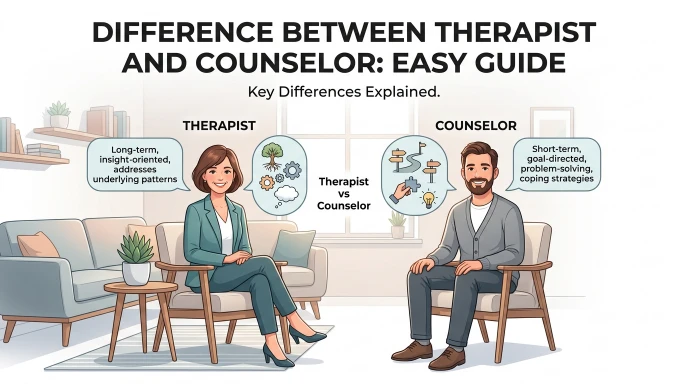
Choosing between a therapist and a counselor can feel confusing, especially when both professionals seem to offer emotional support. The difference between therapist and counselor often comes down to training, scope, goals, and the type of help a person needs.
In simple words, both can help people manage personal or emotional challenges, but their roles are not always identical. Many users search for the difference between therapist and counselor because the terms are sometimes used interchangeably in everyday conversation.
This guide explains what each professional does, how counseling and therapy differ, and when one type of support may be more suitable for a particular situation.
Quick Answer: Difference Between Therapist and Counselor
A therapist is a mental health professional who provides therapy to help people understand and manage emotional, behavioral, or psychological concerns. A counselor also provides professional support, often with a focus on specific life challenges, decisions, relationships, or short-term concerns.
For example, someone dealing with ongoing anxiety may seek therapy, while someone struggling with a recent career decision may work with a counselor.
Definition of Difference Between Therapist and Counselor
- Therapist: A trained professional who uses therapeutic methods to help clients address emotional, behavioral, psychological, or relationship concerns.
- Counselor: A trained professional who helps people work through specific personal, emotional, educational, career, or relationship concerns through counseling.
The exact scope depends on the professional’s license, education, specialization, and local regulations.
How Do You Pronounce Therapist and Counselor?
Therapist
- US English: THER-uh-pist
- UK English: THER-uh-pist
Counselor
- US English: KOWN-suh-ler
- UK English: KOWN-suh-luh
The words sound different, but pronunciation is usually not the reason people confuse them. The bigger issue is that therapy and counseling can overlap in real-world mental health care. To understand the difference between therapist and counselor clearly, it helps to compare what each professional actually does.
Difference Between Therapist and Counselor: A Simple Comparison
| Feature | Therapist | Counselor |
| Main role | Helps clients explore and manage emotional, behavioral, or psychological concerns. | Helps clients work through specific personal, emotional, career, educational, or relationship concerns. |
| Typical focus | May address ongoing or complex concerns and deeper patterns. | Often focuses on current problems, decisions, adjustment, and practical goals. |
| Treatment approach | May use structured psychotherapy approaches. | May use counseling approaches based on the person’s needs and training. |
| Common concerns | Anxiety, depression, trauma, behavior patterns, relationships, and other mental health concerns. | Stress, grief, life changes, relationships, school, career, and personal challenges. |
| Training | Training and licensing vary by profession and location. | Training and licensing vary by profession and location. |
| Session style | Can involve exploring thoughts, emotions, behaviors, and long-term patterns. | Often centers on discussion, coping skills, decisions, adjustment, and goals. |
| Duration | May be short-term or long-term depending on the person’s needs. | May also be short-term or longer depending on the situation. |
| Where they work | Private practices, clinics, hospitals, schools, community settings, and other services. | Schools, colleges, community services, private practices, clinics, workplaces, and other settings. |
The most important point is that job titles and legal scopes vary by country and state. A counselor may provide psychotherapy, and some therapists may focus heavily on practical, short-term concerns. The title alone does not tell you everything about the professional’s training or services.
What Is the Main Difference Between a Therapist and a Counselor?
The main difference is often the scope and focus of care, rather than a strict line between two completely separate professions.
A therapist may work with a broad range of mental health and emotional concerns. Depending on their professional background, they may help clients examine long-term patterns, trauma, relationships, thoughts, emotions, and behaviors.
A counselor may also address mental health concerns, but counseling is often associated with specific life problems, adjustment issues, relationships, education, career decisions, grief, stress, and personal development.
Why the Difference Is Not Always Clear
Many beginners assume that counseling is always short-term and therapy is always long-term. That is too simple.
In real scenarios, a counselor can provide ongoing care, while a therapist may work with someone on a focused issue for only a few sessions. The actual service depends on the professional’s credentials, specialization, treatment approach, and the client’s needs.
A Simple Example
Imagine a student experiencing stress after changing schools.
A counselor might help the student adjust, identify coping strategies, and deal with academic or social concerns.
If the student also has persistent symptoms that require more specialized mental health treatment, a qualified therapist may provide appropriate psychotherapy or recommend another mental health professional.
Is a Therapist the Same as a Counselor?
Not always, although there can be significant overlap.
The word therapist describes a person who provides therapy, while counselor can describe a professional who provides counseling. However, these terms are used differently across professions and locations.
For example, a licensed professional counselor may provide psychotherapy. Likewise, a marriage and family therapist can provide therapy focused on individuals, couples, or families.
This is why checking the professional’s license, qualifications, specialty, and services is more useful than relying only on the title.
What Users Should Check
Before choosing a professional, look at:
- Professional license or registration
- Educational background
- Area of specialization
- Type of therapy or counseling offered
- Experience with your particular concern
- If they work with individuals, couples, families, or children
- If they accept your insurance, if applicable
- If their services are available online or in person
This gives a clearer picture than simply asking if someone is a therapist or counselor.
How Does Therapy Differ From Counseling?
Therapy and counseling can use similar communication skills, but their goals and methods may differ depending on the provider.
Counseling often focuses on helping someone understand a current challenge and develop practical ways to handle it. For example, a person may seek counseling after a breakup, during a career change, or while adjusting to a major life transition.
Therapy, often called psychotherapy, can also address current problems but may involve deeper exploration of emotional patterns, behaviors, relationships, past experiences, and mental health symptoms.
Current Problem vs. Broader Pattern
Consider someone who keeps having conflict at work.
A counseling approach might focus on communication skills, workplace stress, and practical ways to handle the situation.
A therapy approach might also explore why similar conflicts happen repeatedly, how the person’s thoughts and emotional reactions affect relationships, and if older experiences influence current behavior.
Neither example automatically determines which professional is appropriate. The person’s needs and the provider’s qualifications matter.
What Does a Therapist Do?
A therapist works with clients to understand and address emotional, behavioral, psychological, or relationship concerns.
Depending on their professional training, therapists may use approaches such as cognitive behavioral therapy, interpersonal therapy, trauma-focused methods, family therapy, or other evidence-based techniques.
A therapist may help a client:
- Understand difficult emotions
- Identify unhealthy behavior patterns
- Develop coping strategies
- Improve communication
- Work through relationship problems
- Manage stress or anxiety
- Process difficult experiences
- Build healthier habits and responses
Real-World Example
Suppose someone has been avoiding social situations for months because they feel intense fear about being judged.
A therapist may explore the person’s thoughts, emotional reactions, avoidance patterns, and coping strategies. Treatment may then use structured techniques to gradually address the problem.
The exact approach depends on the therapist’s training and the client’s situation.
What Does a Counselor Do?
A counselor helps people understand and manage challenges that affect their personal, emotional, educational, career, or social lives.
Counselors can work in many settings. A school counselor may help students with academic planning and personal concerns. A career counselor may help someone explore career choices. A mental health counselor may provide counseling for emotional and psychological concerns.
Real-World Example
Imagine someone who feels stuck after losing a job.
A counselor might help the person identify goals, manage the emotional impact of the change, explore career options, and create practical next steps.
The focus may be on both emotional support and problem-solving.
Why Do People Search for the Difference Between Therapist and Counselor?
The confusion usually comes from overlapping services and professional titles.
Someone searching Google may see terms such as therapist, counselor, psychologist, psychiatrist, mental health counselor, marriage and family therapist, and psychotherapist. These roles can overlap in some areas but have different education, licensing, and scopes of practice.
Social media can add to the confusion. Platforms such as Instagram, YouTube, and Meta-owned social services often use everyday terms like “therapy” and “counseling” broadly. A short social media post may simplify professional roles for an easy explanation, but real-world credentials are more detailed.
The Important Question
Instead of asking only:
“Should I see a therapist or counselor?”
a more useful question is:
“What kind of support do I need, and which qualified professional is trained to provide it?”
That question shifts the focus from the job title to the actual service.
Can a Counselor Provide Therapy?
In some jurisdictions and professions, yes.
Some counselors receive training that allows them to provide psychotherapy or other forms of mental health treatment. For example, licensed professional counselors may provide counseling and psychotherapy within their legal scope of practice.
However, this is not universal.
The rules depend on the country, state, province, professional license, and type of provider. Someone researching a therapist or counselor should therefore check the provider’s credentials and the services they are legally qualified to offer.
Why This Matters
Two people may both use the word “counselor,” yet have different training and professional roles.
For instance:
- A school counselor may focus on students’ academic and personal development.
- A career counselor may focus on employment and career decisions.
- A licensed mental health counselor may provide mental health counseling and psychotherapy.
- A substance use counselor may specialize in addiction-related support.
The title needs context.
Can a Therapist Provide Counseling?
Yes. Therapy professionals may use counseling skills as part of their work.
A therapy session can involve listening, education, goal setting, coping strategies, problem-solving, and discussion of current life problems. These activities can look similar to counseling.
The distinction becomes clearer when you consider the overall purpose, professional training, and treatment method.
For example, a therapist helping someone manage relationship stress may spend part of a session discussing communication techniques. That does not necessarily make the professional a counselor.
In practical use, the two fields are better understood as overlapping areas rather than two completely separate boxes.
Therapist vs. Counselor: Which One Handles Mental Health Problems?
Both may work with mental health concerns, but the answer depends on the provider’s qualifications and scope of practice.
A qualified mental health counselor may work with concerns such as stress, anxiety, depression, grief, relationships, and adjustment. A therapist may also work with these concerns and may have specialized training in particular forms of psychotherapy.
For more complex situations, the appropriate level of care can depend on symptoms, risk, diagnosis, treatment needs, and the provider’s scope of practice.
This is one reason professional credentials matter more than the label alone.
Does Location Change the Difference Between a Therapist and Counselor?
Yes. Professional titles and licensing systems are not identical everywhere.
In the United States, different states regulate mental health professions through their own licensing rules. Terms such as licensed professional counselor, licensed clinical social worker, marriage and family therapist, psychologist, and other titles can have specific meanings.
In other countries, the terminology may be organized differently.
So if someone searches “difference between therapist and counselor in the UK” or another country-specific query, the answer may differ from a general U.S. explanation.
A Practical Rule
If you’re comparing providers, check the local licensing authority and the professional’s credentials rather than assuming that a title has the same meaning everywhere.
What Should You Look for When Choosing Between Them?
Start with your reason for seeking help.
If you want support with a specific life challenge, adjustment issue, relationship concern, career decision, or personal goal, counseling may be relevant.
If you want help with ongoing emotional, behavioral, or psychological concerns, therapy may be relevant.
But these are not hard rules.
The better approach is to compare:
- Your main concern
- The professional’s training
- Their specialization
- The type of treatment or counseling offered
- Their licensing or registration
- If they regularly work with people facing similar concerns
Quick Decision Example
After graduation, someone seeking help with career planning may find a career counselor to be a logical option.
For persistent emotional symptoms that interfere with daily life, a qualified mental health professional who provides appropriate therapy may be more relevant.
If the situation involves immediate danger or a mental health emergency, regular counseling or therapy appointments may not be enough; urgent local emergency or crisis support may be needed.
Difference and Similarity Between Therapist and Counselor
The difference between therapist and counselor becomes easier to understand when you look at both the differences and the areas where their work overlaps.
| Feature | Therapist | Counselor | Similarity |
| Main purpose | May provide therapy for emotional, behavioral, psychological, or relationship concerns. | Often helps people handle specific personal, emotional, educational, career, or relationship concerns. | Both can provide professional support and guidance. |
| Typical focus | May explore symptoms, patterns, emotions, behaviors, and relationships. | Often focuses on current challenges, adjustment, goals, and practical concerns. | Both can discuss thoughts, feelings, and behaviors. |
| Mental health support | Many therapists provide mental health treatment within their professional scope. | Qualified mental health counselors can also provide mental health care. | Both may work with emotional and mental health concerns. |
| Duration | Can be short-term or long-term depending on treatment goals. | Can also be short-term or continue over time. | Neither is automatically limited to one session length. |
| Training | Depends on the profession, license, and location. | Also depends on the profession, license, and location. | Both require appropriate professional training for their role. |
| Common settings | Clinics, private practices, hospitals, community services, and other care settings. | Schools, colleges, clinics, community services, workplaces, and private practices. | Both can work in professional care environments. |
| Common techniques | May use psychotherapy methods suited to the client’s needs. | May use counseling methods, communication strategies, coping skills, and other approaches within their training. | Both may use structured approaches rather than simple informal advice. |
| Professional scope | Determined by training, license, specialization, and local rules. | Determined by training, license, specialization, and local rules. | Checking credentials gives a clearer answer than the title alone. |
This table clearly shows the difference and similarity between difference between therapist and counselor for quick understanding.
Key Differences Explained Between Therapist and Counselor
The titles can overlap, so looking at the actual role is more useful than memorizing a single definition.
1. Their Typical Focus Can Be Different
Therapists may work with broader emotional, behavioral, psychological, or relationship concerns. Counseling often focuses on a specific challenge, life transition, goal, or area of adjustment.
For example, someone dealing with repeated relationship patterns may explore those patterns in therapy. Someone deciding how to handle a major career change may seek career counseling.
The important word here is “can.” These are common patterns, not strict rules.
2. Therapy May Explore Deeper Patterns
Some forms of therapy look beyond the immediate problem.
A client might arrive because of workplace stress, but therapy could also explore recurring thoughts, emotional reactions, relationship patterns, or past experiences that contribute to the problem.
Counseling can explore these areas too, depending on the professional’s training and approach. This is why the therapy-versus-counseling distinction should not be treated as a rigid boundary.
3. Counseling Often Has a Practical Goal
Many counseling services are strongly goal-oriented.
A person might seek:
- Career guidance
- Academic support
- Relationship help
- Grief support
- Help adjusting to change
- Stress management
- Personal development
The counselor may help the client understand the situation, identify choices, develop coping strategies, and decide on practical next steps.
4. Professional Training Is More Important Than the Title
This is one of the most useful points for anyone comparing mental health professionals.
The word therapist alone does not tell you exactly what someone is licensed or trained to do. The same applies to counselor.
Look at:
- Degree or professional education
- License or registration
- Specialty
- Clinical experience
- Services provided
- Population served
- Local legal scope of practice
A provider’s credentials can tell you much more than the label.
5. Their Work Settings May Differ
Counselors are commonly found in settings such as schools, universities, career centers, community organizations, and mental health services.
Therapists may work in private practices, clinics, hospitals, community programs, and other healthcare or mental health environments.
There is considerable overlap, though. A mental health counselor can work in a clinic, and a therapist can work in a school or community setting.
6. Their Client Groups Can Overlap
Both therapists and counselors may work with:
- Individuals
- Couples
- Families
- Children
- Teenagers
- Adults
- Older adults
The exact population depends on the professional’s education and specialization.
7. The Length of Care Is Not a Reliable Test
A common mistake is thinking:
Counseling = short-term
and
Therapy = long-term
Real practice is more flexible.
Some counseling may continue for an extended period, while some therapy may focus on a specific problem and finish after a relatively short course of treatment.
The goals and needs of the client matter more than a simple time-based rule.
Common Mistakes With Difference Between Therapist and Counselor
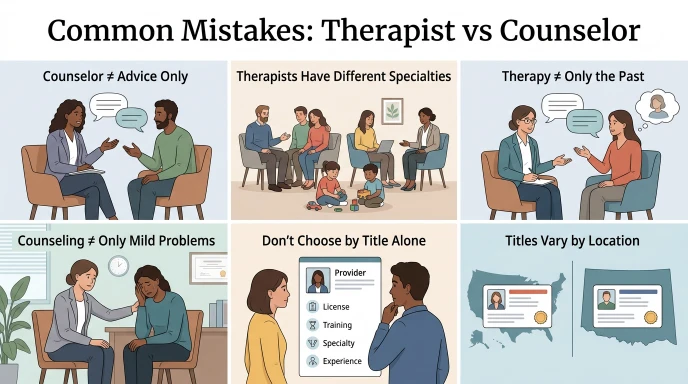
Many users get confused because everyday language makes these professions sound identical. Here are some common mistakes to avoid.
Mistake 1: Assuming a Counselor Only Gives Advice
Counseling is more than telling someone what to do.
A qualified counselor may help a client explore thoughts, emotions, behaviors, choices, and coping strategies. The client remains involved in identifying goals and making decisions.
Fix: Think of counseling as a structured professional process, not casual advice from a friend.
Mistake 2: Assuming Every Therapist Treats the Same Problems
Therapists have different areas of training.
One may specialize in couples therapy, another in trauma, another in children, and another in a particular mental health concern.
Fix: Check the therapist’s specialty before booking an appointment.
Mistake 3: Believing Therapy Is Always About the Past
Some therapy approaches explore past experiences, but therapy can also focus heavily on current thoughts, behaviors, relationships, and practical problems.
Fix: Ask the provider what approach they use and what the sessions typically involve.
Mistake 4: Assuming Counseling Is Only for Mild Problems
Counseling can involve meaningful mental health care. Qualified mental health counselors may work with significant emotional and psychological concerns within their professional scope.
Fix: Judge the service by the provider’s qualifications and scope, not by the word “counselor.”
Mistake 5: Choosing by Title Alone
A person may search for “therapist” and select the first result without checking credentials or specialization.
Fix: Review licensing, training, specialty, treatment approach, and experience.
Mistake 6: Assuming the Terms Mean the Same Thing Everywhere
Professional titles can have different meanings depending on the country, state, province, or regulatory system.
Fix: Check the local licensing rules and the provider’s professional credentials.
Real-Life Examples of the Difference Between Therapist and Counselor
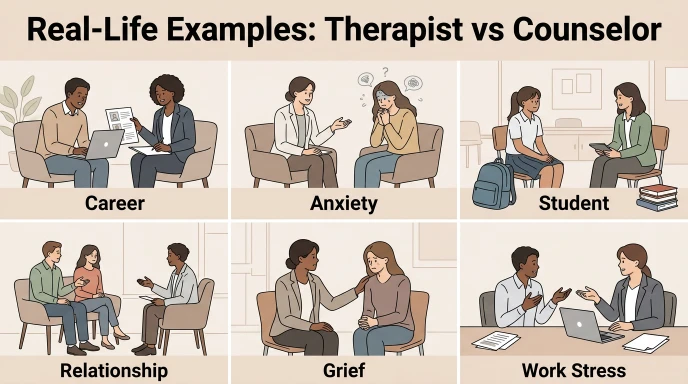
Real situations make the distinction much easier to understand.
Example 1: Career Change
A professional has worked in the same industry for ten years but wants to move into a new field.
A career counselor may help assess goals, skills, interests, career options, and practical next steps.
The main need is career planning rather than psychotherapy.
Example 2: Ongoing Anxiety
Someone regularly avoids social situations because of intense fear and worry.
A qualified therapist may assess the person’s concerns and use an appropriate psychotherapy approach to address thoughts, emotions, and behaviors.
The exact treatment depends on the provider’s training and the person’s needs.
Example 3: Relationship Conflict
A couple keeps having the same argument about communication.
Either a qualified therapist or counselor with appropriate relationship training may be relevant, depending on their credentials and scope of practice.
The sessions may focus on communication, emotional responses, relationship patterns, and practical strategies.
Example 4: Student Adjustment
A student has difficulty adjusting to a new school and feels overwhelmed by academic and social changes.
A school counselor may help the student manage the transition, discuss academic concerns, and develop practical coping strategies.
If the student needs a different level of mental health care, the counselor may recommend an appropriate referral.
Example 5: Grief After a Loss
Someone is struggling after losing a close family member.
A counselor or therapist with experience in grief-related concerns may provide professional support. The appropriate choice depends on the person’s needs and the provider’s specialization.
Example 6: Workplace Stress
An employee feels overwhelmed by workload and has difficulty setting boundaries.
A counselor may help identify stressors, communication issues, and practical coping strategies. A therapist may also be appropriate if the stress is connected to broader emotional or psychological concerns.
When Should You Use a Therapist or Counselor?
There is no single answer that works for everyone. Start with the problem you want help with and then look for a qualified professional whose training matches that need.
A Counselor May Be Relevant When You Need Help With
- Career decisions
- Academic concerns
- Life transitions
- Relationship challenges
- Grief and adjustment
- Everyday stress
- Personal development
- Goal setting
This does not mean counselors cannot address mental health concerns. Qualified mental health counselors may provide therapy and mental health treatment within their scope.
A Therapist May Be Relevant When You Need Help With
- Persistent emotional difficulties
- Anxiety-related concerns
- Depression-related symptoms
- Trauma-related concerns
- Repeated behavioral patterns
- Relationship difficulties
- Emotional regulation
- Other psychological concerns
Again, the provider’s specialization matters.
When the Two Overlap
Sometimes either professional may be able to provide the support you need.
For example, someone experiencing stress after a divorce could potentially work with a counselor or therapist. The deciding factors may include the person’s goals, the professional’s qualifications, the treatment approach, availability, cost, and local scope of practice.
Why People Get Confused About Therapist and Counselor
The confusion is understandable because the two terms are used in overlapping ways.
Everyday Language Simplifies Professional Roles
On Google, Instagram, YouTube, and other platforms, people often use “therapy,” “counseling,” and “mental health support” as broad terms.
A short social media explanation may leave out important details about education and licensing.
Professional Titles Vary by Location
A title that has a specific legal meaning in one region may be used differently somewhere else.
For this reason, searches such as “therapist vs counselor,” “counselor vs therapist,” and “difference between therapist and counselor” can produce answers that appear inconsistent.
Similar Skills Create More Overlap
Both professionals may listen, ask questions, identify goals, teach coping skills, discuss emotions, and help clients make changes.
That overlap is real.
The difference is often found in professional training, specialization, scope of practice, and the type of service being provided.
How Search Engines Understand Difference Between Therapist and Counselor
Search engines such as Google do not need a page to repeat the exact keyword dozens of times to understand its topic.
For a query like difference between therapist and counselor, the surrounding concepts help establish relevance.
Important related concepts include:
- Therapy
- Counseling
- Psychotherapy
- Mental health
- Licensed counselor
- Mental health counselor
- Psychologist
- Psychiatrist
- Marriage and family therapist
- Clinical social worker
- Mental health treatment
- Counseling services
- Professional licensing
A useful article connects these terms naturally while answering the user’s actual question.
Why Search Intent Matters
Someone searching this keyword is usually comparing two professional roles.
They may want to know:
- What each professional does
- If the terms mean the same thing
- Which professional provides therapy
- If counselors can treat mental health concerns
- How training differs
- When to see each one
- How local licensing affects the answer
A strong page should answer those questions directly rather than simply defining two words.
Expert Insight: What Matters More Than the Job Title?
The most practical way to compare a therapist and counselor is to look beyond the title.
In real scenarios, credentials and specialization are often more useful than the label itself.
For example, two professionals may both describe themselves as mental health providers, but one may specialize in trauma while the other focuses on career counseling. Their titles alone would not tell you which service matches a particular need.
A useful checklist is:
Concern → Professional training → Specialty → Treatment approach → License → Fit
This simple process can prevent a common mistake: choosing someone because their title sounds right without checking if they actually provide the service you need.
For anyone researching a provider, official licensing information and the provider’s own professional credentials are stronger sources than a social media bio or generic online directory description.
Frequently Asked Questions
Do I need counseling or therapy?
You may need counseling for specific concerns, decisions, or short-term challenges. Therapy may be more suitable for ongoing emotional or mental health concerns that affect daily life. A qualified professional can help you decide based on your situation.
Which is better, therapy or counseling?
Neither is automatically better. Counseling often focuses on specific goals and current challenges, while therapy may address deeper or longer-term emotional and behavioral concerns. The right option depends on your needs.
Do I need a therapist or a counsellor?
Choose a counselor when you need help with a specific issue, such as relationships, career decisions, grief, or life changes. A therapist may be appropriate for persistent emotional, behavioral, or mental health concerns. Qualifications and services vary by location.
What are the 7 types of counseling?
Seven common types of counseling include individual counseling, couples counseling, family counseling, group counseling, career counseling, school counseling, and grief counseling. The exact categories can vary depending on the setting and professional training.
What are the 7 types of therapy?
Seven widely used types of therapy include cognitive behavioral therapy (CBT), dialectical behavior therapy (DBT), psychodynamic therapy, humanistic therapy, interpersonal therapy, exposure therapy, and family therapy. Different approaches are used for different concerns.
What is a red flag for a therapist?
Red flags can include violating professional boundaries, dismissing your concerns, pressuring you to continue treatment, making inappropriate personal comments, refusing to explain treatment clearly, or ignoring confidentiality rules. If you feel unsafe or uncomfortable, consider discussing your concerns with another qualified professional.
Conclusion
The difference between therapist and counselor is not simply that one “does therapy” and the other “gives advice.” Both can provide professional support, and their roles may overlap depending on their education, license, specialization, and location.
A therapist may provide psychotherapy for emotional, behavioral, psychological, or relationship concerns. A counselor may help with personal challenges, life changes, career or educational decisions, relationships, stress, and mental health concerns. Some counselors also provide psychotherapy.
The clearest way to compare the two is to look at what the professional is trained and licensed to do. If you are choosing a provider, focus on your specific concern first, then check the person’s credentials, specialty, treatment approach, and local scope of practice.
In practical use, the right question is not simply “therapist or counselor?” It is “Which qualified professional offers the type of support I need?” That approach gives you a more accurate answer than relying on the title alone.
READ MORE ABOUT!
- Difference Between Aspirin and Ibuprofen: Uses and Risks
- Difference Between Historic and Historical: Meaning and Examples
- Difference Between Insure and Ensure: Which Word Is Correct?

I am James Carter, a professional content writer from the United States. I specialize in writing simple and clear comparison blogs that help students and readers understand difficult topics easily. My writing focuses on everyday language, education, science, and lifestyle topics. I believe that learning should be easy for everyone, so I use simple words and real-life examples in my articles.