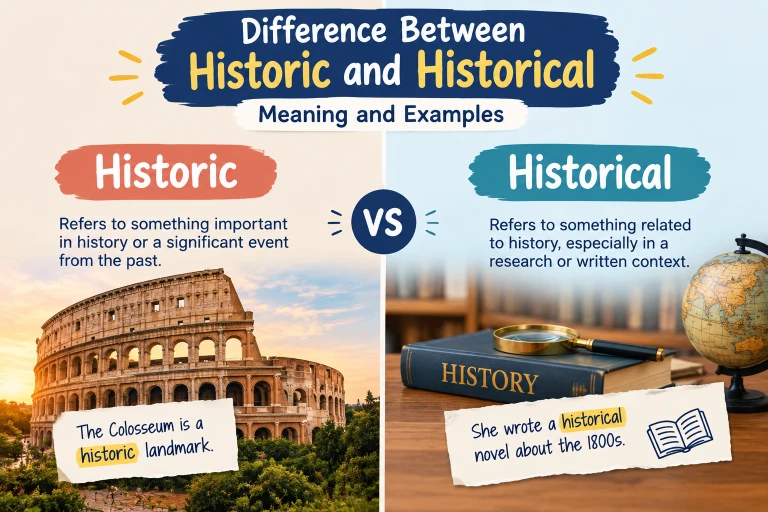
Historic describes something important or memorable in history, while historical simply relates to the past or history.
Many users get confused about the difference between historic and historical because both words relate to the past. They can sometimes describe the same event, but they do not always mean the same thing.
In simple words, historic usually means something important or memorable in history, while historical means something connected with history or the past. Understanding the difference between historic and historical can help you choose the right word in writing, schoolwork, business content, and everyday English.
In this guide, we will explain what each word means, how they differ, when to use each one, and give clear real-life examples.
Quick Answer
Historic describes something important, memorable, or likely to have a major place in history.
Historical describes anything related to history or something that happened in the past.
Example:
“The moon landing was a historic event.”
“A museum displays historical objects from the moon landing.”
Definition of Historic and Historical
- Historic: Something important or significant in history, especially an event that is remembered as a major moment.
- Historical: Something related to history, the past, or events that actually happened in earlier times.
Simple Example
A historical document is a document connected to the past.
A historic document is a document that is especially important or significant in history.
This small difference is the key to understanding the two words.
Pronunciation
The pronunciation is slightly different, but both words begin with the same hist- sound.
- Historic
- US: his-TOR-ik
- UK: his-TOR-ik
- Historical
- US: his-TOR-ik-ul
- UK: his-TOR-ik-uhl
The easiest way to remember them is this: historic focuses on importance, while historical focuses on connection to history.
Now let’s look at the difference between historic and historical more closely.
What Is the Difference Between Historic and Historical?
The main difference is importance versus connection.
Historic is normally used when something is important enough to be remembered as a significant moment in history.
Historical is a broader word. It can describe anything connected with the past, including people, documents, buildings, records, periods, facts, and events.
For example:
“The signing of the peace treaty was historic.”
This means the treaty was an important moment.
Now compare it with:
“The historian studied historical records about the treaty.”
Here, historical simply means the records are related to history.
So, something can be historical without being historic.
That is one of the most useful rules to remember.
Historic vs Historical: Comparison
| Feature | Historic | Historical |
| Basic meaning | Important or significant in history | Related to history or the past |
| Main focus | Importance | Connection to history |
| Usage | Usually describes notable events or achievements | Describes people, objects, places, records, events, and periods |
| Scope | Narrower meaning | Broader meaning |
| Example | A historic victory | A historical record |
| Importance required? | Usually yes | No |
| Common phrase | Historic moment | Historical research |
| Simple question | “Was it important?” | “Is it related to the past?” |
Quick rule: If you mean important in history, choose historic. If you mean related to history, choose historical.
Key Differences Explained Between Historic and Historical
1. Historic Means Important
The most important difference between historic and historical is that historic often carries a sense of importance.
For example:
“The first successful human flight was a historic achievement.”
The sentence does not simply say that the flight happened in the past. It says the achievement was important enough to become a notable part of history.
Another example:
“The country celebrated a historic election.”
This suggests the election had unusual importance or marked a major change.
Practical tip
When the idea is “this moment changed things or will be remembered,” historic is often the better choice.
2. Historical Has a Broader Meaning
Historical is much broader.
It can refer to almost anything connected to the past.
Examples include:
- historical documents
- historical records
- historical buildings
- historical research
- historical facts
- historical figures
- historical photographs
- historical evidence
- historical periods
For example:
“The library contains thousands of historical documents.”
The documents do not necessarily have to be famous or extremely important. They simply relate to history.
3. A Historical Event Is Not Always a Historic Event
This is where many beginners become confused.
An event can be historical because it happened in the past. But calling it historic suggests that it was particularly important.
Consider these sentences:
“The battle is an important historical event.”
This tells us the battle belongs to history.
“The battle was a historic turning point.”
This tells us the battle had major importance.
The same event can therefore be both historical and historic, depending on what the writer wants to emphasize.
4. Historic Often Describes Major Moments
You will frequently see historic before words such as:
- moment
- decision
- victory
- agreement
- election
- achievement
- discovery
- announcement
- breakthrough
- occasion
For example:
“The team achieved a historic victory.”
The word historic tells the reader that the victory was unusually important.
In practical writing, this word is often used when a moment represents a major change or achievement.
5. Historical Often Describes Evidence and Materials
Historical is especially common when talking about things researchers use to understand the past.
Examples include:
historical evidence
historical records
historical sources
historical documents
historical photographs
historical archives
For example:
“Researchers examined historical records before writing the report.”
Here, the records are connected with the past. Their importance is not the main point.
This is why historical is the natural choice in academic and research writing.
Can Something Be Both Historic and Historical?
Yes.
An important event can be both historic and historical.
For example:
“The first person to walk on the Moon was a historic achievement and an important historical event.”
The event is historical because it belongs to the past and is studied as part of history.
It is historic because it was an extremely important achievement.
Think of the relationship this way:
Historical = connected to history
Historic = important in history
Not every historical thing is historic, but a genuinely historic event is also historical.
Historic vs Historical Examples in Real Life
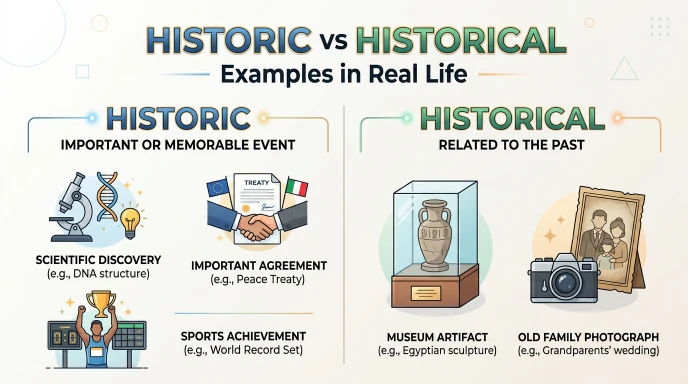
Understanding examples is often easier than memorizing a rule.
Example 1: A Major Scientific Discovery
“The discovery of penicillin was historic.”
Why? Because it had enormous importance and changed medicine.
“Scientists studied historical records about early medical discoveries.”
Why? Because the records are connected to the past.
Example 2: A Museum
“The museum contains historical objects.”
The objects are connected to the past.
But you might say:
“The museum displayed a historic artifact from an important royal ceremony.”
Here, historic emphasizes the artifact’s special importance.
Example 3: Politics
“The leaders signed a historic agreement.”
This means the agreement was especially important.
“Researchers examined historical information about the negotiations.”
This simply means the information relates to the past.
Example 4: Sports
“The athlete won a historic gold medal.”
The medal represents a major achievement.
“The journalist reviewed historical sports records.”
The records contain information from earlier years.
Example 5: Family History
“My family has several historical photographs.”
The photographs are from the past.
You would use historic only if one photograph had exceptional importance, such as showing a major public event.
When Should You Use Historic?
Use historic when you want to highlight the importance or significance of something.
Common examples include:
- a historic victory
- a historic decision
- a historic agreement
- a historic speech
- a historic achievement
- a historic moment
- a historic election
- a historic breakthrough
Easy test
Ask:
“Is this important enough to be remembered as a major moment?”
If yes, historic may be appropriate.
For example:
“The agreement was a historic step toward peace.”
The writer is emphasizing the agreement’s importance.
When Should You Use Historical?
Use historical when something is connected to history or the past.
Common examples include:
- historical facts
- historical research
- historical records
- historical evidence
- historical buildings
- historical figures
- historical documents
- historical events
- historical photographs
- historical studies
Easy test
Ask:
“Is this related to history or the past?”
If yes, historical is usually the safer choice.
For example:
“The researcher used historical documents to support the study.”
The documents are simply sources from or about the past.
Difference Between Historic and Historical in Academic Writing
Academic writing often uses historical because researchers frequently discuss evidence, records, periods, and events from the past.
For example:
“The study examines historical changes in trade.”
Here, historical describes changes across the past.
However, an academic writer might use historic when discussing an event that had major significance.
“The treaty represented a historic change in international relations.”
Both words can appear in the same article because they perform different jobs.
Writing tip
Do not replace every use of historical with historic. They are not perfect synonyms.
Why Do People Get Confused Between Historic and Historical?
The confusion is understandable because both words come from the same idea: history.
There are three common reasons.
1. Their meanings overlap
Both words can describe past events.
For example, an event can be described as both historical and historic.
2. Everyday writing sometimes uses them loosely
News headlines, social media posts, advertisements, and political speeches may use historic to make something sound important.
For example:
“A historic new product launch!”
Sometimes this is simply promotional language rather than a careful historical judgment.
3. Importance can be subjective
What one person considers historic may not seem equally important to another person.
In careful writing, use historic when there is a clear reason to emphasize significance rather than using it only for dramatic effect.
Common Mistakes With Historic and Historical
Mistake 1: Using Historic for Every Past Event
Incorrect idea:
“I read a historic book about ancient Egypt.”
If you only mean the book is about the past, historical is more suitable.
Better:
“I read a historical book about ancient Egypt.”
Mistake 2: Thinking Historical Always Means Important
Historical does not automatically mean significant.
A historical document may be ordinary but still useful for understanding the past.
Better understanding:
Historical = connected to history.
Mistake 3: Assuming Historic and Historical Are Always Interchangeable
They overlap, but the emphasis changes.
“a historic decision” = an important decision
“a historical decision” = a decision related to history or being discussed as part of historical study
The first sentence more strongly highlights importance.
Mistake 4: Using Historic Just to Sound Impressive
Writers sometimes use historic because it sounds stronger.
For example:
“This is a historic sale!”
Unless the sale has genuine historical significance, this may sound exaggerated.
Choose words based on meaning rather than drama.
Mistake 5: Confusing Historical With Old
Something does not have to be extremely old to be historical.
A document from several decades ago can be historical if it is relevant to the past.
Likewise, an old object is not automatically historic.
Real-Life Examples of Historic and Historical
Here are practical situations showing how native English usage works.
Personal Use
“My grandfather kept historical photographs from his childhood.”
The photographs are related to the past.
Business Use
“The company described the merger as a historic milestone.”
The company is emphasizing the importance of the merger.
Education
“Students analyzed historical documents during the lesson.”
The documents provide information about the past.
Journalism
“The newspaper called the agreement a historic development.”
The journalist is emphasizing the significance of the agreement.
Research
“The researchers compared historical data from different decades.”
The data comes from earlier periods.
Public Events
“The first successful launch was a historic moment for the program.”
The event was important enough to be remembered as a major milestone.
Difference and Similarity Between Historic and Historical
| Feature | Historic | Historical | Similarity |
| Meaning | Important in history | Related to history | Both connect to the idea of history |
| Main emphasis | Significance | Past or historical connection | Both can describe past events |
| Scope | More specific | More general | Both are adjectives |
| Events | Often major events | Any event from or about the past | Both can describe events |
| Documents | Usually important documents | Any documents related to history | Both can describe historical material |
| Research | Less common | Very common | Both may appear in historical studies |
| Everyday use | Used for major moments | Used for past-related things | Both are common English words |
| Example | Historic victory | Historical record | Both may describe the same subject differently |
This table clearly shows the difference and similarity between historic and historical for quick understanding.
How Do Historic and Historical Work in Modern Search and Content?
When people search Google for “difference between historic and historical,” they usually want a quick language answer, not a long history lesson.
That is why context matters.
Search engines such as Google can understand that searches such as:
- historic vs historical
- historical or historic
- historic meaning
- historical meaning
- when to use historic
- when to use historical
- difference between historic and historical
are closely related language-intent queries.
The same basic principle applies across digital platforms. A user searching on Instagram might see the words in a caption, while someone watching an English-learning video on YouTube may hear an explanation of the difference.
The platform changes, but the language question remains the same: Does the writer mean “important in history” or simply “related to history”?
How Search Engines Understand the Meaning of These Words
Search engines do not need the words to appear repeatedly to understand the topic.
Context provides the strongest clue.
For example, a page discussing:
- historical documents
- historical records
- historical research
- past events
clearly establishes a historical context.
A page discussing:
- major achievements
- turning points
- famous milestones
- important discoveries
may establish the meaning of historic.
This is why good language content should explain the relationship between the words instead of simply repeating the exact keyword.
Information Gain: The “Importance Test”
A useful way to remember the difference is to use an importance test:
Historical asks:
“Is this connected to the past?”
Historic asks:
“Is this important enough to stand out in history?”
This test works in most everyday situations and is easier to remember than a dictionary definition.
Expert Insight: A Practical Rule for Writers
From a professional language-editing perspective, the safest approach is to avoid treating historic and historical as automatic substitutes.
Use historical when your purpose is descriptive:
“historical research”
“historical evidence”
“historical records”
Use historic when your purpose is evaluative and you are highlighting significance:
“historic achievement”
“historic breakthrough”
“historic agreement”
There is one important nuance: historic can be subjective. Calling something historic makes a judgment about its importance. Therefore, in formal writing, the word should have enough context to support that judgment.
This is especially useful in journalism, academic writing, business communication, and educational content.
Is a Historic Event Also Historical?
Yes.
A historic event is also a historical event because it belongs to history.
The difference is emphasis.
- Historical event: an event connected with history or the past.
- Historic event: an event considered especially important or significant.
For example:
“The battle is a historical event.”
This identifies its place in history.
“The battle was a historic turning point.”
This emphasizes its importance.
Is Historical the Same as Historic?
No, not exactly.
The words are related, but historical has a broader meaning.
Historical means connected with history or the past.
Historic usually means important, notable, or significant in history.
Sometimes both words can correctly describe the same thing, but they communicate slightly different ideas.
Which Is Correct: Historic or Historical?
Neither word is automatically correct. The correct choice depends on what you mean.
Use historic for significance:
“It was a historic achievement.”
Use historical for connection to the past:
“It was a historical study.”
When you are unsure, ask yourself if you are emphasizing importance or simply historical connection.
FAQs
What is the main difference between historic and historical?
Historic usually means important or significant in history, while historical means related to history or the past.
Is a historical event always historic?
No. An event can be historical because it happened in the past without being especially important or significant.
Can something be both historic and historical?
Yes. A major event can be both historical and historic. Historical describes its connection to the past, while historic highlights its importance.
What is an example of historic?
“The first human landing on the Moon was a historic achievement.” The word historic emphasizes the importance of the achievement.
What is an example of historical?
“The museum contains historical documents.” Here, historical means the documents are connected to the past.
Is historic a synonym for important?
Not in every situation, but it often carries the idea of something being important or significant in history.
When should I use historical instead of historic?
Use historical when you are talking about something related to the past, such as historical records, research, buildings, photographs, or facts.
Which word is better in academic writing?
It depends on the sentence. Historical is common when discussing research, evidence, records, and past events. Historic is useful when emphasizing an event’s significance.
Are historic and historical interchangeable?
Not always. They overlap in some contexts, but historic emphasizes importance, while historical emphasizes a connection with history.
Conclusion
The difference between historic and historical becomes simple once you focus on the main idea behind each word. Historical means connected to history or the past. Historic usually means important, memorable, or significant in history.
For example, a museum may contain historical documents because those documents relate to the past. However, an important document that changed the course of events could be described as historic.
A useful memory trick is:
Historical = related to history.
Historic = important in history.
Remember that these words can sometimes describe the same event. A major event can be both historical and historic, but the writer uses each word for a different reason. When writing, ask yourself one simple question: Am I talking about something connected to the past, or am I emphasizing its importance? That answer will usually tell you which word to choose.
Understanding this distinction makes your English more precise and helps you avoid one of the most common adjective-choice mistakes in formal and everyday writing.
READ MORE ABOUT!
- Difference Between Insure and Ensure: Which Word Is Correct?
- Difference Between Aioli and Mayo: Simple Guide

I am James Carter, a professional content writer from the United States. I specialize in writing simple and clear comparison blogs that help students and readers understand difficult topics easily. My writing focuses on everyday language, education, science, and lifestyle topics. I believe that learning should be easy for everyone, so I use simple words and real-life examples in my articles.