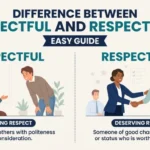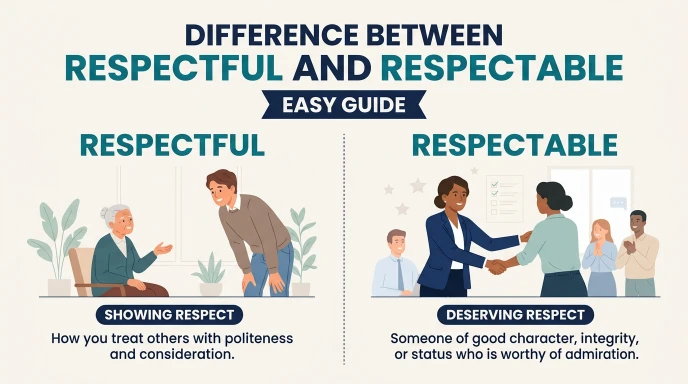
The difference between respectful and respectable is simple: respectful describes how someone treats others, while respectable describes someone or something that deserves respect. These words sound similar, but they have different meanings and uses.
Understanding the difference between respectful and respectable helps you speak clearly, write better sentences, and avoid common English mistakes. For example, a student who listens politely to a teacher is respectful. A student who works hard, acts honestly, and earns the trust of others may be considered respectable.
Many English learners confuse these words because both relate to respect. In this guide, you will learn their definitions, pronunciation, key differences, common mistakes, and real-life examples so you can use each word correctly.
Quick Answer: Difference Between Respectful and Respectable
Respectful means showing respect, kindness, or consideration toward others. Respectable means worthy of respect or considered good and acceptable by others.
Example: A respectful employee listens politely to a manager, while a respectable employee has a good reputation for honesty and reliability.
Definition of Respectful and Respectable
- Respectful: Showing politeness, consideration, or respect for another person, their feelings, or their rights.
- Respectable: Deserving respect or approval because of someone’s character, actions, achievements, or reputation.
The main distinction is between showing respect and being worthy of respect.
Pronunciation
| Word | US pronunciation | UK pronunciation |
| Respectful | ri-SPEKT-fuhl | ri-SPEKT-fuhl |
| Respectable | ri-SPEK-tuh-buhl | ri-SPEK-tuh-buhl |
Both words begin with the same root, respect. However, their endings change their meanings. The ending -ful describes a quality or behavior, while -able suggests that someone or something is worthy of a particular judgment.
Now, let’s look at how these words differ in everyday English.
Comparison: Respectful vs. Respectable
| Feature | Respectful | Respectable |
| Basic meaning | Showing respect toward others | Deserving respect from others |
| Main focus | Behavior and attitude | Character, quality, or reputation |
| Typical use | Describing how someone acts | Describing someone’s standing or worth |
| Common examples | Respectful student, respectful reply | Respectable career, respectable person |
| Social setting | Polite conversations and interactions | Judgments about character and achievements |
| Positive quality | Courtesy and consideration | Trustworthiness and good standing |
| Opposite | Disrespectful | Disreputable or, in some contexts, unworthy of respect |
| Key question | How does this person treat others? | Why is this person or thing worthy of respect? |
Remember: A person can be respectful in a conversation without having a particularly good reputation. Similarly, someone with a respectable reputation may still behave disrespectfully toward others.
Key Differences Explained Between Respectful and Respectable
1. Respectful Describes Behavior
The word respectful tells us how someone treats another person or responds to a situation. It often describes polite speech, thoughtful actions, and consideration for other people’s feelings.
Example: Maya remained respectful while disagreeing with her teacher.
Maya did not have to agree with the teacher. Her respectful behavior meant that she expressed her opinion without being rude.
2. Respectable Describes Worth or Reputation
The word respectable describes someone or something considered worthy of respect, approval, or admiration.
Example: Maya’s teacher has built a respectable career through years of honest work.
Here, respectable refers to the teacher’s professional reputation and conduct, not simply how the teacher speaks to someone.
3. One Focuses on Others; the Other Focuses on Judgment
Respectful behavior is usually directed toward another person, group, tradition, or point of view. Respectable describes how a person, achievement, or thing may be judged.
For example, a respectful customer listens to a shop assistant without interrupting. A respectable business earns trust through fair practices and reliable service.
4. Respectful Can Describe a Single Action
Someone may act respectfully in one moment, even if they do not always behave well.
Example: Although Ben was upset, he gave a respectful response to the complaint.
The sentence describes one particular response. It does not make a broad claim about Ben’s overall character.
5. Respectable Often Suggests a Broader Standard
Calling someone respectable can suggest that their conduct, achievements, or reputation meet a reasonable social or professional standard.
Example: The company has maintained a respectable record of customer service.
This means the company’s record is worthy of approval. It does not necessarily mean that the company is the best in its industry.
6. The Words Have Different Opposites
The most direct opposite of respectful is disrespectful. It describes rude, dismissive, or inconsiderate behavior.
The opposite of respectable depends on the context. Words such as disreputable and unworthy of respect can express the contrast. Disreputable is particularly useful when describing a poor reputation.
Examples:
- Respectful: He listened without interrupting.
- Disrespectful: He laughed while his colleague was speaking.
- Respectable: She earned a respectable reputation for honesty.
- Disreputable: The organization became known for dishonest practices.
7. Both Words Can Describe the Same Person
A person can be both respectful and respectable, but the words communicate different qualities.
Example: A respectable doctor may also be respectful toward every patient.
Respectable refers to the doctor’s professional standing or character. Respectful describes how the doctor treats patients.
This distinction is especially useful in workplaces, schools, healthcare, and other settings where both reputation and interpersonal behavior matter.
Difference and Similarity Between Respectful and Respectable
The following table compares the meanings, contexts, and similarities of both words.
| Feature | Respectful | Respectable | Similarity |
| Meaning | Shows consideration | Deserves respect | Both relate to respect |
| Grammar | Adjective | Adjective | Both describe nouns |
| Behavior | Focuses on how someone acts | May describe overall conduct | Both can describe people |
| Reputation | Not required | Often relevant | Both can create a positive impression |
| Context | Conversations and interactions | Character, work, and achievements | Both appear in everyday English |
| Example | A respectful listener | A respectable professional | Both can describe the same person |
| Main question | Is the behavior considerate? | Is the person or thing worthy of respect? | Both involve judgments about respect |
This table clearly shows the difference and similarity between respectful and respectable for quick understanding.
How to Use Respectful and Respectable Correctly
The easiest way to choose the right word is to look at what you want to describe.
Use respectful when you are talking about the way someone speaks, listens, behaves, or responds. Use respectable when you are describing a person’s character, a professional reputation, a result, or something considered acceptable and worthy of approval.
Consider these examples:
- Respectful conversation: The neighbors had a respectful discussion about the noise.
- Respectable reputation: The restaurant has a respectable reputation for serving fresh food.
- Respectful disagreement: James respectfully explained why he disagreed with the decision.
- Respectable achievement: The team achieved a respectable result in the competition.
Notice that a respectable result does not have to be outstanding. It can simply be good enough to earn approval.
What Does Respectful Mean in a Sentence?
A respectful sentence shows consideration for another person or their point of view.
For example: “The manager gave a respectful reply to the employee’s concerns.”
The manager’s response was polite and considerate. The sentence focuses on behavior rather than reputation.
What Does Respectable Mean in a Sentence?
A respectable sentence describes something worthy of approval or regard.
For example: “The small business earned a respectable profit in its first year.”
Here, respectable means the profit was reasonably good or satisfactory. It does not suggest that the profit itself has feelings or that someone showed politeness.
Common Mistakes With Respectful and Respectable
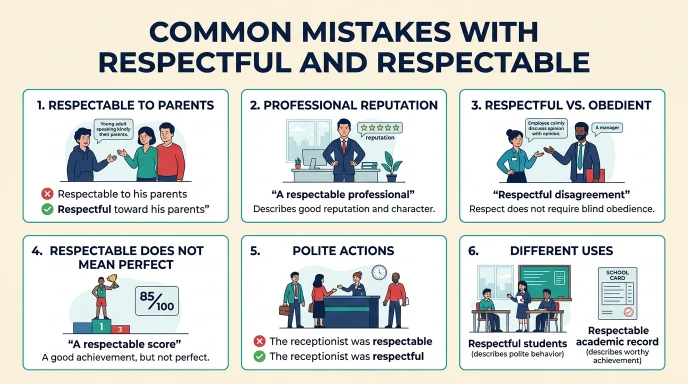
Many English learners understand that both words are positive but use them interchangeably. These corrections will help you avoid that problem.
Mistake 1: Saying “He Is Respectable to His Parents”
This sentence is awkward if you mean that he treats his parents well.
Incorrect: He is respectable to his parents.
Correct: He is respectful toward his parents.
Use respectful because the sentence describes how he treats other people.
Mistake 2: Saying “She Is a Respectful Professional” When You Mean Her Reputation
This sentence is grammatically correct, but it may not express the intended meaning.
Possible correction: She is a respectable professional with a strong reputation.
Use respectable when you want to emphasize professional standing, character, or reputation. Use respectful when you mean that she treats colleagues and clients well.
Mistake 3: Confusing Respectful With Obedient
Being respectful does not mean agreeing with everything someone says or following every instruction without question.
Example: A respectful employee can disagree with a manager while explaining their concerns calmly.
Respect is about consideration, not the absence of independent thought.
Mistake 4: Assuming Respectable Means Perfect
A respectable person or result does not have to be flawless or exceptional.
Example: The athlete achieved a respectable score despite limited training time.
The score was good enough to deserve recognition, even if it was not the highest.
Mistake 5: Using Respectable for Every Polite Action
Awkward: The receptionist was respectable when greeting visitors.
Better: The receptionist was respectful when greeting visitors.
The second sentence clearly describes polite behavior. You might instead say that the receptionist was a respectable professional if you wanted to discuss their reputation.
Mistake 6: Assuming Both Words Are Interchangeable
Respectful: The students were respectful during the ceremony.
Respectable: The school has a respectable record of academic achievement.
The first sentence describes the students’ conduct. The second evaluates the school’s record.
A useful editing tip is to replace respectful with “showing respect” and respectable with “worthy of respect.” If the sentence still makes sense, you have probably chosen correctly.
Real-Life Examples of Respectful and Respectable
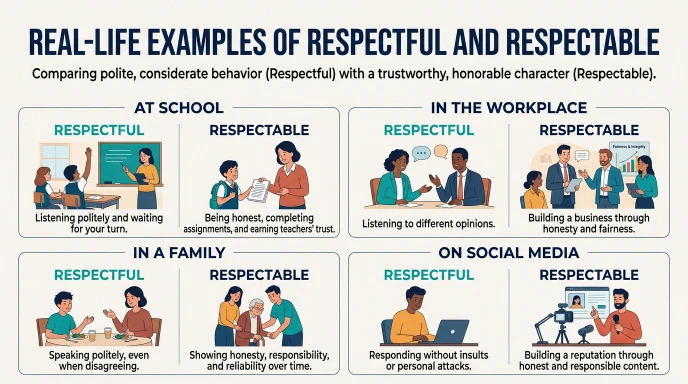
These practical situations show how the difference between respectful and respectable works in daily life.
Example 1: At School
A student waits until the teacher finishes speaking before asking a question. The student is being respectful.
The same student consistently completes assignments, acts honestly, and earns the trust of teachers. The student may be considered respectable.
Example 2: In the Workplace
An employee listens carefully when a coworker shares a different opinion. This is respectful behavior.
A business owner who pays employees fairly, keeps promises, and builds a trustworthy company may be described as respectable.
Both qualities matter at work. Good professional standing does not excuse rude behavior, and polite communication alone does not guarantee a good reputation.
Example 3: In a Family
A teenager listens to a parent’s concerns without mocking or insulting them. The teenager is being respectful, even if they disagree.
A family member who acts honestly, keeps commitments, and helps others over time may be considered respectable.
Example 4: On Social Media
Someone replies to a controversial Instagram post without personal attacks or insulting comments. Their response is respectful.
A creator who develops a strong reputation for honest information and responsible conduct may be considered respectable.
Platforms such as Instagram, YouTube, and Meta’s social networks provide places where people can demonstrate respectful communication. However, popularity and follower counts alone do not make someone respectable.
Example 5: In Customer Service
A customer explains a complaint calmly and allows the support agent to respond. The customer is respectful.
A company known for fair refunds, reliable products, and honest advertising may have a respectable reputation.
This example highlights an important point: respectful behavior describes an interaction, while respectable describes a broader assessment.
When Should You Use Respectful or Respectable?
Choose the word according to the meaning you want to express.
Use respectful for behavior
Choose this word when describing polite speech, thoughtful responses, considerate actions, or the way someone treats others.
Example: Please remain respectful during the discussion.
Use respectable for reputation or worth
Choose this word when describing good character, professional standing, an acceptable standard, or an achievement worthy of approval.
Example: The candidate has a respectable record of public service.
When both meanings are relevant, you can use both words in one sentence: “The respectable manager remained respectful toward every employee.”
Why Do People Get Confused About Respectful and Respectable?
There are several reasons these words are easy to mix up.
1. They Share the Same Root Word
Both words come from respect. Their similar spelling and pronunciation make them look interchangeable, especially to people learning English.
However, the endings help explain their different meanings:
- -ful describes being full of or showing a quality.
- -able often means capable of being or worthy of something.
These endings do not follow one universal rule in every English word, but they provide a useful clue here.
2. Both Words Have Positive Meanings
A respectful person usually behaves considerately. A respectable person is usually viewed positively. Because both descriptions suggest good qualities, writers sometimes choose one without checking the precise meaning.
The solution is to focus on the sentence’s purpose rather than its positive or negative tone.
3. Social Media Uses Reputation and Behavior Differently
On YouTube, Instagram, and other social platforms, a creator might be praised for respectful replies or criticized for disrespectful comments. Separately, their overall reputation may be described as respectable or disreputable.
These ideas overlap, but they measure different things. A polite public response is evidence of behavior in one situation; it does not prove everything about a person’s character.
4. Context Changes the Meaning of Respectable
The word respectable can mean worthy of respect, but it can also mean reasonably good, acceptable, or socially proper.
For example, “a respectable salary” means a reasonably good salary. It does not mean the salary is polite or morally admirable.
By contrast, respectful usually refers to consideration or regard for someone or something.
How Search Engines Understand Respectful and Respectable
Search engines such as Google aim to interpret what a user means, not just match individual words. Someone searching for the difference between respectful and respectable likely wants a clear comparison, example sentences, and guidance on choosing the correct word.
A useful article therefore answers several related questions:
- What does each word mean?
- How are the words different?
- Can both words describe one person?
- What are the correct examples?
- Which word fits a particular sentence?
Clear definitions, accurate examples, descriptive headings, and a helpful comparison table make these answers easier to locate and understand.
Search engines can use language context to distinguish between related terms. For example, “respectful reply” points toward considerate communication, while “respectable salary” indicates an acceptable or good level of pay.
There is no guaranteed formula for ranking first on Google. Helpful content must meet readers’ needs, use language accurately, and provide genuine value. Repeating the target keyword excessively or mentioning unrelated brands will not automatically improve a page’s ranking.
Expert Insight: A Simple Way to Remember the Difference
The most reliable way to distinguish these words is to separate an action from an evaluation.
Respectful usually describes an action, attitude, or way of interacting with people. Respectable usually expresses an evaluation of a person, achievement, reputation, or standard.
Consider two statements:
- “The lawyer was respectful toward the client.”
- “The lawyer has a respectable professional reputation.”
The first tells us how the lawyer treated a client in a particular situation. The second tells us how the lawyer’s professional standing is viewed.
One detail is worth remembering: respectable does not always mean morally admirable. A respectable amount of money, a respectable distance, or a respectable score can simply mean a reasonable or satisfactory amount, distance, or score.
Likewise, being respectful does not mean being submissive. Someone can challenge an unfair decision, question an authority figure, or express a strong disagreement while remaining respectful.
For accurate writing, identify the idea first: Am I describing considerate behavior, or am I judging if something deserves respect? That question usually leads to the right word.
Frequently Asked Questions
What does it mean if someone is respectable?
A respectable person is someone who deserves respect because of their honesty, good behavior, responsibility, and strong values.
What is the difference between “respectful” and “respected”?
Respectful describes someone who shows respect to others, while respected describes someone whom other people admire or value.
What is the difference between respective and respected?
Respective means belonging to each person or thing separately, while respected means admired or held in high regard by others.
What‘s the difference between honorable and respected?
Honorable describes someone with strong moral principles and honesty, while respected describes someone whom others admire or value.
What is another word for “respectable”?
Synonyms for respectable include honorable, decent, admirable, reputable, and worthy.
What makes a respectable person?
A respectable person is honest, treats others kindly, keeps promises, takes responsibility for their actions, and behaves with integrity.
Conclusion
The difference between respectful and respectable comes down to behavior versus worth. Respectful describes how someone treats others, while respectable describes someone or something considered worthy of respect, approval, or regard.
Use respectful when talking about polite conversations, considerate actions, thoughtful responses, or the way someone handles disagreements. Use respectable when describing good character, professional reputation, achievements, or something that meets a reasonable standard.
For example, a respectful manager listens to employees and responds to their concerns politely. A respectable manager has earned a positive reputation through honesty, fairness, and reliable leadership. The same person can be both respectful and respectable.
Remember that neither word guarantees the other. A person can speak politely without having a trustworthy reputation, and someone with an impressive reputation can still behave rudely.
The easiest way to choose correctly is to ask yourself one question: Am I describing how someone shows respect, or if someone or something deserves respect? Once you understand this distinction, you can use both words confidently in everyday conversations, academic writing, and professional communication.
READ MORE ABOUT!
- Difference Between Pardon and Commutation: A Clear Guide
- Difference Between Among and Between: Easy Grammar Guide

I am James Carter, a professional content writer from the United States. I specialize in writing simple and clear comparison blogs that help students and readers understand difficult topics easily. My writing focuses on everyday language, education, science, and lifestyle topics. I believe that learning should be easy for everyone, so I use simple words and real-life examples in my articles.