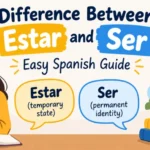
Many Spanish learners get confused by the difference between estar and ser because both verbs can mean “to be” in English.
The key is that Spanish uses them for different kinds of situations. Ser usually describes identity, permanent or defining traits, origin, time, and what something is. Estar usually describes temporary states, locations, conditions, and how someone or something is at a particular moment.
Understanding this difference makes Spanish sentences much easier to build. In this guide, you will learn what ser and estar mean, how they work, why they are different, and when to use each one with simple real-life examples.
Quick Answer: Difference Between Estar and Ser
The simplest way to remember it is:
Ser describes what someone or something is.
Estar describes how or where someone or something is.
- Ella es feliz. = She is a happy person.
- Ella está feliz. = She is happy right now.
The exact meaning can change depending on which verb you use.
Definition of Difference Between Estar and Ser
- Ser: A Spanish verb meaning “to be,” commonly used for identity, origin, profession, characteristics, relationships, and other defining information.
- Estar: A Spanish verb meaning “to be,” commonly used for location, temporary conditions, feelings, and states at a particular time.
For example:
Soy estudiante. = I am a student.
Estoy cansado. = I am tired.
The first sentence tells you something about identity or role. The second describes a current condition.
Pronunciation
Here is a simple pronunciation guide:
| Word | US English Approximation | UK English Approximation |
| ser | “sehr” | “seuh” / “sehr” |
| estar | “eh-STAR” | “eh-STAR” |
The pronunciation is not the difficult part. The real challenge is knowing which verb fits the situation.
So, let’s move from pronunciation to the rule that actually helps you choose between them.
What Is the Difference Between Estar and Ser?
The main difference is the type of information you are giving.
Ser is generally used when you identify or describe something as part of its identity, nature, origin, role, or defining characteristics.
Estar is generally used when you describe a current condition, temporary state, location, or situation.
Think of the two verbs this way:
Ser = what something is
Estar = how or where something is
This is not a perfect rule for every Spanish sentence, but it is an excellent starting point for beginners.
Example
Juan es alto.
Juan is tall.
This describes a characteristic of Juan.
Juan está cansado.
Juan is tired.
This describes Juan’s current condition.
The important point is not simply “permanent versus temporary.” Spanish grammar is more precise than that. Some situations that seem temporary in English still use ser, while some conditions can last a long time and still use estar.
Ser vs. Estar: Main Differences at a Glance
| Feature | Ser | Estar |
| Basic meaning | To be | To be |
| Identity | Used | Usually not used |
| Origin | Used | Not normally used |
| Profession | Used | Not normally used |
| Location | Usually not used for location | Used |
| Temporary condition | Usually not used | Used |
| Feelings | Can describe personality | Common for current feelings |
| Physical condition | Defining traits | Current condition |
| Time and dates | Used | Not normally used |
| Result or state | Less common | Common |
| Characteristics | Used for defining traits | Used for current states |
This table gives you the basic difference between estar and ser, but the real understanding comes from seeing how the verbs behave in actual sentences.
When Do You Use Ser in Spanish?
You normally use ser when talking about identity, origin, profession, relationships, characteristics, time, or what something fundamentally is.
1. Identity
Use ser to identify a person or thing.
Soy María.
I am María.
Él es mi hermano.
He is my brother.
Eso es un teléfono.
That is a phone.
Here, you are explaining what someone or something is.
2. Origin
Use ser to talk about where someone is from.
Soy de México.
I am from Mexico.
Ella es de España.
She is from Spain.
Notice that location normally uses estar, but origin uses ser.
That distinction is extremely important.
3. Profession
Use ser when saying what someone’s profession or role is.
Soy profesor.
I am a teacher.
Mi hermana es doctora.
My sister is a doctor.
You are identifying the person’s professional role, so ser fits naturally.
4. Characteristics
Use ser for characteristics that describe what someone or something is like.
El coche es rápido.
The car is fast.
Ana es inteligente.
Ana is intelligent.
La casa es grande.
The house is big.
These statements describe qualities rather than temporary conditions.
5. Time and Dates
Spanish uses ser for time and dates.
Es lunes.
It is Monday.
Son las tres.
It is three o’clock.
Hoy es septiembre quince.
Today is September 15.
This is one area where English learners sometimes expect estar, but Spanish uses ser.
When Do You Use Estar in Spanish?
Use estar mainly for location, current conditions, feelings, and temporary or changing states.
1. Location
One of the most important uses of estar is location.
Estoy en casa.
I am at home.
Madrid está en España.
Madrid is in Spain.
El libro está sobre la mesa.
The book is on the table.
Even though a place may remain in the same location for hundreds of years, Spanish normally uses estar for physical location.
This is why the simple rule “ser = permanent, estar = temporary” can be misleading.
2. Feelings and Emotions
Use estar to describe how someone feels at a particular time.
Estoy feliz.
I am happy.
Ella está triste.
She is sad.
Estamos nerviosos.
We are nervous.
The focus is on the person’s current emotional state.
3. Physical Conditions
Use estar for many current physical conditions.
Estoy cansado.
I am tired.
Está enfermo.
He is sick.
Estamos listos.
We are ready.
These sentences tell us how someone is at that moment.
4. Changing Conditions
Estar is also common when something is in a particular state.
La puerta está abierta.
The door is open.
La comida está fría.
The food is cold.
El café está caliente.
The coffee is hot.
The focus is on the current condition rather than the identity of the object.
Difference Between Estar and Ser With Adjectives
This is where Spanish becomes especially interesting.
Some adjectives change meaning depending on if you use ser or estar.
Consider aburrido:
Él es aburrido.
He is boring.
Él está aburrido.
He is bored.
The adjective is similar, but the verb changes the meaning.
Another example is listo:
Ella es lista.
She is clever or smart.
Ella está lista.
She is ready.
This shows why memorizing “ser = permanent” and “estar = temporary” is not enough. You need to understand the meaning created by the combination of the verb and adjective.
Ser vs. Estar With “Bueno” and “Malo”
Another useful example is bueno.
Él es bueno.
He is a good person.
Él está bueno.
Depending on context, this can mean he is attractive, physically well, or “good-looking.”
Likewise:
La comida es buena.
The food is good in quality.
La comida está buena.
The food tastes good or is good right now.
The difference comes from what you are trying to communicate.
When learning Spanish, do not translate every sentence word-for-word from English. Ask yourself:
Am I describing what something is, or describing its current state?
Difference Between Estar and Ser for Location
This is one of the most common beginner questions.
The general rule is:
Use estar for physical location.
Examples:
Estoy en la escuela.
I am at school.
El restaurante está cerca.
The restaurant is nearby.
Los libros están en la mochila.
The books are in the backpack.
But use ser when talking about someone’s origin:
Soy de Colombia.
I am from Colombia.
So:
Soy de Colombia. = I am from Colombia.
Estoy en Colombia. = I am in Colombia.
That small difference completely changes the meaning.
Why Is the Difference Between Estar and Ser So Confusing?
English makes the problem harder because English normally uses only one main verb: “to be.”
For example:
- I am tired.
- I am American.
- I am a teacher.
- I am at home.
- I am happy.
Spanish does not use one verb for all these situations.
Instead, Spanish chooses between ser and estar.
That means English speakers often try to translate directly:
“I am” → “soy”
But that does not work every time.
“I am tired” is:
Estoy cansado.
Not:
Soy cansado.
Likewise:
“I am from Canada” is:
Soy de Canadá.
Not:
Estoy de Canadá.
The best approach is to learn the situation, not just the English translation.
KEY DIFFERENCES EXPLAINED BETWEEN ESTAR AND SER
1. Identity vs. Current Condition
Ser identifies someone or something.
Ella es estudiante.
She is a student.
Estar describes a current condition.
Ella está cansada.
She is tired.
2. Origin vs. Location
Ser describes origin.
Somos de Perú.
We are from Peru.
Estar describes current location.
Estamos en Perú.
We are in Peru.
3. Defining Trait vs. Current State
Mi hermano es tranquilo.
My brother is calm by nature.
Mi hermano está tranquilo.
My brother is calm right now.
The first may describe personality. The second focuses on his present state.
4. Profession vs. Condition
Soy médico.
I am a doctor.
Estoy enfermo.
I am sick.
Your profession identifies your role. Being sick describes your current condition.
5. Time vs. Situation
Son las ocho.
It is eight o’clock.
But:
La tienda está cerrada.
The store is closed.
Time uses ser, while a current condition commonly uses estar.
6. General Quality vs. Current Experience
La comida es buena.
The food is good in quality.
La comida está buena.
The food tastes good right now.
This difference becomes easier when you focus on the intended meaning instead of English grammar.
7. Personality vs. Mood
Pedro es una persona triste. Pedro is a sad person.
En este momento, Pedro está triste. Pedro is sad right now.
The first describes a broader characteristic. The second describes a present emotional state.
Difference and Similarity Between Estar and Ser
| Feature | Ser | Estar | Similarity |
| Meaning | Means “to be” | Also means “to be” | Both describe a subject |
| Identity | Gives identity | Usually describes state | Both can describe people |
| Location | Used for origin | Used for physical location | Both can relate to place |
| Characteristics | Describes defining traits | Describes current states | Both work with adjectives |
| Feelings | Can describe personality | Describes current feelings | Both affect meaning with adjectives |
| Profession | Identifies a job or role | Not normally used | Both can appear in personal statements |
| Time | Used for time and dates | Not normally used | Both are common everyday verbs |
| Condition | Less common for current condition | Common for current condition | Both can change sentence meaning |
This table clearly shows the difference and similarity between estar and ser for quick understanding.
Common Mistakes With Estar and Ser
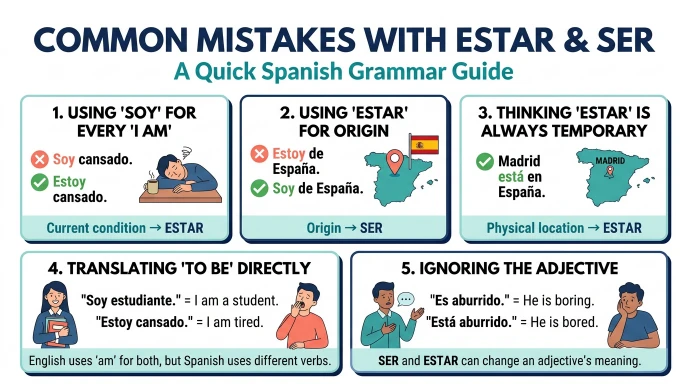
Mistake 1: Using “Soy” for Every “I Am”
A beginner may say:
Soy cansado.
The natural sentence is:
Estoy cansado.
Why? Because tiredness is a current condition.
Fix:
Ask if you are describing who you are or how you are right now.
Mistake 2: Using Estar for Origin
Incorrect:
Estoy de España.
Correct:
Soy de España.
Origin uses ser.
Mistake 3: Thinking Estar Always Means Temporary
This rule can cause problems.
For example:
Madrid está en España.
Madrid’s location is not temporary. Yet Spanish uses estar for physical location.
Fix:
Learn major uses rather than relying only on the permanent/temporary rule.
Mistake 4: Translating “To Be” Directly
English says:
I am a student.
Spanish says:
Soy estudiante.
But:
I am tired.
Spanish says:
Estoy cansado.
The same English verb can require different Spanish verbs.
Mistake 5: Ignoring the Adjective
Some adjectives change meaning with ser and estar.
Es aburrido. = He is boring.
Está aburrido. = He is bored.
Fix:
Learn common adjective pairs as complete expressions.
Real-Life Examples of the Difference Between Estar and Ser
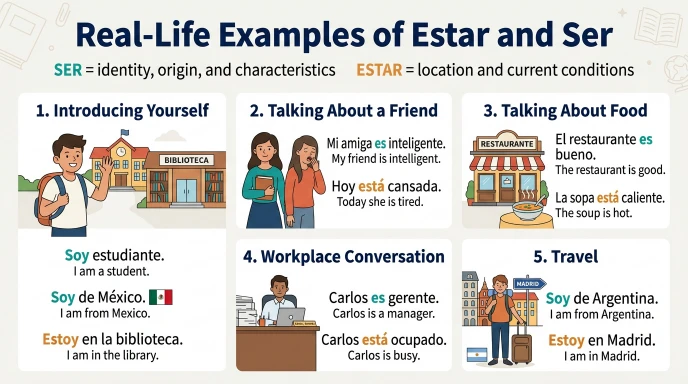
Scenario 1: Introducing Yourself
At a new school, you might say:
Me llamo Daniel. Soy estudiante y vengo de México.
You are giving your name, role, and origin.
Later, you might say:
Estoy en la biblioteca.
Now you are explaining where you are.
Scenario 2: Talking About a Friend
Mi amiga es muy inteligente.
My friend is very intelligent.
Hoy está cansada.
Today she is tired.
Her intelligence is presented as a characteristic. Her tiredness describes today’s condition.
Scenario 3: Talking About Food
El restaurante es bueno.
The restaurant is good.
La sopa está caliente.
The soup is hot.
The first describes the restaurant’s overall quality. The second describes the soup’s current condition.
Scenario 4: Workplace Conversation
Carlos trabaja como gerente. Carlos is a manager.
En este momento, Carlos está ocupado. Carlos is busy.
His job is identified with ser. His current workload is described with estar.
Scenario 5: Travel
Soy de Argentina.
I am from Argentina.
Estoy en Madrid.
I am in Madrid.
This is a perfect real-world example because travelers frequently need both verbs in the same conversation.
When Should You Use Ser or Estar?
Use this quick decision guide:
Choose ser when you are talking about:
- Identity
- Origin
- Profession
- Nationality
- Relationships
- Defining characteristics
- Personality
- Time
- Dates
- What something is made of
- Ownership or classification
Choose estar when you are talking about:
- Physical location
- Current feelings
- Temporary conditions
- Physical states
- Current situations
- Results or states
- How something looks or feels at a particular moment
A simple question to ask yourself
Before choosing the verb, ask:
“Am I explaining what it is, or how/where it is?”
If you are explaining what it is, ser is often the right choice.
If you are explaining how or where it is, estar is often the right choice.
Can Ser and Estar Change the Meaning of a Sentence?
Yes. This is one of the most important reasons to learn the difference.
Consider:
Ella es aburrida.
She is boring.
Ella está aburrida.
She is bored.
The subject has not changed. The adjective is closely related. But the verb changes the meaning.
Another example:
Él es listo.
He is clever.
Él está listo.
He is ready.
These examples show that ser and estar are not interchangeable versions of “to be.” They help Spanish speakers express different ideas.
How Should Beginners Remember Ser and Estar?
A useful memory system is to group the verbs by purpose.
SER = identity and definition
Think:
Who? What? Where from? What kind? When?
Examples:
- Who are you?
- What is it?
- Where are you from?
- What is your profession?
- What is it like?
- What day is it?
ESTAR = state and position
Think:
How? Where? How are you right now?
Examples:
- How are you?
- Where are you?
- Is the door open?
- Is the food hot?
- Are you tired?
- Is the phone on the table?
This method is more useful than trying to memorize a single “permanent versus temporary” rule.
How Search Engines Understand the Difference Between Estar and Ser
Search engines such as Google can understand that searches like “ser vs estar,” “difference between ser and estar,” “when to use ser or estar,” and “ser and estar examples” represent closely related informational intent.
A useful page should therefore answer the main question directly while also covering the connected questions a learner naturally asks.
For example, someone searching the topic may next want to know:
- What does ser mean?
- What does estar mean?
- When do I use estar?
- When do I use ser?
- Is location ser or estar?
- Why is “soy cansado” incorrect?
- Can the meaning change with adjectives?
- What is the easiest way to remember ser and estar?
That is why a complete explanation should connect definitions, grammar rules, examples, exceptions, and practical usage rather than repeating the same definition.
Modern search systems also evaluate the relationship between related concepts. In this topic, terms such as Spanish grammar, Spanish verbs, adjectives, identity, location, origin, feelings, profession, temporary state, and current condition naturally establish that context.
Expert Insight:
One of the most useful learning insights is this:
Do not treat ser and estar as simply “permanent” and “temporary.”
That shortcut helps at first, but it breaks down in real Spanish.
For example:
Madrid está en España.
Madrid’s location is not temporary, but estar is still correct because Spanish uses estar for physical location.
A stronger learning strategy is to memorize the reason for the verb.
Instead of memorizing:
“Estar means temporary.”
Learn:
“Estar is used for location and current states.”
Instead of memorizing:
“Ser means permanent.”
Learn:
“Ser is used for identity, origin, profession, defining characteristics, time, and other identifying information.”
This approach gives beginners a more reliable foundation and helps intermediate learners understand why native Spanish speakers choose one verb over the other.
FAQs
What is the main difference between ser and estar?
Ser usually describes identity, origin, profession, characteristics, and time. Estar usually describes location, current conditions, feelings, and states.
Does ser mean permanent and estar mean temporary?
Not exactly. This is a useful beginner shortcut, but it is not a complete rule. Estar is used for location even when the location is permanent, such as Madrid está en España.
Is location ser or estar?
Physical location normally uses estar.
El libro está en la mesa.
The book is on the table.
Origin, however, uses ser.
Soy de México.
I am from Mexico.
Why do you say “estoy cansado” instead of “soy cansado”?
Because estoy cansado describes your current condition: “I am tired.” Soy cansado can suggest a more general characteristic and is not the normal way to say that you feel tired right now.
Can ser and estar change the meaning of an adjective?
Yes. For example:
Es listo = He is clever.
Está listo = He is ready.
The verb can significantly affect the meaning.
Which verb is used for professions?
Ser is normally used for professions.
Soy profesor.
I am a teacher.
Which verb is used for feelings?
Estar is commonly used for current feelings.
Estoy feliz.
I am happy.
Estamos nerviosos.
We are nervous.
Which verb should I use for nationality?
Use ser.
Soy canadiense.
I am Canadian.
Nationality is part of identity.
Is “soy de” or “estoy de” correct for origin?
Soy de is correct for origin.
Soy de España.
I am from Spain.
What is the easiest way to remember ser and estar?
Remember:
SER = what you are
ESTAR = how or where you are
Then learn the major uses and common exceptions through examples.
Conclusion
The difference between estar and ser becomes much easier when you stop thinking of both verbs as simple translations of “to be.” Spanish uses them to express different kinds of information. Ser is commonly used for identity, origin, profession, nationality, defining characteristics, relationships, time, and dates. Estar is commonly used for physical location, current feelings, temporary conditions, and present states.
The most useful beginner rule is simple: ser often tells you what someone or something is, while estar tells you how or where someone or something is. However, do not depend only on the idea of permanent versus temporary. Location is a good example of why that shortcut is incomplete.
In practical use, ask yourself one question: Am I describing identity or a current state/location? That question will help you choose the correct Spanish verb in many everyday situations.
Once you learn common patterns such as soy de, soy estudiante, estoy cansado, and estoy en casa, the difference between ser and estar becomes much more natural.
READ MORE ABOUT!
- Difference Between Pardon and Commutation: A Clear Guide
- Difference Between Among and Between: Easy Grammar Guide

I am Emily Johnson, a USA-based content writer who creates easy-to-read blogs on language and daily life topics. I explain complex ideas in simple English for students and beginners so they can understand easily.