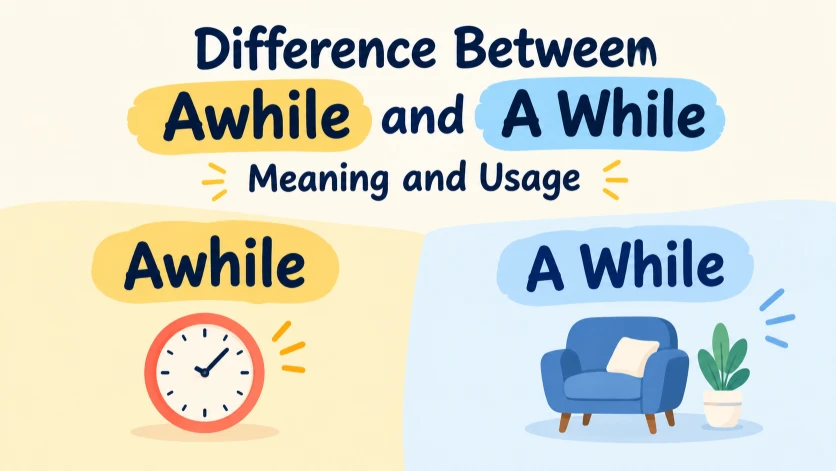
The main difference between awhile and a while is their grammatical use. Awhile is an adverb meaning for a short time, while a while is a noun phrase that also refers to a period of time.
They sound the same, so many writers get confused about which spelling to choose. For example, you can say, “Stay awhile” or “Stay for a while.” Both are correct.
In this guide, you will learn the definitions, pronunciation, grammar rules, common mistakes, and real-life examples to help you use both expressions correctly.
Quick Answer
- Awhile: One word, used as an adverb meaning for a short time.
- A while: Two words, used as a noun phrase meaning a period of time.
Example:
- Please sit awhile.
- Please sit for a while.
Both sentences are correct because awhile can replace the phrase for a while in this construction.
Definition of Awhile and A While
- Awhile: An adverb that means for a short period. Example: “Let’s rest awhile.”
- A while: An article and noun combination referring to a period of time. Example: “We waited for a while.”
The key difference is grammatical, not pronunciation or meaning.
Pronunciation
Both expressions have the same pronunciation in American and British English.
| Expression | US Pronunciation | UK Pronunciation |
| Awhile | uh-WHYLE | uh-WHYLE |
| A while | uh-WHYLE | uh-WHYLE |
Both are pronounced like the words “uh” and “while” spoken together.
Because they sound identical, you cannot identify the correct spelling by listening. You need to look at how the words function in the sentence.
Let’s explore the grammar behind this difference.
Awhile vs. A While: Comparison
The following table highlights the main differences between these two expressions.
| Feature | Awhile | A While |
| Word count | One word | Two words |
| Part of speech | Adverb | Noun phrase |
| Meaning | For a short time | A period of time |
| Grammar | Modifies a verb | Works as a noun phrase |
| Common use | Stay awhile | Stay for a while |
| Article | No separate article | Includes the article “a” |
| Preposition | Usually does not need “for” | Often follows “for” |
| Pronunciation | Uh-while | Uh-while |
| Formal writing | Correct | Correct |
| Example | Rest awhile. | Rest for a while. |
The biggest difference is that awhile functions as an adverb, whereas a while functions as a noun phrase.
Key Differences Explained Between Awhile and A While
Understanding a few simple grammar rules makes choosing the correct spelling much easier.
1. Awhile Is an Adverb
The word awhile describes how long an action continues. It tells the reader that something happens for a short period.
For example:
- Let’s talk awhile.
- You can stay awhile.
- Sit awhile and relax.
In these sentences, awhile modifies the verbs talk, stay, and sit.
2. A While Is a Noun Phrase
The expression a while refers to a period of time. The word while is a noun, and a is the article before it.
For example:
- I haven’t seen you for a while.
- She waited a while.
- It took a while to finish the work.
Here, a while acts as a noun phrase rather than an adverb.
3. The Preposition “For” Helps You Choose
One of the easiest ways to remember the difference is to look for the word for.
When you use for before the expression, write a while as two words.
Correct:
- Wait for a while.
- Stay here for a while.
- Let’s rest for a while.
Incorrect:
- Wait for awhile.
- Stay here for awhile.
- Let’s rest for awhile.
Why? Because the preposition for needs a noun phrase in these examples, not the adverb awhile.
4. Both Expressions Describe Time
Although their grammar differs, both expressions communicate a period of time.
For example:
- I stayed awhile.
- I stayed for a while.
Both sentences tell us that someone stayed for some time.
This shared meaning is the main reason people confuse the two spellings.
5. A While Can Describe a Longer or Unspecified Period
The expression a while does not always mean a few minutes. Its length depends on the situation.
Examples:
- I haven’t visited my hometown in a while.
- We talked for a while after dinner.
- It may take a while to learn a new language.
The period could be short or relatively long. The expression does not give an exact duration.
6. Awhile Is Usually Used Without “For”
When awhile modifies a verb, it already carries the meaning of for a short time.
Examples:
- Stay awhile.
- Think awhile before answering.
- Rest awhile after lunch.
Adding for directly before awhile creates a grammatical problem in standard English.
Easy reminder: Use awhile after an action when you mean for a short time. Use a while when the sentence needs a noun phrase.
Difference and Similarity Between Awhile and A While
Both expressions are related to time, but their grammatical roles are different.
| Feature | Awhile | A While | Similarity |
| Meaning | For a short time | A period of time | Both refer to time |
| Structure | One word | Two words | Both contain the word while |
| Grammar | Adverb | Noun phrase | Both work in time-related sentences |
| Usage | Stay awhile | Stay for a while | Both describe staying |
| Preposition | Does not take preceding for in standard use | Can follow for | Both appear in similar contexts |
| Pronunciation | Uh-while | Uh-while | They sound identical |
| Writing | Written together | Written separately | Both are standard English |
| Duration | Usually a short time | An unspecified period | Neither gives an exact duration |
This table clearly shows the difference and similarity between Awhile and A While for quick understanding.
How to Use Awhile and A While Correctly in Sentences
The easiest way to understand these expressions is to see how they work in everyday writing.
When to Use Awhile
Use awhile when you want to describe an action continuing for some time.
Examples:
- Stay awhile, and we can catch up.
- The children played awhile in the garden.
- I sat awhile and enjoyed the peaceful afternoon.
- Let’s wait awhile before making a decision.
- She rested awhile after completing her work.
Notice that awhile comes after an action or verb phrase. It explains the duration of that action.
When to Use A While
Use a while when you need a noun phrase referring to a period of time.
Examples:
- I will be busy for a while.
- We haven’t talked in a while.
- Give me a while to finish this project.
- It has been a while since our last meeting.
- He thought for a while before replying.
These sentences use a while as a noun phrase.
Common Mistakes With Awhile and A While
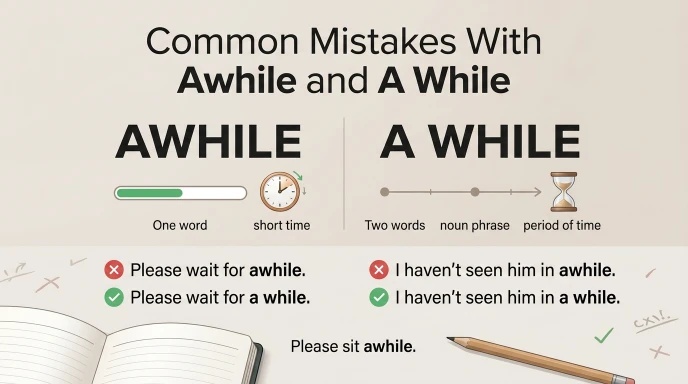
Even people who write English regularly sometimes mix up these expressions. Here are common mistakes and their corrections.
Mistake 1: Writing “For Awhile”
Incorrect: Please wait for awhile.
Correct: Please wait for a while.
Why? The preposition for should be followed by the noun phrase a while.
Mistake 2: Using “A While” Without Understanding Its Grammar
Incorrect: Please sit a while.
Better: Please sit awhile.
Also correct: Please sit for a while.
Why? In this intended meaning, awhile works as an adverb after the verb sit. The version with for a while is also standard.
Mistake 3: Thinking Both Spellings Are Interchangeable Everywhere
Incorrect: I haven’t seen him in awhile.
Correct: I haven’t seen him in a while.
Why? The preposition in is followed by the noun phrase a while in this sentence.
Mistake 4: Choosing Spelling Based on Pronunciation
Incorrect approach: Writing whichever form sounds right.
Correct approach: Check the grammatical structure.
Why? Both expressions sound exactly alike. Pronunciation cannot tell you if to use one word or two.
Mistake 5: Assuming Awhile Always Means a Few Minutes
Incorrect assumption: Awhile always refers to a very short, fixed period.
Correct understanding: It means for a short time, but the exact duration depends on context.
Why? English does not assign a fixed number of minutes to this expression.
Real-Life Examples of Awhile and A While
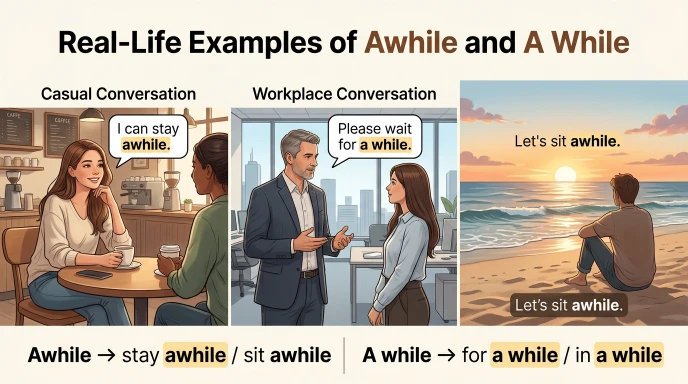
Here are some practical situations that show how these expressions work in everyday communication.
Example 1: A Casual Conversation
Friend 1: “Do you have time to talk?”
Friend 2: “Sure, I can stay awhile.”
Here, awhile describes how long the person can stay.
Example 2: A Workplace Conversation
A manager tells an employee:
“Please wait for a while. I need to finish this meeting.”
The phrase a while refers to an unspecified waiting period.
Example 3: Social Media Caption
Someone posts a picture of a peaceful beach with the caption:
“Let’s sit awhile and enjoy the sunset.”
Here, awhile describes the action of sitting.
Example 4: Business Email
A customer writes:
“I haven’t received an update in a while. Could you please share the latest information?”
The expression a while follows the preposition in.
Example 5: Everyday Learning
A student says:
“I need to study awhile before taking the test.”
The word awhile modifies the verb study.
Example 6: Personal Message
Someone sends a text:
“It’s been a while since we last met. Let’s catch up soon!”
Here, a while refers to the time that has passed since the last meeting.
These examples show that the correct spelling depends on sentence structure, not the situation or writing style.
When Should You Use Awhile or A While?
Choosing the correct expression becomes simple when you understand what your sentence needs.
Use this quick guide:
| Situation | Correct Choice | Example |
| Describing an action | Awhile | Stay awhile. |
| After the preposition for | A while | Wait for a while. |
| After the preposition in | A while | I haven’t seen her in a while. |
| Talking about a period | A while | It took a while. |
| Asking someone to rest | Awhile | Rest awhile. |
| Describing time since an event | A while | It’s been a while. |
A simple trick: Try replacing the expression with “for a short time.”
- If it modifies an action directly, awhile may work.
- If the sentence needs a noun after a preposition, use a while.
For example:
“She rested awhile” becomes “She rested for a short time.”
But “She rested for a while” already has the correct noun phrase.
Why Do People Get Confused Between Awhile and A While?
There are several reasons why these expressions cause confusion.
1. They Sound Exactly the Same
Both expressions have identical pronunciation. When people hear them in conversations, they cannot tell if the speaker means one word or two.
This makes spelling difficult, especially for beginners.
2. Their Meanings Are Very Similar
Both expressions refer to time.
For example:
- Stay awhile.
- Stay for a while.
The meaning is almost identical, but the grammar is different.
3. English Uses Different Word Forms
English sometimes combines words into one form while keeping a similar meaning.
For example, awhile is an adverb, while a while is an article followed by a noun.
Understanding parts of speech helps explain why both spellings exist.
4. Online Writing Creates Confusion
People often use informal language on Instagram, Facebook, Reddit, YouTube, and messaging apps.
Quick typing can lead to spelling mistakes. Readers may also see both forms used incorrectly, making it harder to remember the proper rule.
However, social media habits do not change the standard grammatical distinction.
How Search Engines Understand Awhile and A While
Search engines such as Google use language context to understand written content. They do not simply rely on if two words look similar.
For example, consider these sentences:
- “Stay awhile.”
- “Wait for a while.”
Both communicate a similar idea, but their sentence structures differ.
Modern search systems use context, relationships between words, and natural language processing to interpret queries and web pages.
Why Search Intent Matters
Someone searching for “difference between awhile and a while” usually wants a grammar explanation, not a general definition of time.
A useful article should therefore provide:
- Clear definitions of both expressions.
- Grammar rules explaining their differences.
- Correct and incorrect examples.
- Answers to common spelling questions.
- Practical guidance for everyday writing.
Google, Instagram, and YouTube serve different purposes. Google helps users discover written explanations, while Instagram and YouTube are platforms where people may encounter these expressions in captions, comments, and videos.
There is no special content rule that makes one spelling automatically better than the other. Correct grammar, clear explanations, and relevant content help readers understand the topic.
Expert Insight: The Easiest Way to Remember Awhile vs. A While
The most useful approach is to focus on the word’s grammatical role instead of memorizing separate definitions.
Think of it this way:
Awhile = Adverb
It describes an action.
Example: “Let’s relax awhile.”
A while = Noun phrase
It refers to a period of time.
Example: “Let’s relax for a while.”
One helpful editing technique is to check the word immediately before the expression.
If you see for, in, or another preposition that introduces a time period, you will generally need a while.
This simple grammar check can prevent most common mistakes in emails, school assignments, articles, business writing, and everyday messages.
You do not need a complicated grammar formula. Just understand if your sentence needs an adverb or a noun phrase.
Frequently Asked Questions
When to Use Awhile or A While?
Use awhile as an adverb meaning “for a short time.” Use a while as a noun phrase, usually after a preposition such as for.
- Stay awhile. ✅
- Stay for a while. ✅
- I haven’t seen him in a while. ✅
Is It Correct to Say “For Awhile”?
In standard English, “for awhile” is generally incorrect. Use “for a while” because for is followed by the noun phrase a while.
- I waited for a while. ✅
- I waited for awhile. ❌
What Does “Awhile” Mean?
Awhile means “for a short time.” It is an adverb and usually appears directly after a verb.
Example: “Please sit awhile.”
Is It Correct to Say “Stay a While” or “Stay Awhile”?
Both are correct, but they are structured differently.
- Stay awhile. ✅
- Stay a while. ✅
Awhile works as an adverb, while a while is a noun phrase. Both can mean “stay for a short time.”
Is It Correct to Say “It’s Been Awhile”?
Yes, “It’s been awhile” is common and understandable, especially in informal English.
However, “It’s been a while” is generally preferred in careful or formal writing.
- It’s been a while since we talked. ✅
- It’s been awhile since we talked. ✅ Informal
Which Is Correct: “It Took Me Awhile” or “It Took Me a While”?
Both can be correct, but “It took me a while” is the safer choice in standard writing.
- It took me a while to finish. ✅
- It took me awhile to finish. ✅ Informal/common
A simple rule is: use “awhile” after a verb when it means “for a short time”; use “a while” after prepositions such as “for” and “in.”
Conclusion
The difference between awhile and a while is mainly about grammar. Both expressions relate to time, but they serve different purposes in a sentence.
Remember these two simple rules:
- Awhile: Use one word when you need an adverb meaning for a short time. Example: “Stay awhile.”
- A while: Use two words when you need a noun phrase referring to a period of time. Example: “Stay for a while.”
The easiest way to avoid mistakes is to check the words around the expression. If you use the preposition for before it, choose a while. If the expression directly describes an action, awhile may be the correct choice.
Both forms are accepted in standard English, so you do not need to avoid either one. Once you understand their grammatical roles, choosing between them becomes much easier.
If you are writing a school assignment, sending a text, creating an Instagram caption, or preparing a professional email, this small grammar rule will help make your writing clearer and more accurate.
READ MORE ABOUT!
- Difference Between Sleet and Hail: A Simple Guide
- Difference Between Therapist and Counselor: Easy Guide

I am James Carter, a professional content writer from the United States. I specialize in writing simple and clear comparison blogs that help students and readers understand difficult topics easily. My writing focuses on everyday language, education, science, and lifestyle topics. I believe that learning should be easy for everyone, so I use simple words and real-life examples in my articles.