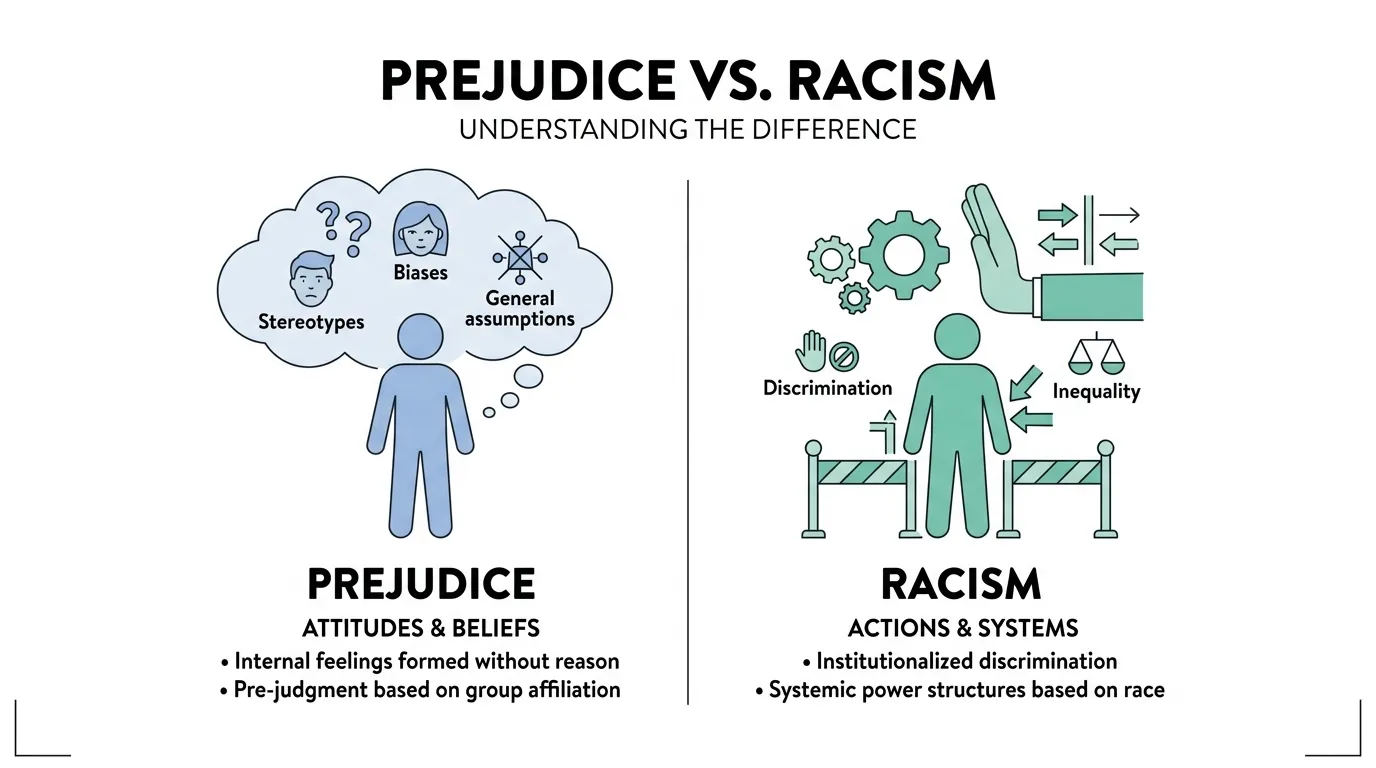
The difference between racism and prejudice is that prejudice is a biased opinion about any group, while racism is unfair treatment or discrimination specifically based on race.
Many users get confused about the difference between racism and prejudice because both terms involve unfair judgment, stereotypes, and negative attitudes toward people.
In simple words, prejudice is a personal opinion or bias, while racism is a larger system or behavior connected to race and power. Understanding the difference between racism and prejudice matters in schools, workplaces, social media discussions, and real-world relationships.
Today, conversations on platforms like Google, Meta, Instagram, and YouTube often include debates about discrimination, equality, bias, stereotypes, and social justice. That is why so many people search for the difference between racism and prejudice online.
In this complete guide, you will learn:
- What racism and prejudice really mean
- How they are different
- Why people confuse them
- Real-life examples
- Similarities and key differences
- When and how each concept appears in society
By the end, you will not need another article to understand this topic clearly.
Difference Between Racism and Prejudice
Prejudice is a pre-judgment or negative opinion about a person or group without knowing the facts. Racism is discrimination, unfair treatment, or systems of inequality based specifically on race.
For example:
- Thinking all teenagers are irresponsible is prejudice.
- Refusing to hire someone because of their race is racism.
In short:
- Prejudice = biased attitude
- Racism = race-based discrimination or system
Definition of Difference Between Racism and Prejudice
- Prejudice: A negative opinion, assumption, or stereotype about a person or group formed before knowing the truth.
- Racism: Belief, behavior, or systems that treat people unfairly because of race or ethnicity.
Simple Example
A person may dislike another group because of stereotypes (prejudice), but racism happens when race becomes the reason for exclusion, discrimination, or unequal treatment.
Pronunciation
| Word | US Pronunciation | UK Pronunciation |
| Racism | RAY-siz-um | RAY-siz-um |
| Prejudice | PREJ-uh-dis | PREJ-uh-dis |
Now that the meanings are clear, let’s understand the topic more deeply with practical comparisons and real-world explanations.
Racism vs Prejudice Comparison
| Feature | Racism | Prejudice |
| Main Meaning | Discrimination based on race | Bias or judgment without facts |
| Focus | Race or ethnicity | Any group or person |
| Type | Social/systemic issue | Personal attitude or belief |
| Power Element | Often linked to power systems | May exist without power |
| Examples | Segregation, racial profiling | Stereotyping introverts |
| Legal Impact | Can violate laws | Not always illegal |
| Social Impact | Creates inequality | Creates unfair opinions |
| Scope | Narrower but deeper | Broader category |
This comparison helps users quickly understand the difference between racism and prejudice in daily life.
Key Differences Explained Between Racism and Prejudice
1. Racism Is About Race Specifically
Racism focuses on race, skin color, or ethnic background. Prejudice can target anything including age, religion, gender, language, or appearance.
Real-Life Example
A company rejecting applicants because of skin color is racism. Assuming older workers are slow with technology is prejudice.
2. Prejudice Starts in the Mind
Prejudice often begins as thoughts, assumptions, or stereotypes. Racism usually appears through actions, systems, or social structures.
Example
Believing a group is “less intelligent” is prejudice. Creating unfair policies against that group becomes racism.
3. Racism Can Be Systemic
One major difference between racism and prejudice is that racism can exist inside institutions like schools, workplaces, housing systems, and law enforcement.
Practical Insight
In real scenarios, unequal opportunities in education or hiring can continue for generations because of systemic racism.
4. Prejudice Does Not Always Involve Power
Someone can hold prejudiced views without controlling systems or institutions. Racism often becomes more harmful when connected to power and authority.
5. Racism Has Larger Social Consequences
Racism can affect jobs, healthcare, education, and legal treatment. Prejudice may hurt feelings or relationships, but racism can shape entire societies.
6. Prejudice Can Exist Without Hatred
Sometimes prejudice comes from ignorance, upbringing, or cultural influence rather than direct hate.
Example
A child repeating stereotypes learned online may show prejudice without fully understanding the impact.
7. Racism Often Leads to Discrimination
Racism usually results in unequal treatment or exclusion.
Example
Racial profiling in airports or policing is racism because it affects how people are treated.
Difference and Similarity Between Racism and Prejudice
| Feature | Racism | Prejudice | Similarity |
| Meaning | Bias tied to race | General unfair judgment | Both involve negative assumptions |
| Target | Ethnic or racial groups | Any individual or group | Both can hurt people emotionally |
| Cause | Historical/social systems | Personal beliefs or experiences | Both may come from stereotypes |
| Impact | Social inequality | Personal conflict | Both damage relationships |
| Behavior | Often action-based | Often attitude-based | Both may lead to discrimination |
| Legal Concern | Can break laws | Usually personal opinion | Both are socially harmful |
| Media Influence | Linked to racial issues | Linked to broad stereotypes | Media can spread both |
| Education Role | Studied in social justice | Studied in psychology | Awareness reduces both |
This table clearly shows the difference and similarity between racism and prejudice for quick understanding.
Why Does Racism Exist in Society?
Racism often develops through history, social systems, political control, and cultural narratives. Over time, stereotypes become normalized through institutions, media, and education.
Historically, racism was used to justify slavery, segregation, colonialism, and unequal treatment. Even today, algorithms, hiring systems, and social structures discussed on platforms like Google and Meta sometimes raise concerns about racial bias in technology and AI systems.
Information Gain Insight
Many articles only explain racism emotionally. But in practical use, racism also survives because systems repeat old patterns automatically unless they are actively corrected.
How Does Prejudice Develop?
Prejudice usually develops from:
- Family beliefs
- Cultural messaging
- Fear of differences
- Lack of education
- Media stereotypes
- Social grouping behavior
Most beginners think prejudice always comes from hate. In reality, it often comes from oversimplified thinking.
Example
A person who has never interacted with another culture may believe stereotypes simply because they lack experience.
How Media and Social Platforms Influence Racism and Prejudice
Modern social platforms shape opinions very quickly. Apps and websites such as Instagram, YouTube, and TikTok can either reduce ignorance through education or spread harmful stereotypes through viral misinformation.
Why This Matters
Algorithms prioritize engagement. Emotional or controversial content often spreads faster than balanced educational content.
Practical Reality
In real scenarios, repeated exposure to stereotypes online can slowly strengthen prejudice even when users do not realize it.
Can Someone Be Prejudiced Without Being Racist?
Yes. This is one of the most searched questions about the difference between racism and prejudice.
A person may hold unfair assumptions about personality, jobs, accents, or social groups without focusing on race.
Example
Believing all rich people are selfish is prejudice, not racism.
However, prejudice can become racism when race becomes the reason for discrimination or exclusion.
Is Racism Always Intentional?
No. Racism can be:
- Intentional
- Unintentional
- Institutional
- Cultural
- Structural
Many organizations today train employees about unconscious bias because people may unknowingly support unfair systems.
Expert Insight
Professionals in workplace diversity programs often explain that intent and impact are different. A person may not intend harm, but racial bias can still create unequal outcomes.
Common Mistakes with Racism and Prejudice
1. Thinking They Mean the Same Thing
Many users use both words interchangeably, but prejudice is broader while racism specifically involves race.
Fix
Remember:
- All racism includes prejudice
- Not all prejudice is racism
2. Believing Racism Only Means Hatred
Racism is not always open hatred. It can appear through policies, exclusion, or unequal opportunities.
Fix
Look at outcomes, not just emotions.
3. Assuming Prejudice Is Always Violent
Prejudice can be subtle, hidden, or passive.
Example
Ignoring someone’s opinion because of stereotypes is prejudice.
4. Ignoring Systemic Racism
Some people think racism only exists between individuals.
Fix
Understand how institutions and systems can create unequal treatment over time.
5. Thinking Education Automatically Removes Bias
Education helps, but awareness alone does not fully eliminate prejudice or racism.
Practical Truth
Human beings naturally categorize people. Critical thinking and experience help reduce harmful bias.
Real Life Examples with Racism and Prejudice
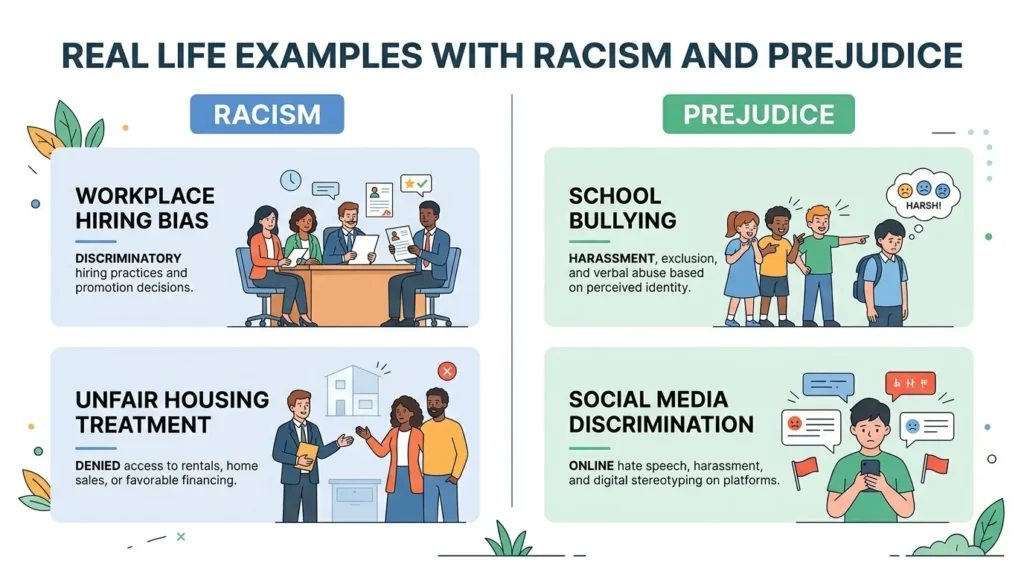
1. Workplace Hiring
A manager rejecting someone because of race is racism.
Assuming young workers are lazy without evidence is prejudice.
2. School Environment
Bullying a student because of ethnicity is racism.
Believing science students are socially awkward is prejudice.
3. Social Media Discussions
Online hate comments targeting racial groups are racism.
Mocking people from certain hobbies or fandoms can be prejudice.
4. Housing and Neighborhoods
Refusing to rent apartments to certain ethnic groups is racism.
Assuming large families are noisy tenants is prejudice.
5. Business and Marketing
Companies today analyze diversity carefully because public trust matters. Brands connected to Meta and Google often monitor harmful content to reduce racial discrimination online.
When to Use Each Concept
| Situation | Correct Term |
| Race-based unfair treatment | Racism |
| General stereotype | Prejudice |
| Biased opinion without evidence | Prejudice |
| Unequal racial policy | Racism |
| Cultural assumptions | Prejudice |
| Racial exclusion | Racism |
Easy Memory Trick
- Prejudice = opinion
- Racism = race-based unfair system or action
Why People Get Confused in Racism and Prejudice
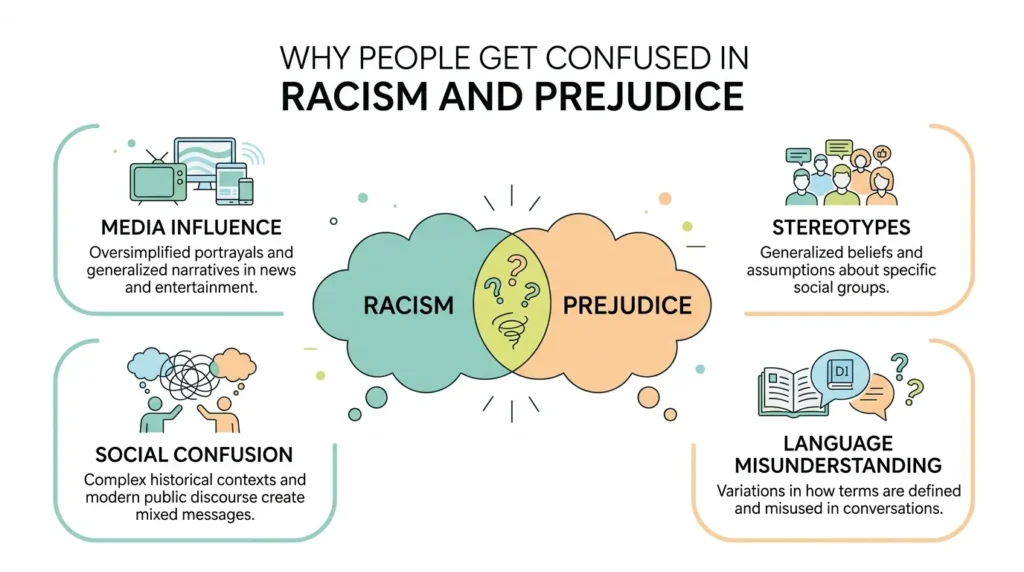
Language Overlap
Both words involve unfair thinking, so people often mix them together.
Media Simplification
News headlines and social media posts sometimes use terms loosely for emotional impact.
Educational Gaps
Many schools explain prejudice but not systemic racism deeply.
Internet Discussions
Online arguments on YouTube and Instagram often oversimplify complex social topics.
How Search Engines Understand Racism vs Prejudice and User Intent
Search engines like Google analyze search intent using NLP (Natural Language Processing), semantic, and contextual understanding.
When users type:
- “difference between racism and prejudice”
- “what is racism”
- “prejudice meaning”
- “racism vs discrimination”
Google tries to identify if users want:
- Definitions
- Social explanations
- Educational content
- Historical context
- Real-world examples
Ranking Insight
Content performs better when it:
- answers questions directly
- uses simple language
- includes examples
- covers related concepts naturally
That is why semantically rich articles usually rank higher in modern search systems.
Expert Insight
From an educational and social psychology perspective, understanding the difference between racism and prejudice helps improve communication, workplace culture, and community awareness.
In practical use, most beginners focus only on personal attitudes. However, experts often analyze larger systems, patterns, and social outcomes. That deeper understanding is important because racism affects opportunities, representation, and trust across society.
Professionals working in education, HR, diversity training, and social research often emphasize that reducing prejudice starts with awareness, but reducing racism also requires fair systems and accountability.
FAQs
What is the main difference between racism and prejudice?
Prejudice is a biased opinion about any group, while racism specifically targets race and often involves discrimination.
Can prejudice exist without racism?
Yes. A person can be prejudiced about age, profession, gender, or hobbies without involving race.
Is all racism based on prejudice?
Usually yes, because racism often begins with stereotypes or biased beliefs.
Can racism be unconscious?
Yes. Unconscious racial bias can influence decisions without a person realizing it.
Why do people confuse racism and prejudice?
Because both involve unfair assumptions and negative judgments.
Is discrimination the same as racism?
No. Discrimination is broader. Racism is one form of discrimination focused on race.
Can social media increase prejudice?
Yes. Repeated stereotypes and misinformation online can reinforce biased thinking.
How can people reduce prejudice?
Education, diverse experiences, critical thinking, and open conversations help reduce prejudice.
Conclusion
Understanding the difference between racism and prejudice is important because the two concepts affect society in different ways. Prejudice is mainly a personal bias or unfair assumption formed without proper knowledge, while racism is race-based discrimination that can operate through individuals, institutions, and social systems.
Many people use these terms interchangeably, but the distinction matters in education, workplaces, media discussions, and everyday communication. In real-life situations, prejudice may stay at the level of thoughts or stereotypes, while racism often creates unequal treatment, exclusion, and long-term social inequality.
The modern digital world has also changed how these issues spread and are discussed. Platforms connected to Google, Instagram, Meta, and YouTube influence public understanding through algorithms, trends, and viral content.
In simple words:
- Prejudice is unfair judgment.
- Racism is race-based unfair treatment and systemic inequality.
Once you understand that core idea, the difference becomes much clearer.
Read more about!
Difference Between Autobiography and Biography: Full Guide
Difference Between Urban and Suburban: Complete Guide

I am James Carter, a professional content writer from the United States. I specialize in writing simple and clear comparison blogs that help students and readers understand difficult topics easily. My writing focuses on everyday language, education, science, and lifestyle topics. I believe that learning should be easy for everyone, so I use simple words and real-life examples in my articles.