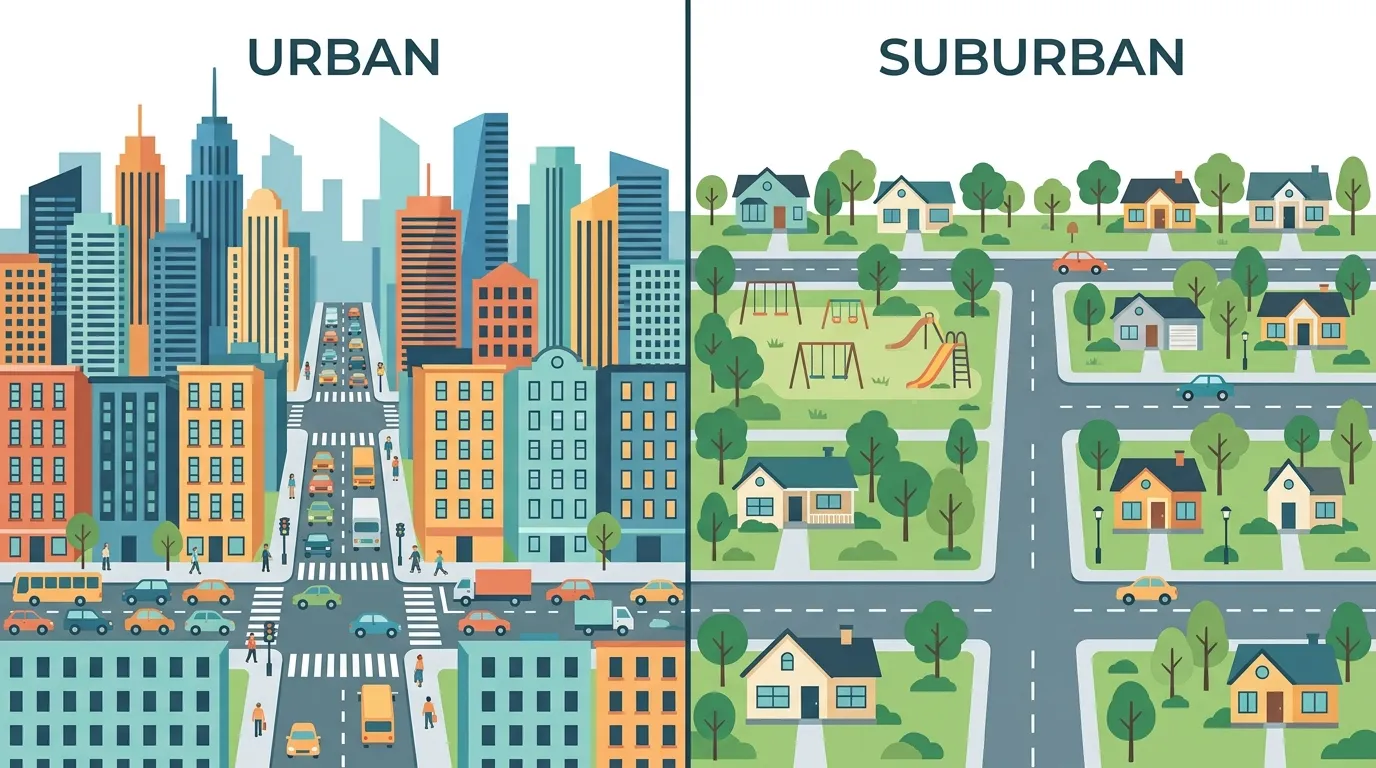
Urban areas are busy city centers with high population and tall buildings, while suburban areas are quieter residential communities located around cities with more space and fewer crowds.
The difference between urban and suburban areas is something many people search before choosing where to live, work, raise a family, or invest in property.
Some people love the fast energy of city life, while others prefer the quieter and more spacious suburban environment. In simple words, urban areas are densely populated city centers, while suburban areas are residential communities located outside major cities.
Understanding the difference between urban and suburban matters more today than ever because remote work, rising housing prices, smart-city development, and digital lifestyles are changing how people choose locations.
Companies like Google, Meta, and YouTube have influenced modern work culture, making suburban living more attractive for remote workers while urban areas still dominate business, entertainment, and networking opportunities.
Many users get confused because urban and suburban communities can sometimes overlap. This guide explains the difference clearly with examples, comparison tables, real-world scenarios, and expert insights so you will not need another article afterward.
Difference Between Urban and Suburban
Urban areas are busy city centers with high population density, tall buildings, public transport, and fast-paced lifestyles. Suburban areas are quieter residential communities located near cities with more space, family housing, and lower population density.
For example, downtown New York City is urban, while nearby residential neighborhoods outside the city center are suburban.
Definition of Difference Between Urban and Suburban
- Urban: A highly populated city area with commercial buildings, apartments, offices, public transportation, and fast economic activity.
- Suburban: A residential area located outside a major city, usually offering larger homes, quieter streets, and more open space.
Simple Example
- Central business districts = Urban
- Residential neighborhoods outside the city = Suburban
Pronunciation
- Urban
- US: UR-buhn
- UK: UR-bən
- Suburban
- US: suh-BUR-buhn
- UK: suh-BUR-bən
Now let’s understand the deeper lifestyle, economic, and social differences between urban and suburban living.
Difference Between Urban and Suburban
| Feature | Urban | Suburban |
| Population | Very dense population | Lower population density |
| Housing | Apartments and condos | Detached homes and townhouses |
| Lifestyle | Fast-paced and busy | Calm and family-oriented |
| Transportation | Public transport common | Cars more commonly used |
| Space | Limited living space | Larger homes and yards |
| Cost of Living | Usually higher | Often more affordable |
| Noise Level | High traffic and activity | Quieter environment |
| Job Opportunities | More corporate and business jobs | Fewer large business hubs |
| Entertainment | Nightlife, events, restaurants | Parks, schools, community centers |
| Environment | More pollution and congestion | More greenery and open areas |
Key Differences Explained Between Urban and Suburban
1. Population Density
Urban areas are crowded because many people live and work there. Suburban areas are less crowded and more spread out.
Real-Life Example
Downtown areas in large cities are packed with office workers, while suburban neighborhoods usually have wider streets and more private homes.
2. Housing Style
Urban housing often includes apartments, skyscrapers, and condos. Suburban housing mainly includes family homes with garages and yards.
User Intent Insight
Many families search for suburban homes because they want more privacy and outdoor space.
3. Transportation System
Urban residents often rely on buses, trains, or metro systems. Suburban residents usually depend on personal cars.
Practical Example
Someone living in urban London may use the subway daily, while suburban commuters often drive to work.
4. Lifestyle Speed
Urban life moves quickly with business activity, nightlife, and crowded schedules. Suburban life is generally slower and quieter.
Why It Matters
Young professionals may enjoy urban excitement, while families often prefer suburban peace.
5. Cost of Living
Urban areas usually have higher rent, parking costs, and entertainment expenses. Suburban living can be more budget-friendly.
Real Scenario
Many remote workers moved to suburban areas after modern hybrid work systems became common.
6. Community Feel
Suburban neighborhoods often have stronger local community interaction. Urban areas can feel more anonymous because of larger populations.
7. Access to Nature
Urban areas have limited green space. Suburban communities usually include parks, gardens, and open land.
Example
Suburban children often have easier access to playgrounds and outdoor sports.
Difference and Similarity Between Urban and Suburban
| Feature | Urban | Suburban | Similarity |
| Meaning | City-centered environment | Residential area outside city | Both are organized living communities |
| Transportation | Public transit-focused | Car-focused | Both connect economically |
| Housing | Compact apartments | Spacious homes | Both provide residential living |
| Economy | Business and corporate hubs | Local businesses and services | Both support jobs and commerce |
| Lifestyle | Fast and social | Calm and family-oriented | Both offer modern conveniences |
| Technology | Smart-city systems | Smart-home systems | Both use modern digital infrastructure |
| Education | Universities and institutes | Schools and colleges | Both support education systems |
| Connectivity | High business networking | Easier residential comfort | Both are linked to city development |
This table clearly shows the difference and similarity between urban and suburban for quick understanding.
Why Does the Difference Between Urban and Suburban Matter Today?
The modern world is changing rapidly. Remote work, digital business models, and online platforms have transformed location preferences.
Companies like Instagram and TikTok influence lifestyle trends by promoting both urban luxury living and peaceful suburban family lifestyles.
In Real Estate
Property buyers compare urban and suburban areas before investing.
In Career Planning
Urban areas often provide more networking opportunities and corporate jobs.
In Family Life
Suburban communities usually attract families looking for safety and schools.
In Digital Work Culture
Remote work reduced the need to live near city offices.
How Urban Living Works
Urban systems are designed for efficiency and economic activity.
Features of Urban Areas
- Public transportation
- High-rise buildings
- Shopping centers
- Business districts
- Entertainment hubs
Real Insight
Urban areas are built to maximize economic productivity and convenience within smaller spaces.
How Suburban Living Works
Suburban systems focus more on residential comfort and family-friendly environments.
Features of Suburban Areas
- Larger homes
- Driveways and garages
- Parks and schools
- Community neighborhoods
- Lower traffic density
Practical Use
Many people choose suburban living for long-term stability and better work-life balance.
Real-Life Examples with Urban and Suburban
1. Young Professional Lifestyle
A software engineer working at Google may choose urban living for networking and nightlife.
2. Family-Oriented Living
A family with children may move to suburban neighborhoods for schools and safer streets.
3. Remote Work Scenario
Someone working remotely through platforms like Zoom may prefer suburban comfort over city congestion.
4. Small Business Use
Restaurants and cafés often thrive in urban centers because of heavy foot traffic.
5. Healthcare Access
Urban hospitals are usually larger and more specialized, while suburban healthcare focuses more on local family care.
6. Education Choices
Urban areas often provide universities and specialized institutes, while suburban areas emphasize school districts and community education.
When to Use Each
Choose Urban If:
- You enjoy fast-paced living
- You need public transportation
- You work in corporate industries
- You love nightlife and events
- You prefer shorter work commutes
Choose Suburban If:
- You want more space
- You have children
- You prefer quieter surroundings
- You work remotely
- You want lower housing costs
Common Mistakes with Urban and Suburban
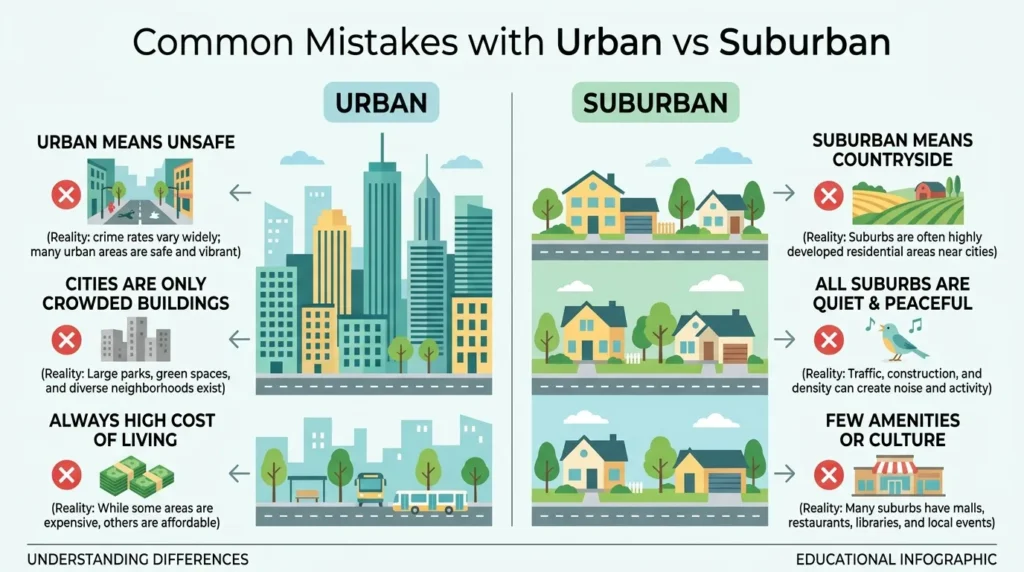
| Mistake | Correction |
| Thinking suburbs are rural | Suburban areas are still connected to cities |
| Assuming urban means dangerous | Many urban districts are safe and modern |
| Believing suburban life is boring | Many suburbs have active communities |
| Confusing suburban with countryside | Countryside areas are more remote |
| Thinking urban living always costs more | Some suburbs can also be expensive |
| Assuming all suburbs are identical | Suburbs vary greatly by region and income |
Why People Get Confused Between Urban and Suburban
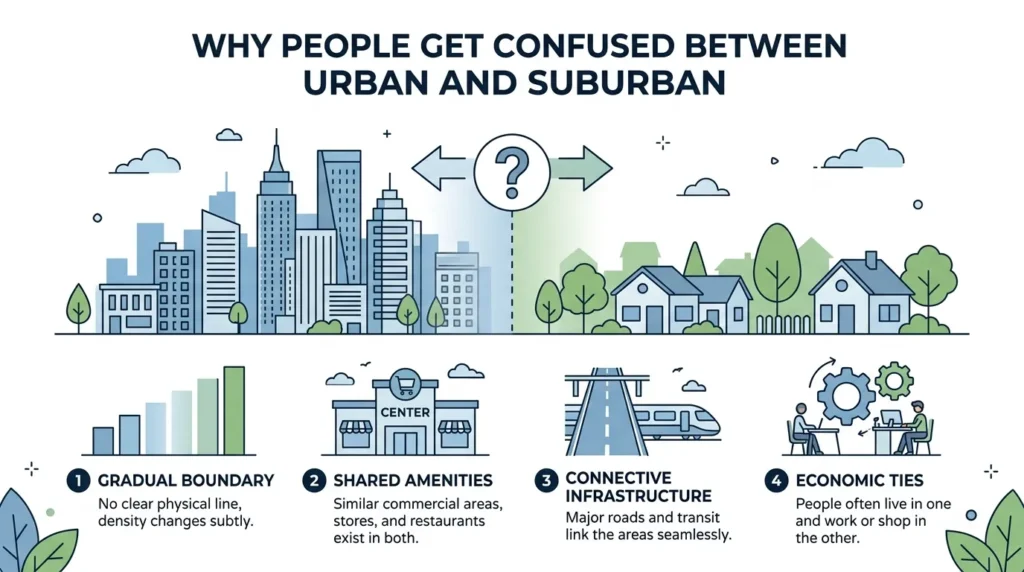
Overlapping Development
Some suburban areas now look highly modern and urbanized.
Media Influence
Movies and social media often blur the line between city and suburban lifestyles.
Regional Differences
Definitions vary across countries.
Example
A suburban neighborhood in Tokyo may feel more urban than suburbs in smaller countries.
Real Estate Marketing
Developers sometimes label areas differently for branding purposes.
Hybrid Work Culture
Remote work has reduced traditional urban dependency.
How Search Engines Understand Difference Between Urban and Suburban and User Intent
Search engines like Google analyze if users want:
- Housing comparisons
- Lifestyle guidance
- Real estate information
- Educational explanations
- Relocation advice
Algorithms prioritize:
- Clear comparison tables
- Location examples
- Practical decision-making advice
- High engagement and readability
- Real-world context
Platforms like YouTube also influence search behavior because many users watch urban-vs-suburban lifestyle videos before searching detailed articles.
Expert Insight
In practical urban planning and real estate analysis, neither urban nor suburban living is automatically “better.” The right choice depends on lifestyle priorities, financial goals, commute tolerance, and family structure.
Many young professionals initially prefer urban environments because of career growth and social activity. However, long-term lifestyle changes often shift preferences toward suburban communities due to affordability, larger living spaces, and better work-life balance.
Modern smart-city systems and remote work technologies are also reducing the traditional gap between urban and suburban living. Today, suburban residents can access digital services, remote jobs, and online education almost as easily as urban residents.
FAQs
What is the main difference between urban and suburban?
Urban areas are crowded city centers, while suburban areas are quieter residential communities outside cities.
Is suburban considered rural?
No. Suburban areas are connected to cities and are more developed than rural areas.
Which is better: urban or suburban living?
It depends on lifestyle needs, budget, work style, and family priorities.
Why do families prefer suburban areas?
Families often prefer suburban neighborhoods because of larger homes, schools, parks, and quieter environments.
Are urban areas more expensive?
Urban living is usually more expensive due to higher rent and demand.
Do suburban areas have fewer jobs?
Large corporate jobs are often concentrated in urban centers, but remote work is changing this trend.
Can suburban areas become urban?
Yes. Rapid development can transform suburban communities into urban districts over time.
Why do young professionals prefer urban areas?
Urban environments offer networking, entertainment, restaurants, and shorter commutes.
How do search engines categorize urban and suburban intent?
Search engines analyze if users want housing, lifestyle, educational, or relocation information.
Is suburban life quieter than urban life?
Yes. Suburban areas usually have lower traffic, less noise, and more residential space.
Conclusion
Understanding the difference between urban and suburban is important for lifestyle planning, housing decisions, education choices, and long-term financial goals. Urban areas offer energy, business opportunities, public transportation, and entertainment, while suburban areas provide space, comfort, family-oriented living, and quieter surroundings.
The modern world has changed how people view both environments. Remote work, digital connectivity, and smart technologies now allow many people to enjoy suburban comfort without sacrificing career opportunities. At the same time, urban centers remain powerful hubs for innovation, networking, and cultural experiences.
Many users get confused because some suburban areas are becoming more urbanized, while some cities are creating greener residential communities. However, the core difference remains clear: urban areas focus on density and economic activity, while suburban areas focus more on residential living and space.
In practical use, the best choice depends on your personal goals, budget, work style, and lifestyle preferences. Once you understand these factors, choosing between urban and suburban living becomes much easier and more informed.
Read more about!
Difference Between Diffusion and Osmosis: Complete Guide
Difference Between Parfum and Toilette: Complete Guide

I am Emily Johnson, a USA-based content writer who creates easy-to-read blogs on language and daily life topics. I explain complex ideas in simple English for students and beginners so they can understand easily.