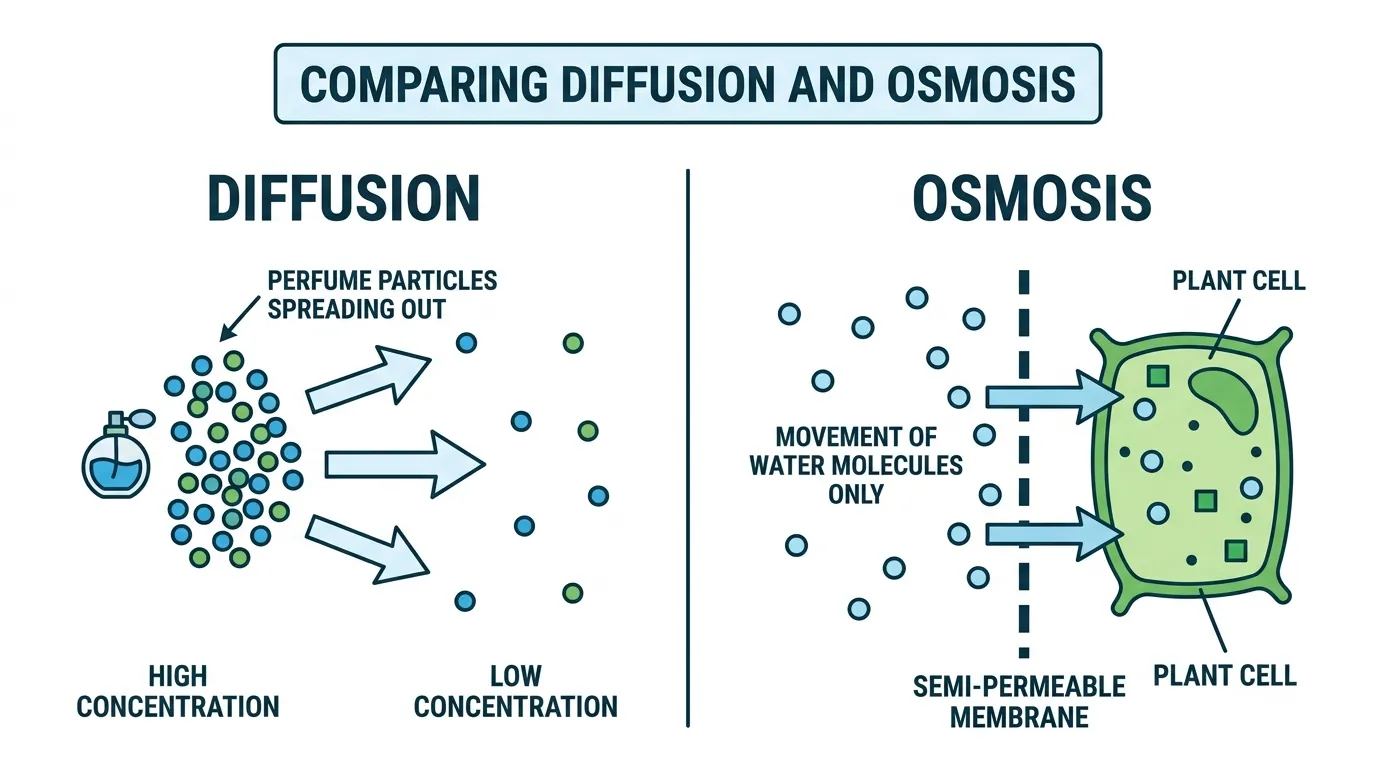
The difference between diffusion and osmosis is that diffusion moves all types of particles from high to low concentration, while osmosis only moves water through a selectively permeable membrane.
The difference between diffusion and osmosis is one of the most searched biology topics because many students, beginners, and even everyday learners confuse these two natural transport processes.
At first glance, diffusion and osmosis look similar because both involve the movement of particles from an area of higher concentration to lower concentration. However, the actual mechanism, purpose, and movement involved are quite different.
In simple words, the difference between diffusion and osmosis is that diffusion can happen with any type of particle, while osmosis only involves water moving through a selectively permeable membrane.
This concept is essential in biology, chemistry, medicine, fitness science, and even modern technologies used by companies like Google and Meta in AI-driven health research simulations.
Many users search for the difference between diffusion and osmosis to understand cell behavior, plant hydration, food preservation, and human body functions.
In this guide, you will learn definitions, key differences, similarities, real-life examples, common mistakes, and expert insights in a clear human-friendly way.
Difference Between Diffusion and Osmosis
Diffusion is the movement of particles like gases, liquids, or molecules from a region of high concentration to low concentration. Osmosis is the movement of water only through a selectively permeable membrane.
For example, perfume spreading in a room is diffusion, while water entering plant roots is osmosis.
Definition of Difference Between Diffusion and Osmosis
- Diffusion: The movement of particles from an area of higher concentration to an area of lower concentration until balance is reached.
- Osmosis: The movement of water molecules through a selectively permeable membrane from a dilute solution to a concentrated solution.
Simple Example
- Tea aroma spreading in air = Diffusion
- Raisins swelling in water = Osmosis
Pronunciation
- Diffusion
- US: dih-FYOO-zhun
- UK: dih-FYOO-zhuhn
- Osmosis
- US: oz-MOH-sis
- UK: oz-MOH-sis
Now that the basic meaning is clear, let’s understand the main comparison in depth.
Difference Between Diffusion and Osmosis
| Feature | Diffusion | Osmosis |
| Definition | Movement of particles from high to low concentration | Movement of water through a membrane |
| Substance Moved | Molecules, gases, ions, liquids | Water molecules only |
| Membrane Needed | Not always required | Always requires selectively permeable membrane |
| Occurs In | Gases, liquids, solids | Liquids only |
| Energy Requirement | Passive process | Passive process |
| Speed | Usually faster in gases | Depends on membrane and water potential |
| Biological Importance | Gas exchange and nutrient spread | Water balance in cells |
| Example | Perfume smell spreading | Water entering roots |
Key Differences Explained Between Diffusion and Osmosis
1. Type of Substance Moving
In diffusion, almost any particle can move. This includes oxygen, carbon dioxide, perfume molecules, or food coloring.
In osmosis, only water molecules move. This is the biggest difference many beginners overlook.
Real-Life Example
Opening a soda bottle releases gas through diffusion, while cucumber slices soaking in salt water lose water through osmosis.
2. Membrane Requirement
Diffusion may happen with or without a membrane. Osmosis cannot happen without a selectively permeable membrane.
Real Scenario
Cell membranes in the human body regulate osmosis constantly to maintain hydration.
3. Medium of Movement
Diffusion can happen in solids, liquids, and gases. Osmosis mainly occurs in liquid environments.
Practical Insight
The spread of ink in water is diffusion, but plant root absorption is osmosis.
4. Biological Role
Diffusion helps in breathing and nutrient transport. Osmosis controls water balance and cell pressure.
Human Body Example
Oxygen entering blood in lungs uses diffusion, while kidney water regulation uses osmosis.
5. Selective Process
Diffusion is less selective. Osmosis is highly selective because membranes only allow water to pass.
This selectivity is important in medical dialysis systems.
6. Concentration Logic
Diffusion moves particles from crowded to less crowded areas. Osmosis moves water toward higher solute concentration.
Many students confuse this directional logic.
7. Effect on Cells
Diffusion usually balances substances. Osmosis can shrink or swell cells depending on water movement.
Example
A red blood cell placed in pure water swells due to osmosis.
Difference and Similarity Between Diffusion and Osmosis
| Feature | Diffusion | Osmosis | Similarity |
| Meaning | Particle movement | Water movement | Both involve movement from high to low concentration |
| Energy Use | Passive | Passive | Neither needs ATP energy |
| Membrane | Optional | Required | Both may involve cells |
| Substance | Any molecules | Water only | Both transport materials |
| Occurrence | Air, liquid, solids | Liquid systems | Both occur naturally |
| Biological Use | Gas exchange | Water regulation | Both maintain balance |
| Speed | Often faster | Usually slower | Both depend on concentration gradient |
| Goal | Reach equilibrium | Maintain water balance | Both stabilize systems |
This table clearly shows the difference and similarity between diffusion and osmosis for quick understanding.
How Does Diffusion Work?
Diffusion happens because particles naturally move randomly. Over time, this random movement spreads particles evenly.
J=−DdCdxJ = -D \frac{dC}{dx}J=−DdxdC
This principle is used in:
- Human lungs
- Food flavor spreading
- Industrial chemical mixing
- Drug delivery systems
Even platforms like YouTube use diffusion-based cooling technologies in large server systems to control heat distribution.
How Does Osmosis Work in Real Life?
Osmosis depends on water concentration and membrane selectivity.
Π=iMRT\Pi = iMRTΠ=iMRT
This osmotic pressure equation explains how water movement creates pressure differences.
Real-Life Uses
- Plant hydration
- Kidney filtration
- Food preservation
- Medical IV solutions
In hospitals, saline solutions are carefully balanced to prevent dangerous osmotic imbalance in cells.
Why Is the Difference Between Diffusion and Osmosis Important?
Many people think these concepts only matter in textbooks, but they affect daily life constantly.
In Human Health
- Oxygen transfer uses diffusion
- Water balance uses osmosis
In Agriculture
Farmers rely on osmosis for healthy crops and nutrient absorption.
In Sports and Fitness
Hydration drinks depend on osmotic balance for quick absorption.
Fitness tracking systems integrated into apps by companies like Apple monitor hydration-related biological responses indirectly connected to osmotic behavior.
Real-Life Examples with Diffusion and Osmosis
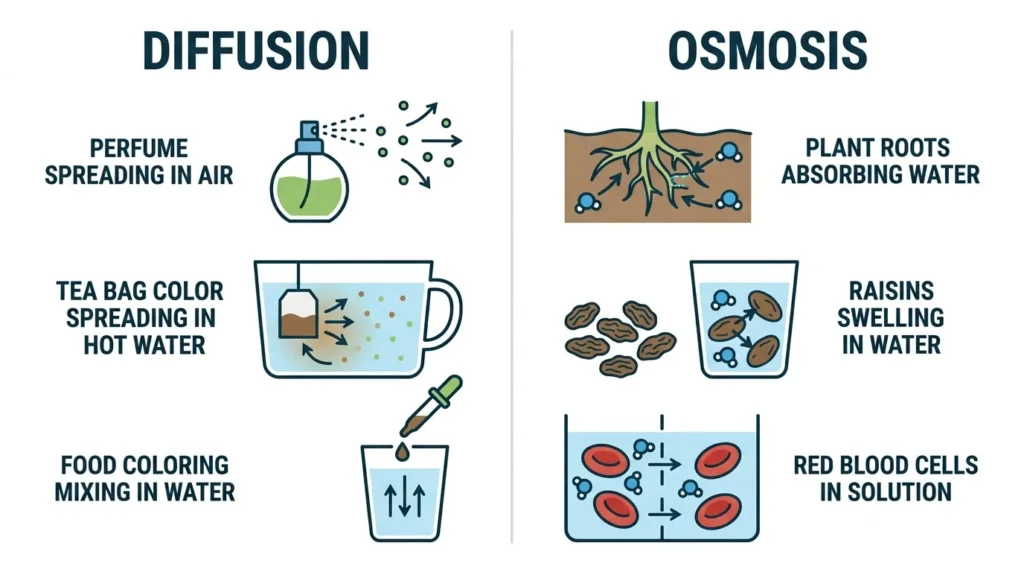
1. Perfume in a Room
Perfume smell spreading through air is diffusion.
2. Plant Roots Absorbing Water
Water enters roots through osmosis.
3. Raisins in Water
Raisins swell because water moves inward via osmosis.
4. Oxygen Exchange in Lungs
Oxygen diffuses from alveoli into blood.
5. Pickles in Salt Water
Water leaves cucumber cells through osmosis.
6. Tea Bag in Hot Water
Tea particles spread by diffusion.
Common Mistakes with Diffusion and Osmosis
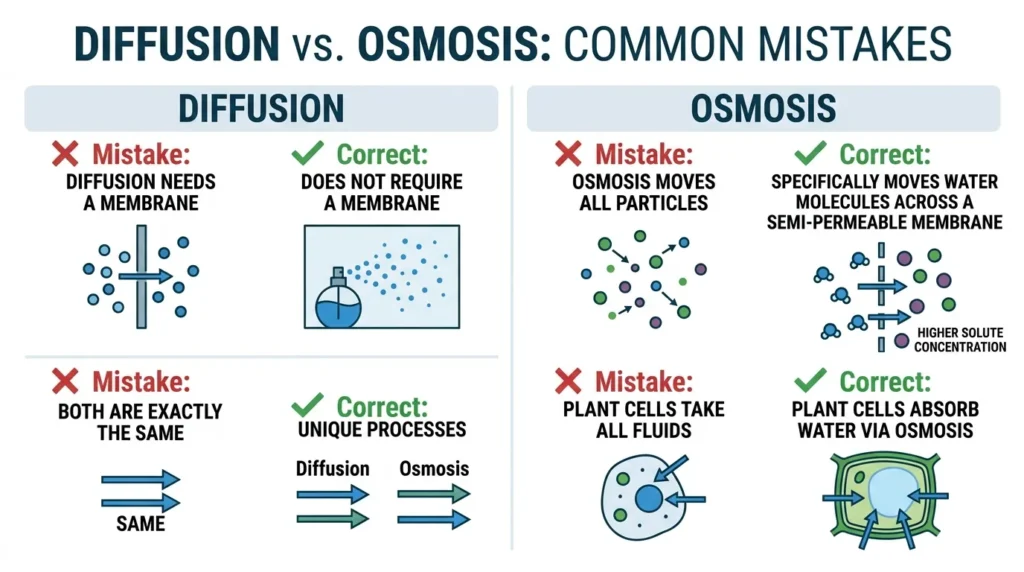
| Mistake | Correction |
| Thinking osmosis moves all molecules | Osmosis moves only water |
| Believing diffusion needs a membrane | Diffusion may occur without one |
| Assuming both are identical | Osmosis is actually a special type of diffusion |
| Ignoring concentration gradients | Concentration difference drives both processes |
| Confusing direction of water flow | Water moves toward higher solute concentration |
Why People Get Confused Between Diffusion and Osmosis
Similar Movement Pattern
Both involve movement from high concentration to low concentration.
Both Are Passive Transport
Neither process requires cellular energy.
Biology Teaching Methods
Many textbooks explain them together without highlighting differences clearly.
Visual Similarity
Diagrams often look almost identical, especially in school-level biology.
Membrane Confusion
Students often forget that osmosis specifically requires a selectively permeable membrane.
When to Use Each Concept
Use Diffusion When:
- Explaining gas exchange
- Discussing molecule spreading
- Understanding smell or heat movement
Use Osmosis When:
- Studying plant cells
- Learning hydration systems
- Understanding kidney function
- Discussing cell water balance
How Search Engines Understand Difference Between Diffusion and Osmosis and User Intent
Modern search engines like Google analyze user intent deeply. When users search “difference between diffusion and osmosis,” the algorithm understands they usually want:
- Simple comparison
- Table format
- Biology explanation
- Real-life examples
- Exam preparation help
Search systems prioritize:
- Clear definitions
- Featured snippet optimization
- Question-based content
- User engagement signals
- Semantic topic depth
Educational content that explains “what,” “how,” and “why” together tends to perform better in modern systems.
Expert Insight
In real educational scenarios, most beginners understand diffusion quickly but struggle with osmosis because membrane selectivity feels abstract. Biology teachers and medical trainers often simplify osmosis using hydration examples rather than technical chemistry definitions.
From a practical science perspective, osmosis is extremely important in medicine. Incorrect osmotic balance in IV fluids can damage cells. Meanwhile, diffusion is critical in respiratory systems because oxygen transfer efficiency directly affects survival.
Modern biomedical engineering also uses both principles in dialysis machines, drug delivery systems, and tissue engineering research.
FAQs
What is the main difference between diffusion and osmosis?
Diffusion moves any particles, while osmosis moves only water through a selectively permeable membrane.
Is osmosis a type of diffusion?
Yes. Osmosis is considered a specialized type of diffusion involving water molecules only.
Does diffusion require energy?
No. Diffusion is a passive transport process.
Why is osmosis important in plants?
Osmosis helps plants absorb water from soil and maintain cell pressure.
Can diffusion happen in gases?
Yes. Diffusion commonly occurs in gases, liquids, and solids.
What is an easy example of osmosis?
A raisin swelling in water is a classic osmosis example.
Why do students confuse diffusion and osmosis?
Because both involve movement across concentration gradients and are taught together in biology.
How does diffusion help humans?
Diffusion allows oxygen and carbon dioxide exchange in the lungs.
Can osmosis happen without a membrane?
No. Osmosis always requires a selectively permeable membrane.
Which process is faster: diffusion or osmosis?
Diffusion is usually faster, especially in gases.
Conclusion
Understanding the difference between diffusion and osmosis becomes much easier when you focus on one key idea: diffusion moves many kinds of particles, while osmosis specifically moves water through a selectively permeable membrane. Although both are passive transport processes driven by concentration gradients, their biological roles are different and highly important.
In practical use, diffusion explains how oxygen spreads in the lungs, how perfume travels in air, and how nutrients move in cells. Osmosis, on the other hand, controls hydration, plant water absorption, kidney filtration, and cellular water balance. These processes are not just academic concepts; they shape real biological and industrial systems every day.
Many users get confused because diffusion and osmosis are closely related, but once you remember that osmosis focuses only on water movement through membranes, the distinction becomes clear. If you are a student, teacher, medical learner, or science enthusiast, understanding these concepts builds a stronger foundation in biology and chemistry.
The difference between diffusion and osmosis ultimately comes down to substance type, membrane involvement, and biological purpose. Once these three ideas are clear, the topic becomes simple and easy to remember.
Read more about!
Difference Between Parfum and Toilette: Complete Guide
Difference Between Centerfire and Rimfire: Complete Guide

I am Emily Johnson, a USA-based content writer who creates easy-to-read blogs on language and daily life topics. I explain complex ideas in simple English for students and beginners so they can understand easily.