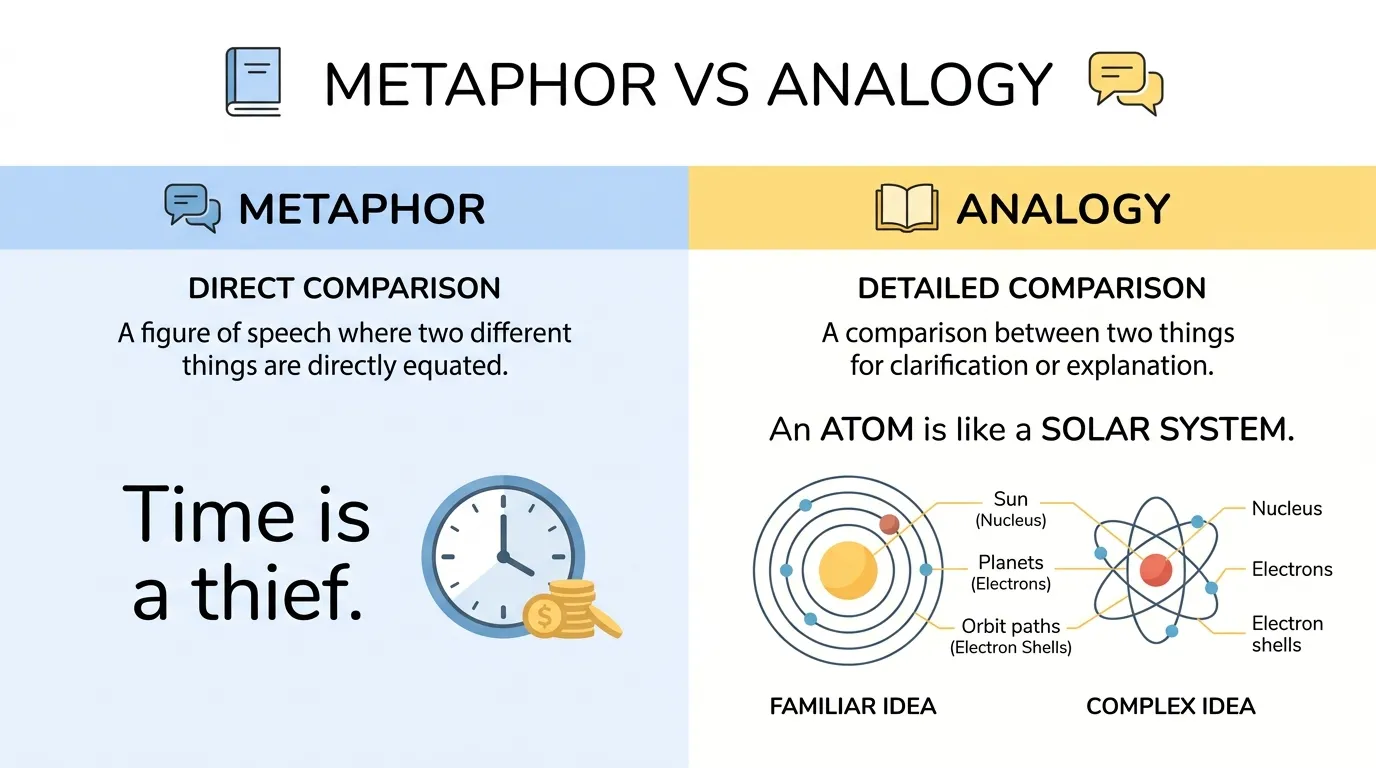
📝 A metaphor directly compares two things for effect, while an analogy explains similarities to make an idea easier to understand.
Have you ever read a sentence like “time is a thief” and wondered if it is a metaphor or an analogy? Many students, writers, bloggers, and even professionals mix these two literary devices together.
The difference between metaphor and analogy may seem small at first, but they work differently in language, storytelling, education, marketing, and communication.
In simple words, a metaphor directly compares two things, while an analogy explains an idea by showing similarities between two different things. Both improve understanding, but they serve different purposes.
People search for:
- “What is a metaphor?”
- “What is an analogy?”
- “Metaphor vs analogy examples”
- “How are metaphor and analogy different?”
- “Difference between metaphor and analogy in literature”
This complete guide explains everything clearly using real-life examples, writing techniques, friendly explanations, educational insights, and practical usage tips. By the end, you will fully understand when and how to use each one correctly.
Difference Between Metaphor and Analogy
The difference between metaphor and analogy is mainly about purpose and structure.
- Metaphor: A direct comparison that says one thing is another thing.
- Analogy: A broader comparison used to explain or clarify an idea.
Simple Example
- Metaphor: “Her smile is sunshine.”
- Analogy: “A teacher guiding students is like a captain steering a ship.”
The metaphor creates imagery. The analogy explains meaning.
Definition of Difference Between Metaphor and Analogy
- Metaphor: A figure of speech that directly compares two unlike things without using “like” or “as.”
- Analogy: A comparison between two things used to explain a concept, relationship, or idea clearly.
Quick Example
A metaphor paints a picture. An analogy teaches a concept.
Pronunciation
| Word | US Pronunciation | UK Pronunciation |
| Metaphor | MET-uh-for | MET-uh-fuh |
| Analogy | uh-NAL-uh-jee | uh-NAL-uh-jee |
Now let’s understand why these language tools exist and why writers use them so often.
Difference Between Metaphor and Analogy: Comparison
| Feature | Metaphor | Analogy |
| Purpose | Creates imagery | Explains ideas |
| Length | Usually short | Often longer |
| Style | Figurative | Explanatory |
| Structure | Direct comparison | Logical comparison |
| Uses “like/as” | Usually no | Sometimes yes |
| Main Goal | Emotional impact | Better understanding |
| Common Use | Poetry, storytelling | Teaching, explaining |
| Complexity | Simple or symbolic | More detailed |
| Reader Effect | Imagination | Clarity |
| Example | “Life is a journey” | “Life is like climbing a mountain” |
This table gives a quick overview of the main difference between metaphor and analogy.
Key Differences Explained Between Metaphor and Analogy
1. Metaphors Create Imagery
A metaphor helps readers visualize something emotionally or creatively.
Example
“His heart was ice.”
This does not mean his heart was literally frozen. It means he was emotionally cold.
Metaphors are common in:
- novels
- songs
- poetry
- speeches
2. Analogies Explain Concepts
An analogy focuses more on understanding than artistic beauty.
Example
“Learning a language is like building muscle. The more you practice, the stronger you become.”
This comparison explains effort and growth clearly.
3. Metaphors Are Usually Shorter
Most metaphors are one sentence or phrase.
Example
“The classroom was a zoo.”
That single sentence creates instant imagery.
4. Analogies Can Be Detailed
Analogies often expand into multiple sentences to explain relationships.
Teachers and educators use analogies heavily because they simplify difficult ideas.
5. Metaphors Focus on Emotion
Writers use metaphors to:
- create mood
- build imagination
- strengthen storytelling
Real-Life Example
Advertising campaigns often use metaphors to create emotional branding.
6. Analogies Focus on Logic
An analogy helps audiences understand unfamiliar concepts through familiar examples.
Example
“A computer firewall works like a security guard checking who enters a building.”
7. Both Compare Things Differently
Many users get confused because both involve comparison.
But the key difference is:
- metaphor = artistic comparison
- analogy = explanatory comparison
What Is a Metaphor and How Does It Work?
A metaphor directly connects two unrelated things to create meaning or imagery.
Structure of a Metaphor
Thing A = Thing B
Example
“Knowledge is power.”
Knowledge is not literally power, but the comparison creates a strong idea.
Why Writers Use Metaphors
Metaphors:
- make writing memorable
- improve emotional connection
- create vivid mental images
- simplify feelings
Authors, songwriters, and filmmakers use metaphors constantly.
What Is an Analogy and Why Is It Different?
An analogy compares two situations to explain something more clearly.
Structure of an Analogy
Thing A works similarly to Thing B.
Example
“Managing money without budgeting is like driving blindfolded.”
This analogy explains financial risk through a familiar image.
Why Analogies Matter
Analogies help:
- teachers explain lessons
- marketers explain products
- speakers simplify difficult topics
- businesses communicate clearly
In practical use, analogies improve understanding faster than technical explanations alone.
Difference Between Metaphor and Analogy in Literature
This is one of the most searched educational questions online.
Metaphors in Literature
Metaphors make writing artistic and emotional.
Famous Example
From Romeo and Juliet:
“Juliet is the sun.”
This metaphor creates beauty and emotional imagery.
Analogies in Literature
Analogies help readers understand complicated themes or situations.
Writers often use analogies in essays, speeches, and educational writing.
Why Students Often Confuse Metaphor and Analogy
Many beginners think all comparisons are metaphors.
But not every comparison is a metaphor.
Main Reason for Confusion
Both techniques:
- compare things
- improve understanding
- use figurative thinking
The difference lies in purpose and structure.
How Metaphors and Analogies Are Used in Modern Communication
Modern communication platforms use both constantly.
Social Media Marketing
Brands use metaphors for emotional branding.
Example
“A battery that never sleeps.”
This metaphor makes a product sound powerful.
Educational Content
Creators frequently use analogies to explain:
- science
- technology
- finance
- AI systems
Example
“Cloud storage works like renting a digital locker.”
Difference + Similarity Generation For Metaphor and Analogy
| Feature | Metaphor | Analogy | Similarity |
| Main Purpose | Create imagery | Explain meaning | Both compare ideas |
| Writing Style | Artistic | Logical | Both improve communication |
| Length | Usually short | Often detailed | Both can simplify concepts |
| Common Use | Poetry and fiction | Teaching and explanation | Both appear in writing and speech |
| Emotional Impact | Strong | Moderate | Both affect reader understanding |
| Literal Meaning | Not literal | Partly logical | Both involve figurative thinking |
| Reader Experience | Imaginative | Educational | Both increase engagement |
| Difficulty Level | Often symbolic | Usually clearer | Both require interpretation |
This table clearly shows the difference and similarity between metaphor and analogy for quick understanding.
Common Mistakes With Metaphor and Analogy
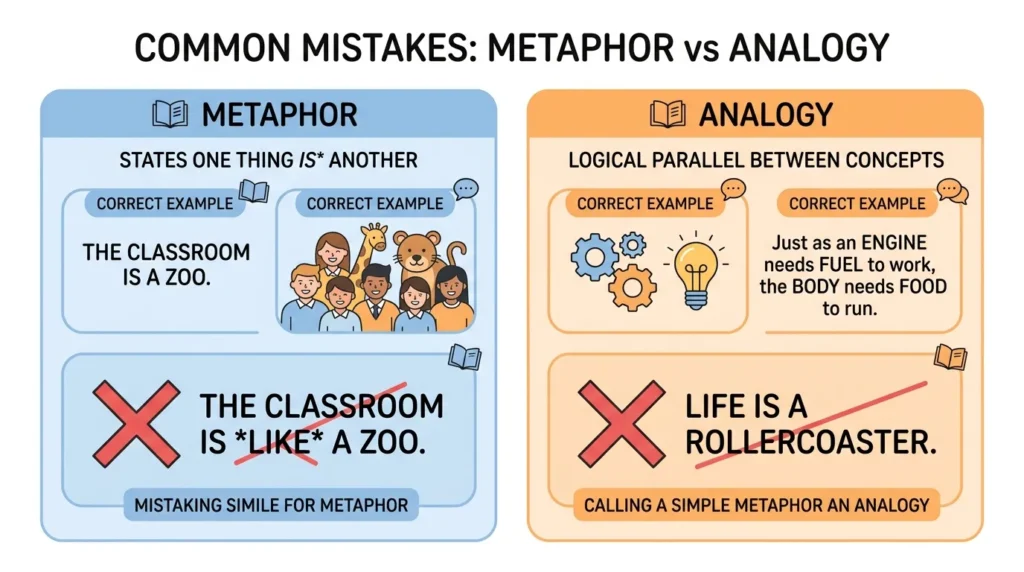
1. Thinking Every Comparison Is a Metaphor
Not all comparisons are metaphors.
Fix
Ask: Is the sentence explaining something logically or creating imagery emotionally?
2. Confusing Similes With Analogies
A simile uses “like” or “as.”
Example:
“Busy as a bee.”
That is not automatically an analogy.
3. Overusing Metaphors
Too many metaphors can confuse readers.
Professional writers balance creativity with clarity.
4. Making Analogies Too Complicated
An analogy should simplify ideas, not make them harder.
5. Using Mixed Metaphors
Example:
“He sailed through the exam but hit a roadblock.”
The imagery clashes awkwardly.
Real Life Examples With Metaphor and Analogy
1. Classroom Teaching
Teachers use analogies to explain difficult subjects.
Example
“The human brain works like a computer processor.”
2. Advertising Campaigns
Brands use metaphors for emotional marketing.
Example
“Red Bull gives you wings.”
3. Motivational Speaking
Speakers use both tools together.
Example
“Life is a marathon.”
This metaphor may expand into a longer analogy about endurance and patience.
4. Business Communication
Companies explain AI systems using analogies.
On platforms, complex machine learning concepts are often simplified through analogies for public understanding.
5. Entertainment and Storytelling
Movies, books, and streaming platforms use metaphors heavily to build emotional themes.
When To Use Each
| Situation | Metaphor | Analogy |
| Creative writing | Excellent | Good |
| Teaching concepts | Moderate | Excellent |
| Emotional storytelling | Excellent | Moderate |
| Technical explanation | Limited | Excellent |
| Marketing slogans | Excellent | Good |
| Academic writing | Moderate | Excellent |
Why People Get Confused in Metaphor and Analogy
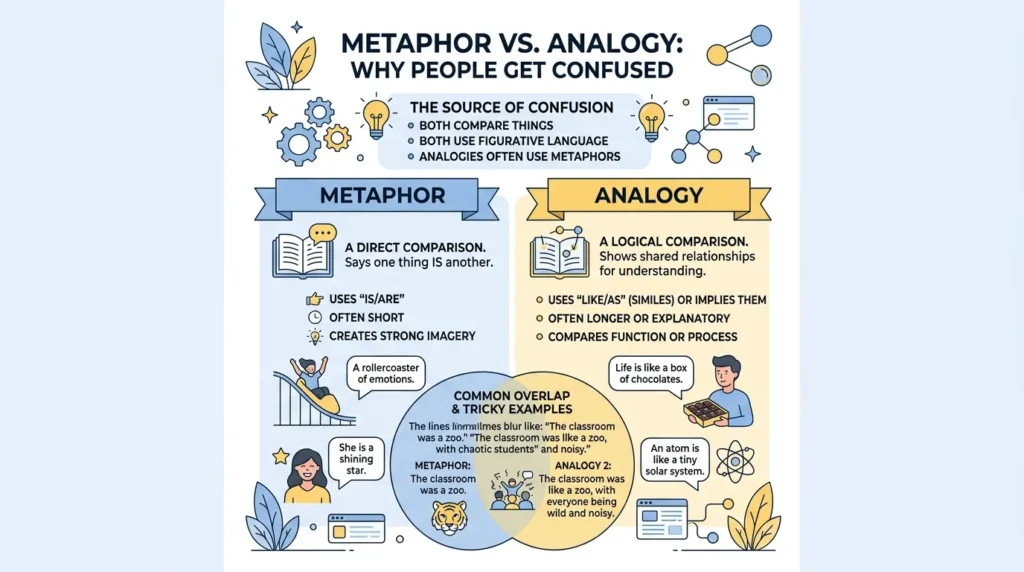
Many users get confused because:
- both compare things
- both are figurative language tools
- both improve communication
- school lessons often teach them together
Another reason is that some analogies contain metaphors inside them.
Example
“Life is a journey” is a metaphor.
But explaining life stages using travel examples becomes an analogy.
How Search Engines Understand Difference Between Metaphor and Analogy and User Intent
Search engines understand that users searching:
- “difference between metaphor and analogy”
- “metaphor vs analogy”
- “examples of metaphor and analogy”
usually want:
- Simple definitions
- Real examples
- Student-friendly explanations
- Writing guidance
- Quick comparison tables
Educational content ranks better when it includes:
- scannable formatting
- examples
- conversational explanations
- semantic clarity
- beginner-friendly structure
That is why modern content combines literary expertise with practical readability.
Expert Insight
In real scenarios, metaphors are more powerful emotionally, while analogies are more powerful educationally.
Professional writers often combine both techniques strategically.
For example:
- marketers use metaphors to trigger emotion
- teachers use analogies to improve comprehension
- public speakers use both for engagement
Most beginners memorize definitions but struggle in practical use. The easiest way to identify them is:
- If it paints a picture → metaphor
- If it explains an idea → analogy
Experienced educators and communication experts know that strong analogies improve audience retention significantly because humans naturally learn through familiar patterns.
FAQs
What is the main difference between metaphor and analogy?
A metaphor creates direct imagery, while an analogy explains ideas through comparison.
Is every analogy a metaphor?
No. Some analogies may include metaphors, but they are not the same thing.
Can a metaphor be part of an analogy?
Yes. Many analogies use metaphoric language inside broader explanations.
Which is better for teaching?
Analogies are usually better for teaching because they improve understanding clearly.
Why do writers use metaphors?
Writers use metaphors to create emotion, imagery, and memorable language.
Are metaphors used in advertising?
Yes. Marketing campaigns frequently use metaphors to create emotional branding.
Do analogies use “like” or “as”?
Often yes, but not always.
Is “life is a journey” a metaphor or analogy?
It is mainly a metaphor, though it can expand into an analogy.
Which is easier to understand?
Analogies are usually easier because they explain concepts directly.
Why do students confuse metaphor and analogy?
Because both compare things and are taught together in language lessons.
Conclusion
Understanding the difference between metaphor and analogy helps improve writing, communication, storytelling, education, and even marketing skills.
A metaphor creates emotional imagery by directly comparing two things, while an analogy explains ideas through logical comparison. In simple words:
- metaphors help readers feel
- analogies help readers understand
Both tools are essential in modern communication. Writers use metaphors to make language vivid and memorable. Teachers, speakers, and businesses use analogies to simplify complex ideas and improve learning.
In practical use, choosing the right one depends on your goal:
- use metaphors for creativity and emotion
- use analogies for explanation and clarity
Once you understand this distinction, reading, writing, and communication become much easier and more effective.
Read more about!
Difference Between Sonogram and Ultrasound: Simple Guide
Difference Between Bourbon and Scotch: Complete Guide

I am Emily Johnson, a USA-based content writer who creates easy-to-read blogs on language and daily life topics. I explain complex ideas in simple English for students and beginners so they can understand easily.