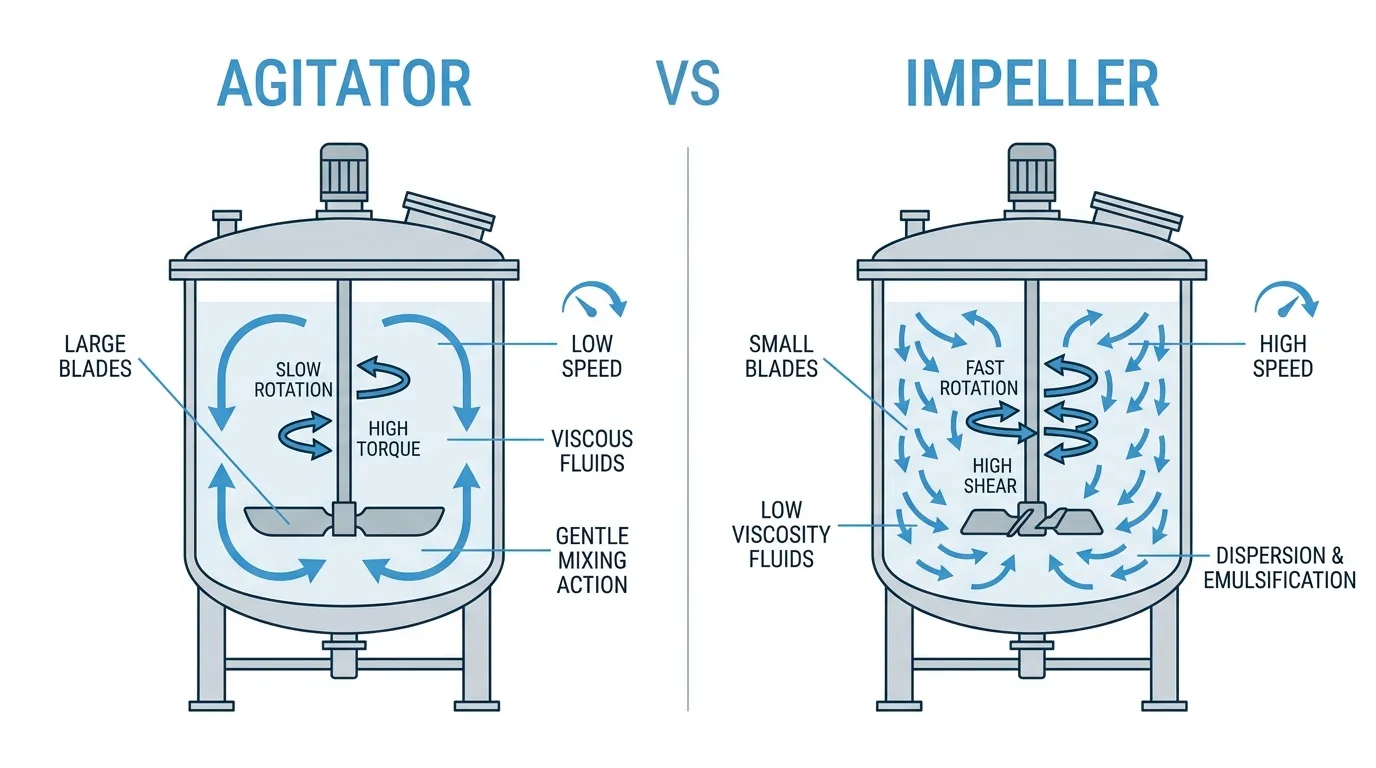
⚙️ An agitator moves liquids slowly for mixing, while an impeller spins faster to create strong fluid flow and efficient blending.
Many people hear the terms “agitator” and “impeller” while buying a washing machine or studying industrial mixing systems. At first glance, both seem to do the same job moving liquid or clothes around. But the difference between agitator and impeller is much bigger than most buyers realize.
In simple words, an agitator uses a central post with strong movement, while an impeller uses a low-profile rotating disc or cone to create water currents. Both systems clean clothes or mix liquids differently.
This topic has become more important in 2026 because modern appliance brands focus heavily on:
- energy efficiency
- water saving
- fabric protection
- smart washing technology
That is why users search:
- “What is an agitator?”
- “Impeller vs agitator washing machine”
- “Which cleans better?”
- “Which uses less water?”
- “Difference between agitator and impeller in washing machines”
This complete guide explains everything clearly using real-life examples, comparison tables, cleaning performance, industrial applications, pros and cons, maintenance insights, and expert-level buying advice. By the end, you will fully understand which system works best for your needs.
Difference Between Agitator and Impeller
The difference between agitator and impeller is mainly about how they move clothes or liquids.
- Agitator: Uses a tall center spindle that twists and rubs clothes aggressively.
- Impeller: Uses a low-profile spinning plate that creates water currents to move clothes gently.
Simple Example
Traditional top-load washers often use agitators, while many modern high-efficiency washers use impellers.
Definition of Difference Between Agitator and Impeller
- Agitator: A central rotating post inside a washing machine or mixing tank that moves materials through direct mechanical action.
- Impeller: A rotating disc, blade, or cone that creates fluid motion and circulation using water flow dynamics.
Quick Example
An agitator physically twists clothes, while an impeller creates motion through water currents.
Pronunciation
| Word | US Pronunciation | UK Pronunciation |
| Agitator | AJ-i-tay-ter | AJ-i-tay-tuh |
| Impeller | im-PEL-er | im-PEL-uh |
Now let’s understand why manufacturers and engineers use these two different systems.
Difference Between Agitator and Impeller: Comparison
| Feature | Agitator | Impeller |
| Design | Tall center spindle | Low-profile disc or cone |
| Cleaning Style | Aggressive movement | Gentle water motion |
| Water Usage | More water | Less water |
| Fabric Care | Rougher on fabrics | Gentler on clothes |
| Capacity | Slightly lower | More space inside drum |
| Noise Level | Usually louder | Usually quieter |
| Energy Efficiency | Lower | Higher |
| Wash Speed | Faster heavy cleaning | Balanced efficient cleaning |
| Maintenance | More moving parts | Simpler structure |
| Best For | Heavy dirty clothes | Everyday mixed laundry |
This table quickly explains the main difference between agitator and impeller systems.
Key Difference Explained Between Agitator and Impeller
1. Cleaning Motion Is Completely Different
An agitator physically rubs and twists clothes.
An impeller creates spinning water currents that move clothes around smoothly.
Real-Life Example
Mud-covered work clothes often clean faster with an agitator.
2. Impellers Save More Water
Modern impeller systems are designed for high-efficiency washing.
Why It Matters
Lower water usage means:
- lower utility bills
- eco-friendly operation
- better energy efficiency
3. Agitators Can Be Tougher on Fabric
Many users get confused because stronger cleaning sounds better.
However, stronger movement may increase:
- fabric wear
- stretching
- tangling
Impellers are generally gentler on delicate clothing.
4. Impeller Washers Usually Have More Space
Without the tall center post, impeller washers can fit:
- blankets
- comforters
- large laundry loads
This is one reason many modern families prefer impeller machines.
5. Agitators Often Clean Heavy Dirt Better
Construction workers, mechanics, and athletes sometimes prefer agitators because they remove stubborn dirt quickly.
Example
Oil stains and thick mud may respond better to aggressive agitation.
6. Impellers Are Usually Quieter
Because they use smoother rotational movement, impeller systems often reduce:
- vibration
- noise
- mechanical stress
7. Technology Trends Favor Impellers
Most smart washing machines now focus on:
- AI wash cycles
- sensor technology
- efficiency optimization
Many premium brands use impeller systems for these reasons.
Videos frequently compare agitator vs impeller cleaning tests because buyers want real-world performance demonstrations.
What Is an Agitator and How Does It Work?
An agitator is a central spindle inside a washing machine.
It usually includes:
- fins
- blades
- rotating arms
How It Works
The agitator twists back and forth rapidly, forcing clothes through water and detergent.
Main Purpose
- aggressive stain removal
- heavy-duty cleaning
- fast wash action
Traditional top-load washers commonly use agitators.
What Is an Impeller and Why Is It Different?
An impeller is a low-profile rotating plate or cone at the bottom of the washer drum.
Instead of twisting clothes directly, it creates:
- water turbulence
- wave motion
- circulation patterns
Main Purpose
- gentle cleaning
- water efficiency
- larger load capacity
Impeller systems are popular in high-efficiency washers.
Difference Between Agitator and Impeller in Washing Machines
This is the most common user search intent.
Agitator Washing Machines
Best For
- heavy stains
- work clothes
- fast deep cleaning
Downsides
- rougher on fabric
- smaller drum space
- higher water use
Impeller Washing Machines
Best For
- delicate fabrics
- energy savings
- larger laundry loads
Downsides
- some heavy stains may need pre-treatment
Modern appliance companies increasingly market impeller machines as eco-friendly solutions.
Why High-Efficiency Washers Use Impellers
High-efficiency washers focus heavily on:
- low water usage
- energy reduction
- smart cleaning optimization
Impellers support these goals because they require less water and allow advanced wash sensors to work efficiently.
Companies promoted and smart appliance channels often advertise impeller systems as premium modern technology.
Difference Between Agitator and Impeller in Industrial Mixing
The comparison is not limited to washing machines.
Industrial systems also use agitators and impellers.
Industrial Agitators
Used for:
- thick liquids
- chemical mixing
- sludge movement
Industrial Impellers
Used for:
- fluid circulation
- aeration systems
- fuel movement
- water treatment
Engineers choose between them depending on viscosity and mixing requirements.
Difference+ Similarity Generation For Agitator and Impeller
| Feature | Agitator | Impeller | Similarity |
| Main Function | Twists materials directly | Creates water flow movement | Both move materials for cleaning or mixing |
| Shape | Tall spindle | Flat disc or cone | Both rotate mechanically |
| Water Usage | Higher | Lower | Both use water circulation |
| Fabric Impact | More aggressive | More gentle | Both clean clothes |
| Drum Space | Reduced space | Larger space | Both fit inside washing machines |
| Noise | Louder operation | Quieter operation | Both create machine movement |
| Efficiency | Traditional approach | Modern efficient design | Both aim to improve cleaning |
| Industrial Use | Thick mixing tasks | Fluid circulation systems | Both used in engineering |
This table clearly shows the difference and similarity between agitator and impeller for quick understanding.
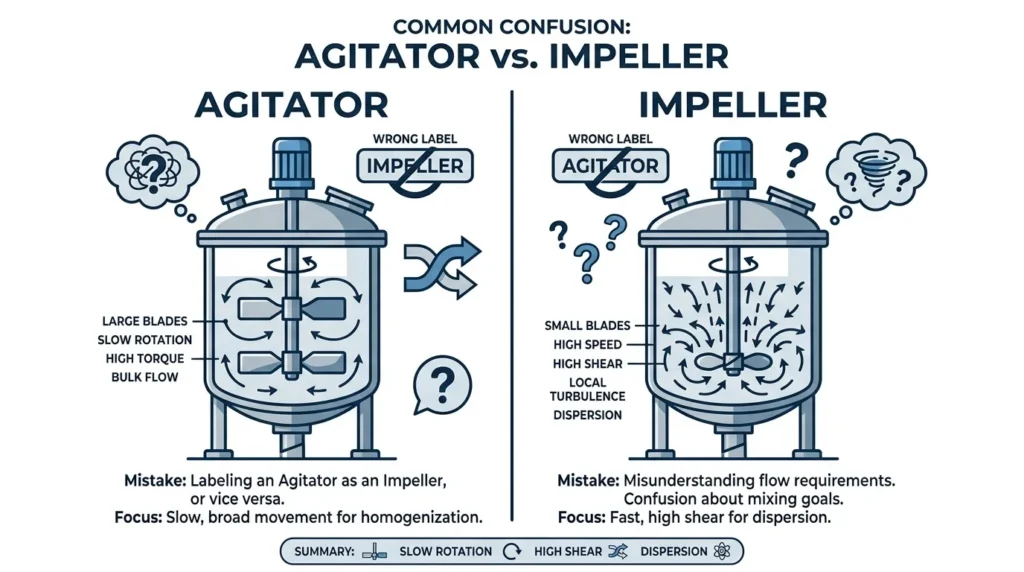
Common Mistakes With Agitator and Impeller
1. Thinking Impellers Clean Poorly
Many users assume gentle motion means weak cleaning.
Reality
Modern impeller systems clean effectively using optimized water dynamics.
2. Assuming Agitators Always Damage Clothes
While agitators are stronger, proper wash settings reduce wear significantly.
3. Ignoring Load Size
Overloading either system reduces cleaning performance.
4. Believing One System Fits Everyone
Laundry habits matter greatly.
Example
Large families may prefer impeller capacity, while mechanics may prefer agitator strength.
5. Confusing Industrial and Household Usage
Industrial impellers and washing machine impellers work on similar principles but serve different purposes.
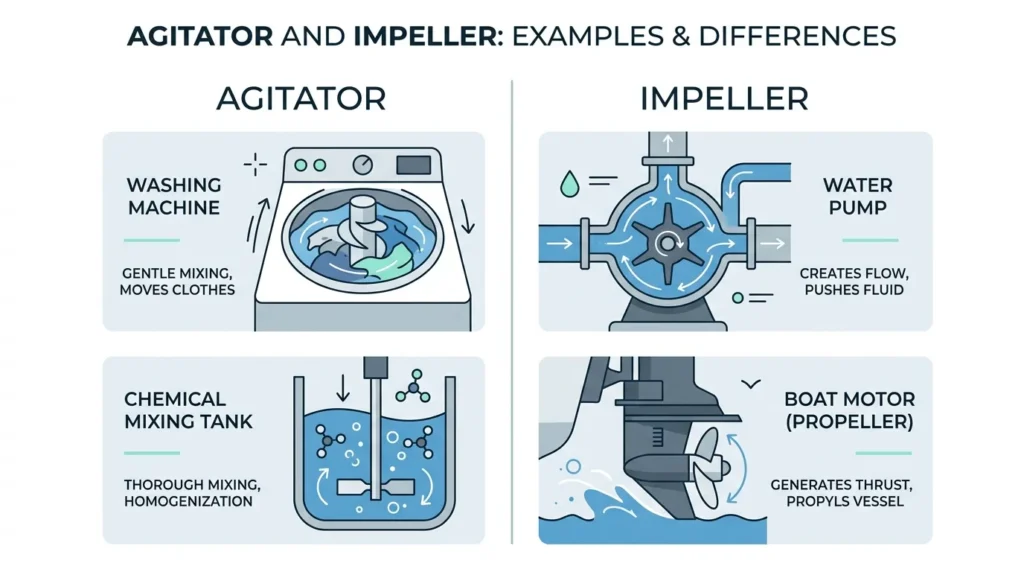
Real Life Examples With Agitator and Impeller
1. Heavy Construction Laundry
A worker cleaning muddy jeans may benefit from an agitator washer.
2. Delicate Family Laundry
Parents washing baby clothes often prefer impeller systems because they are gentler.
3. Large Bedding Loads
Comforters and blankets usually fit better in impeller washers.
4. Chemical Manufacturing
Industrial agitators help mix thick chemicals evenly.
5. Water Treatment Plants
Impellers circulate water efficiently in purification systems.
Search interest for appliance efficiency continues growing because buyers increasingly compare smart washer technologies before purchasing.
When To Use Each
| Situation | Agitator | Impeller |
| Heavy dirt removal | Excellent | Good |
| Delicate fabrics | Limited | Excellent |
| Water saving | Moderate | Excellent |
| Large laundry loads | Moderate | Excellent |
| Fast aggressive cleaning | Excellent | Moderate |
| Quiet operation | Moderate | Excellent |
Why People Get Confused in Agitator and Impeller
Many users get confused because:
- both clean clothes
- both rotate inside washers
- appliance marketing terms vary
- modern machines look similar externally
Another reason is that some brands advertise cleaning power differently, making it hard for buyers to understand the actual mechanism.
On social media platforms discussions often oversimplify the comparison into “old vs modern,” even though both systems still have practical advantages.
How Search Engines Understand Difference Between Agitator and Impeller and User Intent
When users search:
- “difference between agitator and impeller”
- “impeller vs agitator washer”
- “which washer cleans better”
- “agitator vs impeller pros and cons”
search engines understand users usually want:
- Buying advice
- Cleaning performance comparison
- Water efficiency information
- Fabric care insights
- Long-term value explanation
Modern systems prioritize:
- real-world examples
- appliance expertise
- comparison clarity
- semantic product understanding
- practical recommendations
That is why high-ranking content explains not only technical definitions but also user lifestyle needs.
Expert Insight
In practical use, the best choice between agitator and impeller depends less on “which is better” and more on laundry behavior.
Agitators still perform extremely well for:
- dirty workwear
- sports uniforms
- heavy stain removal
Impellers excel in:
- fabric protection
- energy savings
- large family loads
- modern smart washing systems
Most beginners focus only on cleaning strength, but appliance experts also consider:
- long-term fabric wear
- utility costs
- noise levels
- maintenance
- drum capacity
In real scenarios, households washing mixed fabrics daily often prefer impeller machines, while users needing aggressive deep cleaning may still prefer agitators.
FAQs
What is the main difference between agitator and impeller?
An agitator twists clothes directly, while an impeller creates water currents to move clothes gently.
Which cleans clothes better?
Agitators often clean heavy dirt faster, while impellers balance cleaning with fabric care.
Are impeller washers better for delicate clothes?
Yes. They are generally gentler on fabrics.
Do agitators use more water?
Usually yes, compared to high-efficiency impeller systems.
Why are impeller washers popular now?
Because they save water, reduce energy use, and fit larger loads.
Which system lasts longer?
Both can last many years with proper maintenance.
Are agitator washers cheaper?
Often yes, though pricing varies by brand and features.
Can impellers clean blankets?
Yes. Their larger drum space helps with bulky items.
Are impellers quieter than agitators?
Usually yes because of smoother movement.
Which is better for heavy-duty laundry?
Agitators often perform better for extremely dirty clothing.
Conclusion
Understanding the difference between agitator and impeller helps buyers choose the right washing or mixing system based on real needs rather than marketing claims.
Agitators use strong mechanical movement for aggressive cleaning, making them ideal for heavy dirt and workwear. Impellers rely on water flow and gentle circulation, offering better efficiency, quieter operation, and improved fabric care.
In simple words:
- agitators focus on powerful cleaning
- impellers focus on efficient modern washing
Both systems have advantages depending on:
- laundry type
- family size
- stain level
- energy priorities
- fabric sensitivity
Modern appliance trends increasingly favor impeller technology because of water-saving and smart efficiency benefits. However, agitators remain highly effective for tough cleaning tasks.
The best choice ultimately depends on your lifestyle, cleaning habits, and washing priorities.
Read more about!
Difference Between Mixtape and Album: Full Guide
Difference Between Latte and Mocha: Complete Guide

I am James Carter, a professional content writer from the United States. I specialize in writing simple and clear comparison blogs that help students and readers understand difficult topics easily. My writing focuses on everyday language, education, science, and lifestyle topics. I believe that learning should be easy for everyone, so I use simple words and real-life examples in my articles.