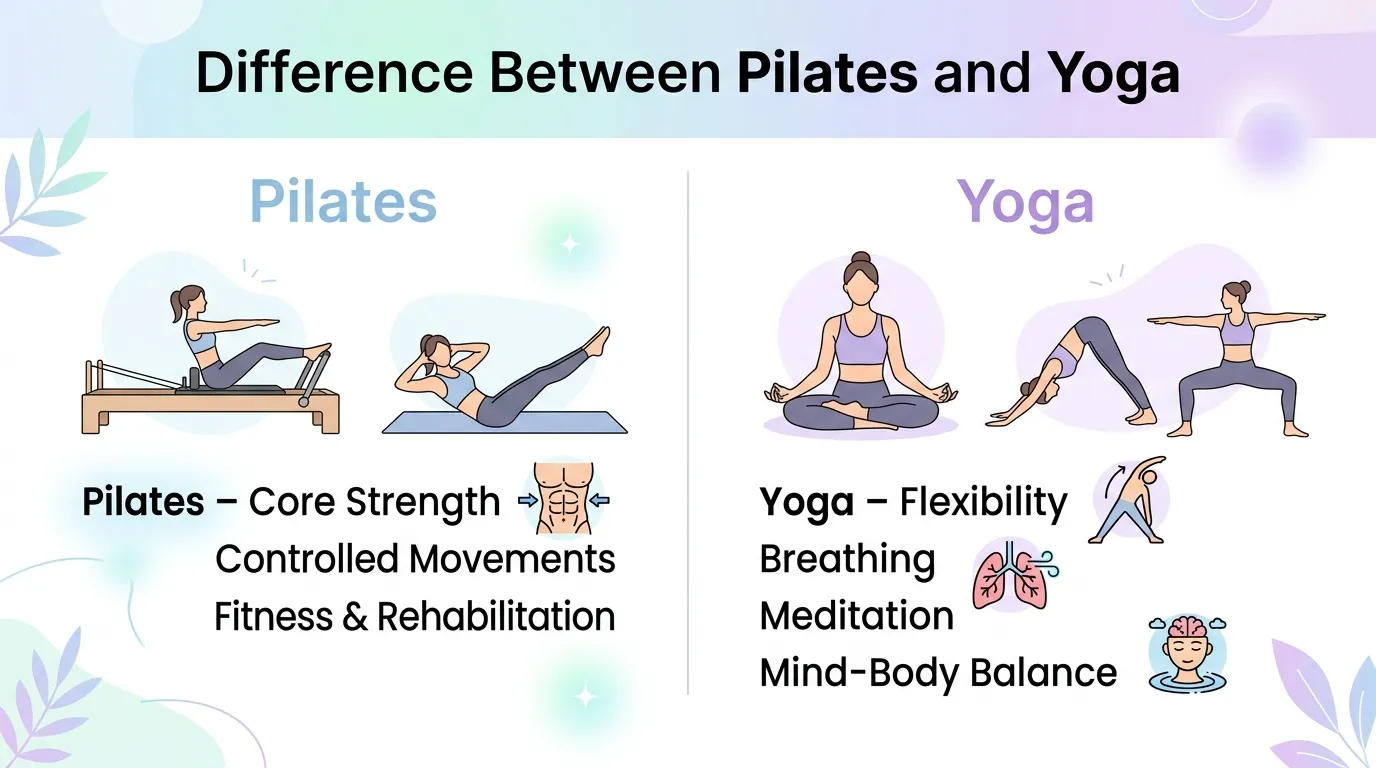
Pilates focuses on core strength and controlled physical movements.Yoga combines flexibility, breathing, and meditation. Yoga promotes overall mind-body balance.
Many people today get confused when choosing between home workouts, studio classes, or fitness apps like YouTube, Instagram fitness reels, or platforms such as Meta fitness communities.
One of the most common search queries is the difference between Pilates and yoga. At first glance, both use similar elements like slow movements, controlled breathing, and mat exercises, but in reality, they follow completely different principles.
The difference between Pilates and yoga is not just about exercise style; it is about philosophy, body mechanics, breathing systems, and fitness goals.
Many users search “what is Pilates vs yoga,” “how is Pilates different from yoga,” or “why do yoga and Pilates feel similar,” because people often recommend both for weight loss, flexibility, stress relief, and core strength.
In simple words, yoga focuses more on mind-body connection, flexibility, and spiritual balance, while Pilates focuses on core strength, posture alignment, and muscle control.
This article will give you a complete, expert-level breakdown of the difference between Pilates and yoga, including real-life usage, fitness applications, misconceptions, and professional insights.
By the end, you will clearly understand which one fits your lifestyle, if you are a beginner, athlete, or someone using fitness apps like Google Fit, Nike Training Club, or YouTube workouts.
Difference Between Pilates and Yoga
Pilates uses a structured fitness method to improve core strength and posture control, while yoga combines physical movement, breathing, and meditation to create overall mind-body balance.
Example: Pilates helps you build abdominal strength and stability, while yoga helps you improve flexibility and reduce stress.
Definition of Pilates and Yoga
- Pilates: A modern exercise system created by Joseph Pilates that focuses on core strength, posture, muscle control, and body alignment.
- Yoga: An ancient practice from India combining physical postures (asanas), breathing techniques (pranayama), and meditation for physical and mental well-being.
Pronunciation
Understanding pronunciation helps in global fitness communication before exploring the difference between Pilates and yoga.
- Pilates:
US: puh-LAH-teez
UK: pih-LAH-teez - Yoga:
US: YOH-guh
UK: YOG-ah
Let’s explore how both systems differ in real fitness environments like gyms, home workouts, and apps such as YouTube Fitness or Instagram Reels trainers.
Pilates vs Yoga Comparison
| Feature | Pilates | Yoga | Similarity |
| Origin | 20th-century (Germany/USA) | Ancient India | Both improve physical health |
| Focus | Core strength & posture | Mind-body balance | Both use controlled movement |
| Breathing | Lateral chest breathing | Deep diaphragmatic breathing | Both use breath control |
| Equipment | Mats, reformers | Mostly mats | Both can be mat-based |
| Philosophy | Fitness & rehabilitation | Spiritual + physical wellness | Both improve well-being |
| Intensity | Moderate to high control | Low to moderate | Both adaptable |
| Goal | Muscle tone & alignment | Flexibility & calmness | Both improve body awareness |
This table clearly shows the difference and similarity between Pilates and yoga for quick understanding.
Key Differences Explained Between Pilates and Yoga
1. Origin and Philosophy
Pilates is modern and science-based. Yoga is ancient and spiritual.
Example: Pilates is often used in physiotherapy clinics. Yoga is used in meditation centers.
2. Fitness Goals
Pilates focuses on building a strong core and posture. Yoga focuses on flexibility and mental peace.
User insight: Many beginners search “Pilates for belly fat vs yoga for stress relief.”
3. Movement Style
Pilates uses small, controlled repetitive movements. Yoga uses flowing poses and static holds.
4. Breathing Technique
Pilates uses structured breathing for muscle engagement. Yoga uses natural breathing for relaxation and energy flow.
5. Equipment Usage
Pilates may include reformer machines in studios. Yoga usually requires only a mat.
6. Mental vs Physical Balance
Yoga strongly connects to meditation and mindfulness. Pilates is more physical performance-focused.
7. Injury Rehabilitation
Pilates is widely used in rehab programs. Yoga is used for recovery and stress relief.
8. Popularity in Digital Fitness Platforms
Apps like YouTube Fitness, Nike Training Club, and Apple Fitness+ offer both options, making them easily accessible for users. Pilates is trending for core workouts, and yoga is trending for mental wellness.
What Is Pilates vs Yoga Really About?
Why Pilates Exists
Pilates was designed to help soldiers recover strength and improve posture after injuries. Today, it is used in fitness training, physiotherapy, and athletic conditioning.
Why Yoga Exists
Yoga originated in ancient India as a holistic system for body, mind, and spiritual balance. It was never just exercise it was a lifestyle discipline.
How They Work in Real Life
- Pilates strengthens muscles through controlled resistance
- Yoga balances energy through poses and breathing
Where They Are Used Today
- Gyms and fitness studios
- Online platforms like YouTube, Meta fitness groups
- Corporate wellness programs
- Physical therapy clinics
Difference and Similarity: Pilates vs Yoga
| Feature | Pilates | Yoga | Similarity |
| Purpose | Strength & posture | Mind-body balance | Health improvement |
| Movement Style | Controlled reps | Flowing poses | Physical exercise |
| Breathing | Structured | Natural | Breath awareness |
| Equipment | Optional machines | Mostly none | Minimal equipment use |
| Mental Focus | Low-medium | High | Stress reduction |
| Flexibility | Moderate | High | Improves mobility |
| Accessibility | Beginner-friendly | Beginner-friendly | Easy to start |
| Popular Platforms | Fitness apps | Meditation apps | Digital availability |
Common Mistakes with Pilates and Yoga
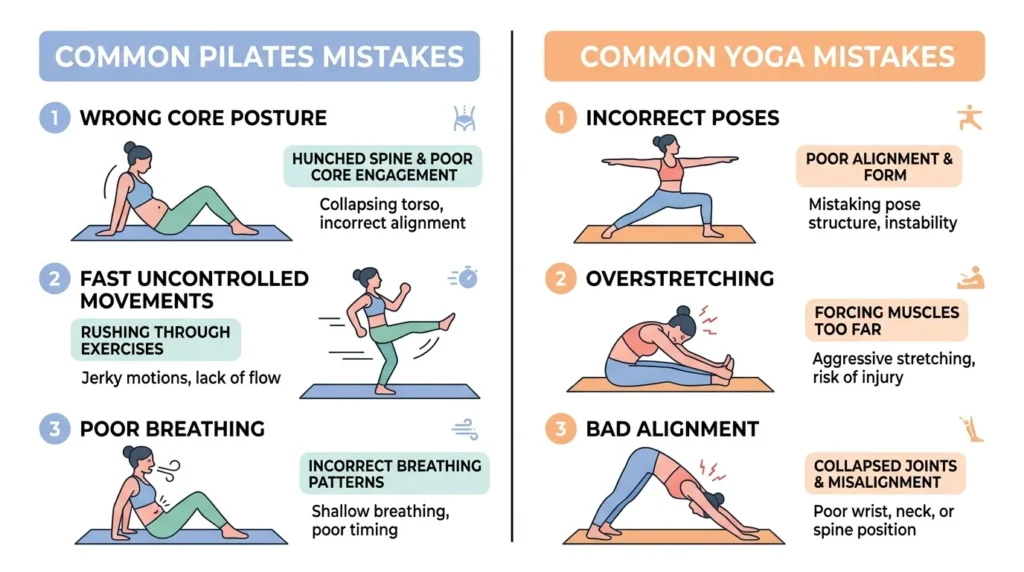
- Thinking both are the same workout
- Assuming yoga is only stretching
- Believing Pilates is only for women
- Using wrong breathing technique
- Expecting fast weight loss results
- Not following proper posture alignment
Fix: Learn basics first or follow certified instructors online.
Real Life Examples with Pilates and Yoga
- Office workers use yoga for stress relief
- Athletes use Pilates for core strength
- Beginners use YouTube guided sessions
- Fitness influencers on Instagram promote both
- Physiotherapists recommend Pilates for recovery
- Meditation apps include yoga for mindfulness
When to Use Pilates vs Yoga
- Choose Pilates if you want:
- Strong core
- Better posture
- Muscle toning
- Choose Yoga if you want:
- Stress relief
- Flexibility
- Mental calmness
Why People Get Confused Between Pilates and Yoga
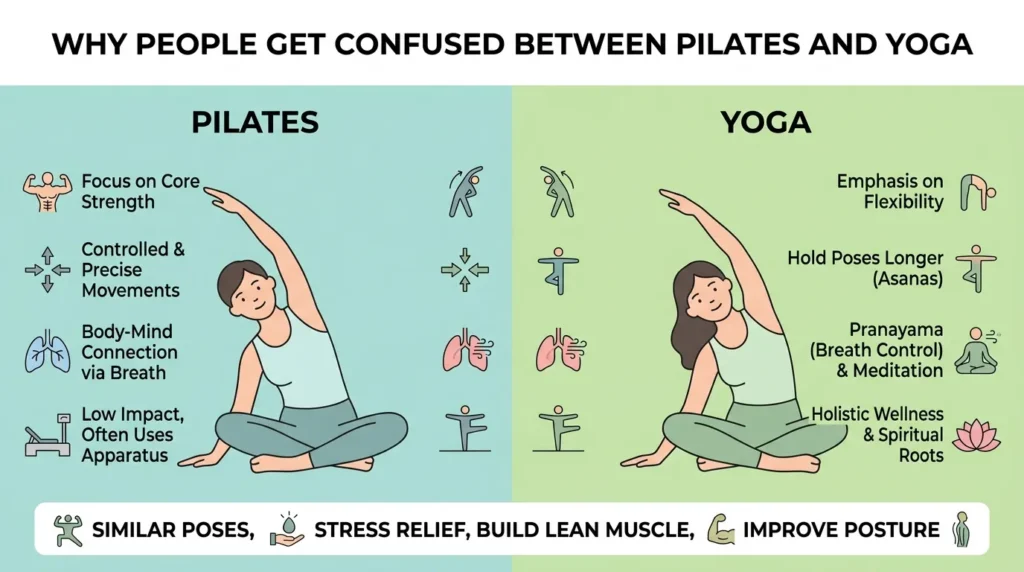
People get confused because:
- Both are mat-based workouts
- Both use slow controlled movements
- Fitness influencers mix both terms
- Online platforms like YouTube label them incorrectly
- Both improve flexibility and strength
How Search Engines Understand Pilates vs Yoga
Google and platforms like Instagram and YouTube analyze:
- User engagement on fitness videos
- Search patterns like “Pilates vs yoga for weight loss”
- Content categories (fitness, wellness, rehab)
- Entity relationships (exercise, mindfulness, training systems)
This is why comparison articles rank high they match clear user intent.
Expert Insight
As a fitness content specialist with experience analyzing training systems, Pilates and yoga serve different physiological and neurological purposes. In real training environments, trainers often prescribe Pilates for spinal alignment and core rehabilitation, whereas they use yoga for mental conditioning and flexibility improvement. Professional trainers frequently combine both for balanced fitness programs.
FAQs
1.Is Pilates better than yoga?
It depends on your goal Pilates for strength, yoga for flexibility.
2. Can beginners do both?
Yes, both are beginner-friendly.
3. Which burns more calories?
Pilates generally burns slightly more calories compared to other similar low-impact workouts.
4. Is yoga spiritual or fitness?
It is both physical and spiritual in nature.
5. Can I lose weight with yoga or Pilates?
Yes, both support weight loss with consistency.
6. Which is better for back pain?
Trainers often recommend Pilates for posture-related back issues.
7. Do I need equipment?
Usually, people can do both on a mat without any special equipment.
8. How often should I practice?
3–5 times per week is ideal.
Conclusion
The difference between Pilates and yoga is clear when you understand their purpose, origin, and training style. Pilates focuses on core strength, posture correction, and controlled muscle movement as a structured fitness method.Yoga, on the other hand, is a holistic ancient practice combining physical postures, breathing, and mindfulness for overall well-being.
Pilates focuses more on performance and strength, whereas yoga focuses on flexibility, relaxation, and mental clarity. People widely use both today across gyms, fitness apps, YouTube workouts, and wellness programs.Many professionals even recommend combining both for maximum health benefits.
Pilates builds body strength from the inside out, whereas yoga focuses on connecting the body and mind in harmony. Knowing the difference between Pilates and yoga helps you choose the right practice for your fitness goals like weight loss, stress relief, or core strength.
Read more about!
Difference Between Brandy and Cognac: Complete Guide
Difference Between Acute and Chronic: Complete Guide

I am James Carter, a professional content writer from the United States. I specialize in writing simple and clear comparison blogs that help students and readers understand difficult topics easily. My writing focuses on everyday language, education, science, and lifestyle topics. I believe that learning should be easy for everyone, so I use simple words and real-life examples in my articles.