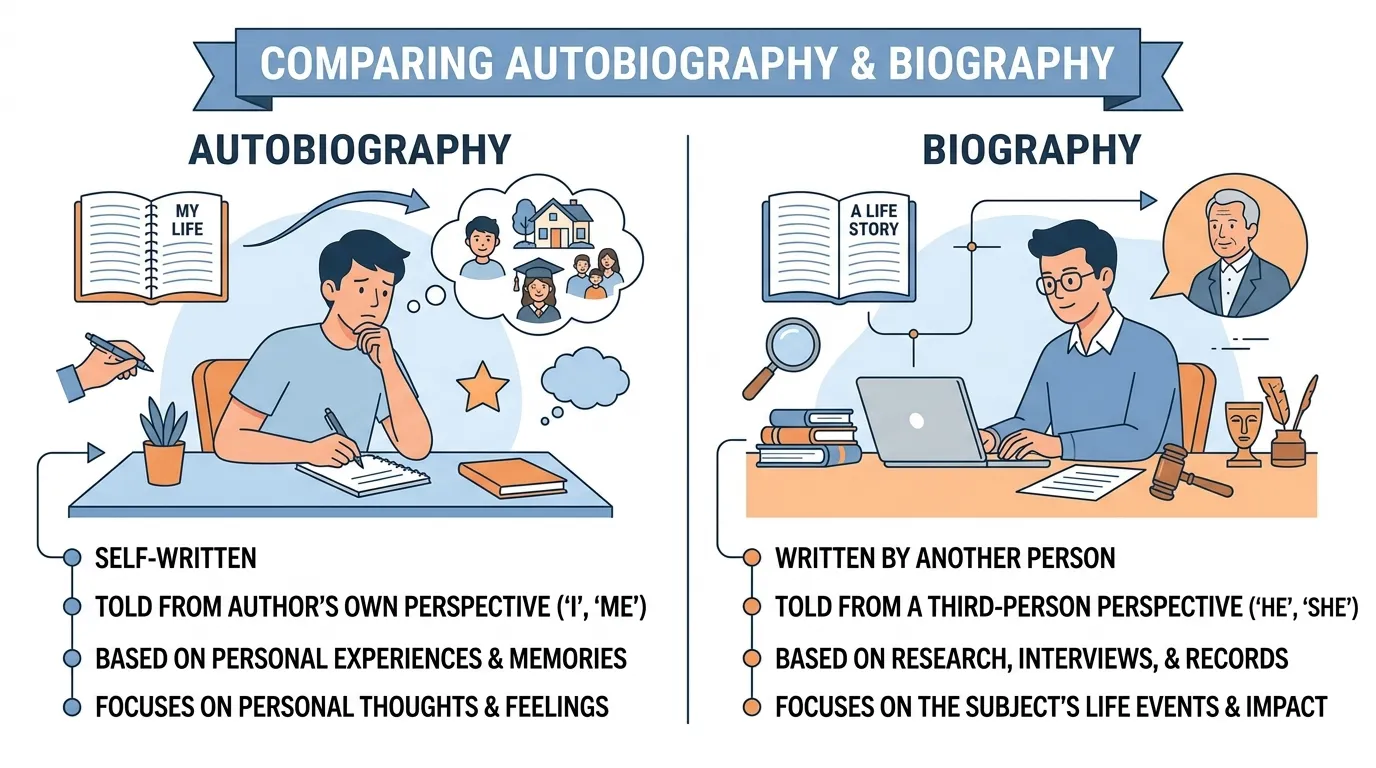
The difference between autobiography and biography is that an autobiography is written by the person themselves, while a biography is written by someone else about that person’s life.
Many users get confused about the difference between autobiography and biography because both are stories about a person’s life.
In simple words, the main difference is who writes the story. An autobiography is written by the person themselves, while a biography is written by someone else.
The difference between autobiography and biography matters in schools, publishing, journalism, and even on platforms like Google and YouTube, where people search for real-life stories, historical figures, and inspirational journeys.
If you are a student, writer, content creator, or book lover, understanding this topic helps you choose the right format.
In this complete guide, you will learn:
- what autobiography and biography mean
- how they are different
- when to use each one
- common mistakes people make
- real-world examples
- why search engines understand these terms differently
By the end, you will not need another article on the topic.
Difference Between Autobiography and Biography
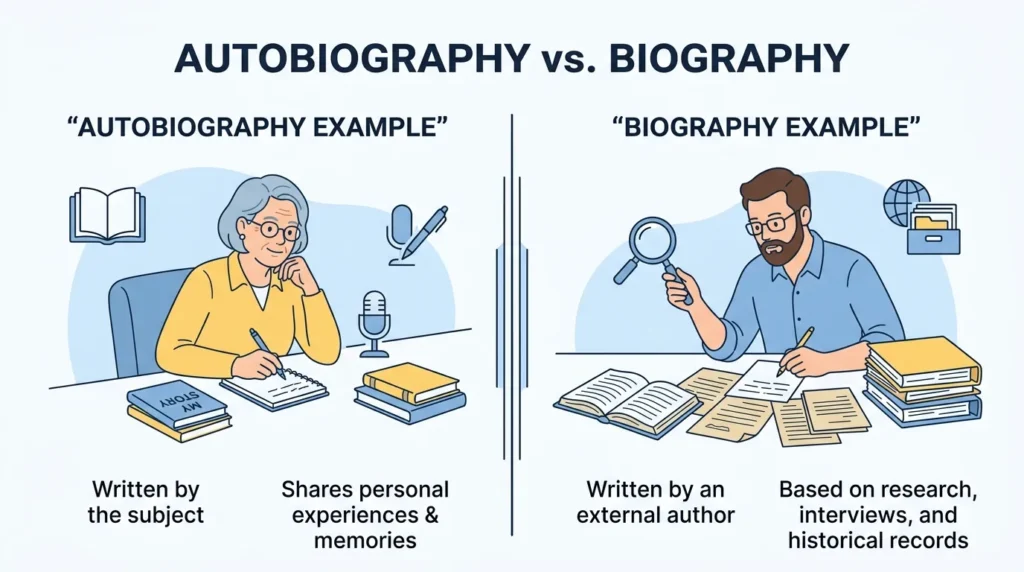
An autobiography is a life story written by the person themselves, while a biography is written by another author about someone’s life.
For example:
- Nelson Mandela wrote his own autobiography Long Walk to Freedom.
- A writer creating a book about Albert Einstein would be writing a biography.
Definition of Difference Between Autobiography and Biography
- Autobiography: A book or written account where a person tells the story of their own life using personal experiences and memories.
- Biography: A written account of someone’s life created by another writer based on research, interviews, and historical information.
Simple Example
- If a celebrity writes about their own journey, it is an autobiography.
- If a journalist writes about that celebrity, it is a biography.
Pronunciation
| Word | US Pronunciation | UK Pronunciation |
| Autobiography | aw-toh-bye-OG-ruh-fee | aw-tuh-bye-OG-ruh-fee |
| Biography | bye-OG-ruh-fee | bye-OG-ruh-fee |
Now that the meanings are clear, let’s understand the deeper comparison between autobiography and biography.
Difference Between Autobiography and Biography
| Feature | Autobiography | Biography |
| Writer | Written by the person themselves | Written by another person |
| Point of View | First-person (“I”, “my”) | Third-person (“he”, “she”, “they”) |
| Information Source | Personal memories and experiences | Research, interviews, and records |
| Emotional Depth | Usually more personal and emotional | Often more objective |
| Accuracy Risk | May include personal bias | Depends on author research |
| Purpose | Self-expression and life reflection | Informing readers about someone |
| Writing Style | Personal storytelling | Analytical or historical |
| Example | The Diary of a Young Girl by Anne Frank | Biography of Steve Jobs by Walter Isaacson |
Key Differences Explained Between Autobiography and Biography
1. Who Writes the Story
The biggest difference between autobiography and biography is authorship.
- In an autobiography, the person writes about themselves.
- In a biography, another writer tells the story.
Real-Life Example
Barack Obama wrote Dreams from My Father, making it an autobiography.
2. Personal Emotions vs Research
Autobiographies often contain emotions, personal struggles, and hidden thoughts.
Biographies usually focus more on facts, timelines, and historical accuracy.
Practical Insight
Many readers choose autobiographies for emotional connection and biographies for detailed learning.
3. Writing Perspective
Autobiographies use first-person language:
- “I worked hard.”
- “My childhood was difficult.”
Biographies use third-person narration:
- “He became successful.”
- “She inspired millions.”
This changes how readers experience the story.
4. Reliability of Information
Many beginners assume autobiographies are always more accurate. That is not always true.
A person may forget details or present events emotionally. A skilled biographer often checks:
- interviews
- documents
- news reports
- historical records
This is why publishers and academic researchers still value biographies highly.
5. Purpose of Writing
Autobiographies are often written to:
- inspire
- share lessons
- explain personal struggles
Biographies are usually written to:
- educate readers
- preserve history
- analyze achievements
6. Reader Experience
Autobiographies feel intimate and personal.
Biographies feel broader and more researched.
In real scenarios, readers who enjoy emotional storytelling often prefer autobiographies, while students and historians prefer biographies.
What Is an Autobiography?
An autobiography is a self-written life story. The writer shares:
- childhood memories
- career experiences
- failures and achievements
- personal opinions
The main goal is usually self-expression and sharing life lessons.
Famous Autobiography Examples
- Long Walk to Freedom by Nelson Mandela
- The Story of My Experiments with Truth by Mahatma Gandhi
What Is a Biography?
A biography is a detailed account of someone’s life written by another author.
Biographers often spend years researching:
- interviews
- newspapers
- documentaries
- letters
- academic archives
Famous Biography Examples
- Biography of Elon Musk
- Biography of Marie Curie
Biographies are common in:
- schools
- documentaries
- history books
- publishing industries
Why Does the Difference Between Autobiography and Biography Matter?
Many people think the distinction is small, but it actually changes:
- credibility
- emotional tone
- storytelling style
- reader trust
For example:
- Universities may prefer biographies for research.
- Fans may prefer autobiographies for personal insight.
Even modern media platforms like Instagram and Meta encourage personal storytelling, which has increased interest in autobiographical content.
Difference and Similarity Between Autobiography and Biography
| Feature | Autobiography | Biography | Similarity |
| Meaning | Self-written life story | Life story written by others | Both describe a person’s life |
| Writing Style | Personal and emotional | Research-based and objective | Both use storytelling |
| Perspective | First-person narration | Third-person narration | Both explain life experiences |
| Purpose | Share personal journey | Inform readers | Both educate and inspire |
| Sources | Personal memories | Interviews and records | Both may include facts and events |
| Reader Experience | Emotional connection | Historical understanding | Both engage readers |
| Accuracy | Can include personal bias | Depends on research quality | Both can contain opinions |
| Common Use | Memoirs and reflections | Academic and historical works | Both are popular book genres |
This table clearly shows the difference and similarity between autobiography and biography for quick understanding.
Common Mistakes With Autobiography and Biography
1. Thinking They Are the Same
Many users use both terms interchangeably. The writer’s identity is the key difference.
2. Confusing Memoir With Autobiography
A memoir focuses on specific experiences, while an autobiography usually covers an entire life journey.
3. Assuming Biographies Are Always Objective
Some biographies contain author bias or incomplete research.
4. Believing Autobiographies Are Always True
Personal memory can change facts or perspectives over time.
5. Ignoring Writing Perspective
Students often forget:
- autobiography = first person
- biography = third person
This is a common exam mistake.
Real-Life Examples With Autobiography and Biography
Personal Use
A retired athlete writes about their career journey. This becomes an autobiography.
Business Use
Companies publish biographies of founders like Walt Disney to strengthen brand identity.
Education Industry
Schools assign biographies of scientists and leaders to teach history and leadership.
Media and Entertainment
Streaming platforms and documentary creators often adapt biographies into films and series.
Example:
Movies based on biographies frequently appear on Netflix and YouTube.
Social Media Influence
Modern creators sometimes share mini-autobiographical stories through blogs, podcasts, and video platforms.
When to Use Each
Use an Autobiography When:
- sharing personal experiences
- telling your own journey
- inspiring readers emotionally
- reflecting on life lessons
Use a Biography When:
- researching historical figures
- writing educational content
- creating documentaries
- presenting objective life analysis
Simple Decision Rule
If you write about yourself → autobiography
If you write about another person → biography
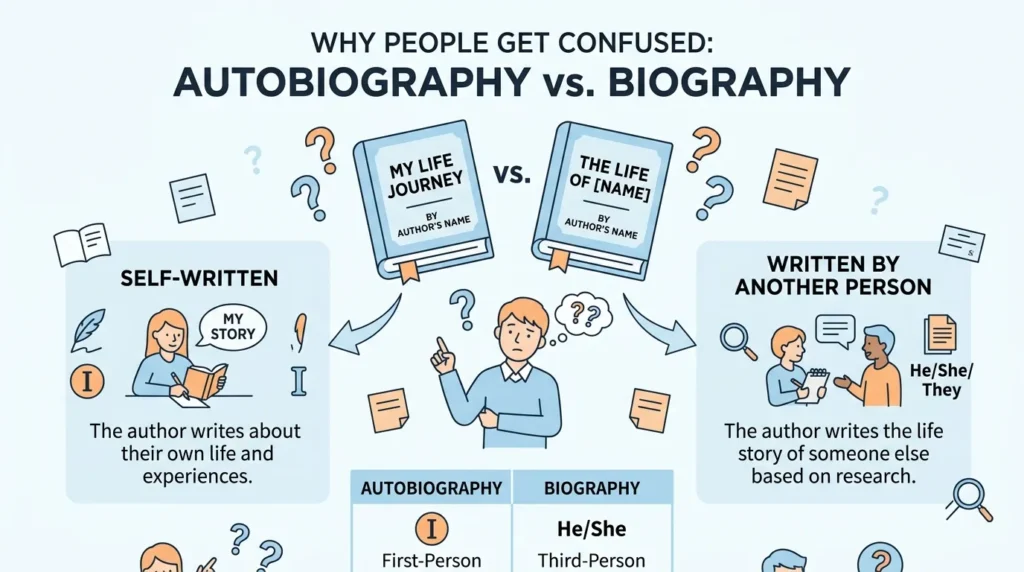
Why People Get Confused Between Autobiography and Biography
Similar Names
Both words contain “biography,” which naturally causes confusion.
Similar Purpose
Both tell life stories, so many readers think they are identical genres.
Media Influence
Movies, blogs, and online articles often misuse the terms.
School-Level Confusion
Many students memorize definitions without understanding the actual writing perspective.
How Search Engines Understand Autobiography vs Biography and User Intent
Search engines use semantic and user intent analysis to understand if users want:
- definitions
- comparisons
- examples
- book recommendations
- writing help
For example:
- “What is autobiography?” shows educational definitions.
- “Best biographies to read” triggers book recommendation results.
- “Difference between autobiography and biography” activates comparison-based search intent.
Modern algorithms also analyze:
- engagement signals
- readability
- topical authority
- entity relationships
That is why high-quality content performs better when it includes:
- examples
- comparison tables
- FAQs
- semantic keyword variations
Search engines now prioritize content that fully satisfies user intent instead of repeating keywords unnaturally.
Expert Insight
In practical publishing and educational use, autobiographies usually create stronger emotional engagement because readers connect directly with the author’s voice.
However, biographies often provide wider historical context and balanced analysis. Professional writers, journalists, and historians generally prefer biographies for academic work because they allow independent research and verification.
Most beginners focus only on “who wrote it,” but experienced readers also examine:
- reliability
- narrative style
- source quality
- emotional depth
- factual consistency
This deeper understanding helps readers evaluate books more intelligently.
FAQs
What is the main difference between autobiography and biography?
An autobiography is self-written, while a biography is written by another person.
Is a memoir the same as an autobiography?
No. A memoir focuses on specific life experiences, while an autobiography usually covers an entire life story.
Can biographies contain opinions?
Yes. Even researched biographies may reflect the author’s interpretation or perspective.
Why do students confuse autobiography and biography?
Because both involve life stories and have similar terminology.
Which is more trustworthy: autobiography or biography?
It depends on the quality of memory, honesty, and research involved.
Can celebrities write autobiographies?
Yes. Many celebrities publish autobiographies to share personal experiences directly with fans.
Why are biographies important in education?
They help students understand historical figures, leadership, and social impact.
Does Google treat autobiography and biography differently?
Yes. Search engines classify them differently based on user intent and semantic meaning.
Are autobiographies written in first person?
Yes. They usually use “I,” “my,” and “me.”
Can a biography become a movie?
Yes. Many films and documentaries are based on biographies.
Conclusion
Understanding the difference between autobiography and biography is important because both forms tell life stories in very different ways. An autobiography gives readers a direct and personal view from the individual themselves, while a biography provides an outside perspective based on research and analysis.
In simple words:
- autobiography = self-written life story
- biography = life story written by someone else
Both genres are valuable. Autobiographies create emotional connection and personal insight, while biographies provide historical depth and broader understanding. In real-world use, students, writers, researchers, publishers, and even search engines treat these formats differently because the writing style, perspective, and purpose are not the same.
As content platforms, digital publishing, and storytelling continue evolving in 2026, the demand for authentic life stories is growing rapidly. If you are reading for inspiration, education, or research, knowing the difference between autobiography and biography helps you choose the right type of content with confidence.
Read more about!
Difference Between Urban and Suburban: Complete Guide
Difference Between Diffusion and Osmosis: Complete Guide

I am James Carter, a professional content writer from the United States. I specialize in writing simple and clear comparison blogs that help students and readers understand difficult topics easily. My writing focuses on everyday language, education, science, and lifestyle topics. I believe that learning should be easy for everyone, so I use simple words and real-life examples in my articles.