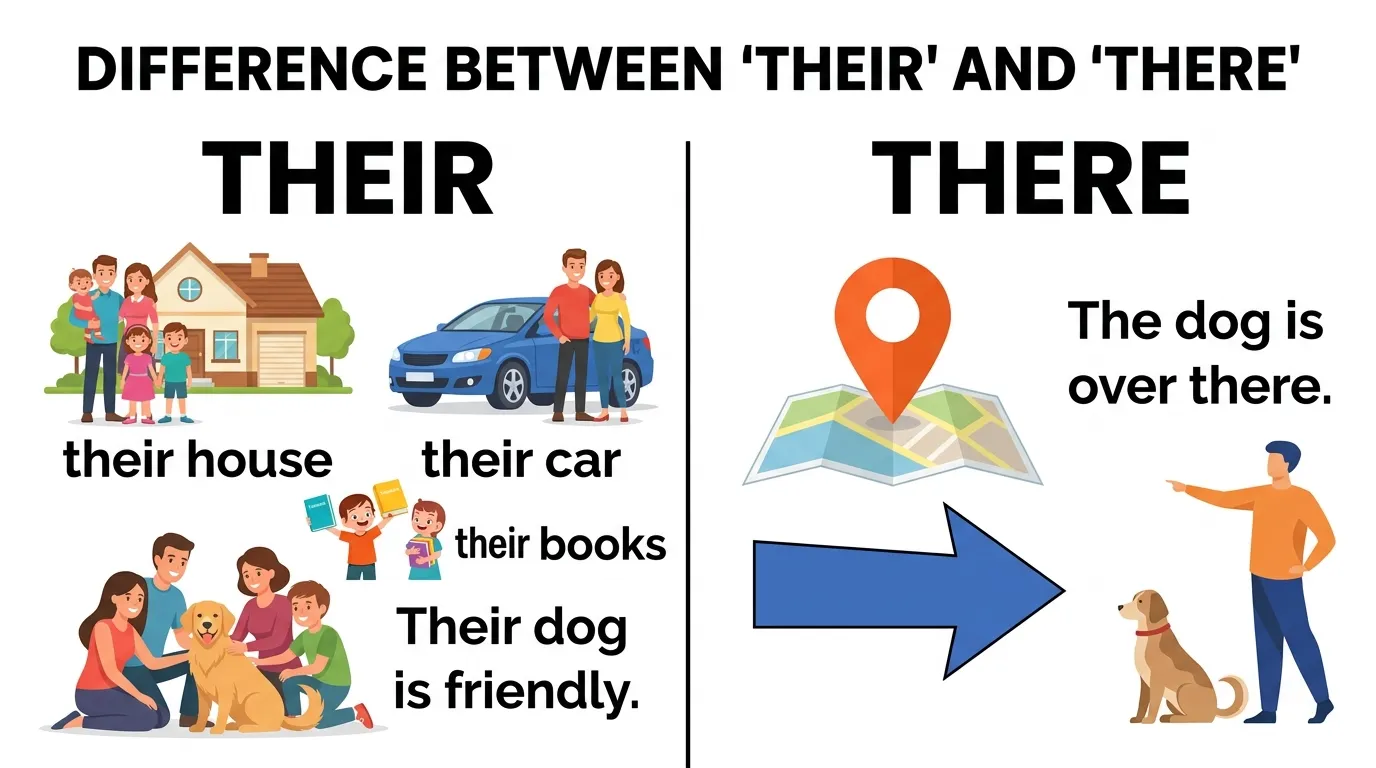
The difference between their and there is that their shows ownership, while there refers to a place or indicates that something exists.
The difference between their and there is one of the most searched grammar questions in English. Many users get confused because both words sound the same, but they have completely different meanings and uses.
If you have ever written “their is a problem” instead of “there is a problem,” you are not alone. Understanding the difference between their and there helps improve writing, communication, school assignments, business emails, and social media posts.
In this guide, you’ll learn what each word means, when to use it, common mistakes, pronunciation, real-life examples, and practical tips to remember the difference forever.
Difference Between Their and There
Their shows ownership or possession.
There refers to a place, location, or the existence of something.
Example:
- Their car is parked outside. (The car belongs to them.)
- There is a car parked outside. (A car exists in that place.)
In simple words:
- Their = belongs to them
- There = location or existence
Definition of Their and There
Their:
A possessive determiner used to show that something belongs to a group of people or individuals.
Example: Their house is beautiful.
There:
An adverb or pronoun used to indicate a place, position, or existence.
Example: There is a book on the table.
Pronunciation
| Word | US Pronunciation | UK Pronunciation |
| Their | /ðer/ | /ðeə/ |
| There | /ðer/ | /ðeə/ |
Interestingly, both words are pronounced almost exactly the same in most English accents. This is one major reason why people confuse them.
Now that you know how they sound, let’s understand how they function differently in everyday English.
Comparison Between Their and There
| Feature | Their | There |
| Meaning | Shows ownership | Shows location or existence |
| Grammar Type | Possessive determiner | Adverb, pronoun, or noun |
| Indicates | Something belongs to someone | A place or presence |
| Answers Question | Whose? | Where? |
| Example | Their dog is friendly. | The dog is over there. |
| Possession | Yes | No |
| Location | No | Yes |
| Common Use | Ownership statements | Place and existence statements |
Key Differences Explained Between Their and There
1. Ownership vs Location
Their indicates ownership.
Example: Their laptop is new.
There points to a location.
Example: The laptop is over there.
2. Answers Different Questions
- Their answers “Whose?”
- There answers “Where?”
Example
Whose backpack is this?
→ Their backpack.
Where is the backpack?
→ It’s there.
3. Possessive Function
Their acts like ownership markers such as my, your, our, and his.
Example
- My phone
- Your phone
- Their phone
4. Location Indicator
There commonly identifies places.
Example
- Put the package there.
- We met there yesterday.
5. Existence Statements
There often starts sentences showing that something exists.
Examples
- There is a problem.
- There are many students.
- There was a meeting today.
6. Grammar Role
Their modifies a noun.
Example
Their project won an award.
There often functions independently.
Example
There are several solutions available.
7. Writing Accuracy
Using the wrong word can change the meaning and make writing look unprofessional.
Example
❌ Their is a restaurant nearby.
✅ There is a restaurant nearby.
Why Does the Difference Between Their and There Exist?
English developed from multiple language influences, including Germanic and French roots.
The word their evolved to express possession.
The word there developed to describe places and positions.
Although they sound alike today, they serve different grammatical purposes.
This is a classic example of English homophones words that sound the same but have different meanings.
How Does Their Work in Sentences?
Think of their as a word that always connects people with something they own.
Examples
- Their teacher assigned homework.
- Their company launched a new product.
- Their account was verified.
- Their team won the championship.
Whenever you can replace the word with belongs to them, “their” is usually correct.
Quick Test
“Their car”
Means:
“The car belongs to them.”
How Does There Work in Sentences?
There has two major uses:
1. Location
- The keys are there.
- We stayed there for a week.
2. Existence
- There is a solution.
- There are several options available.
Many websites, business emails, and social media posts use existence statements beginning with “there is” or “there are.”
Difference Between Their and There in Modern Digital Communication
Today, grammar matters more than many people realize.
If you’re posting on Google, commenting on YouTube, messaging through Instagram, or using platforms owned by Meta, correct grammar affects credibility.
Example
Incorrect:
“There going to launch there product.”
Correct:
“They’re going to launch their product there.”
Small grammar improvements can make communication appear more professional and trustworthy.
Difference and Similarity Between Their and There
| Feature | Their | There | Similarity |
| Meaning | Ownership | Location or existence | Both are English words |
| Pronunciation | Sounds like “there” | Sounds like “their” | Same pronunciation |
| Grammar Function | Possessive determiner | Adverb/pronoun | Both appear in sentences |
| Indicates | Belonging | Place or existence | Both provide context |
| Answers | Whose? | Where? | Help clarify meaning |
| Used Before Nouns | Usually yes | Usually no | Commonly used in writing |
| Common Error | Mixed with there | Mixed with their | Frequently confused |
| Writing Importance | Shows ownership clearly | Shows location clearly | Essential for good grammar |
This table clearly shows the difference and similarity between their and there for quick understanding.
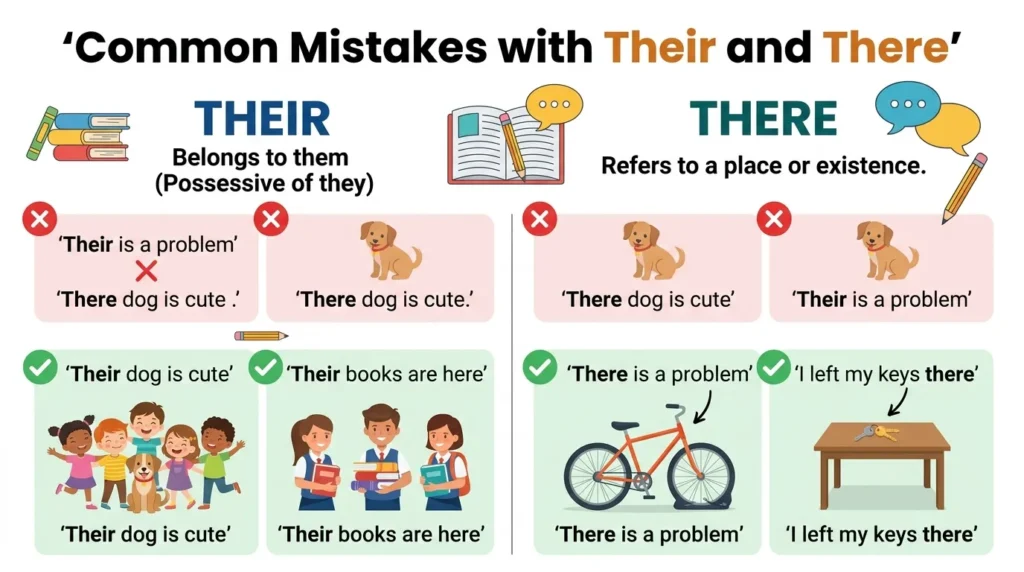
Common Mistakes with Their and There
| Mistake | Correction |
| Their is a problem. | There is a problem. |
| Put the books in their. | Put the books in there. |
| There dog is barking. | Their dog is barking. |
| Their are many reasons. | There are many reasons. |
| We left their yesterday. | We left there yesterday. |
Helpful Tip
If you mean belongs to them, use their.
If you mean a place or something exists, use there.
Real Life Examples with Their and There
Personal Use
Their family is visiting tomorrow.
There is plenty of food prepared.
School Use
Their project received first place.
There are five students in the library.
Business Use
Their company expanded internationally.
There is a meeting scheduled for Monday.
Social Media Use
Their content gained thousands of views.
There are many comments on the post.
Workplace Communication
Their manager approved the budget.
There will be a team meeting at noon.
When to Use Each
Use Their When:
- Talking about ownership
- Referring to possessions
- Showing something belongs to people
Examples
- Their office
- Their website
- Their strategy
Use There When:
- Talking about location
- Referring to a place
- Showing existence
Examples
- Sit there.
- There is a problem.
- There are many choices.
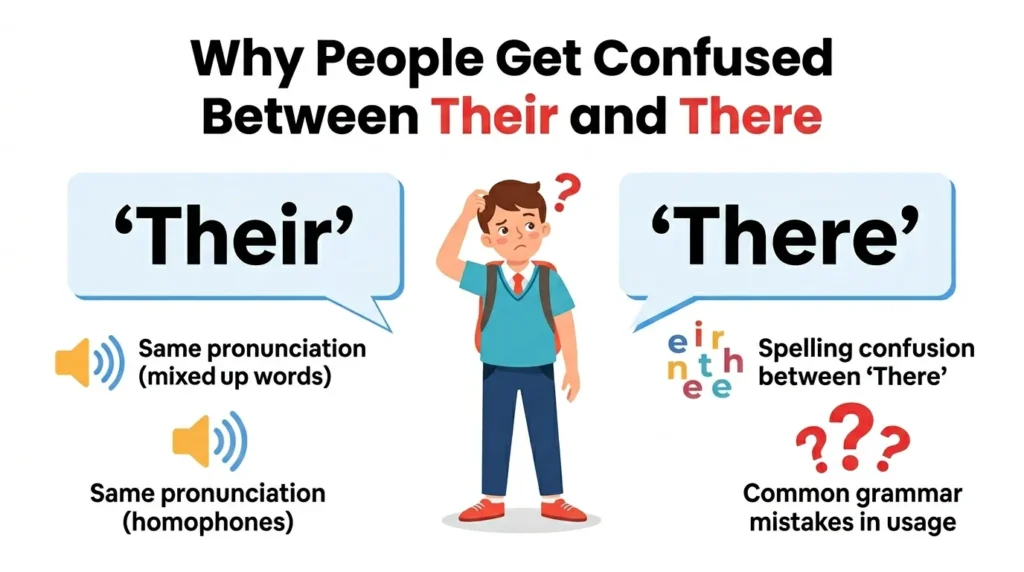
Why People Get Confused Between Their and There
Several factors contribute to confusion:
Same Pronunciation
Both words sound nearly identical.
Fast Typing
Many mistakes happen during texting and online communication.
Autocorrect Issues
Spell-checkers may not always detect contextual errors.
Early Learning Challenges
Beginners often learn pronunciation before grammar rules.
Homophone Effect
English contains many homophones that create confusion.
Examples include:
- To, Too, Two
- Your, You’re
- Their, There, They’re
How Search Engines Understand Their and There and User Intent
Search engines such as Google analyze context rather than pronunciation.
For example:
- “their meaning” triggers possession-related results.
- “there meaning” triggers location-related results.
- “difference between their and there” triggers comparison content.
Modern search algorithms use semantic understanding, natural language processing (NLP), user behavior signals, and contextual relationships to determine intent.
This is why detailed comparison guides often rank higher than simple dictionary definitions.
Expert Insight
From a language and content-writing perspective, the easiest way to remember the difference is to focus on the question being asked.
If the sentence answers “Whose?”, choose their.
If the sentence answers “Where?” or indicates existence, choose there.
In practical editing and professional writing, this simple method eliminates most errors immediately. Most beginners improve accuracy dramatically once they stop focusing on pronunciation and start focusing on meaning.
FAQs
What is the difference between their and there?
Their shows ownership, while there refers to a place or existence.
Is their a possessive word?
Yes. Their indicates that something belongs to them.
Is there used for location?
Yes. There often points to a place or position.
Why do their and there sound the same?
They are homophones words with the same pronunciation but different meanings.
Which word shows ownership?
Their.
Which word is used in “there is” and “there are”?
There.
Is “their is” grammatically correct?
No. The correct phrase is “there is.”
How can I remember the difference quickly?
Remember:
- Their = belongs to them
- There = place or existence
Are their and there interchangeable?
No. They have different meanings and grammatical functions.
What is the difference between their, there, and they’re?
- Their = possession
- There = location/existence
- They’re = contraction of “they are”
Conclusion
Understanding the difference between their and there is essential for clear and professional English communication. Although the two words sound almost identical, they serve very different purposes. Their is used to show ownership, while there refers to a place or indicates that something exists.
In real-world writing from school assignments and business emails to social media posts and website content using the correct word improves clarity and credibility. Most mistakes happen because these words are homophones, but a simple memory trick can help: if you can replace the phrase with “belongs to them,” use their. If you’re talking about a location or existence, use there.
The difference between their and there becomes much easier once you focus on meaning rather than pronunciation. By understanding the definitions, examples, comparison tables, common mistakes, and practical applications covered in this guide, you can confidently choose the correct word every time.
Mastering this small grammar rule may seem simple, but it has a big impact on effective communication and polished writing.
Read more about!
Difference Between BS and BA: Complete Guide
Difference Between Zyrtec and Claritin: Complete Guide

I am Emily Johnson, a USA-based content writer who creates easy-to-read blogs on language and daily life topics. I explain complex ideas in simple English for students and beginners so they can understand easily.