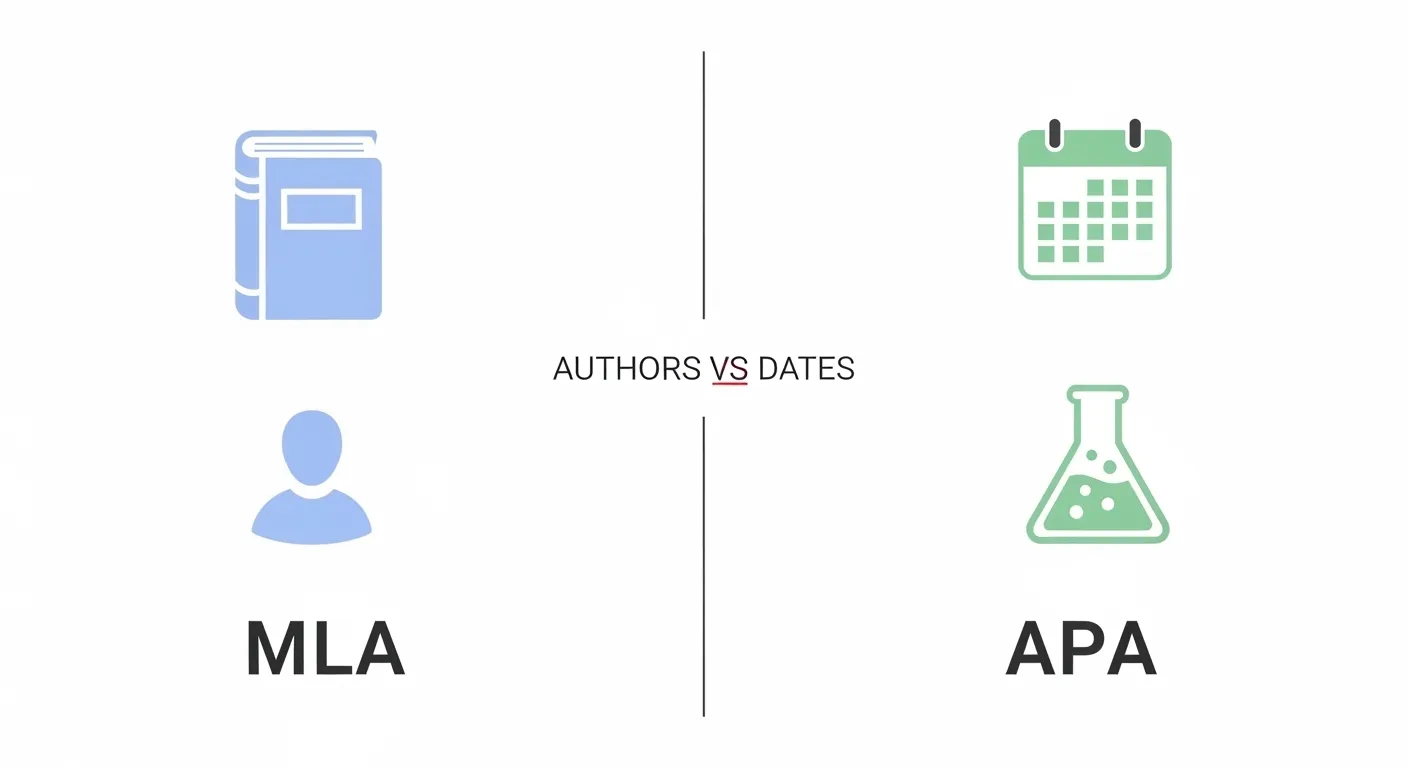
📚 MLA vs APA: MLA focuses on authors and humanities style, while APA emphasizes dates and is used in social sciences.
Have you ever wondered why students and researchers follow certain styles for writing papers? Two of the most common styles are MLA and APA. Imagine you are in a library.
You pick up a book, and the references inside are listed in different ways. One book uses author names first, while another lists the year first. That is exactly the difference between MLA and APA.
MLA, or Modern Language Association style, is often used for literature and arts, while APA, or American Psychological Association style, is mostly used in social sciences and psychology.
Knowing the difference between MLA and APA helps learners avoid mistakes in citations and helps experts maintain credibility. Proper citation keeps your work clear, professional, and trustworthy.
Pronunciation:
- MLA – US /ˌɛm el ˈeɪ/, UK /ˌɛm el ˈeɪ/
- APA – US /ˌeɪ pi ˈeɪ/, UK /ˌeɪ pi ˈeɪ/
Let’s dive deeper to see the main differences and understand why people get confused about their use.
Difference Between MLA and APA
Here are 10 clear points of difference with examples:
- Subject Focus
- MLA: Focuses on literature, arts, and humanities.
Example: A paper on Shakespeare’s plays uses MLA. - APA: Focuses on psychology, education, and social sciences.
Example: A study on child behavior uses APA.
- MLA: Focuses on literature, arts, and humanities.
- Title Page
- MLA: Usually does not require a separate title page.
Example: MLA essay has title on the first page. - APA: Requires a title page with title, author, and institution.
Example: APA research paper includes a full title page.
- MLA: Usually does not require a separate title page.
- In-Text Citations
- MLA: Uses author-page format (Smith 23).
- APA: Uses author-year format (Smith, 2020).
- Reference List Name
- MLA: Called “Works Cited.”
- APA: Called “References.”
- Date Placement
- MLA: Date appears at the end of citation.
- APA: Date appears right after author’s name.
- Font and Spacing
- MLA: Usually Times New Roman, 12pt, double-spaced.
- APA: Times New Roman or Arial, 12pt, double-spaced with running head.
- Page Numbers
- MLA: Includes page numbers in header with author name.
- APA: Page numbers only, running head optional.
- Quotations
- MLA: Short quotes in quotation marks; long quotes indented.
- APA: Similar but emphasizes year in citation.
- Use of Footnotes
- MLA: Footnotes and endnotes are allowed.
- APA: Less common, mostly in appendices.
- Overall Style
- MLA: More flexible, simple format.
- APA: Structured, formal style for research.
Nature and Behavior
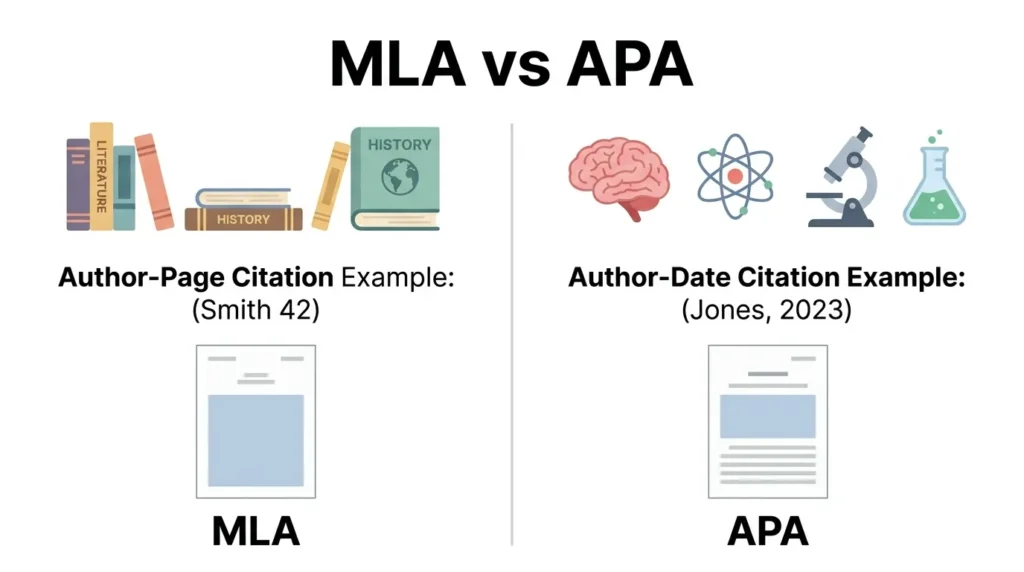
- MLA: Informal, narrative-friendly, used in storytelling and analysis.
- APA: Formal, scientific, data-focused, structured for research clarity.
Why Are People Confused About Their Use?
Many students mix MLA and APA because both deal with citations and references. While one focuses on arts, the other is for sciences. Also, rules change slightly over time, which adds confusion.
MLA vs APA of Difference and Similarity
| Feature | MLA | APA | Similarity |
| Subject Focus | Arts, literature | Psychology, sciences | Both provide structured citations |
| Title Page | Optional | Required | Both start with title |
| In-Text Citation | Author-page | Author-year | Both credit sources |
| Reference List Name | Works Cited | References | Both list all sources used |
| Date Placement | End of citation | After author | Both follow consistent style |
| Quotation Handling | Quotes & indents | Quotes & indents | Both follow citation rules |
| Footnotes | Allowed | Rare | Both can provide extra info |
| Overall Style | Flexible | Formal | Both organize content clearly |
Which Is Better in What Situation?
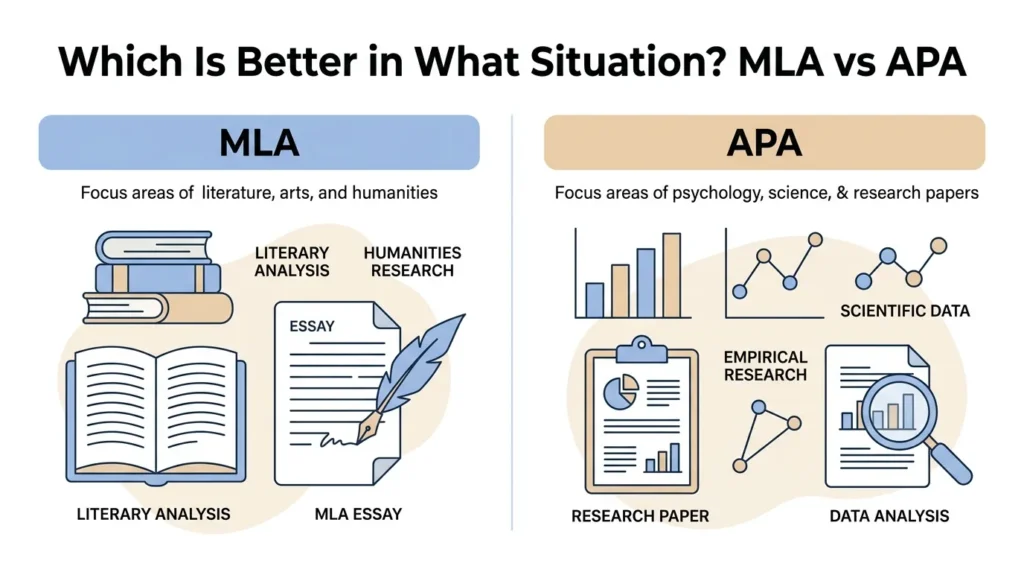
MLA is better when writing essays on novels, poems, or art. It makes the text easy to read and keeps citations simple. APA is better for research reports, psychology studies, or surveys. It gives structure, clarity, and emphasizes dates and data. Choose MLA for narrative papers and APA for scientific writing.
How Are MLA and APA Used in Metaphors and Similes?
- MLA: “MLA is like a storybook map, guiding readers through words.”
- APA: “APA is like a blueprint, showing every fact in precise order.”
Connotation:
- MLA – neutral/positive, user-friendly.
- APA – neutral/positive, scientific and structured.
Idioms or Proverbs Related
- “Dot your i’s and cross your t’s” – APA reminds writers to be precise.
- “Read between the lines” – MLA allows interpretation and analysis.
Works in Literature
- MLA mentioned in The MLA Handbook, Modern Language Association, 2016 (Guidebook)
- APA mentioned in Publication Manual of the APA, American Psychological Association, 2020 (Manual)
Movies Related
- No direct movies titled after MLA or APA; used indirectly in documentaries on education (e.g., Schooling the World, 2010, India).
FAQs
- Which is easier, MLA or APA?
- MLA is simpler for humanities; APA is detailed for sciences.
- Can MLA be used in science papers?
- It’s not recommended; APA fits better.
- Do both require references?
- Yes, both styles cite sources accurately.
- Are online sources cited differently?
- MLA includes URL; APA includes DOI or URL.
- Does APA need a title page?
- Yes, MLA usually does not.
How Are Both Useful for Surroundings?
Proper citation prevents plagiarism and supports honest research. MLA and APA create clarity in schools, colleges, and workplaces. They make information easy to trace and ensure trust in research for society.
Final Words
Both MLA and APA are essential tools for learners, writers, and researchers. Knowing when and how to use each ensures credibility and improves communication in both arts and sciences.
Conclusion
Understanding the difference between MLA and APA is vital for academic and professional writing. MLA helps writers focus on narrative clarity and arts, while APA supports scientific accuracy and structured research.
Learning both improves writing quality, avoids plagiarism, and ensures proper credit to authors. If in schools, universities, or workplaces, knowing these styles enhances trust, knowledge-sharing, and credibility. Proper use of MLA and APA keeps your work professional, neat, and readable for everyone.
Read more about!
Internship vs Externship – Key Difference Explained
Difference Between Agitator and Impeller: Complete Guide

I am Emily Johnson, a USA-based content writer who creates easy-to-read blogs on language and daily life topics. I explain complex ideas in simple English for students and beginners so they can understand easily.