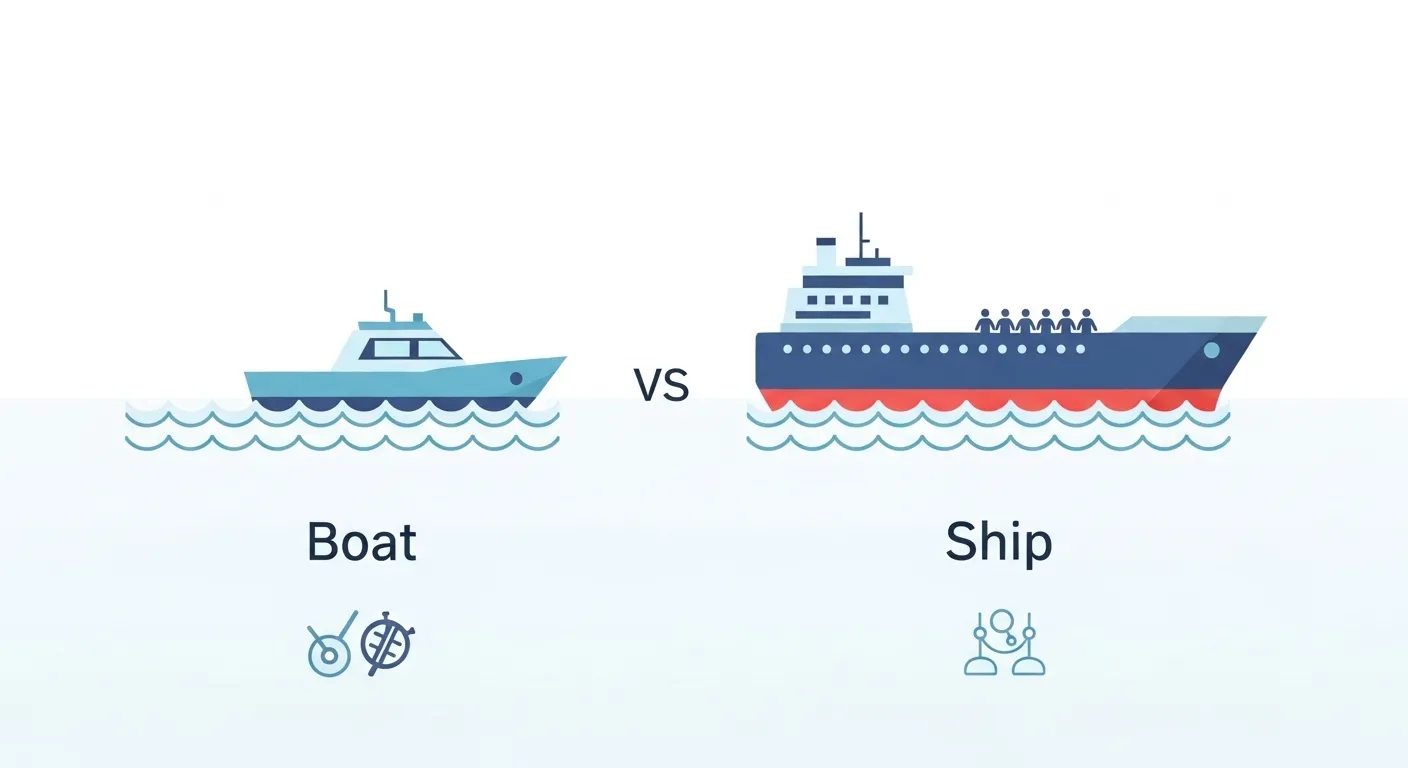
A boat 🚤 is smaller and used for short trips, while a ship 🚢 is much larger and built for long-distance travel across oceans 🌊.
Many people get confused about the difference between boat and ship because both are water vehicles and often used in similar situations. But in reality, the difference between boat and ship is very clear when you look at size, purpose, and navigation ability.
In simple words, the difference between boat and ship is that a boat is smaller and used for short-distance travel, while a ship is larger and built for long ocean journeys. This confusion often appears in travel discussions, shipping industry topics, and even online searches on Google.
You’ll also find people asking “what is a boat?”, “what is a ship?”, or “how do they differ?” on platforms like YouTube when learning maritime basics.
In this complete guide, you will learn:
✔ Clear definitions of boat and ship
✔ Key differences in structure and use
✔ Real-world examples
✔ Why the distinction matters in navigation
Let’s break it down in a simple, human way.
🟢Difference Between Boat and Ship
A boat is a small watercraft used for short trips, while a ship is a large vessel designed for deep-water and long-distance travel.
👉 Example: A fishing boat stays near the coast, but a cargo ship travels across oceans.
🟢 Definition of Boat and Ship
- Boat: A small water vehicle used for fishing, transport, or recreation in rivers, lakes, or coastal areas.
- Ship: A large ocean-going vessel designed for transporting goods, passengers, or military operations across long distances.
🟢 Pronunciation
- Boat: /boʊt/ (US & UK)
- Ship: /ʃɪp/ (US & UK)
Now that pronunciation is clear, let’s understand how both actually behave in real maritime life.
🟢 Boat vs Ship:Comparison
| Feature | Boat | Ship |
| Size | Small | Very large |
| Purpose | Short trips | Long voyages |
| Water Type | Rivers, lakes, coast | Deep oceans |
| Crew Size | Few people | Large crew |
| Navigation | Simple systems | Advanced systems |
| Construction | Lightweight | Heavy and complex |
| Capacity | Limited | Huge cargo/passengers |
| Example | Fishing boat | Cargo ship |
🟢 Key Differences Explained Between Boat and Ship
1. Size Difference
Boats are small and easy to operate, while ships are massive structures.
👉 Example: A yacht is a boat, but a cruise liner is a ship.
2. Travel Range
Boats are used for short distances, ships travel globally.
👉 Example: River fishing vs ocean cargo transport.
3. Purpose of Use
Boats are for recreation or small transport; ships are for trade and transport industries.
4. Navigation System
Ships use advanced radar and GPS systems, boats use basic controls.
👉 This is why maritime professionals treat them differently.
5. Crew and Capacity
Boats carry few people, ships carry thousands of passengers or tons of goods.
🟢 What is a Boat and How Does It Work?
A boat is designed for simplicity and flexibility. It moves using engines, sails, or paddles depending on its type.
In real scenarios:
- Used for fishing
- Used for tourism
- Used in rivers and lakes
Boats are common in daily life and often seen in coastal regions and small ports.
🟢 What is a Ship and Why Is It Important?
A ship is built for power, endurance, and long-distance travel. It is engineered to survive deep oceans and harsh weather conditions.
In practical use:
- Cargo transport
- Passenger cruise travel
- Military operations
Ships are essential for global trade and international shipping systems.
🟢 Why Does the Difference Between Boat and Ship Exist?
This difference exists because maritime engineering needs two categories:
- Small-scale water transport (boats)
- Large-scale ocean transport (ships)
Without this classification, safety and navigation standards would be unclear.
🟢 Boat vs Ship in Real Life Usage
Let’s make it practical:
- Fishing in a lake → Boat
- Cruise vacation → Ship
- River transport → Boat
- International cargo → Ship
Even travel content creators on Instagram often show the difference visually in travel reels.
🟢 Difference and Similarity Between Boat and Ship
| Feature | Boat | Ship | Similarity |
| Purpose | Short travel | Long travel | Both used for water transport |
| Size | Small | Large | Both floating vessels |
| Environment | Rivers/lakes | Oceans | Both operate on water |
| Crew | Few people | Large crew | Both need operators |
| Engine | Simple | Advanced | Both use propulsion systems |
| Navigation | Basic tools | Advanced tech | Both require direction systems |
| Use Case | Local travel | Global trade | Both serve transport needs |
This table clearly shows the difference and similarity between boat and ship for quick understanding.
🟢 Common Mistakes with Boat and Ship
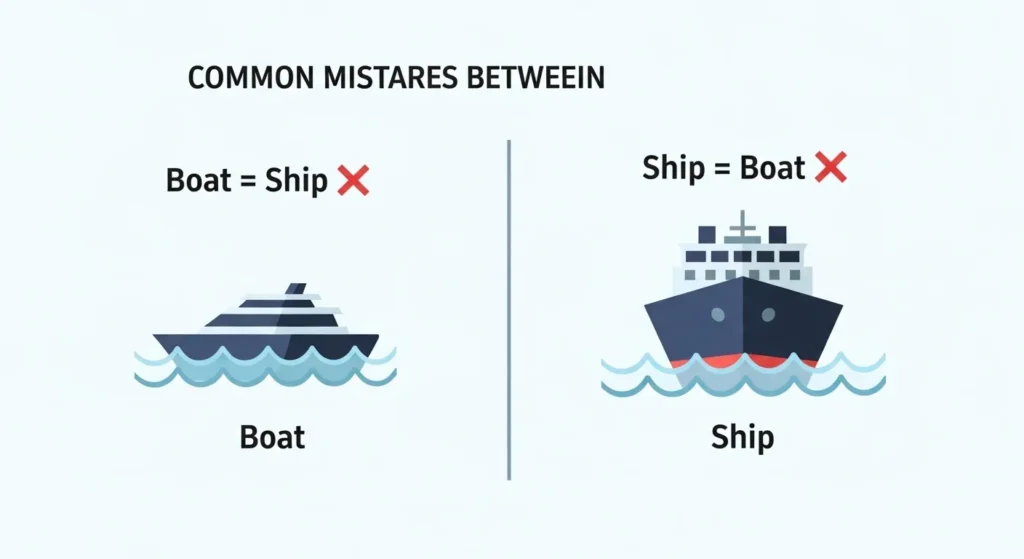
❌ Mistake 1: Calling Every Water Vehicle a Boat
✔ Fix: Ships are not boats due to size and purpose
❌ Mistake 2: Thinking Size Doesn’t Matter
✔ Fix: Size defines classification
❌ Mistake 3: Confusing Yacht with Ship
✔ Fix: Yachts are boats, not ships
❌ Mistake 4: Ignoring Ocean Capability
✔ Fix: Only ships are designed for deep oceans
🟢 Real Life Examples with Boat and Ship
1. Fishing Industry
Small boats used for catching fish near coast
2. Tourism
Cruise ships carry thousands of tourists
3. Cargo Transport
Massive ships transport goods globally
4. Military Use
Naval ships used for defense operations
5. Personal Travel
Boats used for river rides and leisure
🟢 When to Use Boat vs Ship
Use boat when:
✔ Traveling short distances
✔ Fishing or recreation
✔ Operating in rivers or lakes
Use ship when:
✔ Traveling across oceans
✔ Transporting cargo or passengers
✔ Operating large-scale maritime systems
🟢 Why People Get Confused Between Boat and Ship
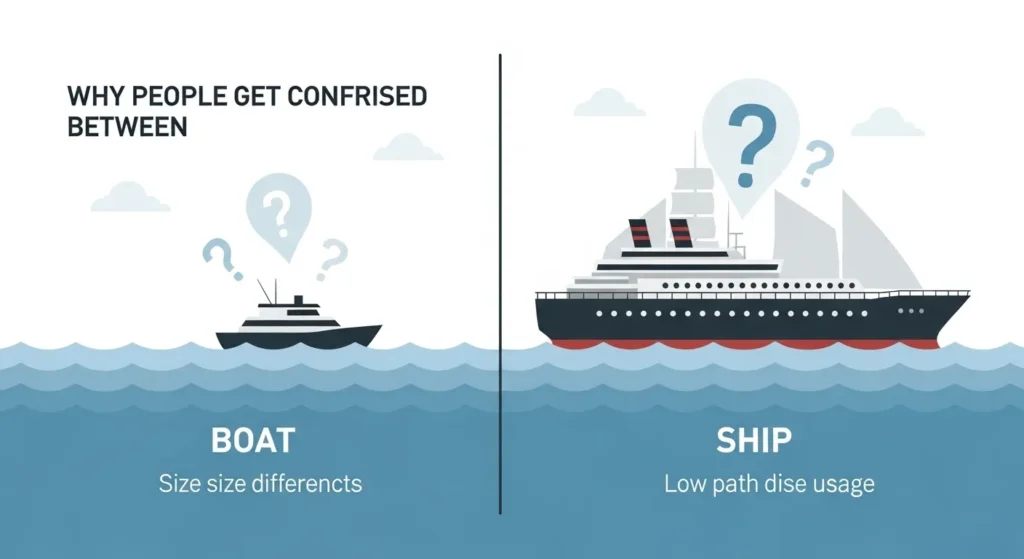
People get confused because:
- Both float on water
- Both use engines or sails
- Movies and media use terms loosely
Even content platforms like YouTube sometimes mix terminology in travel videos.
🟢 How Search Engines Understand Boat vs Ship Queries
Search engines like Google analyze queries such as:
- “difference between boat and ship”
- “what is bigger boat or ship”
They rank content based on:
✔ clarity
✔ examples
✔ semantic depth
✔ user intent satisfaction
🟢 Expert Insight
From a maritime understanding perspective, the distinction between boats and ships is not just size it’s about engineering purpose.
Professionally speaking:
👉 Boats are designed for flexibility
👉 Ships are designed for endurance
In real-world marine training, this classification is essential for safety rules, licensing, and navigation laws.
🟢 FAQs
1. What is the main difference between boat and ship?
Boats are small; ships are large ocean vessels.
2. Can a boat become a ship?
Yes, if it is significantly upgraded in size and capability.
3. Is a yacht a boat or ship?
A yacht is considered a boat.
4. What is bigger, boat or ship?
A ship is always bigger.
5. Do boats travel in oceans?
Usually no, only ships do.
6. Why are ships safer in oceans?
Because they are built for deep-water stability.
🟢 Conclusion
The difference between boat and ship is mainly based on size, purpose, and travel capability. Boats are small watercraft used for short-distance travel, while ships are large vessels designed for long ocean journeys and heavy transport.
Understanding the difference between boat and ship helps you clearly identify how maritime transport works in real life. If you are watching travel content, learning geography, or exploring shipping industries, this distinction is essential.
In simple terms: boats are for local water travel, while ships are for global ocean navigation. Both are important, but each serves a completely different role in transportation systems.
Once you understand this, you’ll never confuse them again and you’ll see how essential both are in global travel and trade systems.
Read more about!
Difference Between Roasting and Baking: Easy Guide
Difference Between Parfum and Toilette: Complete Guide

I am Emily Johnson, a USA-based content writer who creates easy-to-read blogs on language and daily life topics. I explain complex ideas in simple English for students and beginners so they can understand easily.