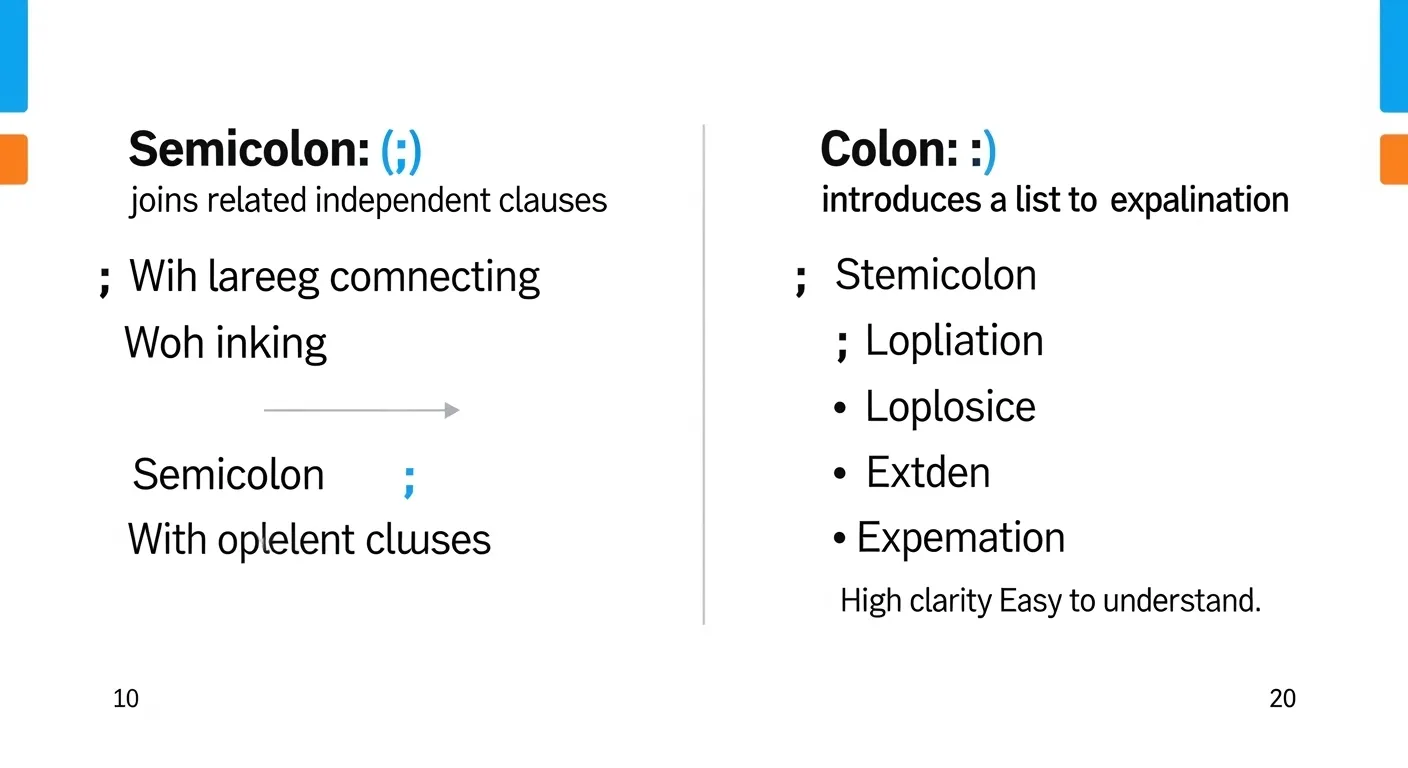
A semicolon (;) connects closely related ideas or sentences, while a colon (:) introduces an explanation, list, or example.
Many users get confused about the difference between semicolon and colon because both punctuation marks look similar and often appear in formal writing.
In simple words, the difference between semicolon and colon is about connection vs explanation. A semicolon connects related ideas, while a colon introduces or explains something.
If you’ve ever wondered “when to use a semicolon or colon?” or “how are they different in real sentences?” you’re not alone. This is one of the most searched grammar topics on platforms like Google and even discussed widely on writing forums and apps like Grammarly.
In this complete guide, you’ll learn:
✔ What semicolons and colons really mean
✔ How to use each correctly
✔ Real-life examples (simple to advanced)
✔ Common mistakes and expert tips
Difference Between Semicolon and Colon
A semicolon (;) connects closely related sentences, while a colon (:) introduces information like a list, explanation, or example.
👉 Example:
- Semicolon: I was tired; I still finished my work.
- Colon: I need three things: coffee, focus, and silence.
Definition of Semicolon and Colon
- Semicolon (;): A punctuation mark used to link closely related independent clauses without a conjunction.
- Colon (:): A punctuation mark used to introduce a list, explanation, example, or emphasis.
Pronunciation
- Semicolon: /ˌsem.iˈkoʊ.lən/ (US), /ˌsem.iˈkəʊ.lən/ (UK)
- Colon: /ˈkoʊ.lən/ (US), /ˈkəʊ.lən/ (UK)
Now that you know how to say them, let’s clearly understand how they actually work in writing.
Semicolon vs Colon
| Feature | Semicolon (;) | Colon (:) |
| Main Purpose | Connect related sentences | Introduce information |
| Usage Type | Between independent clauses | Before lists, explanations |
| Tone | Smooth connection | Strong emphasis or pause |
| Replacement | Can replace “and”, “but” | Cannot replace conjunctions |
| Example | She studied hard; she passed. | She passed: she studied hard. |
| List Usage | Rarely used | Commonly used |
| Sentence Structure | Joins two complete ideas | Introduces incomplete or complete idea |
| Formality | More formal writing | Used in both formal & informal |
KEY Differences Explained Between Semicolon and Colon
1. Connection vs Introduction
A semicolon connects ideas; a colon introduces them.
👉 Example:
- Semicolon: I love writing; it relaxes me.
- Colon: I love writing: it relaxes me.
2. Sentence Independence
Semicolons join two full sentences.
Colons can introduce phrases or lists.
3. Use in Lists
Semicolons are rarely used in lists.
Colons are commonly used before lists.
4. Tone and Emphasis
Semicolons create a smooth flow.
Colons create a strong pause or emphasis.
5. Real Writing Context
Semicolons are common in essays and formal writing.
Colons appear in instructions, emails, and content writing (like on YouTube descriptions).
What is a Semicolon and How Does It Work in Writing?
A semicolon exists to connect ideas that are closely related but could stand alone as sentences.
👉 Think of it as a “soft full stop.”
In real scenarios:
- Academic writing
- Professional emails
- Complex sentence structures
Example:
“I didn’t call him; I knew he was busy.”
It avoids repetition and keeps writing smooth.
What is a Colon and Why is It Important?
A colon exists to introduce or highlight information.
👉 Think of it as saying: “Here it comes.”
Used for:
- Lists
- Explanations
- Quotes
- Emphasis
Example:
“She had one goal: success.”
Colons are powerful because they grab attention.
Difference Between Semicolon and Colon in Real Writing
Let’s understand this clearly:
- Semicolon → connects equal ideas
- Colon → introduces new information
👉 Real example:
- Semicolon: He loves gaming; he plays every night.
- Colon: He loves one thing: gaming.
In practical use, semicolons maintain flow, while colons create focus.
Why Does the Difference Between Semicolon and Colon Exist?
This difference exists because writing needs both:
- Flow (Semicolon)
→ Keeps ideas connected smoothly - Clarity (Colon)
→ Highlights important details
Without this distinction, writing would either feel too broken or too unclear.
How Semicolons and Colons Are Used in Digital Content
Modern platforms rely on punctuation clarity:
- Blog posts (like this one) use colons for headings
- Social media captions on Instagram use colons for emphasis
- Professional tools like Grammarly suggest semicolons for better sentence flow
Even algorithms analyze punctuation for readability and engagement.
Difference and Similarity Between Semicolon and Colon
| Feature | Semicolon (;) | Colon (:) | Similarity |
| Function | Connect ideas | Introduce ideas | Both improve clarity |
| Structure | Between sentences | Before explanation | Both used in writing |
| Tone | Smooth | Strong pause | Both affect tone |
| Use Case | Essays, formal writing | Lists, emphasis | Both used professionally |
| Complexity | Slightly advanced | Beginner-friendly | Both need understanding |
| Position | Middle of sentence | Before key info | Both guide readers |
This table clearly shows the difference and similarity between semicolon and colon for quick understanding.
Common Mistakes with Semicolon and Colon
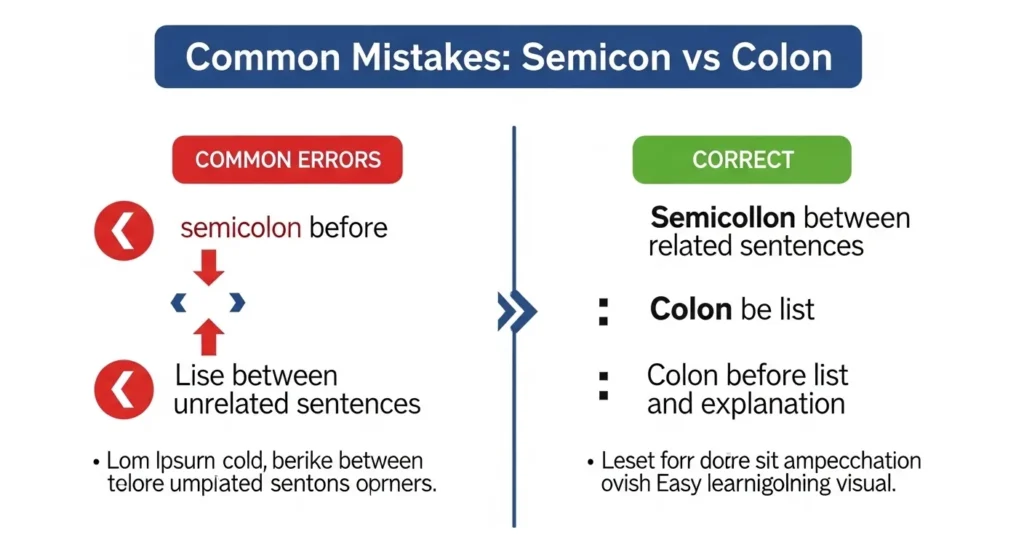
❌ Mistake 1: Using Semicolon Instead of Colon
✔ Fix: Use colon before lists
❌ Mistake 2: Using Colon Between Two Sentences Incorrectly
✔ Fix: Ensure second part explains the first
❌ Mistake 3: Overusing Semicolons
✔ Fix: Use only when ideas are closely related
❌ Mistake 4: Ignoring Sentence Structure
✔ Fix: Semicolon needs full sentences on both sides
Real Life Examples with Semicolon and Colon
1. Personal Writing
“I was nervous; I still gave the speech.”
2. Business Email
“Please bring the following: documents, ID, and laptop.”
3. Content Creation
On YouTube:
“Topics covered: grammar, punctuation, writing tips.”
4. Academic Writing
“The results were clear; the hypothesis was correct.”
When to Use Each
Use semicolon when:
✔ Joining related sentences
✔ Avoiding conjunctions
✔ Writing formally
Use colon when:
✔ Introducing lists
✔ Giving explanations
✔ Adding emphasis
Why People Get Confused in Semicolon and Colon
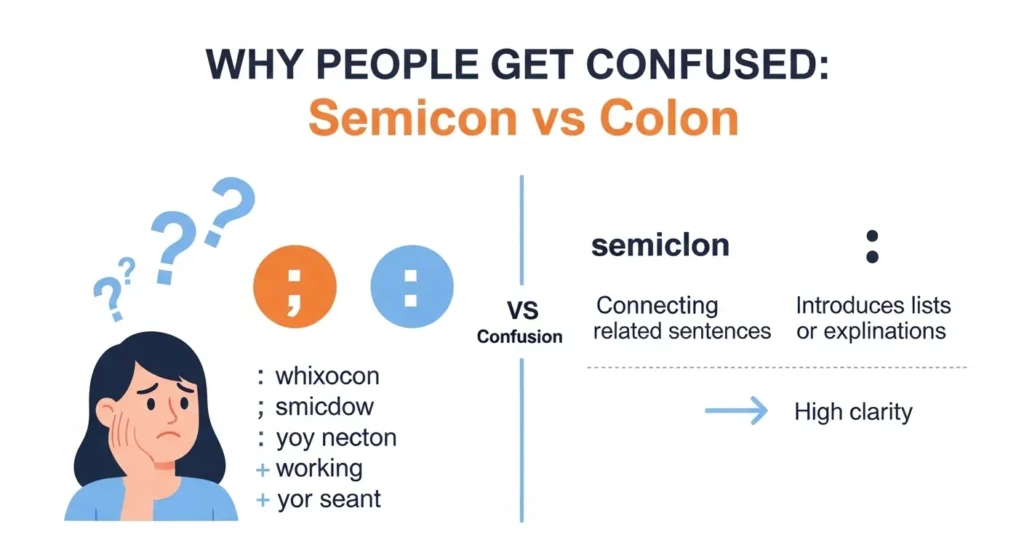
Many users struggle because:
- Both marks look similar
- School explanations are often unclear
- Real-world usage varies
Also, casual writing online often ignores proper punctuation, causing confusion.
How Search Engines Understand Semicolon vs Colon Queries
Search engines like Google analyze queries such as:
- “what is semicolon vs colon”
- “when to use colon in sentence”
They rank content based on:
✔ clarity
✔ examples
✔ structure
✔ readability
That’s why structured guides perform best.
Expert Insight
In real writing practice, mastering the difference between semicolon and colon instantly improves clarity and professionalism.
From an expert perspective:
👉 Use semicolons sparingly for flow
👉 Use colons confidently for emphasis
Most beginners overthink semicolons but underuse colons. In practical use, colons are more powerful for modern content writing.
FAQs
1. What is the difference between semicolon and colon in simple words?
Semicolon connects sentences; colon introduces information.
2. When should I use a semicolon?
When joining two related independent clauses.
3. When should I use a colon?
Before lists, explanations, or emphasis.
4. Can I replace a colon with a semicolon?
No, they serve different purposes.
5. Is semicolon formal?
Yes, it is mostly used in formal writing.
6. Which is easier to use?
Colon is easier and more common.
Conclusion
The difference between semicolon and colon becomes simple once you understand their purpose: semicolons connect ideas, while colons introduce them.
Both punctuation marks play a key role in clear and effective writing. Semicolons help maintain flow between related thoughts, while colons highlight important information or lists.
In real-world writing if emails, blogs, or social media knowing when to use each can make your content more professional and easier to read.
Once you master this concept, your writing will instantly feel more structured, clear, and impactful.
Read more about!
Difference Between IBS and IBD:Simple Guide
Difference Between Centerfire and Rimfire: Complete Guide

I am James Carter, a professional content writer from the United States. I specialize in writing simple and clear comparison blogs that help students and readers understand difficult topics easily. My writing focuses on everyday language, education, science, and lifestyle topics. I believe that learning should be easy for everyone, so I use simple words and real-life examples in my articles.