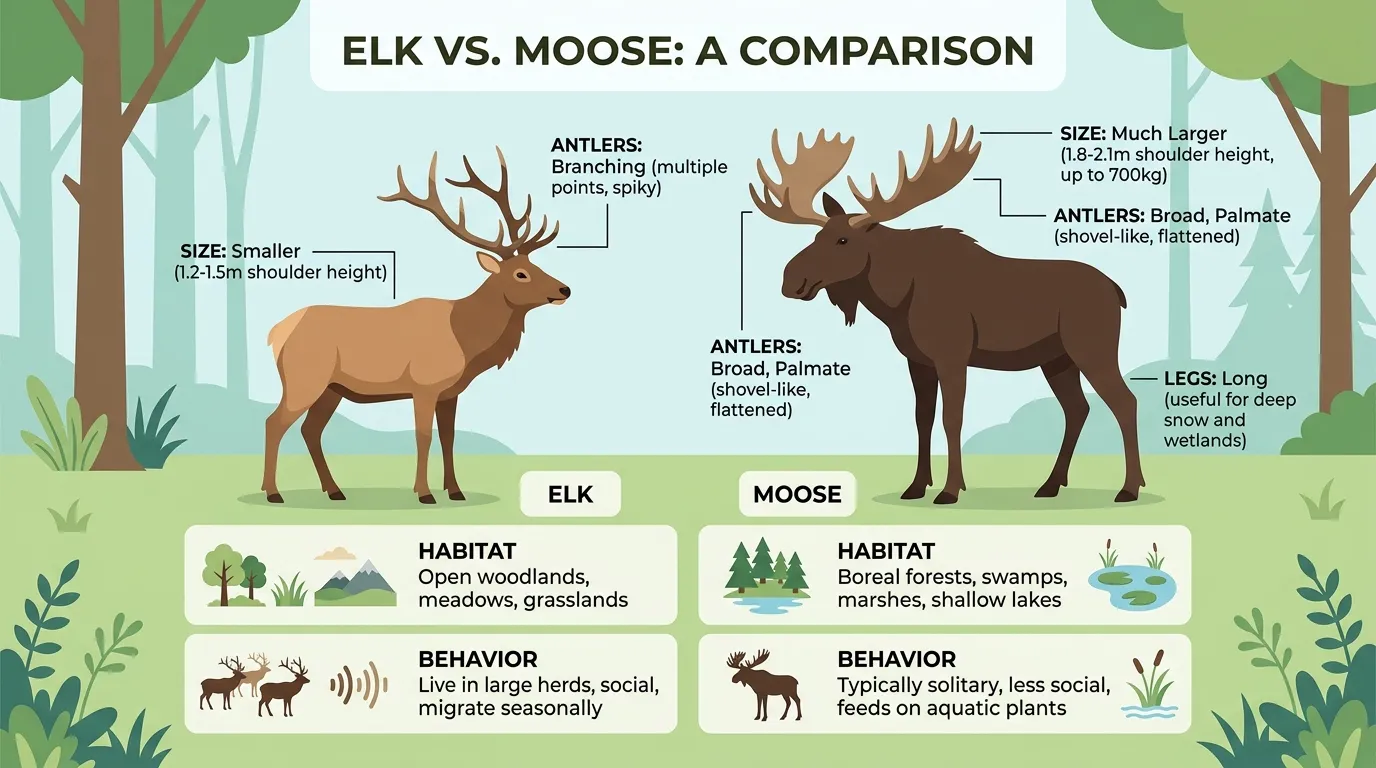
Elk are smaller and lighter with pointed antlers, while moose are larger and heavier with broad, flat antlers.
Many people search for the difference between elk and moose because both animals look large, powerful, and somewhat similar at first glance.
If you’ve ever seen wildlife videos on platforms like YouTube or nature clips shared on Instagram, chances are you’ve wondered if you’re looking at an elk or a moose.
Here’s the clear answer right away: the difference between elk and moose lies in their size, antlers, behavior, and habitat. Moose are much larger with broad, paddle-shaped antlers, while elk are smaller with long, pointed antlers and tend to live in herds.
Understanding the difference between elk and moose is important for wildlife enthusiasts, students, hunters, and travelers exploring North America or Europe.
In this complete guide, you’ll learn definitions, behavior patterns, physical differences, real-life examples, and expert insights so you’ll never confuse them again.
Difference Between Elk and Moose
The difference between elk and moose is that moose are larger, solitary animals with wide, flat antlers, while elk are smaller, social animals with long, branching antlers.
👉 Example: A huge animal with a dark body and broad antlers near a lake is a moose, while a group of lighter-colored deer-like animals in forests is likely elk.
Definition of Elk and Moose
- Elk: A large deer species (Cervus canadensis) known for living in herds and having long, pointed antlers.
- Moose: The largest member of the deer family (Alces alces), recognized by its massive body and wide, paddle-shaped antlers.
Pronunciation
- Elk
- US: /elk/
- UK: /elk/
- Moose
- US: /muːs/
- UK: /muːs/
Now that pronunciation is clear, let’s dive deeper into how elk and moose differ in real-world scenarios.
Difference and Similarity Between Elk and Moose
| Feature | Elk | Moose | Similarity |
| Size | Large but smaller than moose | Largest deer species | Both are large mammals |
| Antlers | Long, branching | Wide, paddle-shaped | Only males have antlers |
| Habitat | Forests & mountains | Wetlands & cold regions | Both prefer cooler climates |
| Behavior | Social (herds) | Solitary | Both can be aggressive |
| Color | Light brown | Dark brown/black | Both change coat seasonally |
| Diet | Grass, plants | Leaves, aquatic plants | Both are herbivores |
| Speed | Fast runners | Slower but strong | Both can escape predators |
Key Differences Explained Between Elk and Moose
1. Size Difference
The biggest difference between elk and moose is size. Moose can weigh up to 700 kg, while elk are smaller.
👉 Real example: Moose often appear almost horse-sized compared to elk.
2. Antler Shape
Moose have wide, flat antlers like paddles, while elk have tall, branching antlers.
👉 This is the easiest way to visually identify them.
3. Behavior
Elk are social animals and live in groups, especially females. Moose are mostly solitary.
👉 In practical wildlife observation, seeing a group usually means elk.
4. Habitat
Moose prefer cold, wet environments like swamps and lakes. Elk prefer forests and grasslands.
5. Neck and Body Structure
Moose have a long nose and a hanging flap of skin (called a dewlap), while elk have a slimmer face.
6. Speed and Movement
Elk are faster runners. Moose rely more on strength than speed.
7. Sound and Communication
Elk are known for loud bugling sounds during mating season, while moose are quieter.
Why Do Elk and Moose Exist as Different Species?
From an evolutionary perspective, elk and moose adapted to different environments:
- Moose → cold wetlands, need size for survival
- Elk → open forests, need speed and group behavior
This explains why their body structures and behaviors differ so much.
Common Mistakes with Elk and Moose
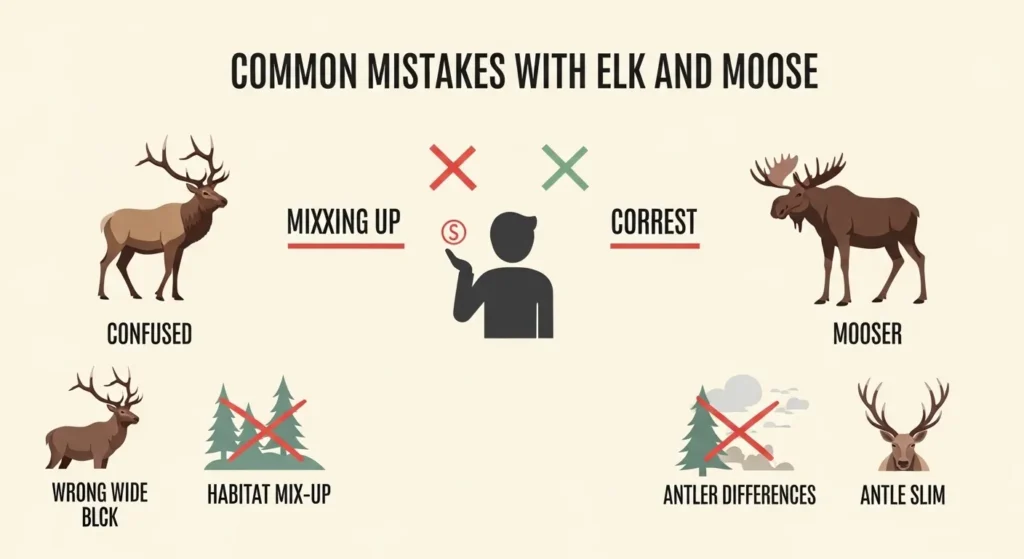
- Thinking both animals are the same
👉 Fix: Look at antlers and size - Assuming elk are bigger
👉 Fix: Moose are actually larger - Ignoring habitat differences
👉 Fix: Moose prefer water-rich areas - Confusing herd behavior
👉 Fix: Elk = group, Moose = alone
Real-Life Examples of Elk and Moose
- 🦌 Elk seen in Yellowstone National Park (tourism context)
- 🦌 Moose spotted near lakes in Canada
- 🦌 Wildlife documentaries on YouTube
- 🦌 Nature photography shared on Instagram
When to Use Elk vs Moose
- Use elk when referring to group-living deer in forests
- Use moose when referring to large, solitary animals near water
👉 This helps in correct identification and communication.
Why People Get Confused Between Elk and Moose
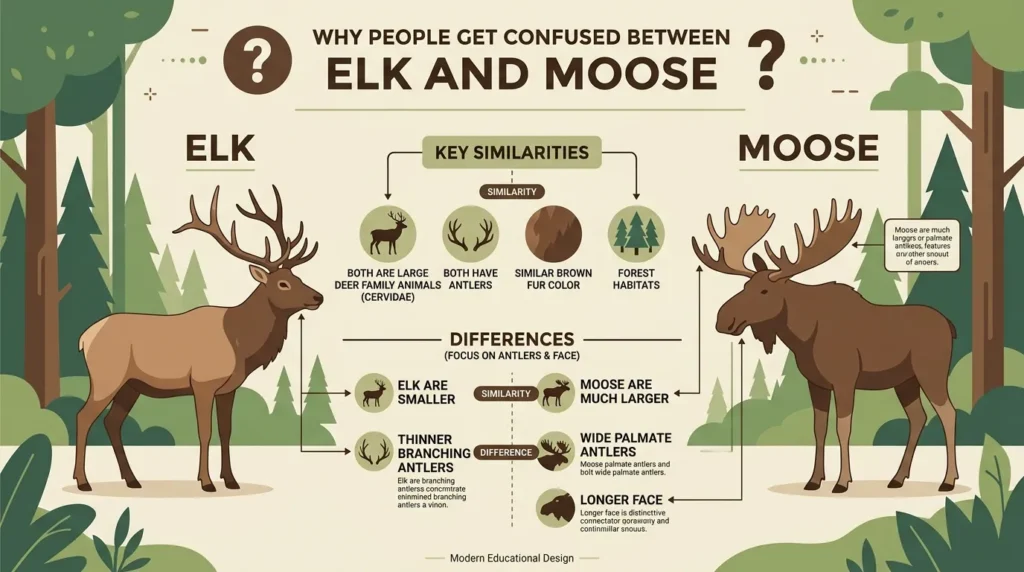
- Similar appearance
- Both belong to deer family
- Media confusion
- Lack of wildlife knowledge
Even search engines like Google show mixed images sometimes, adding to confusion.
How Search Engines Understand Elk vs Moose
Search engines analyze:
- User intent (comparison query)
- Semantic keywords (wildlife, deer species)
- Behavioral signals (clicks, time spent)
Platforms like Meta and Instagram influence how people visually learn these differences through content sharing.
Expert Insight
From a wildlife biology perspective, elk and moose are excellent examples of adaptive evolution. Moose evolved for survival in colder, water-rich ecosystems, while elk evolved for mobility and social interaction.
In real scenarios, wildlife experts identify them instantly based on antler shape and body size these are the most reliable indicators.
FAQs
1. What is the main difference between elk and moose?
Moose are larger and solitary, while elk are smaller and social.
2. Which is bigger, elk or moose?
Moose is bigger.
3. Are elk and moose the same species?
No, they are different species in the deer family.
4. Where do moose live?
Moose live in cold, wet environments like lakes and forests.
5. Where do elk live?
Elk live in forests and mountainous regions.
6. Which is more dangerous?
Both can be dangerous if provoked.
7. How to identify elk vs moose quickly?
Check antlers and body size.
Conclusion
The difference between elk and moose becomes clear once you understand their size, antlers, behavior, and habitat. Moose are massive, solitary animals built for cold, wet environments, while elk are smaller, social animals adapted for forests and open lands.
In simple terms, if you see a giant animal near water with wide antlers, it’s a moose. If you see a group of deer-like animals with pointed antlers, it’s elk.
By understanding this difference between elk and moose, you not only improve your wildlife knowledge but also enhance your ability to identify animals correctly in real-world situations.
Read more about!
Difference Between IBS and IBD:Simple Guide
Difference Between Centerfire and Rimfire: Complete Guide

I am James Carter, a professional content writer from the United States. I specialize in writing simple and clear comparison blogs that help students and readers understand difficult topics easily. My writing focuses on everyday language, education, science, and lifestyle topics. I believe that learning should be easy for everyone, so I use simple words and real-life examples in my articles.