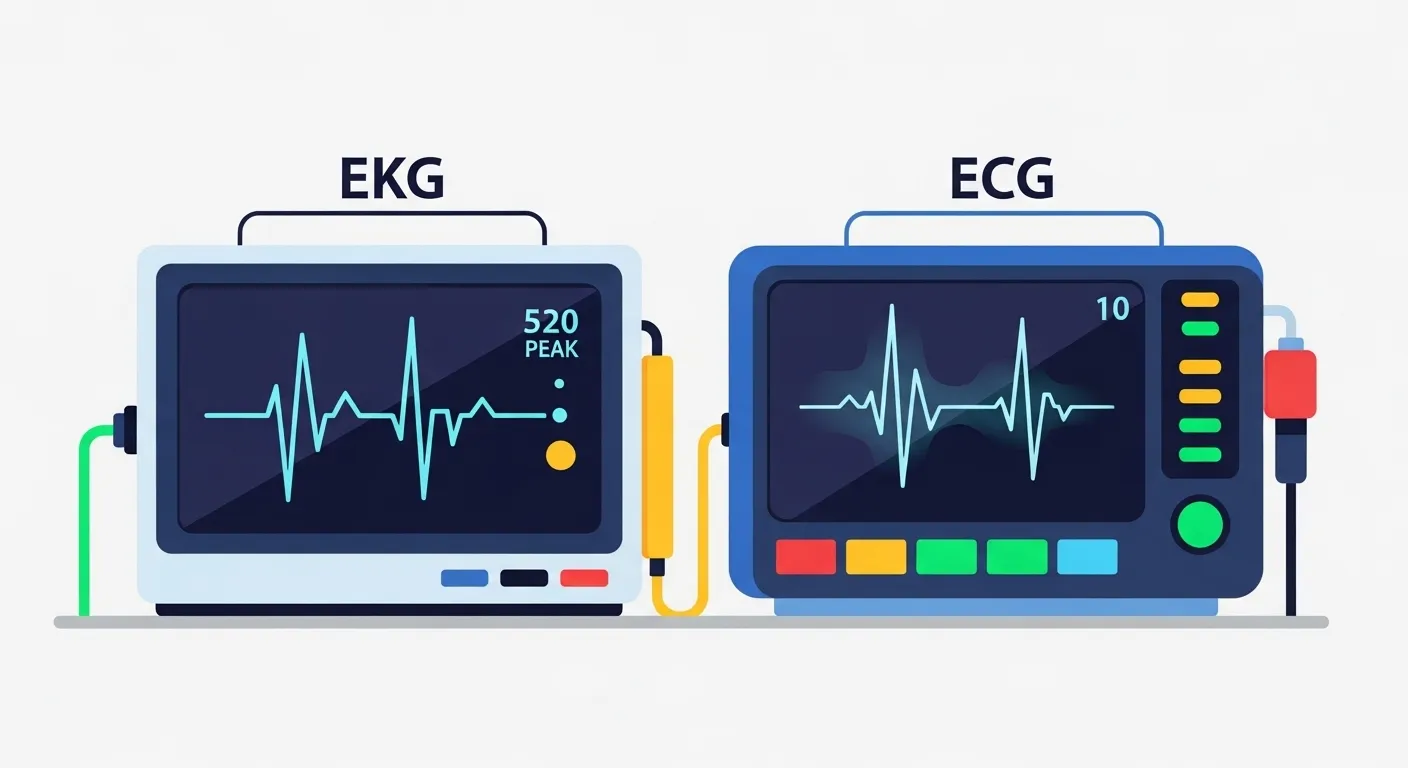
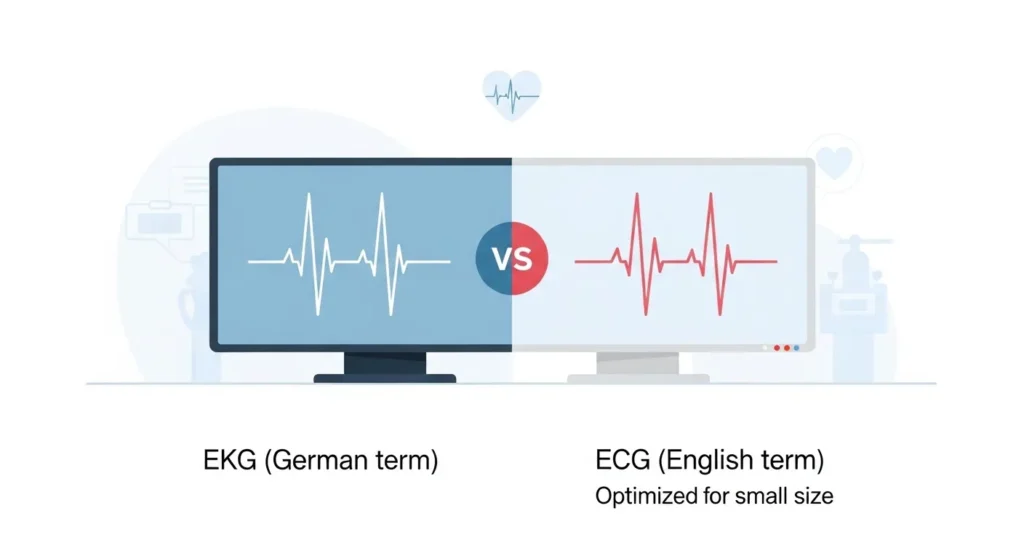
The difference between an EKG and an ECG is only in the name EKG comes from the German word “Elektrokardiogramm,” while ECG is the English abbreviation; both refer to the same heart test.
A man walks into a hospital with chest pain. The doctor quickly asks for a test. The nurse says, “Prepare the ECG.” Another staff member says, “Yes, the EKG is ready.” The patient looks confused. Are these two different tests? Or the same?
The difference between EKG and ECG is a common question. Many people hear both terms in hospitals. The truth is simple, but the names make it look hard. The difference between EKG and ECG is not about the test itself. It is about language and spelling.
Doctors use both terms every day. The difference between EKG and ECG matters more in writing than in action. Once you learn it, you will never feel confused again. Understanding the difference between EKG and ECG makes medical terms easy and clear.
Key Difference Between the Both
The main difference between EKG and ECG is the spelling and language origin.
- ECG comes from English (Electrocardiogram)
- EKG comes from German (Elektrokardiogramm)
Both mean the same test.
Why Is Their Difference Important for Learners and Experts?
Knowing the difference between EKG and ECG helps in many ways:
- Students avoid confusion in exams
- Doctors communicate clearly worldwide
- Patients feel less stress in hospitals
- Medical writing stays correct
This small difference helps build trust and clear understanding in society.
Pronunciation
- ECG (US): ee-see-jee
- ECG (UK): ee-see-jee
- EKG (US): ee-kay-jee
- EKG (UK): ee-kay-jee
Linking Hook
Now that you know the basic idea, let’s explore the difference between EKG and ECG in detail with simple points and examples.
Difference Between EKG and ECG
1. Language Origin
ECG comes from English. EKG comes from German.
- Example 1: A UK doctor writes ECG in reports.
- Example 2: A German doctor may use EKG.
2. Meaning
Both mean heart electrical test.
- Example 1: ECG checks heart rhythm.
- Example 2: EKG also checks heart rhythm.
3. Usage Region
ECG is common worldwide. EKG is often used in the USA.
- Example 1: British hospitals say ECG.
- Example 2: US hospitals may say EKG.
4. Medical Reports
ECG is used in formal writing.
- Example 1: Research papers use ECG.
- Example 2: Journals prefer ECG.
5. Everyday Speech
EKG is common in spoken US English.
- Example 1: A nurse says “Get an EKG.”
- Example 2: A patient hears EKG in ER.
6. Confusion Avoidance
EKG avoids mix-up with EEG (brain test).
- Example 1: ECG and EEG look similar.
- Example 2: EKG is clearer in speech.
7. Spelling Style
ECG follows English spelling rules.
- Example 1: Electro + cardio + gram
- Example 2: Short form becomes ECG
8. Historical Use
EKG came from early German science.
- Example 1: Early machines used German names
- Example 2: Old texts show EKG
9. Academic Preference
ECG is preferred in textbooks.
- Example 1: Medical books use ECG
- Example 2: Exams ask ECG
10. Practical Use
Both are used for the same test in hospitals.
- Example 1: ECG machine records heart signals
- Example 2: EKG machine does the same work
Nature and Behaviour of EKG and ECG
ECG:
It is formal, global, and standard. It is used in books and research.
EKG:
It is practical, simple, and common in speech. It helps avoid confusion.
Why People Get Confused About Their Use
People see two names for one test. This creates doubt.
- Same meaning but different spelling
- Different countries use different terms
- Similar terms like EEG increase confusion
Difference and Similarity
| Feature | ECG | EKG |
| Meaning | Heart test | Heart test |
| Origin | English | German |
| Usage | Worldwide | Mostly USA |
| Formal Writing | Yes | Less |
| Function | Same | Same |
Which Is Better in What Situation?
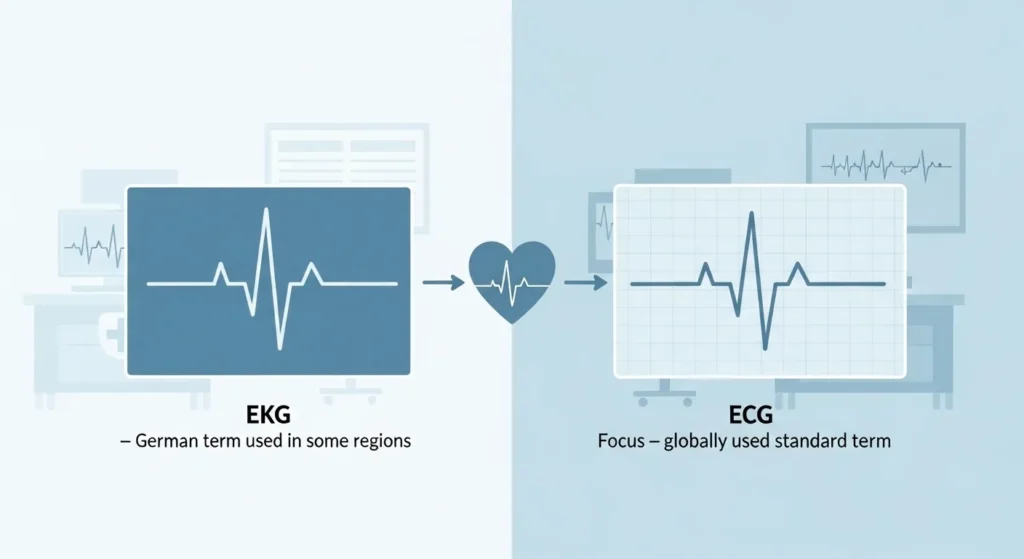
ECG is better in writing, study, and exams. It is standard and accepted worldwide. Doctors use it in reports and research papers. It keeps things simple and uniform across countries.
EKG is better in speech, especially in the USA. It avoids confusion with similar terms like EEG. Nurses and doctors often use it in busy hospital settings for quick communication.
How Are the Keywords Used in Metaphors and Similes
People use ECG/EKG as symbols of life and emotion.
- “His love was like an ECG line full of ups and downs.”
- “Her calm mind was like a flat ECG steady and quiet.”
Connotative Meaning
- ECG: Neutral and professional
- Example: “The ECG report is normal.”
- EKG: Slightly informal but still neutral
- Example: “The doctor asked for an EKG.”
Idioms or Proverbs Related
There are no direct idioms, but similar ideas exist:
- “Back to life”
- Example: The ECG brought hope back to life.
- “A heartbeat away”
- Example: The EKG showed danger was a heartbeat away.
Works in Literature
- The Heart Speaks (Medical, John Carter, 2015)
- Rhythms of Life (Health, Anna Lee, 2018)
Movies Related to the Topic
- Flatliners (1990, USA)
- Coma (1978, USA)
FAQs
1. Are EKG and ECG the same?
Yes, both are the same heart test.
2. Why are there two names?
One comes from English, the other from German.
3. Which one should I use?
Use ECG in writing and EKG in speech if needed.
4. Do doctors prefer one term?
Most prefer ECG in formal settings.
5. Is there any difference in function?
No, both perform the same test.
How Are Both Useful for Surroundings
Both help doctors check heart health. They save lives by finding problems early. Hospitals use them daily. They help people stay safe and aware of heart conditions.
Final Words for Both
ECG and EKG are two names for one important test. The difference is simple, but the impact is big. Knowing both makes you smarter and more confident.
Conclusion
The difference between EKG and ECG is easy to understand once you learn the basics. Both terms refer to the same heart test. The only real difference lies in language and usage. ECG is more formal and used worldwide, while EKG is common in spoken American English. This small difference can confuse many people, but it is not complex. By understanding it, students, doctors, and patients can communicate better. In the end, both terms serve the same purpose to check heart health and save lives.
Read more about!
Difference Between Lynx and Bobcat: Simple Guide
Difference Between Latte and Mocha: Complete Guide

I am James Carter, a professional content writer from the United States. I specialize in writing simple and clear comparison blogs that help students and readers understand difficult topics easily. My writing focuses on everyday language, education, science, and lifestyle topics. I believe that learning should be easy for everyone, so I use simple words and real-life examples in my articles.