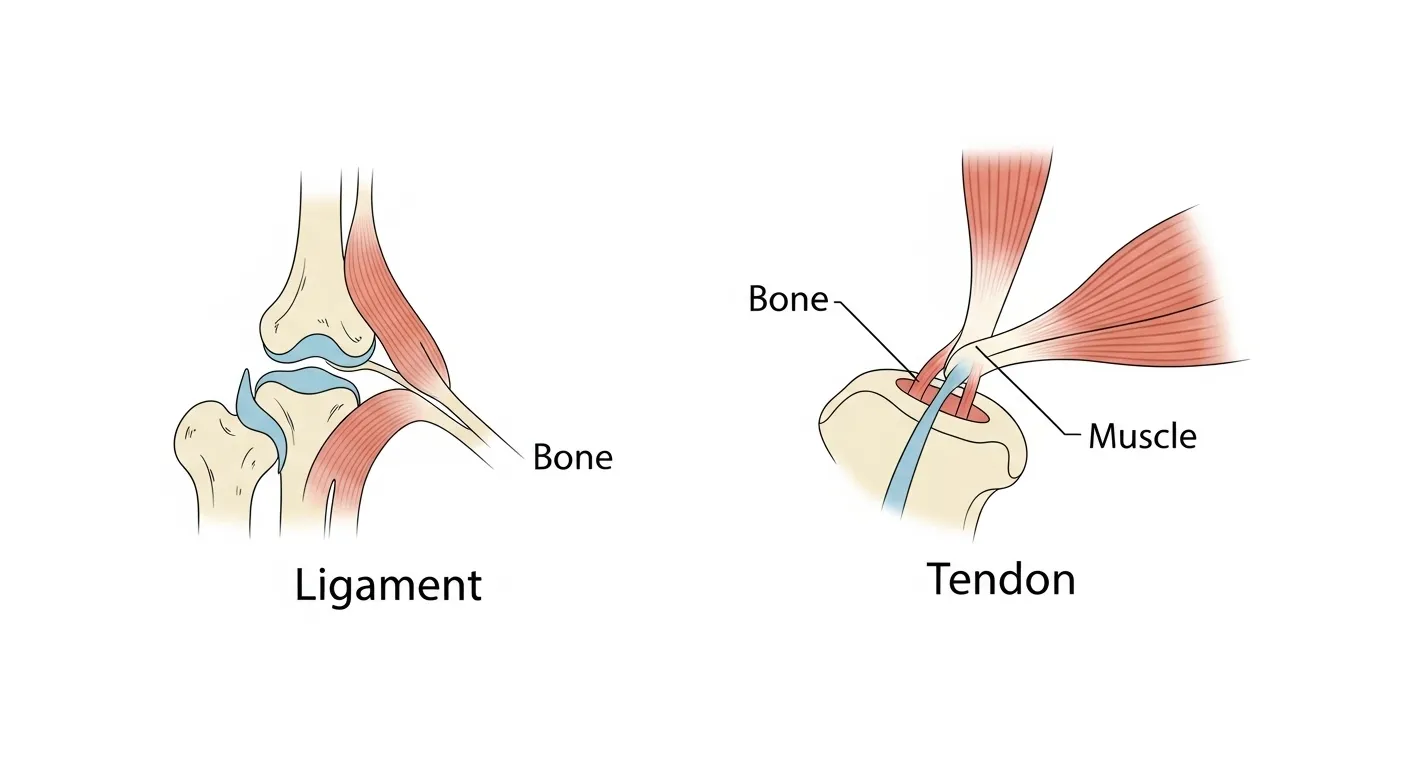
🦴 Ligament vs Tendon: A ligament connects bone to bone, while a tendon connects muscle to bone.
During a football match, a player suddenly fell and held his knee in pain. The doctor later explained that the player had injured a ligament, not a tendon.
Many people in the stadium wondered about the difference between ligament and tendon because both are important parts of the human body.
Many people hear these terms in sports injuries or medical discussions. However, they often feel confused about the difference between ligament and tendon. Both are strong connective tissues that help the body move and stay stable.
The difference between ligament and tendon mainly lies in what they connect and how they support movement. Understanding the difference between ligament and tendon helps students, athletes, and health professionals understand body structure and prevent injuries.
🔑 Key Difference Between the Both
The main difference is connection.
A ligament connects bone to bone, while a tendon connects muscle to bone.
🌍 Why Their Difference Is Important for Learners and Experts
Knowing the difference between ligament and tendon is very important in medicine, sports science, and biology. Doctors and physiotherapists must identify the correct tissue to treat injuries properly.
In society, athletes and active people often face injuries related to ligaments and tendons. Understanding the difference between ligament and tendon helps people protect their joints, exercise safely, and recover better after injuries.
🔊 Pronunciation
Ligament
- US: /ˈlɪɡəmənt/
- UK: /ˈlɪɡəmənt/
Tendon
- US: /ˈtendən/
- UK: /ˈtendən/
Before going further, let us clearly examine the difference between ligament and tendon step by step.
Difference Between Ligament and Tendon
1. Function
Ligaments hold bones together. Tendons attach muscles to bones.
Examples of ligaments:
- Knee ligament connecting bones
- Ankle ligament supporting joint
Examples of tendons:
- Achilles tendon connecting calf muscle to heel
- Tendon connecting arm muscles to bone
2. Connection Type
Ligaments connect bone to bone. Tendons connect muscle to bone.
Examples of ligaments:
- Ligament joining thigh bone and shin bone
- Ligament stabilizing shoulder joint
Examples of tendons:
- Tendon connecting biceps muscle to bone
- Tendon linking finger muscles to bones
3. Role in Movement
Ligaments stabilize joints. Tendons help create movement.
Examples of ligaments:
- Knee ligament keeping joint stable
- Wrist ligament supporting joint
Examples of tendons:
- Tendon helping fingers move
- Tendon moving the foot
4. Elasticity
Ligaments are slightly elastic. Tendons are less elastic and stronger for pulling.
Examples of ligaments:
- Ligaments stretching slightly in joints
- Ligaments allowing flexible movement
Examples of tendons:
- Tendons pulling bones during muscle contraction
- Tendons transferring muscle force
5. Location
Ligaments are mainly around joints. Tendons connect muscles to bones across the body.
Examples of ligaments:
- Ligaments in knees
- Ligaments in elbows
Examples of tendons:
- Tendons in hands
- Tendons in feet
6. Injury Type
Ligament injuries are called sprains. Tendon injuries are called strains.
Examples of ligament injuries:
- Knee sprain
- Ankle sprain
Examples of tendon injuries:
- Achilles tendon strain
- Wrist tendon strain
7. Structure
Ligaments contain flexible fibers. Tendons contain strong collagen fibers.
Examples of ligaments:
- Flexible tissue supporting joints
- Elastic connective fibers
Examples of tendons:
- Strong rope-like tissue
- Dense collagen structure
8. Healing Time
Ligaments often heal slowly. Tendons may heal faster but still require rest.
Examples of ligaments:
- Knee ligament recovery time
- Ankle ligament healing period
Examples of tendons:
- Tendon repair after strain
- Tendon healing after sports injury
9. Strength
Ligaments provide joint stability. Tendons provide strong pulling force.
Examples of ligaments:
- Stabilizing knee joint
- Supporting shoulder joint
Examples of tendons:
- Pulling bone during muscle movement
- Supporting strong muscle action
10. Example in Body
Different parts of the body contain ligaments and tendons.
Examples of ligaments:
- ACL ligament in knee
- Wrist ligaments
Examples of tendons:
- Achilles tendon
- Hand tendons
Nature and Behaviour of Both
Ligament:
A ligament is a strong band of tissue that connects bones together. It stabilizes joints and allows controlled movement.
Tendon:
A tendon is a tough connective tissue that connects muscles to bones. It transfers the force of muscle movement to the bones.
🤔 Why People Are Confused About Their Use
People often feel confused because both ligaments and tendons are connective tissues in the body. Both also play important roles in movement and appear in discussions about sports injuries.
Difference and Similarity
| Feature | Ligament | Tendon | Similarity |
| Connection | Bone to bone | Muscle to bone | Both connective tissues |
| Function | Joint stability | Movement | Both support body |
| Elasticity | Slightly elastic | Less elastic | Both strong tissues |
| Injury type | Sprain | Strain | Both can be injured |
| Location | Around joints | Between muscles and bones | Both in musculoskeletal system |
🏃 Which Is Better in What Situation?
Ligament:
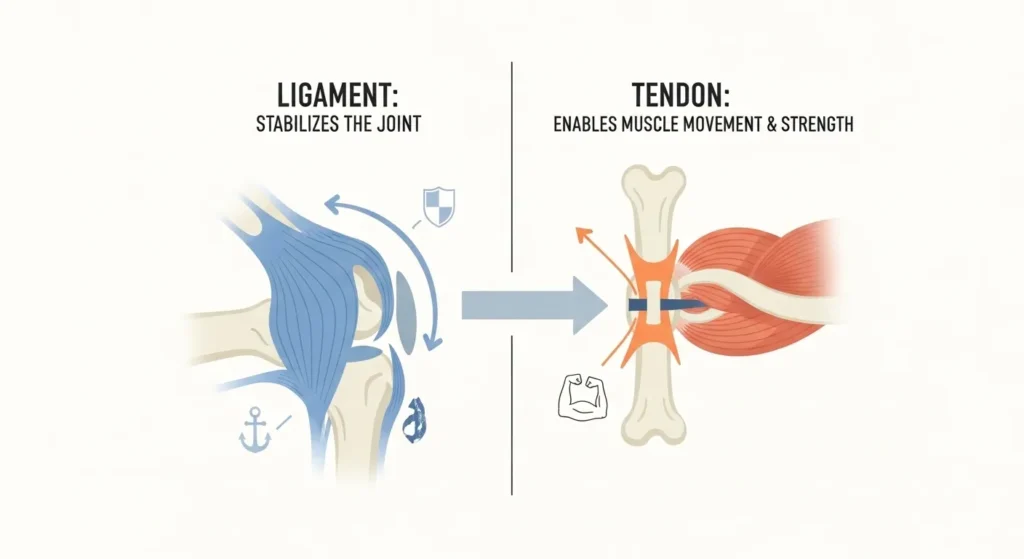
Ligaments are important when the body needs joint stability. They hold bones together and keep joints from moving too far. This stability is essential during activities like running, jumping, and lifting.
Tendon:
Tendons are important for movement. When muscles contract, tendons pull the bones to create motion. Without tendons, muscles could not move the body.
🎭 How Ligament and Tendon Are Used in Metaphors and Similes
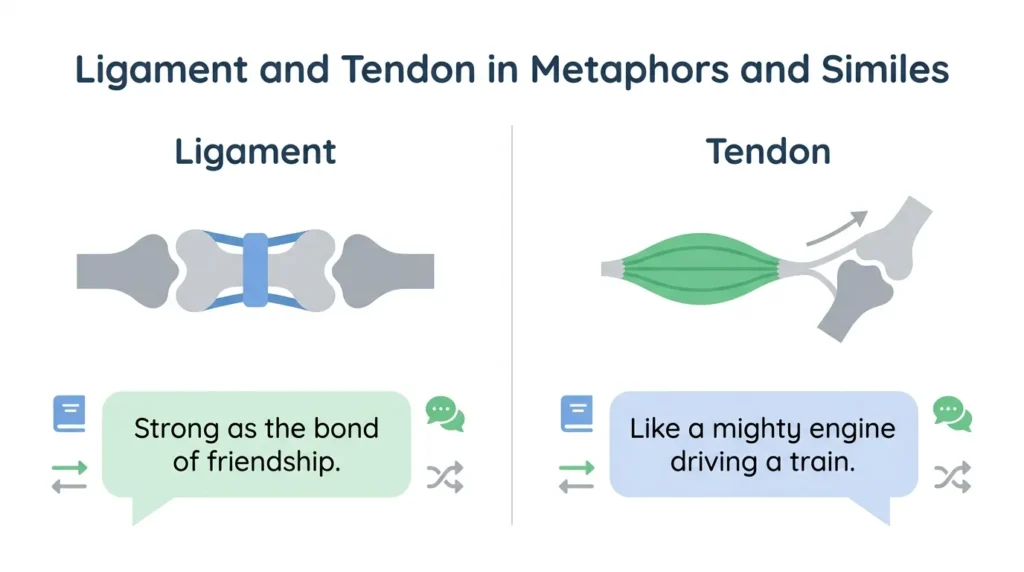
These words sometimes appear in descriptive language.
Ligament examples
- “Trust is the ligament of strong relationships.”
- “The team’s unity acted like a ligament holding them together.”
Tendon examples
- “His strength was like a tight tendon ready to pull.”
- “The connection worked like a tendon linking effort and result.”
Connotative Meaning
Ligament
Usually neutral and associated with support or connection.
Example: “Friendship acted like a ligament connecting the group.”
Tendon
Neutral meaning related to strength and movement.
Example: “Hard work became the tendon that moved his career forward.”
Idioms or Expressions
There are no common idioms directly using ligament or tendon in English. However, these words appear in medical and sports discussions.
Examples:
- “He tore a ligament during the match.”
- “She injured a tendon while running.”
📚 Works in Literature
- Gray’s Anatomy – Medical Reference, Henry Gray, 1858
- Clinical Sports Medicine – Medical Guide, Peter Brukner, 1993
🎬 Movies Related to the Words
There are no major films specifically titled Ligament or Tendon, but these terms frequently appear in sports and medical documentaries.
❓ FAQs
1. What is the main difference between ligament and tendon?
A ligament connects bone to bone, while a tendon connects muscle to bone.
2. Which tissue helps movement?
Tendons help muscles move bones.
3. Which tissue stabilizes joints?
Ligaments stabilize joints.
4. What injury affects ligaments?
Ligament injuries are called sprains.
5. What injury affects tendons?
Tendon injuries are called strains.
🌍 How Ligament and Tendon Are Useful for Surroundings
Ligaments and tendons help the body move, run, and perform daily activities. They support physical strength and mobility.
In sports and physical work, these tissues allow people to perform movements safely and efficiently. Their proper function is essential for healthy body movement.
Final Words for Both
Ligaments and tendons are both essential parts of the human musculoskeletal system. They support stability and movement in the body.
Conclusion
The difference between ligament and tendon mainly lies in their function and connection. Ligaments connect bones to other bones and provide joint stability, while tendons connect muscles to bones and allow movement. Both tissues are strong and important for the body’s structure and motion. Understanding the difference between ligament and tendon helps students, athletes, and medical professionals better understand body mechanics and prevent injuries.
Read more about!
Difference Between Ramen and Pho: Simple Guide
Difference Between Flautas and Taquitos: Complete Guide

I am James Carter, a professional content writer from the United States. I specialize in writing simple and clear comparison blogs that help students and readers understand difficult topics easily. My writing focuses on everyday language, education, science, and lifestyle topics. I believe that learning should be easy for everyone, so I use simple words and real-life examples in my articles.