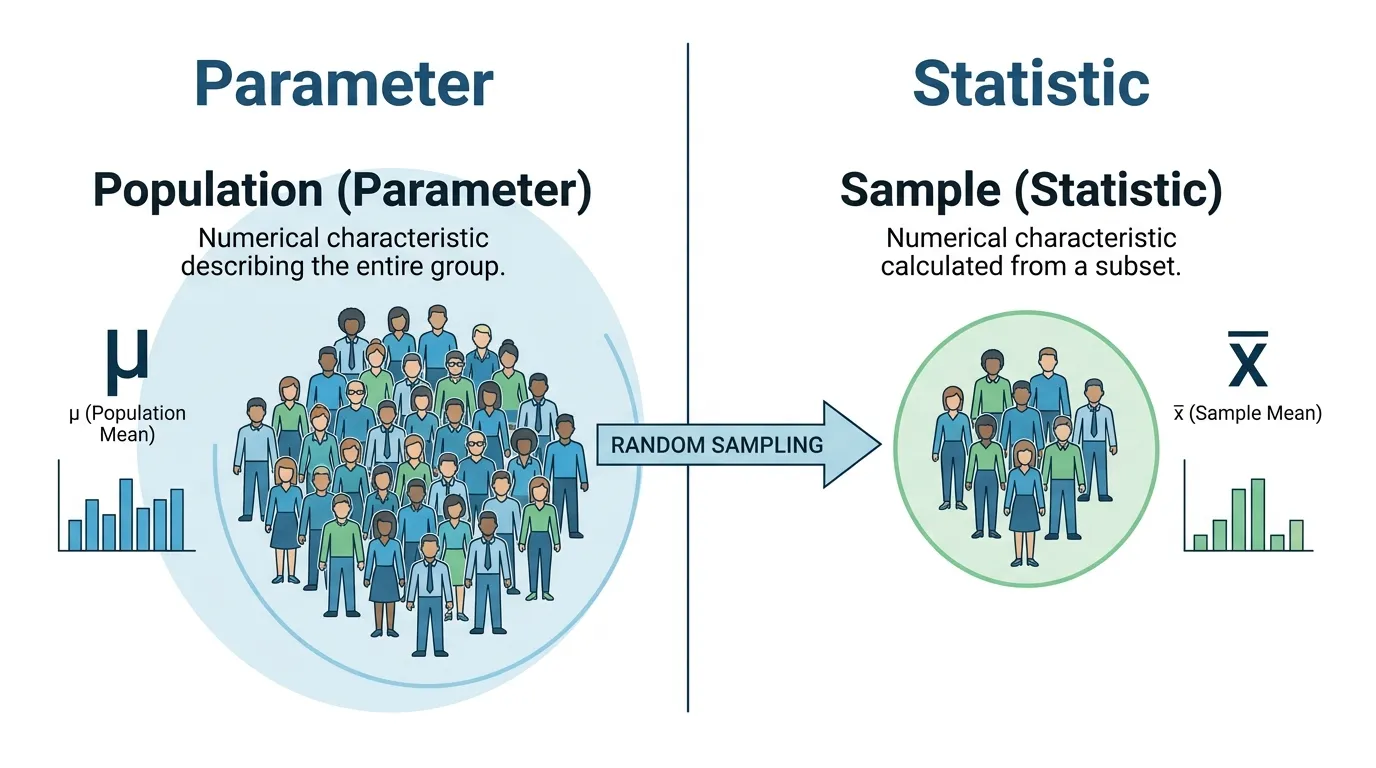
A parameter describes an entire population, while a statistic describes a sample taken from that population.
A teacher wants to know the average height of all students in a school. She cannot measure every student, so she checks only one class.
She gets an average from that class and guesses for the whole school. This simple act shows the difference between parameter and statistic.
The difference between parameter and statistic is a basic idea in data and math. A parameter describes a whole group. A statistic describes a small part of that group.
Many people mix them up because they both use numbers. The difference between parameter and statistic is about size and source.
When you understand the difference between parameter and statistic, you can read data better. The difference between parameter and statistic helps students, researchers, and decision-makers use numbers in the right way.
Key Difference Between the Both
The main difference between parameter and statistic is:
- Parameter describes a whole population
- Statistic describes a sample (part of population)
Why Is Their Difference Important for Learners and Experts?
Knowing the difference between parameter and statistic is important because:
- It helps in research accuracy
- It improves data analysis
- It supports correct decisions
- It builds trust in results
This knowledge helps society make better choices using data.
Pronunciation
- Parameter (US): puh-ram-uh-ter
- Parameter (UK): puh-ram-uh-tuh
- Statistic (US): stuh-tis-tik
- Statistic (UK): stuh-tis-tik
Linking Hook
Now let’s explore the difference between parameter and statistic in detail with simple points and clear examples.
Difference Between Parameter and Statistic
1. Definition
Parameter is a value for a whole population. Statistic is a value for a sample.
- Example 1: Average height of all citizens = parameter
- Example 2: Average height of one class = statistic
2. Scope
Parameter covers all data. Statistic covers part of data.
- Example 1: All voters in a country
- Example 2: Survey of 100 voters
3. Accuracy
Parameter is exact. Statistic is an estimate.
- Example 1: Full census gives parameter
- Example 2: Survey gives estimate
4. Collection
Parameter is hard to collect. Statistic is easier.
- Example 1: Measuring whole population
- Example 2: Taking a sample
5. Symbol
Parameter uses Greek letters. Statistic uses normal letters.
- Example 1: μ (mu) for mean
- Example 2: x̄ (x-bar) for sample mean
6. Use
Parameter is used in theory. Statistic is used in practice.
- Example 1: Parameter in research models
- Example 2: Statistic in surveys
7. Change
Parameter stays fixed. Statistic can change.
- Example 1: Population mean stays same
- Example 2: Sample mean varies
8. Cost
Parameter is costly to find. Statistic is cheaper.
- Example 1: Census costs more
- Example 2: Sample survey costs less
9. Time
Parameter takes more time. Statistic is faster.
- Example 1: Full data takes long
- Example 2: Sample is quick
10. Reliability
Parameter is more reliable. Statistic depends on sample quality.
- Example 1: Full data is accurate
- Example 2: Bad sample gives wrong result
Nature and Behaviour of Parameter and Statistic
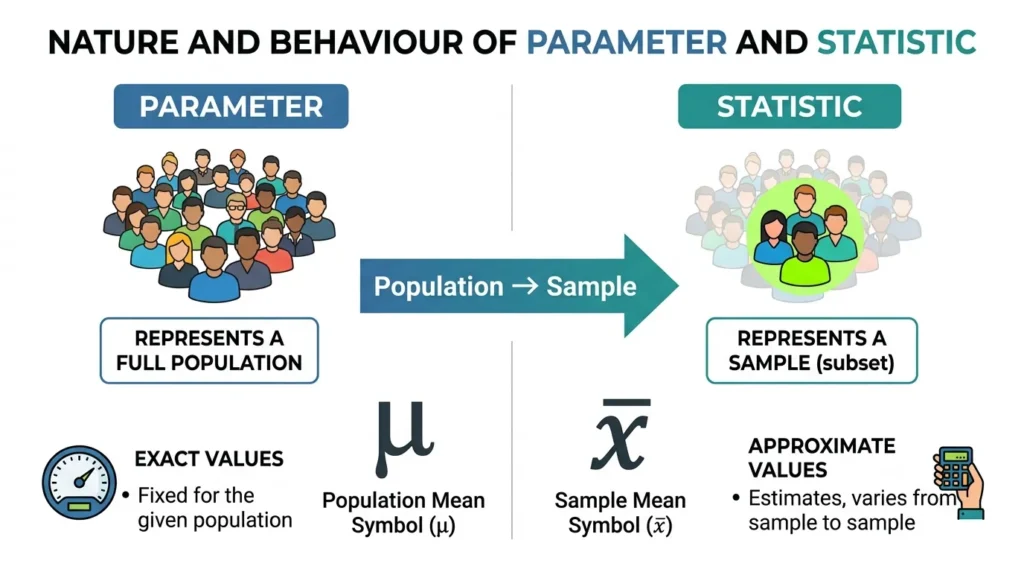
Parameter:
It is fixed and complete. It represents the whole group, is hard to find but very accurate, and does not change easily.
Statistic:
It is flexible and partial.It represents a small group, is easy to find but may vary, and changes with different samples.
Why People Get Confused About Their Use
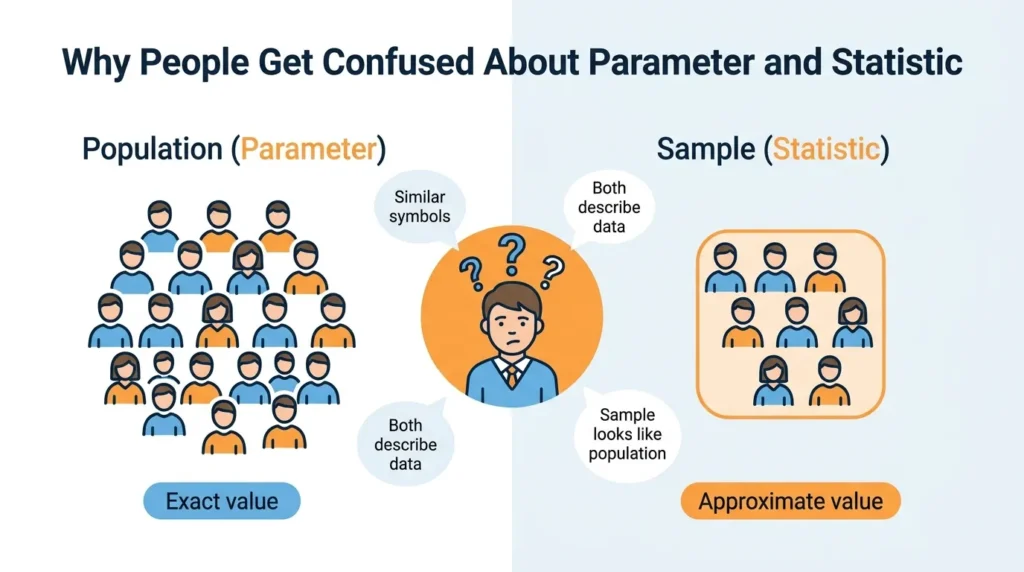
People get confused because:
- Both use numbers
- Both describe data
- Both sound similar
This makes the difference between parameter and statistic hard to understand at first.
Difference and Similarity
| Feature | Parameter | Statistic |
| Scope | Whole group | Sample |
| Accuracy | Exact | Estimate |
| Cost | High | Low |
| Time | Slow | Fast |
| Change | Fixed | Variable |
Which Is Better in What Situation?
Parameter is better when you need full accuracy. It gives exact information about the whole population. It is useful in official reports and research studies. But it takes more time and cost to collect full data.
Statistic is better when quick results are needed. It saves time and money. It is useful in surveys and predictions. Even though it is not exact, it gives a good idea of the population.
How Are the Keywords Used in Metaphors and Similes
- “His rules were like parameters fixed and clear.”
- “Her guess was like a statistic close but not exact.”
Connotative Meaning
- Parameter: Neutral (limit, boundary)
- Example: “Stay within the parameter.”
- Statistic: Neutral (number, data)
- Example: “The statistic shows growth.”
Idioms or Proverbs Related
- “By the numbers”
- Example: The statistic tells the story by the numbers.
- “Set the limits”
- Example: Parameters set the limits.
Works in Literature
- Naked Statistics (Non-fiction, Charles Wheelan, 2013)
- The Signal and the Noise (Non-fiction, Nate Silver, 2012)
Movies Related to the Topic
- Moneyball (2011, USA)
- The Big Short (2015, USA)
FAQs
1. Are parameter and statistic the same?
No, they are different.
2. Which is more accurate?
Parameter is more accurate.
3. Why use statistic?
Because it is easier and faster.
4. Can statistic become parameter?
No, but it can estimate it.
5. Where are they used?
In research, surveys, and data analysis.
How Are Both Useful for Surroundings
Both help in understanding data. They guide decisions in business, health, and education. They help society grow using facts and numbers.
Final Words for Both
Parameter and statistic are simple but powerful ideas. Knowing their difference helps you understand data clearly.
Conclusion
The difference between parameter and statistic is easy to understand once you know the basics. A parameter describes the whole population, while a statistic describes a sample. Both are important in data analysis and research. Many people confuse them because they look similar, but their roles are different. By understanding the difference between parameter and statistic, you can read data better and make smarter decisions. This knowledge is useful for students, researchers, and anyone who works with numbers. It helps build a strong base in statistics and real-life problem solving.
Read more about!
Difference Between Ligament and Tendon:Simple Guide
Difference Between Parfum and Toilette: Complete Guide

I am Emily Johnson, a USA-based content writer who creates easy-to-read blogs on language and daily life topics. I explain complex ideas in simple English for students and beginners so they can understand easily.