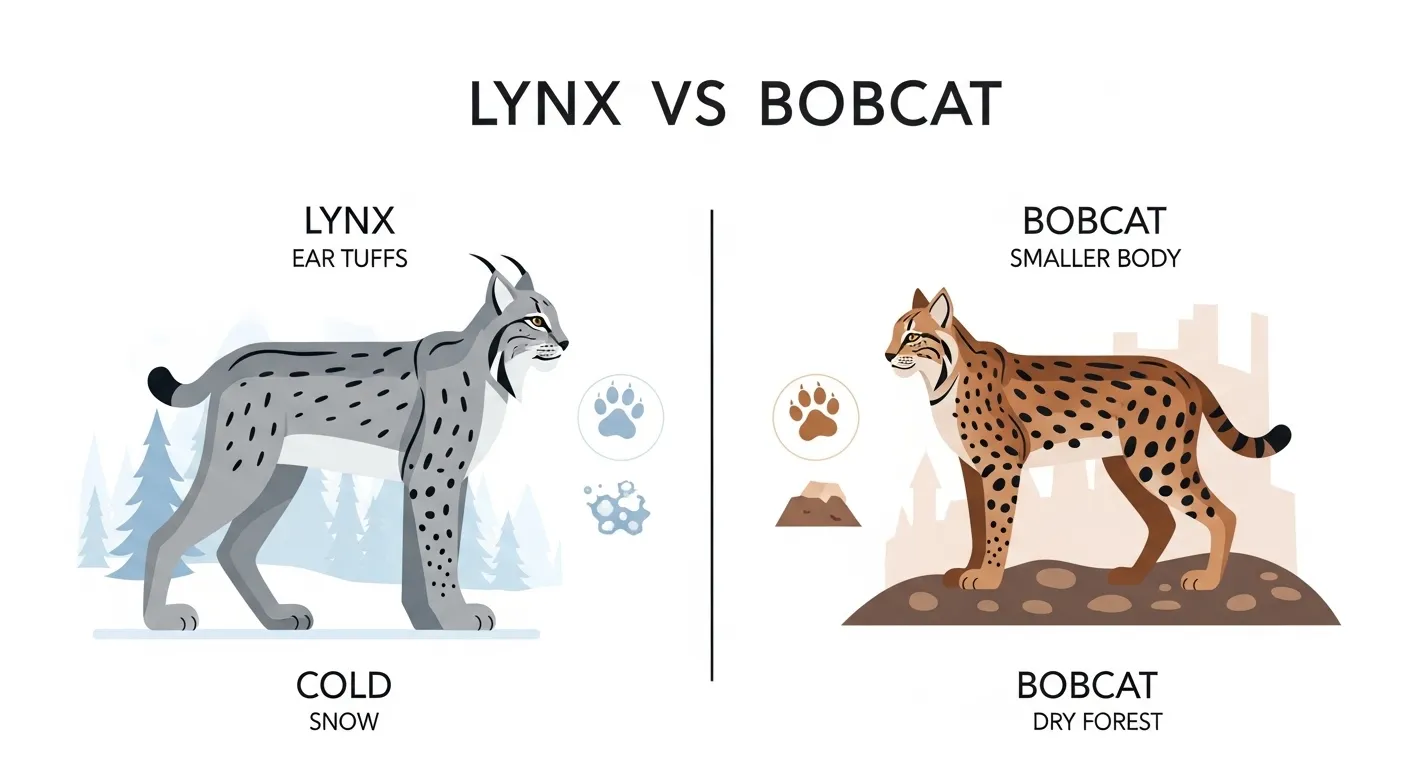
🐾 A lynx is larger with longer legs, bigger paws, and tufted ears adapted for deep snow, while a bobcat is smaller, more adaptable, and found in a wider range of habitats.
A wildlife photographer once traveled to a snowy forest to capture pictures of wild cats. One animal looked like a bobcat, but another looked slightly bigger with longer ear tufts.
The photographer later learned about the difference between lynx and bobcat. Although both animals belong to the same wild cat family, they have several distinct features.
Many people see photos of these animals and feel confused about the difference between lynx and bobcat. At first glance, both animals have short tails, spotted fur, and pointed ears. However, the difference between lynx and bobcat lies in their size, habitat, and physical appearance.
Understanding the difference between lynx and bobcat helps nature lovers, students, and researchers identify these animals correctly and appreciate their role in wildlife ecosystems.
🔑 Key Difference Between the Both
The main difference is size and habitat. Lynx are usually larger and live in colder northern regions, while bobcats are smaller and live in a wider range of environments.
🌍 Why Their Difference Is Important for Learners and Experts
Understanding the difference between lynx and bobcat is important for wildlife students, conservationists, and researchers. Identifying species correctly helps scientists study animal behavior and protect natural habitats.
In society, learning about wild animals increases awareness about biodiversity and environmental protection. When people understand the difference between lynx and bobcat, they can better appreciate the unique characteristics of each species.
🔊 Pronunciation
Lynx
- US: /lɪŋks/
- UK: /lɪŋks/
Bobcat
- US: /ˈbɑːbˌkæt/
- UK: /ˈbɒbˌkæt/
Now let us clearly explore the difference between lynx and bobcat step by step.
🐱Difference Between Lynx and Bobcat
1. Size
Lynx are usually larger than bobcats.
Examples of lynx:
- Canadian lynx with larger body
- Eurasian lynx growing quite large
Examples of bobcat:
- Smaller North American bobcat
- Compact body compared to lynx
2. Ear Tufts
Lynx have long ear tufts. Bobcats have shorter ear tufts.
Examples of lynx:
- Long black ear tufts
- Prominent pointed ears
Examples of bobcat:
- Short ear tufts
- Less noticeable ear tips
3. Tail Appearance
Lynx tails are short with black tips. Bobcat tails are short with mixed coloring.
Examples of lynx:
- Tail with solid black tip
- Very short tail
Examples of bobcat:
- Tail with white underside
- Spotted tail pattern
4. Paw Size
Lynx have larger paws for walking on snow. Bobcats have smaller paws.
Examples of lynx:
- Large snowshoe-like paws
- Wide paw prints in snow
Examples of bobcat:
- Smaller paw prints
- Normal paw size for walking
5. Habitat
Lynx usually live in colder northern forests. Bobcats live in many environments.
Examples of lynx:
- Northern forests
- Snowy mountain areas
Examples of bobcat:
- Deserts
- Woodlands and grasslands
6. Fur Thickness
Lynx have thicker fur for cold climates. Bobcats have lighter fur.
Examples of lynx:
- Dense winter coat
- Thick fur in cold areas
Examples of bobcat:
- Shorter fur coat
- Lighter fur for warm climates
7. Geographic Range
Lynx live mostly in northern regions. Bobcats live across much of North America.
Examples of lynx:
- Canada
- Northern Europe and Asia
Examples of bobcat:
- United States
- Southern Canada and Mexico
8. Face Shape
Lynx have round faces with longer fur. Bobcats have more narrow faces.
Examples of lynx:
- Thick facial fur
- Wide face shape
Examples of bobcat:
- Slim face shape
- Less facial fur
9. Leg Length
Lynx often have longer legs. Bobcats have shorter legs.
Examples of lynx:
- Tall legs for deep snow
- Long-legged body structure
Examples of bobcat:
- Shorter legs
- Compact body shape
10. Hunting Style
Both hunt small animals, but lynx often hunt snowshoe hares in snowy regions.
Examples of lynx:
- Hunting hares in snow
- Hunting in cold forests
Examples of bobcat:
- Hunting rabbits
- Hunting rodents in various habitats
Nature and Behaviour of Both
Lynx:
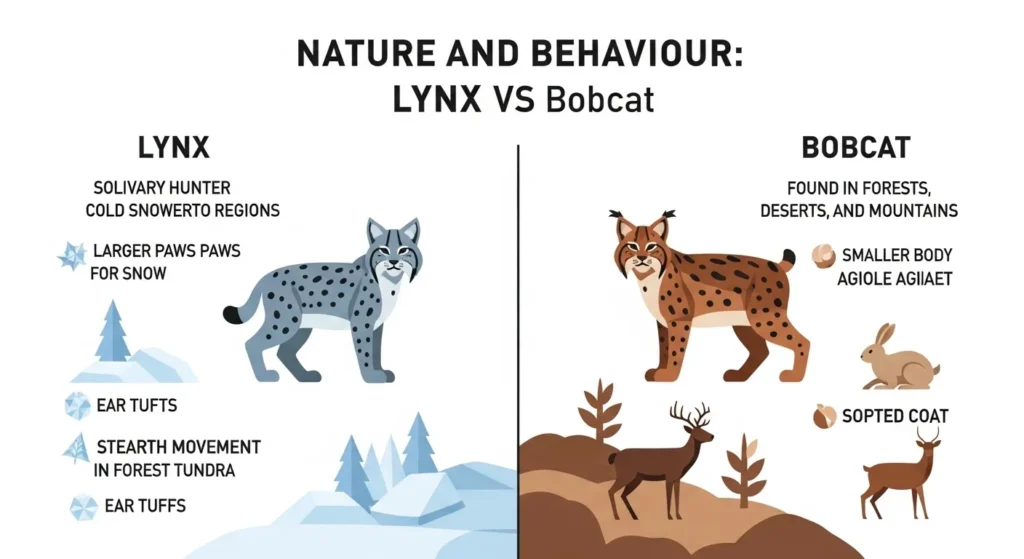
Lynx are wild cats adapted to cold environments. They have thick fur, large paws, and long ear tufts. They often live in snowy forests.
Bobcat:
Bobcats are adaptable wild cats that live in many habitats. They are smaller and can survive in forests, deserts, and mountains.
🤔 Why People Are Confused About Their Use
People often confuse these animals because both have short tails, spotted fur, and pointed ears. Their similar appearance in photographs also makes identification difficult for beginners.
Difference and Similarity
| Feature | Lynx | Bobcat | Similarity |
| Size | Larger | Smaller | Both wild cats |
| Ear tufts | Long | Short | Both have ear tufts |
| Habitat | Cold forests | Many habitats | Both predators |
| Paws | Large | Smaller | Both have sharp claws |
| Range | Northern regions | North America wide | Both carnivores |
🐾 Which Is Better in What Situation?
Lynx:
Lynx are better adapted for cold and snowy environments. Their large paws and thick fur help them walk on snow and survive in harsh winter climates.
Bobcat:
Bobcats are better suited for a variety of habitats. They can live in forests, deserts, and mountains, making them one of the most adaptable wild cats in North America.
🎭 How Lynx and Bobcat Are Used in Metaphors and Similes
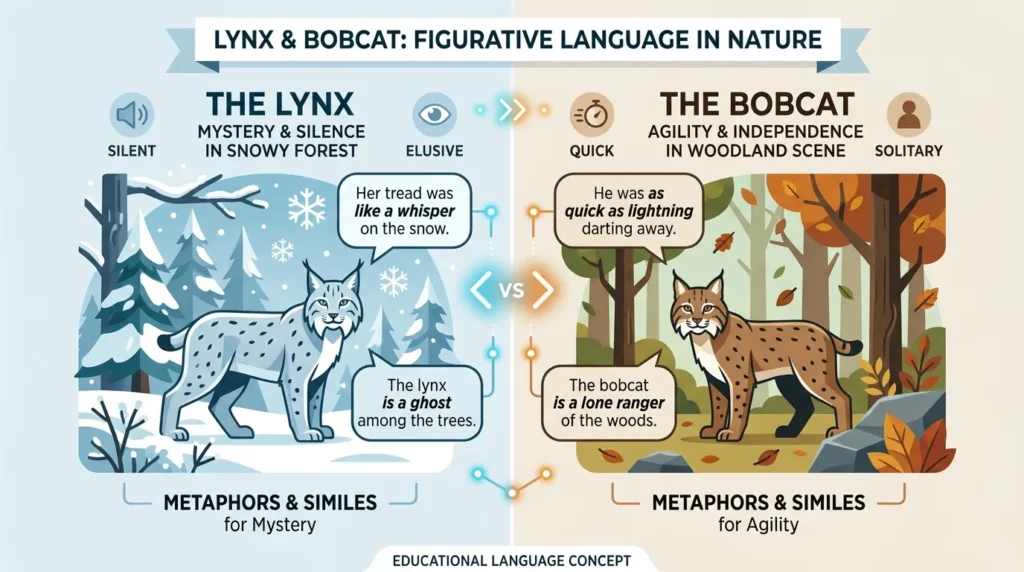
These animal names sometimes appear in descriptive language.
Lynx examples
- “He watched carefully like a lynx.”
- “Her eyes were sharp like a lynx.”
Bobcat examples
- “The runner moved fast like a bobcat.”
- “He jumped quickly like a bobcat.”
Connotative Meaning
Lynx
Often linked with sharp vision and alertness.
Example: “She noticed details with lynx-like eyes.”
Bobcat
Often linked with agility and speed.
Example: “The athlete moved like a bobcat.”
Idioms or Expressions
Lynx-eyed
Meaning: having very sharp eyesight.
Example: “The guard was lynx-eyed and noticed every movement.”
There are no widely known idioms using bobcat directly, but it is often used in comparisons.
Example:
- “He moved like a quick bobcat.”
📚 Works in Literature
- The Lynx and the Hare – Wildlife Study, David Mech, 1980
- Bobcat: Master of Survival – Wildlife Non-fiction, Kevin Hansen, 2006
🎬 Movies Related to the Words
- Lynx – 2021, France
- Bobcat Goldthwait’s Misfits & Monsters – 2018, United States (name reference)
❓ FAQs
1. What is the main difference between lynx and bobcat?
Lynx are larger and live in colder northern regions, while bobcats are smaller and live in many habitats.
2. Do lynx and bobcats belong to the same family?
Yes. Both are wild cats in the same genus.
3. Which animal has bigger paws?
Lynx have larger paws.
4. Which animal is more common in North America?
Bobcats are more common.
5. Can both animals climb trees?
Yes. Both lynx and bobcats are skilled climbers.
🌍 How Lynx and Bobcat Are Useful for Surroundings
Both animals play an important role in ecosystems. They help control populations of rabbits, rodents, and other small animals.
By maintaining balance in nature, lynx and bobcats help protect plant life and support healthy wildlife environments.
Final Words for Both
Lynx and bobcats are fascinating wild cats with unique features. Each species has special adaptations that help it survive in its environment.
Conclusion
The difference between lynx and bobcat mainly lies in their size, habitat, and physical features. Lynx are larger animals with thick fur, large paws, and long ear tufts that help them survive in cold northern forests. Bobcats are smaller and more adaptable, living in many types of environments across North America. Although they look similar at first, understanding the difference between lynx and bobcat helps people identify these animals correctly and appreciate their role in maintaining healthy ecosystems.
Read more about!
Difference Between Guilt and Shame: Complete Guide
Difference Between Homicide and Murders: Simple Guide

I am James Carter, a professional content writer from the United States. I specialize in writing simple and clear comparison blogs that help students and readers understand difficult topics easily. My writing focuses on everyday language, education, science, and lifestyle topics. I believe that learning should be easy for everyone, so I use simple words and real-life examples in my articles.