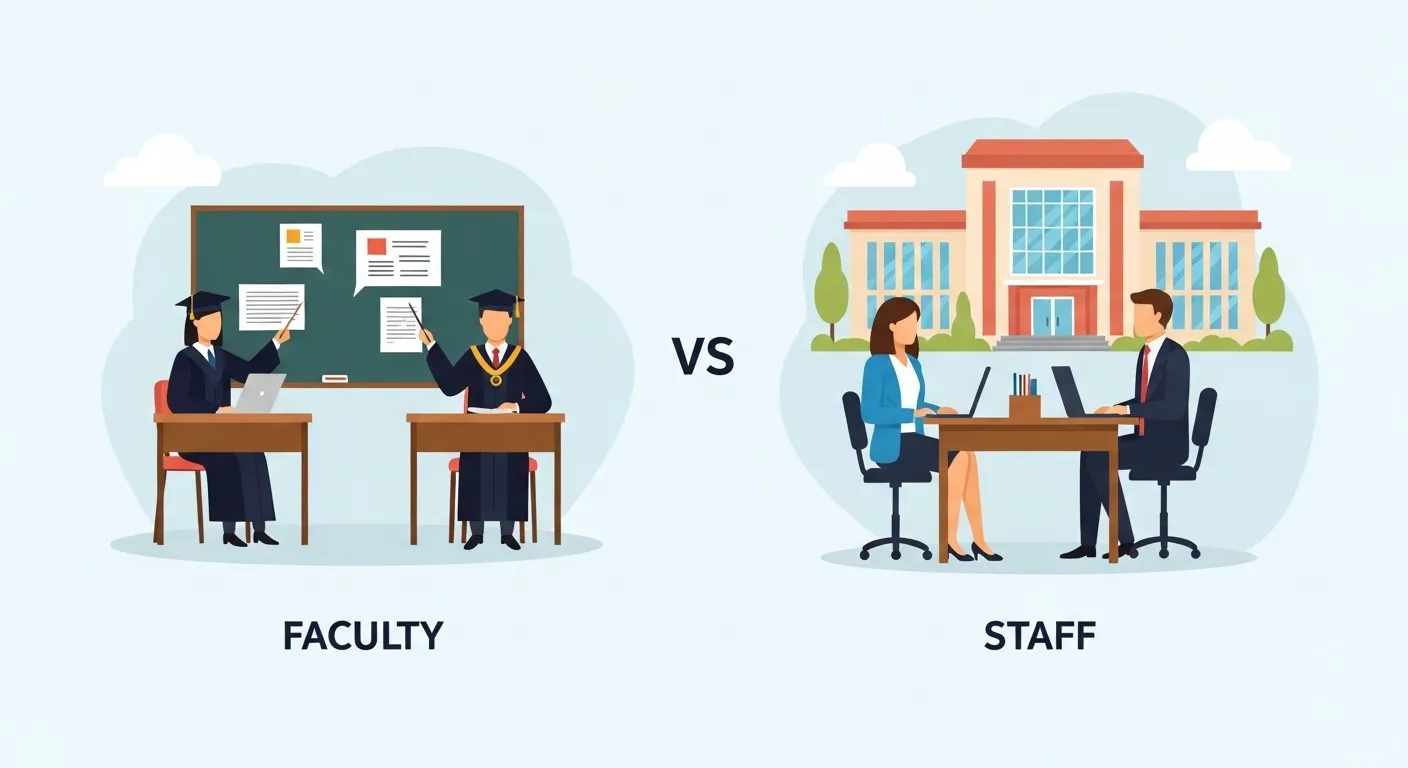
Faculty are academic teachers and researchers in an institution, while staff are non-teaching employees who support its operations.
Many students search the difference between faculty and staff when they enter a school, college, or university environment. In simple words, the difference between faculty and staff is about roles: faculty are responsible for teaching and academics, while staff handle administration and support services.
You’ll often hear this confusion in real life especially on Google or during orientation sessions in universities. People ask: what is faculty? what is staff? why are they different?
In this guide, we will clearly break down the difference between faculty and staff, explain real-life roles, give examples, tables, and show why this separation exists in educational systems.
Difference Between Faculty and Staff
Faculty are teachers, lecturers, and professors responsible for education, while staff are employees who manage administration, operations, and support services in an institution.
👉 Example: A professor teaching math is faculty, while the office administrator handling admissions is staff.
Definition of Difference Between Faculty and Staff
- Faculty: Academic professionals who teach students, conduct research, and create curriculum.
- Staff: Non-teaching employees who manage administration, maintenance, admissions, and student services.
Pronunciation
- Faculty: /ˈfæk.əl.ti/
- Staff: /stæf/ (US), /stɑːf/ (UK)
Now let’s understand this clearly with real-world educational logic.
Comparison: Faculty vs Staff
| Feature | Faculty | Staff | Explanation |
| Role | Teaching & research | Administration & support | Core function differs |
| Interaction | Students in classroom | Students & office work | Different engagement style |
| Qualification | Advanced degrees (PhD, Masters) | Varies by job role | Academic vs operational |
| Work Type | Academic work | Non-academic work | System separation |
| Example | Professor, Lecturer | Clerk, HR officer | Clear role difference |
| Goal | Education delivery | Institution support | Shared institution purpose |
| Work Setting | Classroom, labs | Office, campus services | Location difference |
| Responsibility | Curriculum & learning | Management & logistics | Different responsibilities |
Key Differences Explained Between Faculty and Staff
1. Job Purpose
Faculty focus on teaching and learning. Staff focus on operations.
👉 Example: A lecturer teaches biology; an administrator handles exams.
2. Educational Role
Faculty directly shape student knowledge. Staff support the system behind learning.
3. Qualification Requirements
Faculty usually require higher academic degrees like PhD or Masters. Staff roles vary widely.
4. Student Interaction
Faculty interact in classrooms. Staff interact in offices and service points.
5. Decision Making
Faculty influence curriculum. Staff manage policies and execution.
6. Work Environment
Faculty work in academic settings. Staff work in administrative departments.
7. Skill Type
Faculty need teaching and research skills. Staff need management and organizational skills.
What is the Difference Between Faculty and Staff in Education System?
In schools and universities, the system is divided into two main parts:
- Academic system (faculty)
- Administrative system (staff)
This structure ensures smooth functioning of institutions worldwide, including universities listed on Google results.
Why Does the Difference Between Faculty and Staff Exist?
The separation exists to balance education and management. Without faculty, there is no learning. Without staff, there is no system support.
👉 Simple logic:
- Faculty = knowledge creation
- Staff = system operation
How Does the Difference Between Faculty and Staff Work in Real Life?
In real educational institutions:
- Faculty design lectures, teach students, and evaluate exams
- Staff handle admissions, fee management, scheduling, and campus maintenance
On platforms like YouTube, university tours show both roles working together. On Meta platforms, universities often post faculty achievements and staff announcements separately.
Difference and Similarity Between Faculty and Staff
| Feature | Faculty | Staff | Similarity |
| Purpose | Teach students | Support institution | Both serve education system |
| Role Type | Academic | Administrative | Both essential roles |
| Interaction | Classroom teaching | Office support | Both interact with students |
| Skills | Teaching expertise | Management skills | Both require professionalism |
| Workplace | Academic areas | Office departments | Same institution |
| Goal | Learning outcomes | Smooth operations | Shared institutional success |
This table clearly shows the difference and similarity between faculty and staff for quick understanding.
Common Mistakes with Faculty and Staff
- Thinking both are the same
✔ Faculty = teaching, Staff = support - Calling all employees “teachers”
✔ Only academic staff are faculty - Ignoring staff importance
✔ Staff are essential for system function - Confusing roles in small schools
✔ One person may perform multiple roles - Assuming faculty do administrative work
✔ Their focus is academic
Real Life Examples with Faculty and Staff
- University Example: Professors teach while clerks manage admissions
- School Example: Teachers are faculty, office assistants are staff
- Corporate Education: Trainers = faculty, HR team = staff
- Online Learning Platforms: Instructors = faculty, support team = staff
- Research Institutions: Scientists = faculty, lab technicians = staff
When to Use Each Term
Use Faculty when:
- Talking about teachers or professors
- Referring to academic roles
Use Staff when:
- Talking about administration
- Referring to support roles
Why People Get Confused Between Faculty and Staff
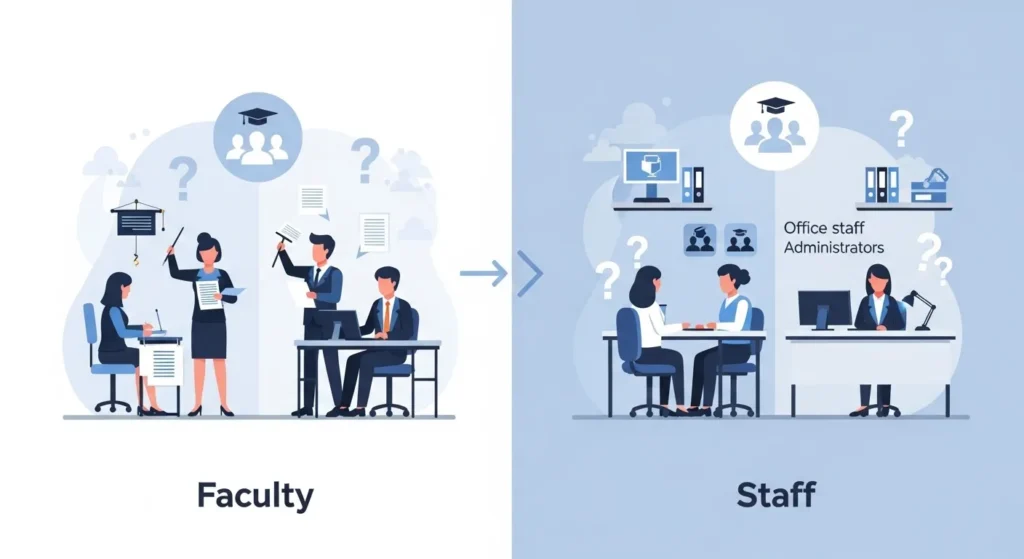
- Overlapping job roles in small institutions
- Media simplification on Instagram
- Lack of awareness about academic structure
- Some employees perform mixed duties
- Similar workplace environment
How Search Engines Understand Faculty and Staff Queries
Search engines like Google analyze:
- Educational intent (“faculty meaning”)
- Comparison intent (“faculty vs staff”)
- Institutional context
Content that clearly defines roles and gives examples ranks higher.
Expert Insight
In real academic systems, faculty represent intellectual authority, while staff represent operational stability.
From practical experience in education systems, confusion usually happens in institutions where roles overlap. However, globally, universities strictly separate academic and administrative departments for efficiency and clarity.
FAQs
What is the main difference between faculty and staff?
Faculty teach students, while staff manage administration.
Is a teacher faculty or staff?
A teacher is part of faculty.
Can staff become faculty?
Yes, with required academic qualifications.
Are office workers considered staff?
Yes, they are administrative staff.
Do faculty members do administration?
Sometimes, but their main role is teaching.
Why are faculty and staff both important?
Because both ensure smooth functioning of institutions.
Conclusion
The difference between faculty and staff is simple but very important in understanding any educational system. Faculty are the academic backbone of institutions they teach, research, and guide students. Staff are the operational support they manage systems, administration, and daily functions.
In real-world scenarios, both roles work together like two sides of the same system. Without faculty, there is no learning. Without staff, there is no structure to support learning.
So, the difference between faculty and staff is not about importance but about function. One focuses on knowledge delivery, and the other ensures smooth operation. Understanding this difference helps students, parents, and professionals clearly navigate educational environments.
Read more about!
Difference Between Pension and 401k Explained Clearly
Difference Between Agitator and Impeller: Complete Guide

I am James Carter, a professional content writer from the United States. I specialize in writing simple and clear comparison blogs that help students and readers understand difficult topics easily. My writing focuses on everyday language, education, science, and lifestyle topics. I believe that learning should be easy for everyone, so I use simple words and real-life examples in my articles.