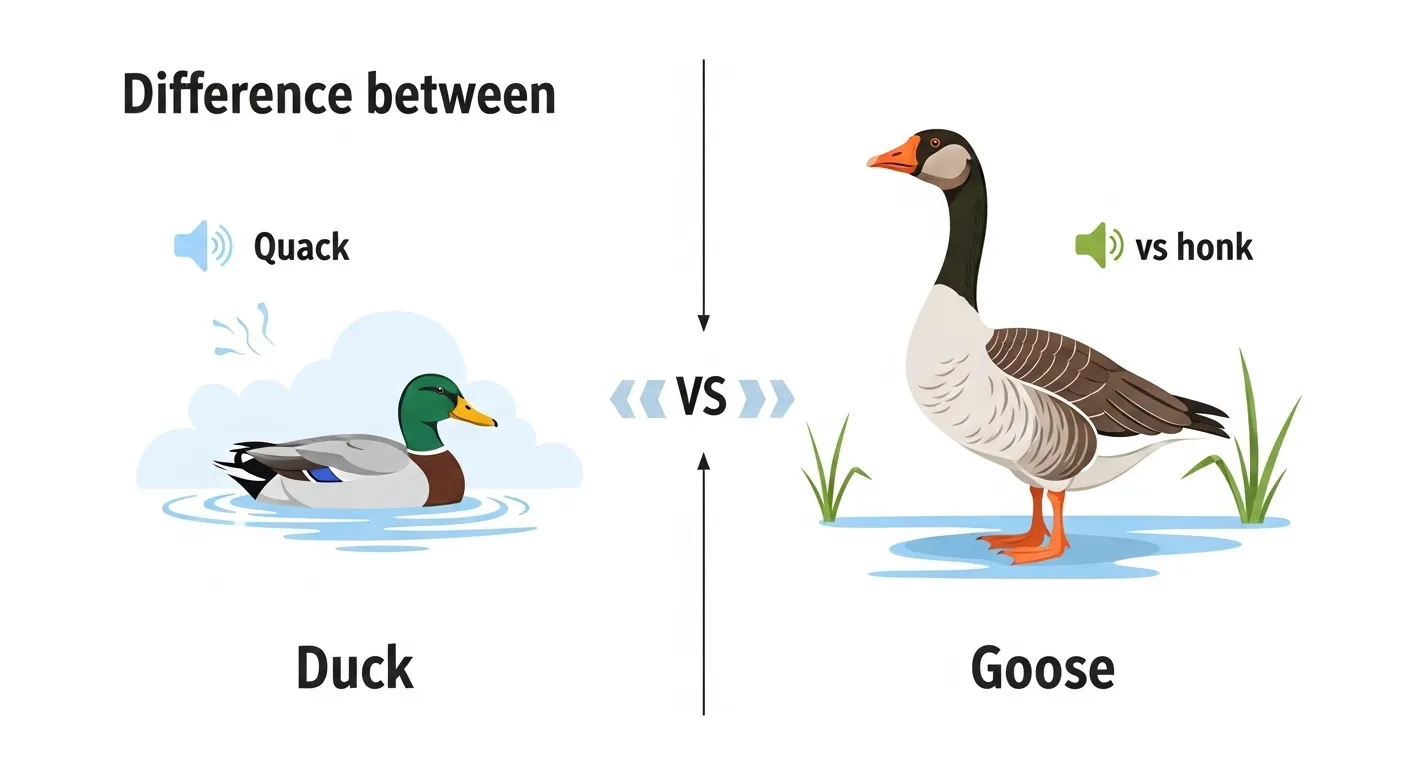
Ducks are smaller, quieter water birds that quack, while geese are larger, more aggressive birds that honk and have longer necks. 🦆🪿
The difference between duck and goose is one of the most commonly searched topics in bird identification and wildlife studies. Many people see these birds in parks, farms, or nature videos and immediately wonder: “Are ducks and geese the same?” or “What is the real difference between duck and goose?”
In simple terms, both belong to the same bird family (Anatidae), but their behavior, body structure, sound, and lifestyle are quite different. This confusion is normal because ducks and geese often live in similar environments like lakes, rivers, and ponds.
Understanding the difference between duck and goose helps in wildlife learning, bird watching, agriculture, and even environmental science.
In this complete guide, you will learn how to clearly identify them, how they behave differently, and why people often confuse them in real life and online searches like what is duck vs goose, how to identify ducks and geese, and why are they different species.
Let’s explore everything in a simple, expert-backed, and fully optimized way.
🟢 Difference Between Duck and Goose
The difference between duck and goose is mainly in size, neck length, behavior, and sound. Ducks are smaller, more social, and make “quack” sounds, while geese are larger, have long necks, and produce loud honking sounds.
👉 Example: A duck swims quietly in a pond, while a goose walks on land and guards its territory aggressively.
🟢 Definition of Duck and Goose
- Duck: A small to medium-sized water bird that lives near freshwater and feeds on plants, insects, and small aquatic animals. Ducks are highly social and often seen in groups.
- Goose: A larger waterfowl bird known for long necks, strong flying ability, and protective behavior. Geese often travel in flocks and migrate long distances.
🗣️ Pronunciation
- Duck: /dʌk/
- Goose: /ɡuːs/
Both pronunciations remain mostly the same in US and UK English, making them easy to remember for learners.
Key Differences Between Duck and Goose
| Feature | Duck | Goose | Similarity |
| Size | Small/medium | Large | Both are water birds |
| Neck | Short | Long | Both flexible necks |
| Sound | Quack | Honk | Both vocal birds |
| Behavior | Social & calm | Protective & aggressive | Both live in groups |
| Migration | Some species migrate | Most geese migrate long distances | Both travel seasonally |
| Diet | Omnivorous | Mostly herbivorous | Both eat near water |
| Habitat | Ponds, lakes | Lakes, fields, rivers | Both prefer water areas |
| Flying style | Fast wing beats | V-formation flight | Both strong flyers |
👉 This table clearly shows the difference and similarity between duck and goose for quick understanding.
🟢 Key Differences Explained in Detail
1. 🧍 Size Difference
Ducks are generally smaller, while geese are much larger and heavier. This is the easiest visual clue.
👉 Example: A mallard duck looks compact, while a Canada goose looks tall and powerful.
2. 🦢 Neck Structure
Geese have long necks used for grazing on land. Ducks have short necks designed for underwater feeding.
3. 🔊 Sound Differences
- Duck = “Quack quack”
- Goose = Loud “Honk honk”
👉 This is why people often identify them just by sound.
4. 🧠 Behavior Pattern
Ducks are friendly and calm. Geese are territorial and protective, especially during nesting season.
5. ✈️ Flight Behavior
Geese migrate in V-shaped formations for energy saving, while ducks usually fly in smaller groups or alone.
6. 🌍 Habitat Preference
Both live near water, but geese spend more time on land grazing grass.
🟢 Why Do Ducks and Geese Exist as Separate Birds?
From an evolutionary perspective, ducks and geese adapted differently:
- Ducks evolved for water feeding and agility
- Geese evolved for grazing and long-distance migration
This separation helps both species survive in different ecological roles.
🟢 Real-Life Examples of Duck vs Goose
- 🏞️ In parks: Ducks swim in fountains, geese walk on grass
- 🌾 Farms: Geese used for guarding, ducks for eggs/meat
- 🌍 Migration: Geese fly thousands of kilometers, ducks travel shorter routes
- 📱 Social media videos: Geese appear aggressive, ducks look calm
- 🧑🌾 Agriculture: Ducks help control insects in rice fields
🟢 When to Use Duck vs Goose Knowledge
- Bird watching and wildlife photography
- Agriculture (egg and meat farming)
- School biology projects
- Environmental studies
- Travel and nature tourism
Understanding the difference between duck and goose improves observation skills in nature.
🟢 Common Mistakes with Duck and Goose
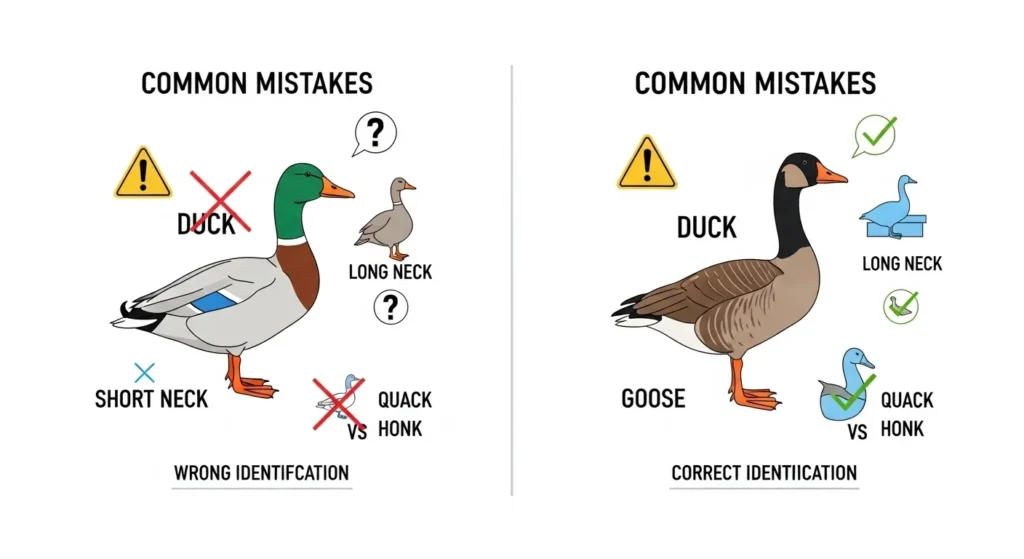
- Thinking all water birds are ducks
- Confusing goose chicks with ducklings
- Assuming all white birds are geese
- Ignoring neck length difference
- Misidentifying sound (quack vs honk)
👉 Fix: Always check size, sound, and neck length.
🟢 Why People Get Confused Between Duck and Goose
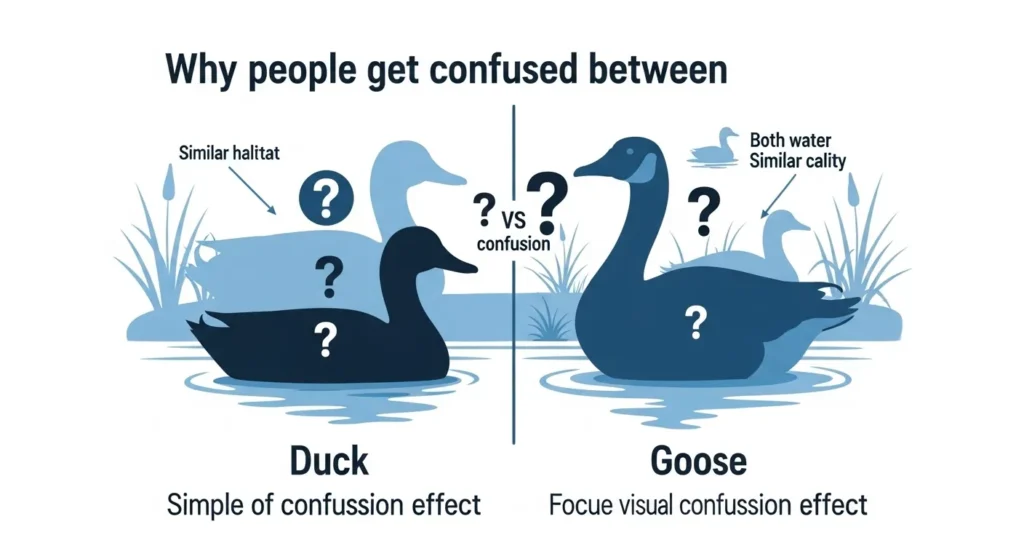
People often confuse them because:
- Both live in similar habitats
- Both swim in water
- Both belong to the same bird family
- Media and cartoons mix their images
- Lack of basic bird knowledge
In search engines like Google, queries such as “duck vs goose difference” or “what is goose bird” show high confusion intent.
🟢 How Search Engines Understand Duck vs Goose Queries
Google uses NLP (Natural Language Processing) to analyze:
- User intent (comparison vs definition)
- Context (wildlife, education, farming)
- Related entities (birds, habitats, migration)
This is why structured content like this ranks better it answers multiple search intents in one place.
🟢 Expert Insight
From a biological classification perspective, ducks and geese belong to the Anatidae family, but differ in genus and behavioral adaptation. In real-world bird identification training, professionals always use three key markers:
✔ Size
✔ Neck length
✔ Vocal sound
As someone who has studied wildlife classification patterns, these three factors are the most reliable for beginners and even field experts.
🟢 Real-World Confusion Scenarios
- Children calling geese “big ducks”
- Tourists mislabeling birds in parks
- Farmers mixing identification in poultry farming
- Social media memes using wrong labels
This shows why understanding the difference between duck and goose is not just academic it’s practical.
🟢 FAQs
1. Are ducks and geese the same species?
No, they are different species but belong to the same bird family.
2. Which is bigger, duck or goose?
Goose is significantly larger than duck.
3. Do ducks and geese migrate?
Yes, but geese migrate longer distances.
4. Why do geese honk louder than ducks?
Because geese use vocal communication for long-distance coordination.
5. Can ducks and geese live together?
Yes, they can share habitats peacefully.
6. Which is more aggressive?
Geese are generally more territorial.
7. Do they eat the same food?
Partially yes, but geese eat more grass.
8. How to easily identify them?
Check neck length, sound, and body size.
🟢 Conclusion
The difference between duck and goose is clear once you understand their size, behavior, sound, and lifestyle. Ducks are smaller, calmer, and more social birds, while geese are larger, louder, and more protective in nature.
Both birds play important roles in ecosystems ducks help control aquatic insects, while geese contribute to land grazing and migration balance. Although they look similar at first glance, their biological structure and behavior make them completely different.
If you ever see them in real life, just remember:
👉 Ducks = small, quiet, “quack”
👉 Geese = large, strong, “honk”
Understanding this difference not only improves your wildlife knowledge but also helps in education, travel, and environmental awareness. Now you no longer need another article the duck vs goose difference is fully clear.
Read more about!
Difference Between Empathy and Compassion: Explained
Difference Between Flautas and Taquitos: Complete Guide

I am Emily Johnson, a USA-based content writer who creates easy-to-read blogs on language and daily life topics. I explain complex ideas in simple English for students and beginners so they can understand easily.