Empathy is feeling and understanding someone else’s emotions, while compassion is understanding their feelings and wanting to help them. 💙
Many people often search for the difference between empathy and compassion because both terms sound similar but actually represent very different emotional and psychological responses.
In simple life situations like helping a friend, supporting a colleague, or reacting to someone’s pain people get confused about if they are showing empathy or compassion.
That is exactly why understanding the difference between empathy and compassion is important in psychology, communication, and even daily relationships.
In modern digital platforms like Google, Instagram, and YouTube, these terms are widely used in mental health, emotional intelligence, and self-improvement content. But most explanations online are either too technical or too shallow.
In this guide, you will clearly understand what is empathy, what is compassion, and the real difference between empathy and compassion with practical examples, tables, and real-life scenarios.
We will also explore why people confuse them, how psychologists define them, and how both emotions affect human behavior in real-world situations. This article is written in a simple, expert, and friendly way so you don’t need to read anything else.
Difference Between Empathy and Compassion
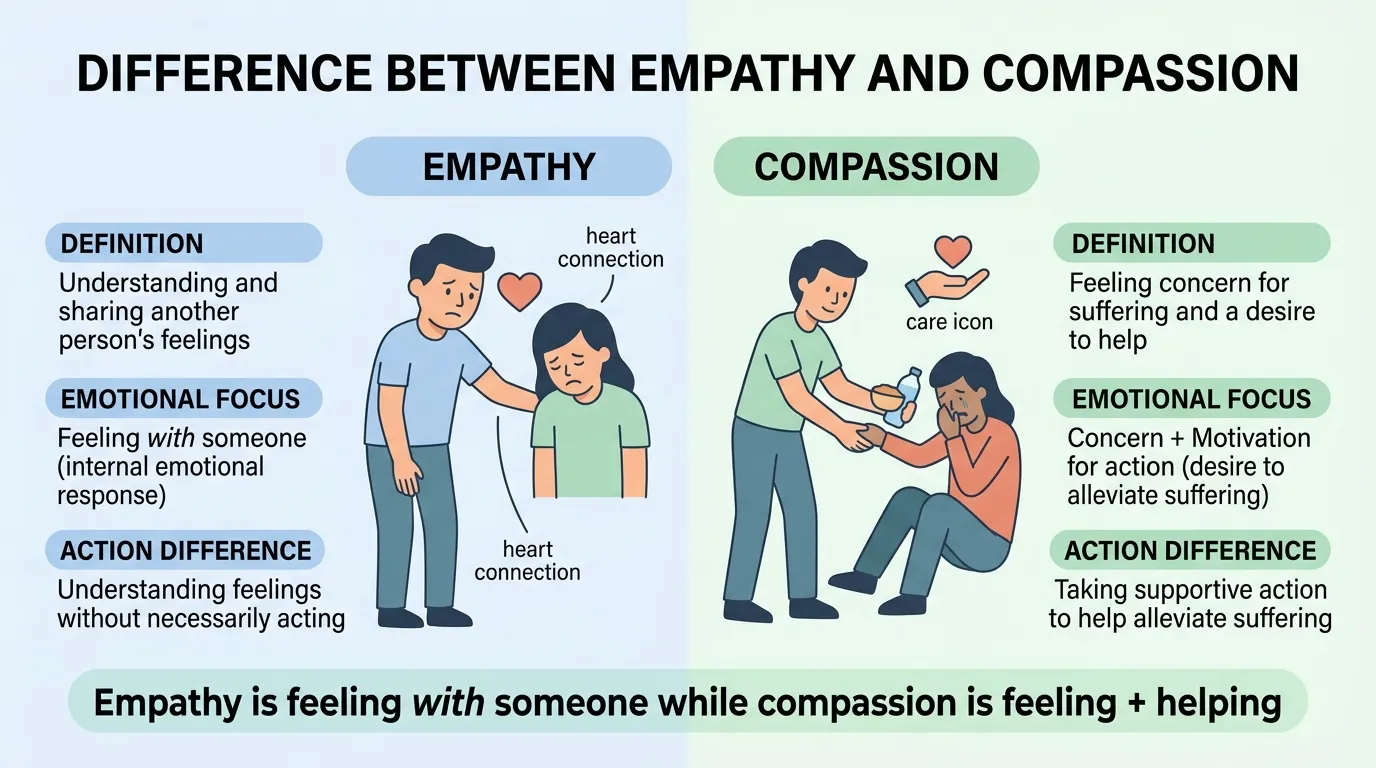
Empathy means understanding and feeling someone else’s emotions, while compassion means understanding someone’s pain and taking action to help them.
👉 Example: If your friend is sad and you feel their sadness, that is empathy. If you feel their sadness and try to help them feel better, that is compassion.
🟢 Definition of Both
🔹 Empathy:
Empathy is the ability to understand and share the feelings of another person emotionally.
🔹 Compassion:
Compassion is the feeling of concern for someone’s suffering combined with the desire to help them.
👉 In short:
- Empathy = Feel + Understand
- Compassion = Feel + Understand + Help
🟢 Pronunciation
- Empathy: /ˈem.pə.θi/ (US & UK similar)
- Compassion: /kəmˈpæʃ.ən/ (US & UK similar)
Now let’s go deeper into the difference between empathy and compassion to understand it clearly.
Comparison
| Feature | Empathy | Compassion | Similarity |
| Meaning | Feeling others’ emotions | Feeling + helping others | Both involve emotional awareness |
| Focus | Emotional connection | Action-oriented care | Both come from kindness |
| Response | Internal feeling | External action | Both respond to suffering |
| Psychology | Emotional resonance | Pro-social behavior | Both improve relationships |
| Example | Feeling sad with a friend | Helping a sad friend | Both support emotional bonding |
| Outcome | Emotional understanding | Emotional + practical support | Both build trust |
| Usage in life | Emotional support | Active support | Both used in relationships |
👉 This table clearly shows the difference between empathy and compassion for quick understanding.
Key Differences Explained
1. Emotional Connection vs Action
Empathy is about feeling emotions, while compassion pushes you to take action.
👉 Example: Seeing a homeless person and feeling their pain is empathy; giving them food is compassion.
2. Internal vs External Response
Empathy stays inside your emotional mind. Compassion moves outside into behavior.
👉 Example: Crying after hearing someone’s loss (empathy) vs helping their family (compassion).
3. Psychological Function
Empathy builds emotional understanding, while compassion builds helpful behavior patterns.
👉 Example: Therapists use empathy to understand patients and compassion to guide healing.
4. Emotional Intensity
Empathy can sometimes be overwhelming because you feel others’ pain deeply. Compassion is more balanced and action-focused.
👉 Example: Doctors must control empathy and use compassion to treat patients effectively.
5. Real-Life Usage
Empathy is used in emotional bonding; compassion is used in leadership and caregiving roles.
👉 Example: Teachers use empathy to understand students and compassion to support their growth.
6. Relationship Building
Empathy creates emotional closeness, while compassion builds trust through action.
👉 Example: A friend listening to your problems (empathy) vs helping solve them (compassion).
Why Empathy and Compassion Exist in Human Psychology
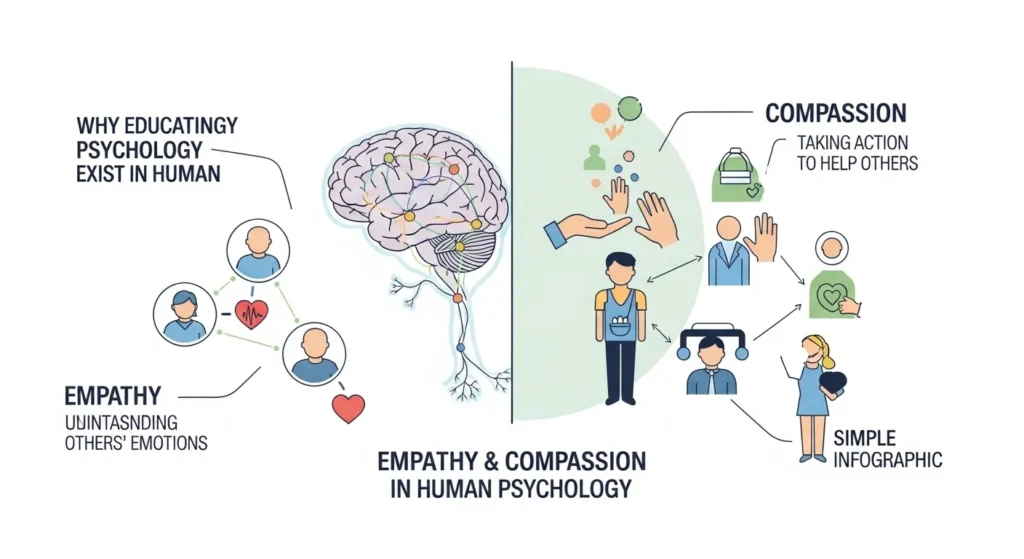
Empathy and compassion exist because humans are social beings. According to psychology research shared on platforms like Google Scholar, Meta studies, and neuroscience journals, these emotions help humans survive and cooperate.
- Empathy helps us understand social pain
- Compassion helps us reduce suffering in society
👉 Without empathy, society becomes emotionally disconnected
👉 Without compassion, empathy becomes useless emotional overload
Difference Between Both in Real Life
🧑🤝🧑 Personal Life
- Empathy: Feeling your friend’s breakup pain
- Compassion: Helping them recover emotionally
🏢 Workplace (Google / Meta / YouTube culture)
- Empathy: Understanding employee stress
- Compassion: Offering flexible work support
🏥 Healthcare
- Empathy: Feeling patient pain
- Compassion: Providing treatment and care
📱 Social Media (Instagram / YouTube)
- Empathy: Emotional reactions to posts
- Compassion: Supporting campaigns or donations
Common Mistakes with Empathy and Compassion
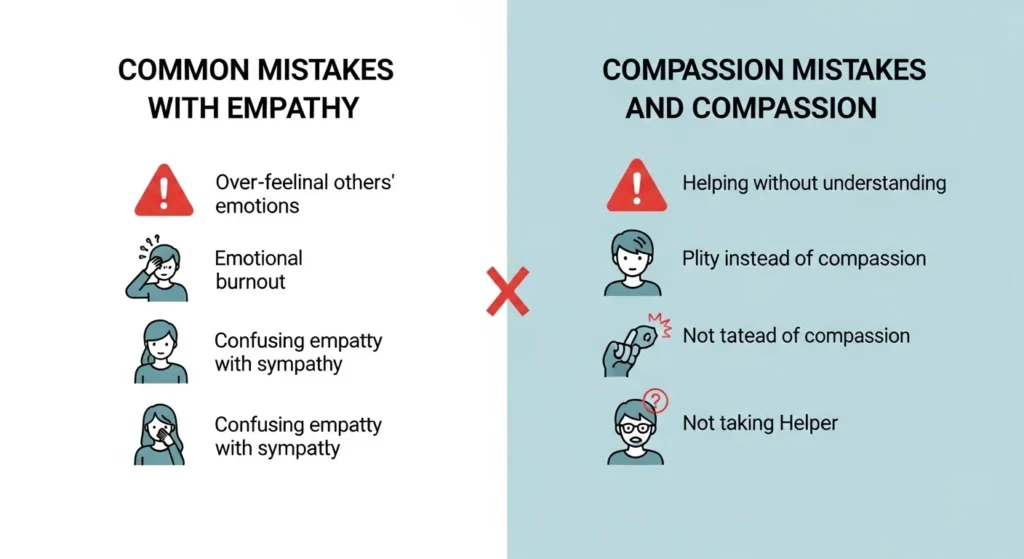
- Thinking empathy and compassion are the same
- Over-empathizing and becoming emotionally drained
- Showing sympathy instead of empathy
- Confusing compassion with pity
- Not taking action after feeling empathy
👉 Fix: Always balance emotional understanding with helpful action.
Real-Life Examples
- A friend loses a job
- Empathy: You feel their stress
- Compassion: You help them find a new opportunity
- Seeing disaster news
- Empathy: Feeling sadness
- Compassion: Donating or volunteering
- Workplace stress
- Empathy: Understanding colleague pressure
- Compassion: Sharing workload
When to Use Empathy and Compassion
- Use empathy when you want to connect emotionally
- Use compassion when action is required
👉 Best leaders, teachers, and doctors combine both effectively.
Why People Get Confused
People confuse empathy and compassion because:
- Both involve emotions
- Both relate to kindness
- Social media uses them interchangeably
- Lack of psychology understanding
How Google Understands Empathy vs Compassion
Google’s NLP systems analyze:
- emotional intent
- behavioral meaning
- contextual usage
For example:
- “I feel your pain” → empathy signal
- “I want to help you” → compassion signal
Platforms like Instagram and YouTube also categorize content based on emotional engagement signals.
Expert Insight
From a psychological perspective, empathy is a mirror emotion system while compassion is a pro-social action system. Research in behavioral science shows that highly effective leaders balance both traits to build trust and productivity.
In real-world experience, professionals in healthcare, education, and leadership roles rely more on compassion-driven action rather than pure emotional empathy.
FAQs
1. What is the main difference between empathy and compassion?
Empathy is feeling emotions, compassion is feeling + helping.
2. Can you have compassion without empathy?
No, compassion usually starts with empathy.
3. Is empathy stronger than compassion?
Not stronger, just different in function.
4. Why is compassion important?
Because it leads to action and support.
5. Can empathy be harmful?
Yes, too much empathy can cause emotional burnout.
6. Which is better in leadership?
A balance of both empathy and compassion.
7. Are empathy and sympathy the same?
No, sympathy is feeling pity, not understanding.
8. How do doctors use empathy and compassion?
Empathy to understand patients, compassion to treat them.
🟢 Conclusion
The difference between empathy and compassion is simple but very powerful in understanding human behavior. Empathy means feeling and understanding another person’s emotions, while compassion goes one step further by turning that emotional understanding into action and support.
In real life, both emotions are essential. Empathy helps you connect with people emotionally, while compassion helps you improve their situation. Without empathy, human relationships become cold. Without compassion, empathy becomes inactive emotion.
If you are a student, teacher, doctor, or leader, mastering the difference between empathy and compassion will improve your communication, relationships, and emotional intelligence. The best approach is to balance both feel deeply, but also act wisely.
Read more about!
Difference Between Anatomy and Physiology:Easy Guide
Difference Between Octopus and Squid: Simple Guide

I am James Carter, a professional content writer from the United States. I specialize in writing simple and clear comparison blogs that help students and readers understand difficult topics easily. My writing focuses on everyday language, education, science, and lifestyle topics. I believe that learning should be easy for everyone, so I use simple words and real-life examples in my articles.