🧠 Anatomy studies the body’s structure, while physiology explains how those parts function and work together.
Many students get confused when they first learn biology and search for the difference between anatomy and physiology. At first glance, both terms seem similar because they are closely related to the study of the human body.
However, the difference between anatomy and physiology is very important to understand if you want to build a strong foundation in medical science, nursing, fitness, or healthcare studies.
In simple words, anatomy is about structure, while physiology is about function. This is the core idea behind the difference between anatomy and physiology, and once you understand this, everything becomes much easier.
Students often search Google, YouTube, and educational platforms like Khan Academy or medical apps because they want a clear explanation of what is anatomy and physiology, how they are different, and why both are important in human biology.
In this complete guide, you will learn:
✔ Clear definitions
✔ Real-life examples
✔ Key differences explained simply
✔ Tables for quick understanding
✔ Common mistakes students make
✔ Why this topic is important in healthcare
Let’s understand the difference between anatomy and physiology in the simplest way possible.
Difference Between Anatomy and Physiology
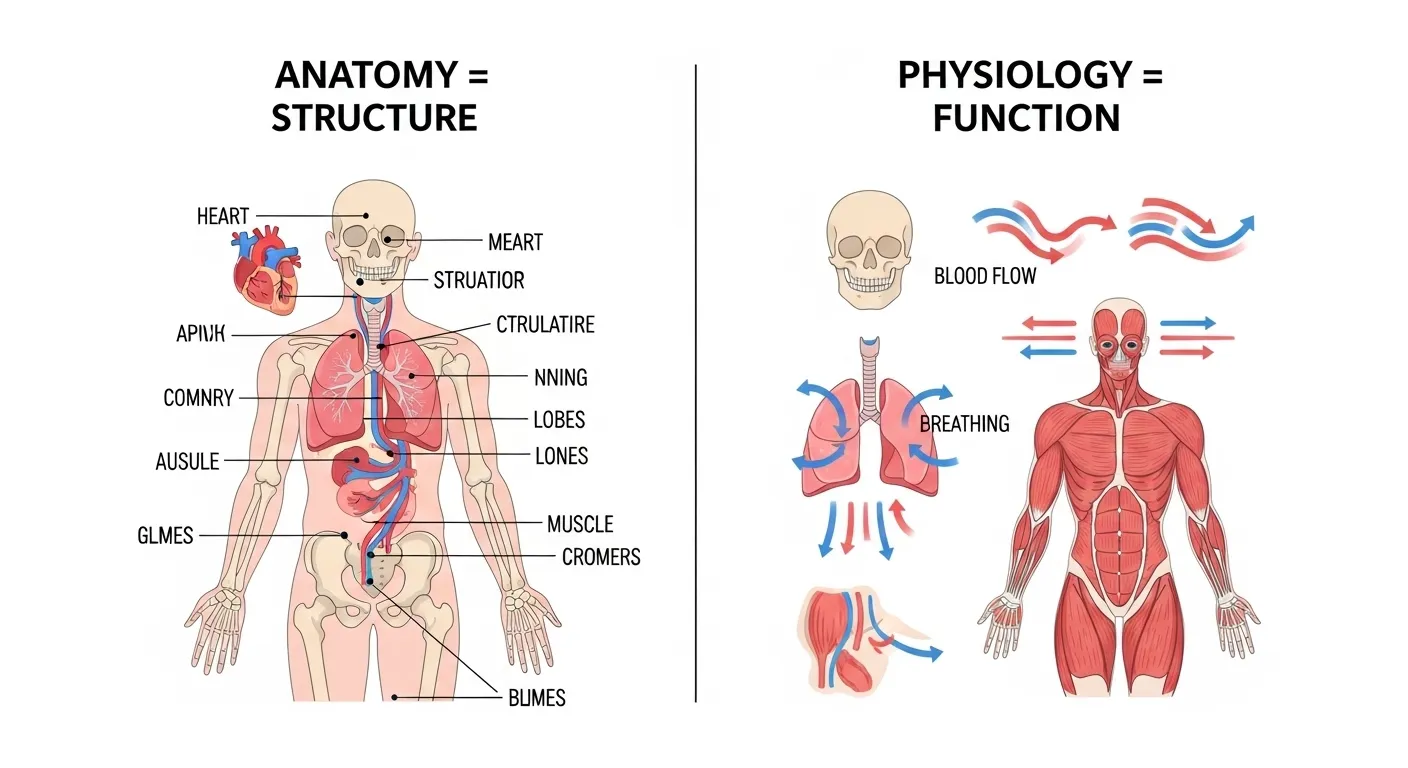
Anatomy is the study of body structure (what the body is made of), while physiology is the study of body function (how the body works).
👉 Example:
- Anatomy = Heart structure (size, shape, chambers)
- Physiology = How the heart pumps blood
Definition of Anatomy and Physiology
- Anatomy: The branch of biology that studies the structure of body parts such as organs, tissues, and cells.
- Physiology: The branch of biology that studies the functions and processes of those body parts.
✔ Anatomy = Structure
✔ Physiology = Function
Pronunciation
Understanding pronunciation helps learners remember the difference between anatomy and physiology more easily:
- Anatomy → /əˈnætəmi/ (uh-NAT-uh-mee)
- Physiology → /ˌfɪziˈɒlədʒi/ (FIZ-ee-OL-uh-jee)
These terms are widely used in medical platforms like Google Health, WebMD, YouTube medical lectures, and Meta educational content.
Comparison: Anatomy vs Physiology
| Feature | Anatomy | Physiology | Similarity |
| Meaning | Study of body structure | Study of body function | Both study human body |
| Focus | Shape, size, location | Processes, working system | Both essential in biology |
| Example | Heart structure | Heart pumping blood | Both describe heart |
| Field | Medical science | Medical science | Same discipline |
| Tools | Dissection, imaging | Experiments, tests | Both use research |
| Goal | Understand body parts | Understand body function | Both improve health knowledge |
| Study type | Static | Dynamic | Both interrelated |
👉 This table clearly shows the difference between anatomy and physiology for quick understanding.
Key Differences Explained Between Anatomy and Physiology
1. Structure vs Function
- Anatomy explains what the body is made of
- Physiology explains how it works
✔ Example: Bones vs movement of bones
2. Static vs Dynamic Study
- Anatomy is static (unchanging structure)
- Physiology is dynamic (active processes)
✔ Example: Lung shape vs breathing process
3. Observation vs Experimentation
- Anatomy uses observation tools
- Physiology uses experiments and measurements
✔ Example: MRI scan vs heart rate test
4. Micro vs Macro Study
- Anatomy studies organs and tissues
- Physiology studies chemical and biological reactions
✔ Example: Cell structure vs oxygen transport
5. Real-Life Medical Use
- Doctors use anatomy in surgery
- Doctors use physiology in treatment planning
✔ Example: Understanding heart structure vs controlling blood pressure
6. Learning Purpose
- Anatomy helps identify body parts
- Physiology helps understand health functions
✔ Example: Knowing liver location vs liver function
Why Anatomy and Physiology Exist
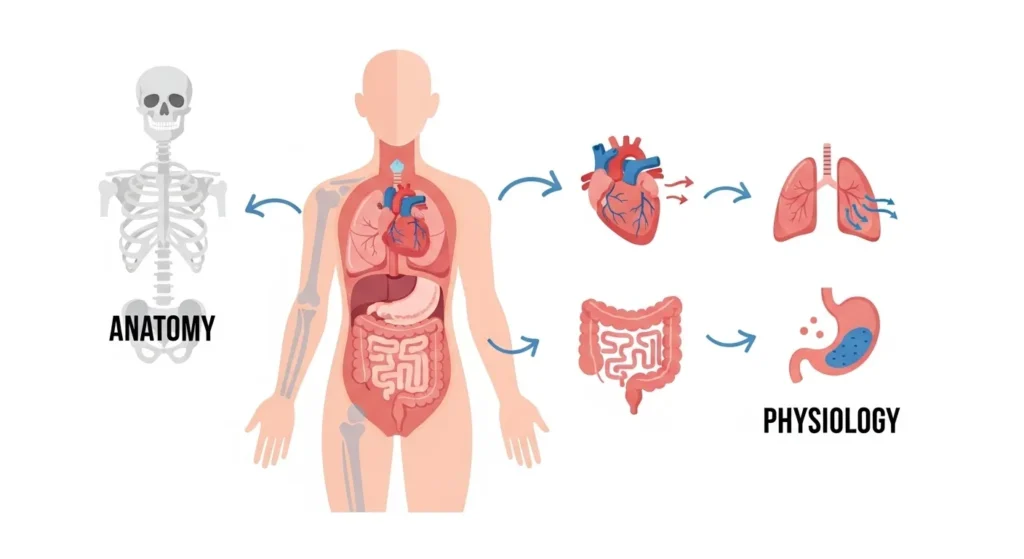
The human body is extremely complex. That’s why science divides it into two parts:
✔ Anatomy = “What is inside the body?”
✔ Physiology = “How does it work?”
Platforms like Google Health, NIH research, and medical universities use this classification to train doctors, nurses, and healthcare professionals.
Without anatomy, you cannot locate organs.
Without physiology, you cannot understand diseases.
WHEN TO USE EACH
Use Anatomy when:
✔ Studying body structure
✔ Learning organ locations
✔ Preparing for dissection
Use Physiology when:
✔ Studying body functions
✔ Understanding diseases
✔ Learning treatments
WHY PEOPLE GET CONFUSED
✔ Both are studied together in textbooks
✔ Same organs are used in both topics
✔ Medical terminology overlap
✔ English learners mix meanings
Many beginners think they are the same, but in reality, they are two sides of the same system.
Real-Life Examples
Medical Use:
- Anatomy: Location of brain
- Physiology: Brain controlling body
Fitness Use:
- Anatomy: Muscle structure
- Physiology: Muscle contraction
Daily Life:
- Anatomy: Heart shape
- Physiology: Heart pumping blood
Healthcare Apps:
- Apps like Google Fit and Apple Health use physiology data for tracking body functions.
Common Mistakes with Anatomy and Physiology
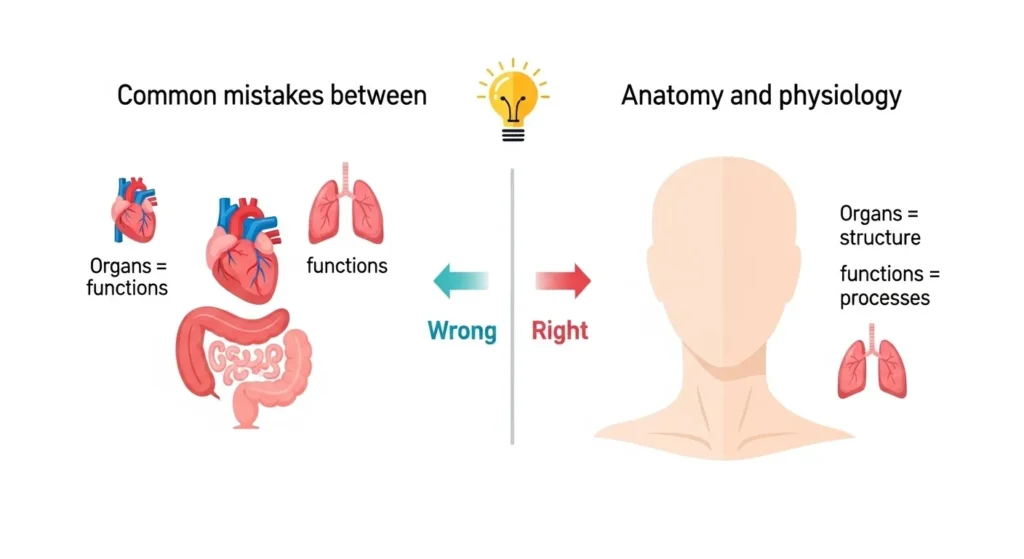
- Thinking both are the same
- Mixing structure with function
- Memorizing without understanding
- Ignoring real-life examples
- Confusing medical terms
✔ Fix: Always remember structure vs function
Why Anatomy and Physiology Matter
✔ Essential for medical students
✔ Important in healthcare careers
✔ Used in fitness and nutrition
✔ Helps understand diseases
Without these two, modern medicine like MRI, CT scans, surgeries, and diagnostics would not be possible.
How Search Engines Understand This Topic
Google and AI systems analyze:
✔ User intent: “difference between anatomy and physiology”
✔ Educational context
✔ Medical relevance
✔ Semantic meaning
Platforms like YouTube, Google Scholar, and Meta educational systems prioritize accurate scientific explanations for ranking.
Expert Insight
From a medical education perspective, understanding the difference between anatomy and physiology is the foundation of all health sciences. In real teaching environments, students who clearly separate structure from function perform better in clinical practice.
Most healthcare professionals agree that mastering these concepts early helps in diagnosing diseases faster and understanding patient conditions more accurately.
FAQs
1. What is the main difference between anatomy and physiology?
Anatomy studies structure, physiology studies function.
2. Are anatomy and physiology related?
Yes, both are closely connected.
3. Which is harder, anatomy or physiology?
Physiology is usually more complex.
4. Can you study one without the other?
No, both are needed together.
5. Why are anatomy and physiology important?
They explain how the human body works.
6. Is anatomy just memorization?
Mostly yes, but understanding is also required.
7. What comes first anatomy or physiology?
Usually anatomy is studied first.
8. Do doctors use both?
Yes, both are essential in medicine.
Conclusion
The difference between anatomy and physiology is simple but extremely important in biology and medical science. Anatomy focuses on the structure of the human body, while physiology focuses on the function of those structures. Both work together to explain how the human body operates in real life.
Understanding this difference helps students, doctors, and healthcare professionals build strong foundational knowledge. In real learning, you cannot separate them completely because structure and function are deeply connected. However, knowing their difference makes studying medicine, fitness, and biology much easier.
If you fully understand the difference between anatomy and physiology, you unlock the basic foundation of all human biological sciences. This knowledge is essential not just for exams, but for real-world medical understanding and health awareness.
Read more about!
Difference Between Horizontal and Vertical:Simple Guide
Difference Between Acute and Chronic: Complete Guide

I am Emily Johnson, a USA-based content writer who creates easy-to-read blogs on language and daily life topics. I explain complex ideas in simple English for students and beginners so they can understand easily.