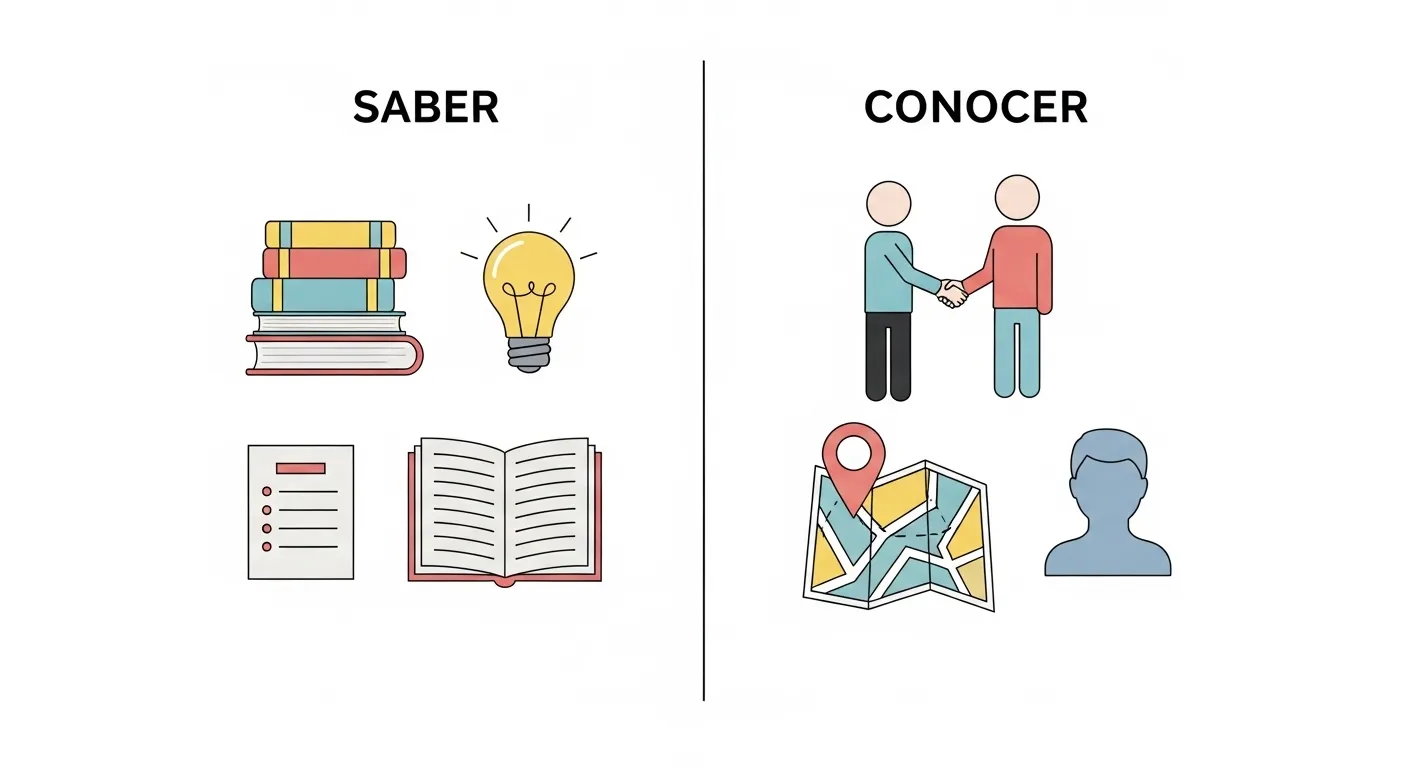
The main difference between saber and conocer is that saber means “to know facts or how to do something,” while conocer means “to know people, places, or be familiar with something.”
Many Spanish learners get confused when they hear the terms difference between saber and conocer, because both words translate into English as “to know.” This creates a major problem for beginners trying to speak naturally in real conversations.
In fact, understanding the difference between saber and conocer is one of the most important steps in mastering Spanish grammar and fluency.
In simple words, both verbs express knowledge, but they are used in completely different contexts. The confusion happens because English only uses one word “know,” while Spanish separates them based on type of knowledge. That is why learners often ask: what is the real difference between saber and conocer?
In this complete guide, you will learn:
✔ Exact meanings of both verbs
✔ Real-life usage examples
✔ Common mistakes learners make
✔ When to use each verb correctly
✔ Easy memory tricks
✔ Expert-level explanation for fluency
By the end, you will fully understand the difference between saber and conocer like a native speaker.
Difference Between Saber and Conocer
Saber is used for facts, skills, and information you know.
Conocer is used for people, places, and familiarity.
👉 Example:
- I know how to swim = Sé nadar
- I know Maria = Conozco a María
Definition of Saber and Conocer
Saber:
Used to express knowledge of facts, information, or skills.
Conocer:
Used to express familiarity with people, places, or things.
Simple rule:
✔ Saber = information & skills
✔ Conocer = familiarity & experience
Pronunciation
Understanding pronunciation helps learners remember the difference between saber and conocer more effectively.
- Saber → /ˈsa.ber/ (SAH-ber)
- Conocer → /ko.noˈθer/ (Spain) or /ko.noˈser/ (Latin America)
Both pronunciations are widely accepted depending on region, especially in platforms like YouTube language tutorials, Duolingo, and Google Translate audio tools.
Comparison: Saber vs Conocer
| Feature | Saber | Conocer | Similarity |
| Meaning | To know facts/skills | To know people/places | Both mean “to know” |
| Usage | Information-based | Experience-based | Used in daily Spanish |
| Object type | Facts, data, skills | People, places | Both describe knowledge |
| Grammar role | Irregular verb | Irregular verb | Both highly used verbs |
| Learning context | Academic knowledge | Social familiarity | Both essential for fluency |
| Example | Sé la respuesta | Conozco Madrid | Both express understanding |
👉 This table clearly shows the difference between saber and conocer for quick understanding.
Key Differences Explained in Detail
1. Knowledge Type
- Saber: Used for learned knowledge (facts, skills)
- Example: Sé matemáticas
- Conocer: Used for personal familiarity
- Example: Conozco a tu hermano
2. People vs Information
- Saber never directly refers to people
- Conocer always relates to people or places
Example:
- ❌ Sé María (wrong)
- ✔ Conozco a María (correct)
3. Skill Usage
- Saber expresses ability
- Example: Sé conducir (I know how to drive)
4. Experience Factor
- Conocer is based on experience
- Example: Conozco París (I have been to Paris)
5. Question Forms
- Saber → ¿Sabes la respuesta?
- Conocer → ¿Conoces a Juan?
6. Digital Usage (Modern Context)
On platforms like:
- Google Search
- Instagram captions
- YouTube language tutorials
Both verbs are used in educational Spanish content, but always in correct context depending on intent.
Why Saber and Conocer Exist
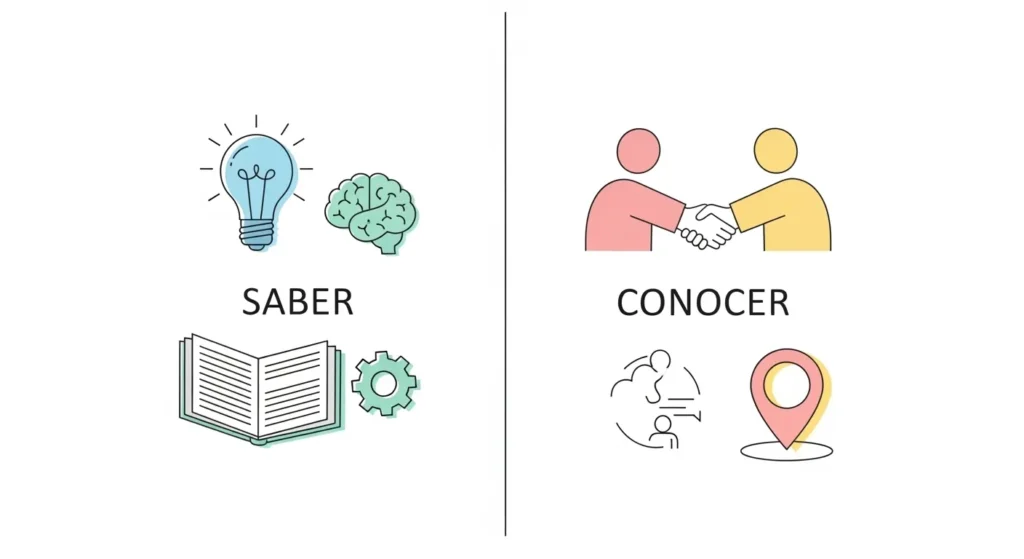
Spanish language separates knowledge into two categories:
✔ Objective knowledge (Saber)
✔ Subjective experience (Conocer)
This helps speakers express more precise meaning than English. Many NLP language systems (like Google Translate and AI models) also rely on this distinction to improve translation accuracy.
When to Use Saber
Use saber when talking about:
✔ Facts
✔ Information
✔ Skills
✔ Learned knowledge
Examples:
- Sé hablar inglés
- No sé la respuesta
- Sabemos la verdad
When to Use Conocer
Use conocer when talking about:
✔ People
✔ Places
✔ Familiar experiences
Examples:
- Conozco a Ana
- Conozco España
- ¿Conoces este lugar?
Common Mistakes with Saber and Conocer
- Using “saber” for people
❌ Sé Juan
✔ Conozco a Juan - Mixing skills with familiarity
❌ Conozco nadar
✔ Sé nadar - Direct translation from English
English “I know” leads to confusion - Forgetting “a” with people
✔ Conozco a María - Overusing one verb only
Beginners avoid switching correctly
Real-Life Examples
Personal Use:
- Sé cocinar pasta
- Conozco a mi vecino
Travel Use:
- Conozco Italia
- Sé dónde está el hotel
Academic Use:
- Sé la teoría
- Conozco el tema
Social Media Use:
- Conozco a ese influencer de Instagram
- Sé cómo funciona el algoritmo de YouTube
When to Use Each
Use Saber when:
✔ You talk about facts
✔ You talk about skills
✔ You answer questions
Use Conocer when:
✔ You talk about people
✔ You describe experience
✔ You express familiarity
Why People Get Confused
✔ English only has one word “know”
✔ Spanish divides knowledge into two types
✔ Direct translation habits
✔ Lack of practice in real conversations
✔ Overthinking grammar rules
How Search Engines Understand This Topic
Google and NLP systems analyze:
✔ User intent (“what is difference between saber and conocer”)
✔ Context (grammar learning, Spanish education)
✔ Semantic meaning (knowledge vs familiarity)
Platforms like Duolingo, Google Translate, and YouTube education channels use this distinction in AI-driven learning models.
Expert Insight
As language learning experts explain, mastering the difference between saber and conocer is not just grammar it’s about thinking in Spanish. Real fluency comes when learners stop translating from English and start associating verbs with context directly.
In practical teaching environments, students who practice real conversation (not just memorization) master this topic 3x faster.
FAQs
1. What is the main difference between saber and conocer?
Saber is for facts and skills, while conocer is for people and places.
2. Can I use saber for people?
No, you should use conocer.
3. Is conocer used for places?
Yes, it shows familiarity with places.
4. What does saber mean in English?
It means “to know” in terms of facts or skills.
5. Why are saber and conocer confusing?
Because English uses only one word “know.”
6. How can I remember them easily?
Saber = Study facts
Conocer = Connection with people
7. Do natives mix them?
Rarely, because they learn context naturally.
8. Is this important for fluency?
Yes, it is essential for correct Spanish communication.
Conclusion
The difference between saber and conocer is one of the most important grammar concepts in Spanish learning. While both verbs mean “to know,” their usage depends on context. Saber is used for facts, skills, and information, while conocer is used for people, places, and familiarity.
Understanding this difference helps you speak naturally, avoid mistakes, and sound more like a native speaker. Many learners struggle at first, but once you practice real-life examples, the confusion disappears quickly.
If you master the difference between saber and conocer, your Spanish communication becomes clearer, more accurate, and more confident. This concept is not just grammar it is a foundation of real Spanish fluency.
Read more about!
Difference Between EPO and PPO: Complete Guide
Difference Between Flautas and Taquitos: Complete Guide

I am James Carter, a professional content writer from the United States. I specialize in writing simple and clear comparison blogs that help students and readers understand difficult topics easily. My writing focuses on everyday language, education, science, and lifestyle topics. I believe that learning should be easy for everyone, so I use simple words and real-life examples in my articles.