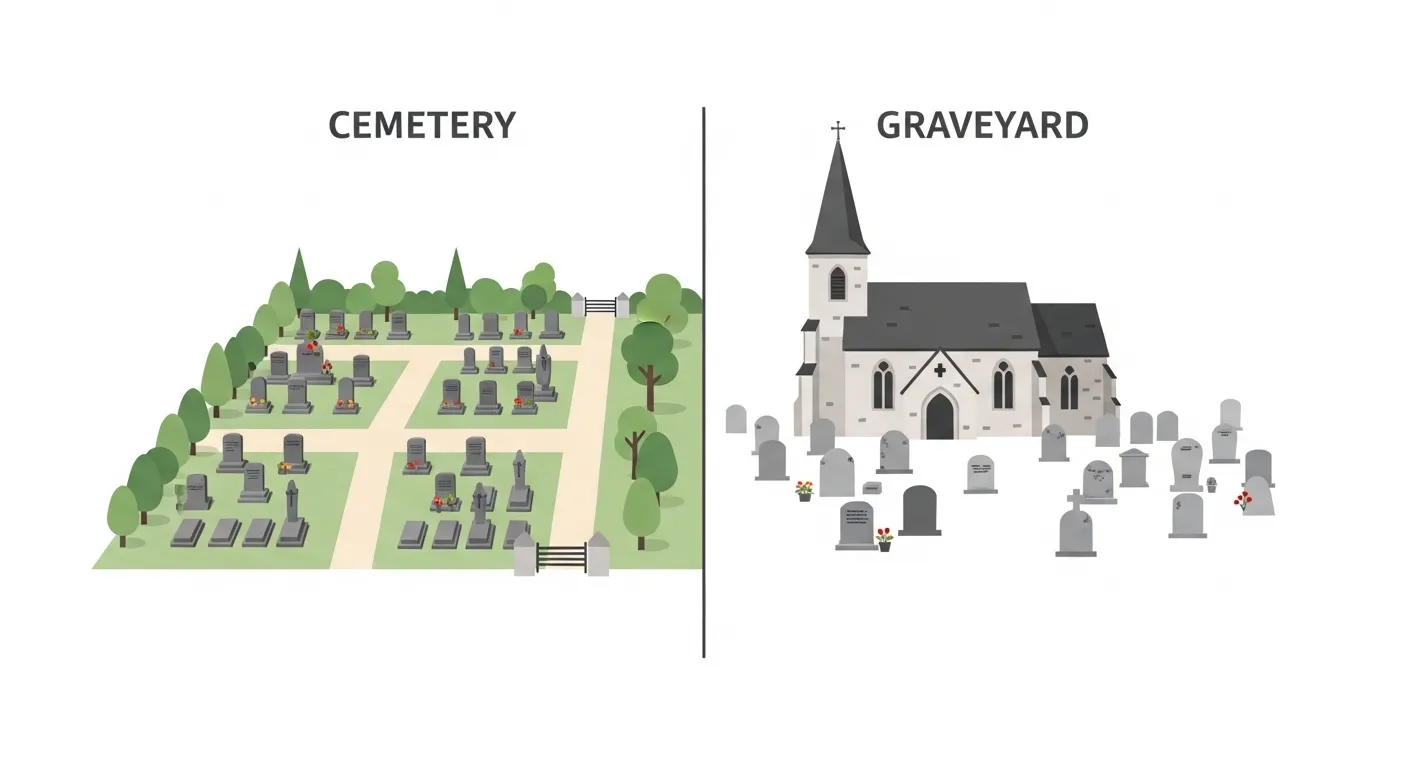
A cemetery is a modern, planned burial ground, while a graveyard is an older burial area usually located next to a church ⛪.
One afternoon, a traveler visited an old village. He saw a small burial place beside a church. Later, in the city, he noticed a large burial area with many rows of graves and trees.
When he asked a guide, the guide explained the difference between cemetery and graveyard. The traveler learned that these two places are not exactly the same.
This small experience shows why people often ask about the difference between cemetery and graveyard. Both places are used to bury the dead, and they may look similar at first. However, the difference between cemetery and graveyard becomes clear when we study their location, history, and use.
Understanding the difference between cemetery and graveyard helps students, historians, and visitors use the correct term. When people know the difference between cemetery and graveyard, they better understand cultural and historical traditions in society.
🔑 Key Difference Between the Both
The main difference is location and origin. A graveyard is usually located next to a church, while a cemetery is a large burial ground that may not be connected to a church.
🌍 Why Their Difference Is Important for Learners and Experts
Knowing the difference between cemetery and graveyard is useful for historians, writers, and language learners. It helps people describe burial places correctly in books, research, and daily conversation.
In society, these places also represent history and respect for ancestors. Churches, communities, and governments maintain burial grounds in different ways. Understanding the difference between cemetery and graveyard helps people appreciate traditions and cultural practices related to burial and remembrance.
🔊 Pronunciation
Cemetery
- US: /ˈseməˌteri/
- UK: /ˈsemɪtri/
Graveyard
- US: /ˈɡreɪv.jɑːrd/
- UK: /ˈɡreɪv.jɑːd/
Before we explore deeper, let us clearly examine the difference between cemetery and graveyard.
Difference Between Cemetery and Graveyard
1. Location
A cemetery can exist anywhere. A graveyard is usually beside a church.
Examples of cemetery:
- City public cemetery
- Military cemetery
Examples of graveyard:
- Church graveyard in a village
- Old cathedral graveyard
2. Origin of the Word
Cemetery comes from a Greek word meaning “sleeping place.” Graveyard comes from the words “grave” and “yard.”
Examples of cemetery:
- Modern memorial cemetery
- Public burial cemetery
Examples of graveyard:
- Church burial yard
- Parish graveyard
3. Size
Cemeteries are often large. Graveyards are usually small.
Examples of cemetery:
- Large national cemetery
- Big city cemetery park
Examples of graveyard:
- Small village church graveyard
- Old monastery graveyard
4. Management
Cemeteries are managed by public or private organizations. Graveyards are often managed by churches.
Examples of cemetery:
- Municipal cemetery
- Private memorial cemetery
Examples of graveyard:
- Church-maintained graveyard
- Parish graveyard
5. History
Graveyards are usually older and historical. Cemeteries developed later when cities grew.
Examples of cemetery:
- Modern city cemetery
- Memorial park cemetery
Examples of graveyard:
- Medieval church graveyard
- Historic monastery graveyard
6. Religious Connection
Cemeteries may serve people of many religions. Graveyards are usually connected to a specific church.
Examples of cemetery:
- Public cemetery for all religions
- National military cemetery
Examples of graveyard:
- Christian church graveyard
- Parish burial ground
7. Layout
Cemeteries often have planned roads and sections. Graveyards may have simple layouts.
Examples of cemetery:
- Organized memorial sections
- Tree-lined cemetery paths
Examples of graveyard:
- Small uneven grave area
- Old stone graveyard
8. Appearance
Cemeteries may look like parks with trees and paths. Graveyards often look older and simpler.
Examples of cemetery:
- Garden-style cemetery
- Memorial park cemetery
Examples of graveyard:
- Old stone cross graveyard
- Historic churchyard graves
9. Purpose
Cemeteries serve large communities. Graveyards serve a church community.
Examples of cemetery:
- City burial ground
- National memorial cemetery
Examples of graveyard:
- Local parish graveyard
- Church burial yard
10. Modern Use
Today most new burial grounds are cemeteries. Graveyards mainly exist at old churches.
Examples of cemetery:
- Modern memorial cemetery
- Suburban cemetery park
Examples of graveyard:
- Historic church graveyard
- Old village graveyard
Nature and Behaviour of Cemetery and Graveyard
Cemetery:
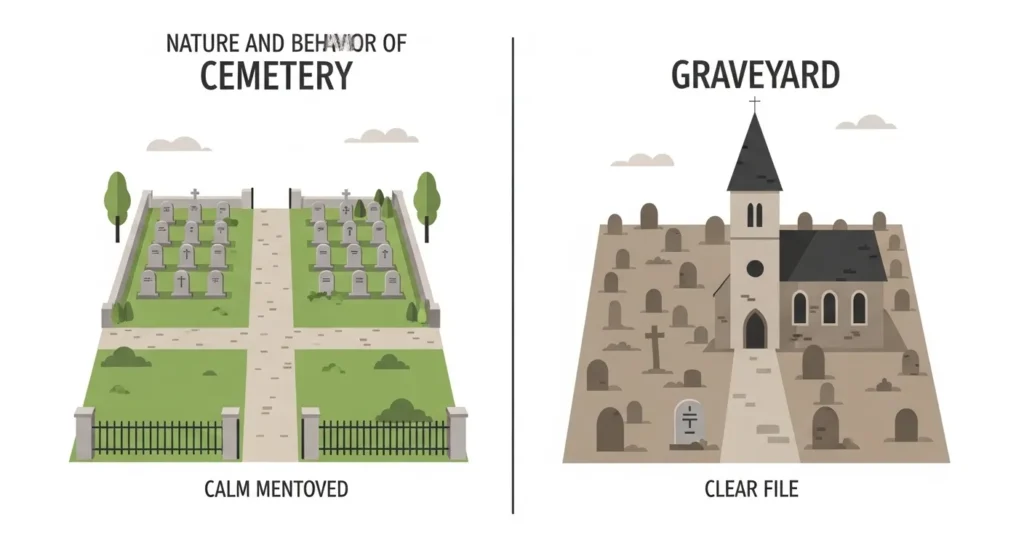
A cemetery is organized and spacious. It often has roads, gardens, and memorial areas. Many communities use cemeteries today.
Graveyard:
A graveyard is smaller and older. It usually sits beside a church and reflects local history and traditions.
🤔 Why People Are Confused About Their Use
Many people feel confused because both places are used for burial. In everyday speech, people often use the words cemetery and graveyard as if they mean the same thing. Their similar appearance also causes confusion.
Difference and Similarity
| Feature | Cemetery | Graveyard | Similarity |
| Location | Anywhere | Near church | Both burial places |
| Size | Large | Small | Both contain graves |
| Management | Public or private | Church | Both maintained areas |
| Age | Often modern | Often historic | Both part of culture |
| Religion | Mixed religions | Church-related | Both show respect for the dead |
⚖️ Which Is Better in What Situation?
Cemetery:
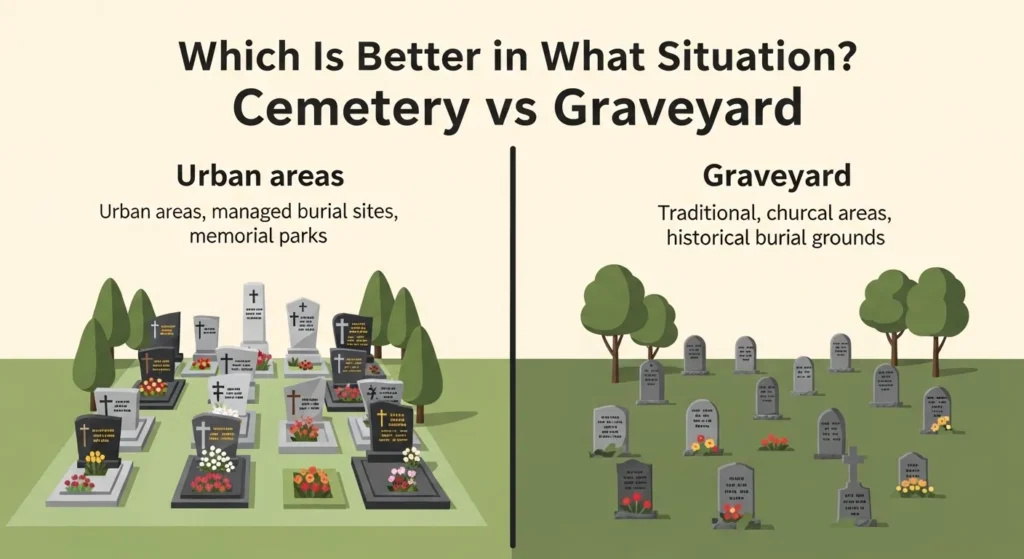
A cemetery is better for large cities and growing populations. It provides organized space for many families and includes roads, gardens, and memorial areas. Public cemeteries also allow people from different religions to share the same burial space.
Graveyard:
A graveyard is better for small communities and churches. It keeps burial traditions close to the place of worship. Many families feel comfort knowing their loved ones rest near the church where they prayed.
🎭 How Cemetery and Graveyard Are Used in Metaphors and Similes
These words sometimes appear in figurative language.
Cemetery examples
- “The old factory looked like a cemetery of machines.”
- “The battlefield became a cemetery of memories.”
Graveyard examples
- “The silent street felt like a graveyard at night.”
- “The abandoned cars formed a graveyard of metal.”
Connotative Meaning
Cemetery
Neutral meaning. It represents rest and remembrance.
Example: “The cemetery was peaceful and quiet.”
Graveyard
Often slightly negative or eerie in stories.
Example: “The dark graveyard looked mysterious at night.”
Idioms and Expressions
Graveyard shift
Meaning: Work during late night hours.
Example: “He works the graveyard shift at the hospital.”
Silent as a graveyard
Meaning: Very quiet.
Example: “The classroom was silent as a graveyard during the exam.”
📚 Works in Literature
- The Graveyard Book – Fantasy Novel, Neil Gaiman, 2008
- Pet Sematary – Horror Novel, Stephen King, 1983
🎬 Movies Related to the Words
- Pet Sematary – 1989, United States
- The Graveyard – 2006, United States
❓ FAQs
1. Is every graveyard a cemetery?
No. A graveyard is usually part of a church.
2. Are cemeteries larger than graveyards?
Yes. Cemeteries are usually much larger.
3. Do modern cities build graveyards?
Most modern cities build cemeteries instead.
4. Why were graveyards near churches?
People wanted burial places close to their place of worship.
5. Can different religions use cemeteries?
Yes. Many cemeteries allow multiple religions.
🌳 How Cemetery and Graveyard Are Useful for Surroundings
Both places preserve history and culture. Old graves tell stories about past generations. Many cemeteries also act like green parks with trees and quiet paths.
They provide peaceful spaces for reflection and remembrance. Communities visit them to honor loved ones and learn about their heritage.
Final Words for Both
Cemeteries represent modern organized burial spaces. Graveyards represent historic church burial grounds. Both hold deep cultural and emotional value.
Conclusion
The difference between cemetery and graveyard mainly relates to location, history, and management. Cemeteries are larger burial grounds that can exist anywhere and often serve entire communities. Graveyards are smaller burial places usually located beside churches. Although people sometimes use the terms interchangeably, understanding the difference between cemetery and graveyard helps us appreciate cultural traditions and historical practices. Both places provide peaceful spaces where families remember loved ones and honor the past. By learning the difference between cemetery and graveyard, we gain a clearer understanding of language, history, and society.
Read more about!
Difference Between Kind and Nice:Simple Guide
Difference Between Homicide and Murders: Simple Guide

I am James Carter, a professional content writer from the United States. I specialize in writing simple and clear comparison blogs that help students and readers understand difficult topics easily. My writing focuses on everyday language, education, science, and lifestyle topics. I believe that learning should be easy for everyone, so I use simple words and real-life examples in my articles.