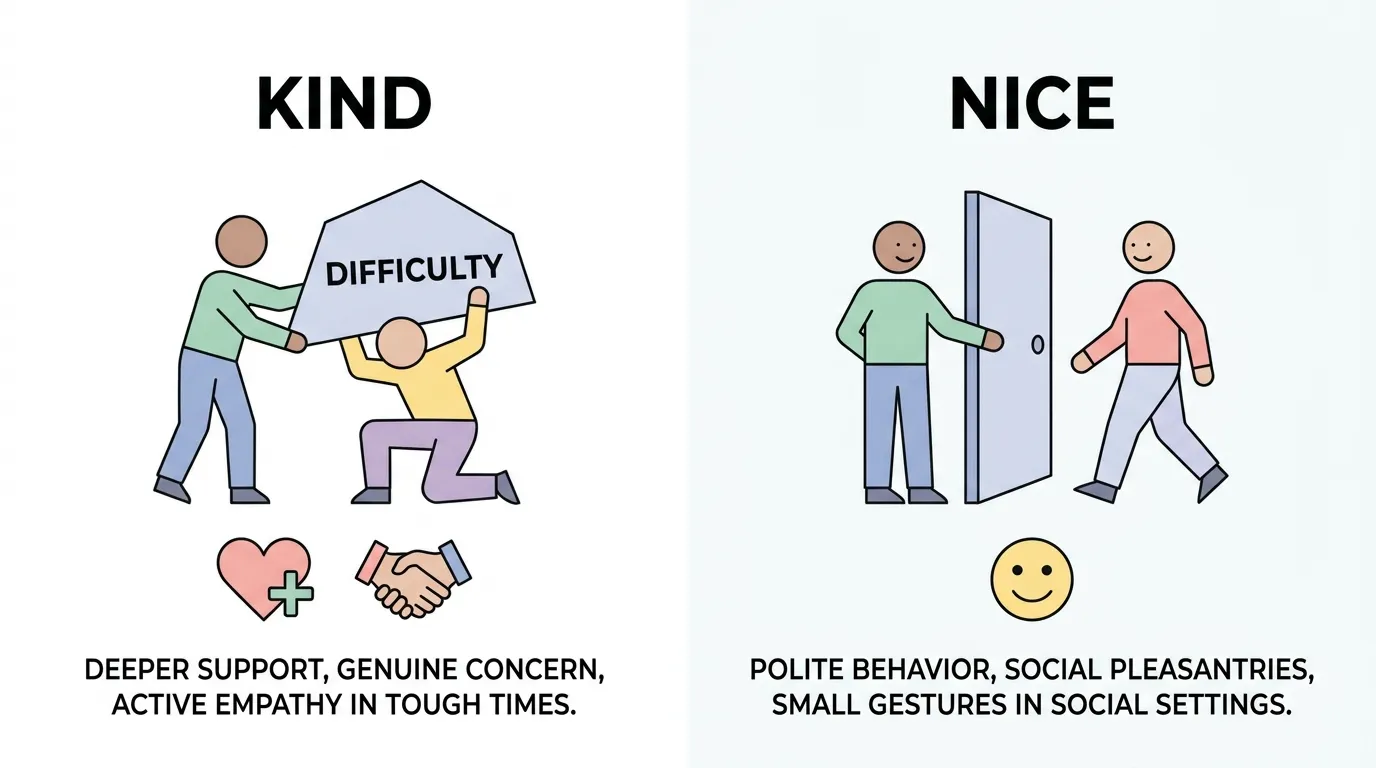
💡 Kind shows genuine care and compassion, while Nice is more about being polite or agreeable.
A child drops his books on the road. One person walks by and smiles but does nothing. Another person stops, picks up the books, and helps him.
Both people seem polite, but only one truly helps. This is where the difference between kind and nice becomes clear.
The difference between kind and nice is easy to miss. Many people think they are the same. But the difference between kind and nice is about action and intention. Nice is about being pleasant. Kind is about doing good for others.
When you understand the difference between kind and nice, you see people more clearly. The difference between kind and nice helps us build better relationships and a better society.
Key Difference Between the Both
The main difference between kind and nice is:
- Kind means caring and helpful actions
- Nice means polite and pleasant behavior
Why Is Their Difference Important for Learners and Experts?
Knowing the difference between kind and nice is important because:
- It improves communication
- It builds real relationships
- It teaches emotional intelligence
- It promotes kindness in society
This helps create a caring and respectful world.
Pronunciation
- Kind (US): ky-nd
- Kind (UK): ky-nd
- Nice (US): nys
- Nice (UK): nys
Linking Hook
Now let’s explore the difference between kind and nice in detail with simple points and clear examples.
Difference Between Kind and Nice
1. Meaning
Kind means caring and helpful. Nice means polite and friendly.
- Example 1: A kind person helps others.
- Example 2: A nice person smiles and greets.
2. Action vs Behavior
Kind shows in actions. Nice shows in behavior.
- Example 1: Kind gives support.
- Example 2: Nice speaks softly.
3. Depth
Kind is deeper. Nice is surface-level.
- Example 1: Kind helps in hard times.
- Example 2: Nice is friendly in daily talk.
4. Intention
Kind has true care. Nice may aim to please.
- Example 1: Kind acts from heart.
- Example 2: Nice avoids conflict.
5. Honesty
Kind can be honest even if hard. Nice avoids hurting feelings.
- Example 1: Kind tells truth gently.
- Example 2: Nice may hide truth.
6. Strength
Kind needs courage. Nice is easy.
- Example 1: Kind stands for right.
- Example 2: Nice goes along.
7. Impact
Kind changes lives. Nice creates comfort.
- Example 1: Kind helps in need.
- Example 2: Nice makes people feel good.
8. Duration
Kind lasts long. Nice may be short.
- Example 1: Kind builds trust.
- Example 2: Nice is momentary.
9. Sacrifice
Kind may involve sacrifice. Nice rarely does.
- Example 1: Kind gives time.
- Example 2: Nice gives compliments.
10. Social Value
Kind is highly valued. Nice is appreciated.
- Example 1: Kind people are respected.
- Example 2: Nice people are liked.
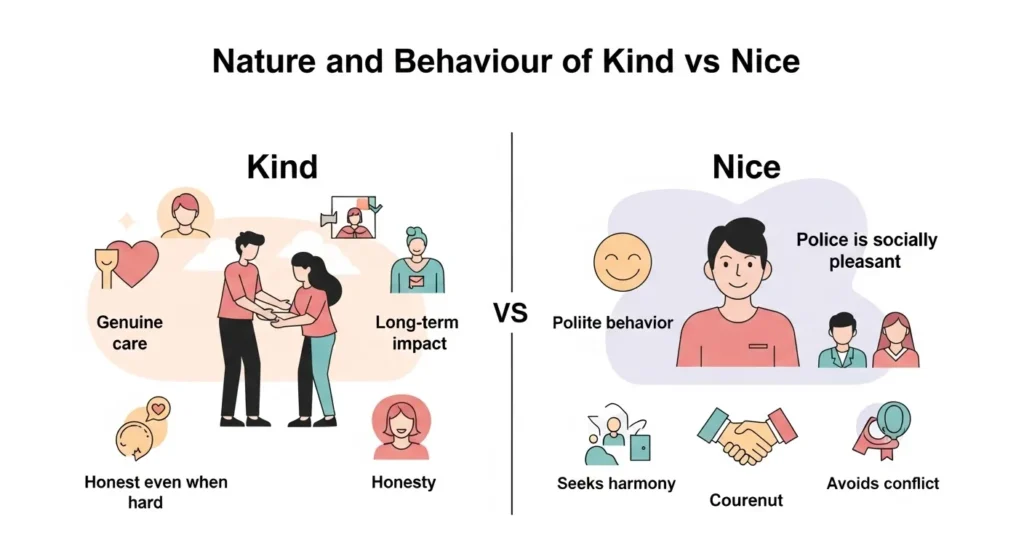
Nature and Behaviour of Kind and Nice
Kind:
It is deep and real.It comes from care and empathy, involves action and sometimes sacrifice, and builds strong bonds.
Nice:
It is light and simple. It shows politeness and good manners, avoids conflict, and makes social life smooth.
Why People Get Confused About Their Use
People get confused because:
- Both are positive traits
- Both involve good behavior
- Both are used in daily speech
This makes the difference between kind and nice hard to see.
Difference and Similarity
| Feature | Kind | Nice |
| Nature | Deep | Surface |
| Action | Yes | Less |
| Purpose | Help others | Be pleasant |
| Strength | Strong | Soft |
| Impact | Long-term | Short-term |
Which Is Better in What Situation?
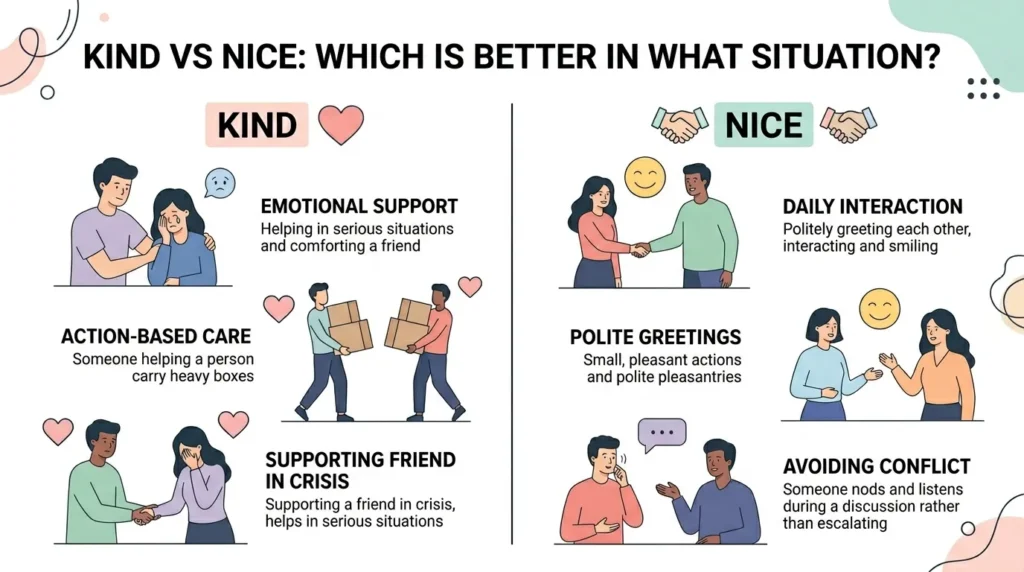
Kind is better when someone needs real help. It shows care and action. It builds trust and strong relationships. In hard times, kindness matters more than politeness. It may be difficult, but it creates lasting value.
Nice is better in social settings. It helps people feel comfortable. It keeps conversations smooth. In daily life, being nice makes interactions easy and pleasant. It is simple but important for harmony.
How Are the Keywords Used in Metaphors and Similes
- “Her heart was as kind as the sun.”
- “His smile was nice like a warm day.”
Connotative Meaning
- Kind: Positive (deep care)
- Example: “She has a kind soul.”
- Nice: Positive (pleasant)
- Example: “He is a nice person.”
Idioms or Proverbs Related
- “Kill them with kindness”
- Example: She handled anger with kindness.
- “Nice guys finish last”
- Example: He stayed nice but lost the chance.
Works in Literature
- To Kill a Mockingbird (Fiction, Harper Lee, 1960)
- Wonder (Fiction, R.J. Palacio, 2012)
Movies Related to the Topic
- Wonder (2017, USA)
- Pay It Forward (2000, USA)
FAQs
1. Are kind and nice the same?
No, kind is deeper than nice.
2. Which is better?
Kind is better for strong impact.
3. Can someone be both?
Yes, a person can be kind and nice.
4. Is nice always good?
Yes, but it may lack depth.
5. Why is kindness important?
It builds trust and helps others.
How Are Both Useful for Surroundings
Kindness helps people in need. Niceness keeps peace in society. Both improve relationships and create a positive environment.
Final Words for Both
Kind and nice are both good traits. But kindness has more depth and power. Knowing their difference helps you grow as a person.
Conclusion
The difference between kind and nice is simple but meaningful. Kindness comes from deep care and shows in actions. Niceness is about being polite and pleasant. Both are important, but they serve different roles. Kindness builds strong relationships and creates real change, while niceness keeps social life smooth. Many people confuse them, but once you understand the difference between kind and nice, you can use both wisely. This knowledge helps improve communication, relationships, and society as a whole.
Read more about!
Difference Between Warning and Watch: Simple Guide
Difference Between Octopus and Squid: Simple Guide

I am James Carter, a professional content writer from the United States. I specialize in writing simple and clear comparison blogs that help students and readers understand difficult topics easily. My writing focuses on everyday language, education, science, and lifestyle topics. I believe that learning should be easy for everyone, so I use simple words and real-life examples in my articles.