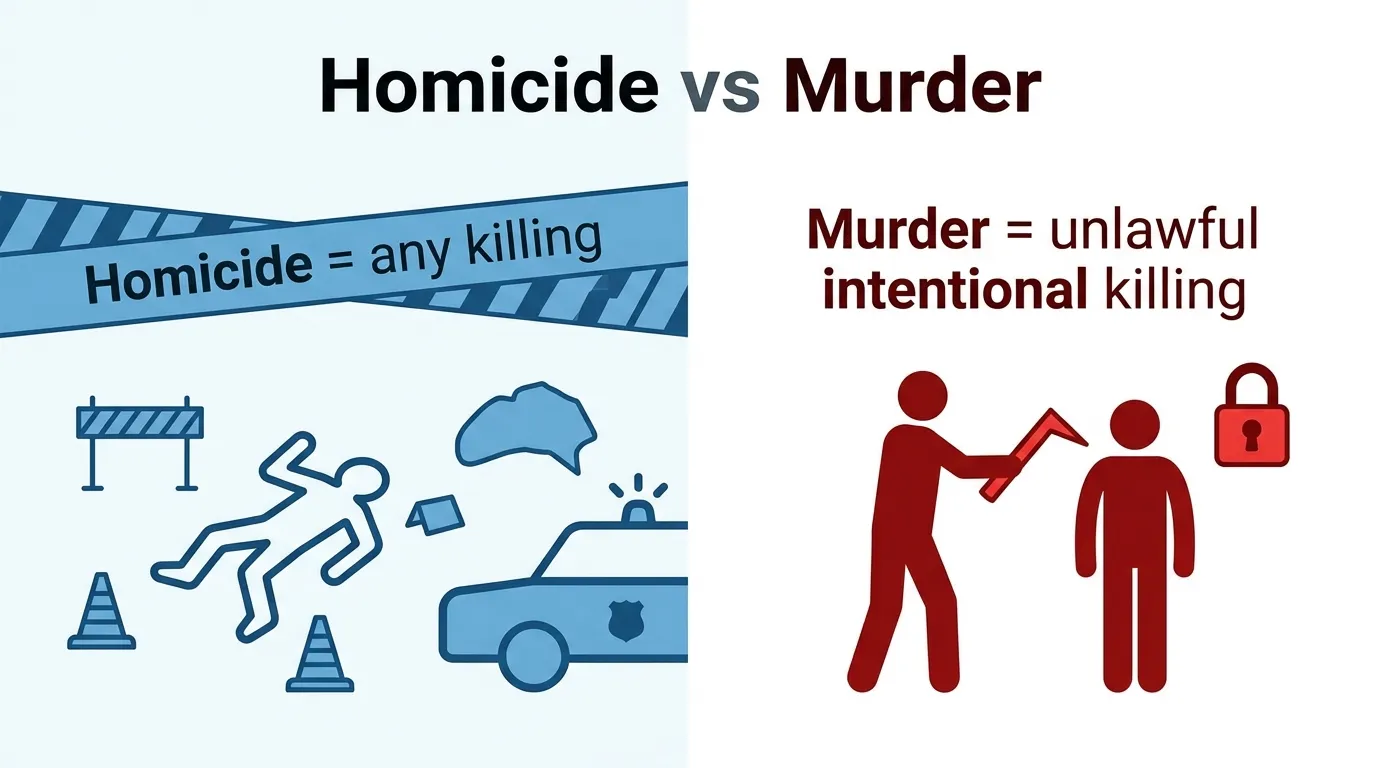
Homicide is the general term for one person killing another, while murder is a specific type of homicide that is intentional and illegal.
Many people hear the words “homicide” and “murder” in crime news, court cases, police reports, and documentaries on platforms or streaming services.
Because both terms involve the death of a person, people often think they mean exactly the same thing. But legally, they are different.
The difference between homicide and murders is that homicide is a broad legal term for one human causing the death of another human, while murder is a specific type of unlawful homicide committed intentionally or with extreme recklessness. In simple words, all murders are homicides, but not all homicides are murders.
Many users search:
- “What is homicide vs murder?”
- “Is homicide always illegal?”
- “Why do police say homicide instead of murder?”
- “Can self-defense be homicide?”
This complete guide explains the difference between homicide and murders with legal definitions, real-life examples, comparison tables, court logic, criminal justice insights, and beginner-friendly explanations. By the end, you will fully understand how these terms work in real legal systems.
Difference Between Homicide and Murders
The difference between homicide and murders is simple:
- Homicide means one person causes another person’s death.
- Murder is an intentional and unlawful killing.
Example
If a person kills someone in self-defense, it may legally be considered homicide but not murder. However, if someone intentionally plans and kills another person illegally, it becomes murder.
Definition of Difference Between Homicide and Murders
- Homicide: The killing of one human being by another human being. It can be legal or illegal depending on the situation.
- Murder: A criminal act involving intentional or unlawful killing with malice or serious criminal intent.
Quick Example
A police officer lawfully using deadly force may be involved in a homicide, but not necessarily murder.
Pronunciation
| Word | US Pronunciation | UK Pronunciation |
| Homicide | HOM-uh-side | HOM-uh-side |
| Murder | MUR-der | MUR-duh |
Now that the basic definitions are clear, let’s understand why the legal system separates homicide from murder.
Difference Between Homicide and Murders Comparison
| Feature | Homicide | Murder |
| Meaning | One human causes another’s death | Intentional unlawful killing |
| Legal Status | Can be legal or illegal | Always illegal |
| Intent Required | Not always | Usually yes |
| Includes Self-Defense | Yes | No |
| Criminal Charge | Sometimes | Always |
| Broader Category? | Yes | No |
| Court Investigation | Determines legality | Focuses on criminal guilt |
| Example | Accidental fatal incident | Planned killing |
| Severity | Depends on situation | Serious felony offense |
| Legal Outcome | Varies widely | Usually prison or severe punishment |
This table quickly explains the core difference between homicide and murders.
Key DifferencesExplained Between Homicide and Murders
1. Homicide Is a General Category
Homicide includes every case where one person causes another person’s death.
Example
- accidental killing
- self-defense
- manslaughter
- murder
All may legally fall under homicide categories.
2. Murder Is Always Illegal
Murder specifically refers to unlawful killing with criminal intent.
Real-Life Example
A planned revenge killing is murder.
3. Not Every Homicide Leads to Criminal Charges
Some homicides are legally justified.
Example
Self-defense cases may not result in murder charges if the court finds the action lawful.
4. Intent Matters Greatly in Murder Cases
Intent is one of the biggest differences.
Example
Accidentally causing death in a car crash differs legally from intentionally attacking someone.
5. Murder Usually Carries Severe Punishment
Murder often leads to:
- long prison sentences
- life imprisonment
- in some countries, capital punishment
6. Homicide Includes Manslaughter
Manslaughter is another type of homicide but usually lacks premeditated intent.
7. Police Often Use “Homicide” Early in Investigations
Many users get confused when police say “homicide investigation.”
That does not automatically mean murder happened. Investigators first determine:
- intent
- legality
- evidence
- circumstances
What Is Homicide and Why Does the Legal System Use It?
Homicide is a broad legal classification used in criminal justice systems worldwide.
It simply means:
One human caused another human’s death.
The word itself does not automatically mean a crime occurred.
Why This Legal Category Exists
The law separates homicide into different categories because not all deaths happen under the same circumstances.
Examples of Homicide Categories
| Type | Legal Status |
| Justifiable homicide | Legal |
| Criminal homicide | Illegal |
| Negligent homicide | Illegal |
| Manslaughter | Illegal |
| Murder | Illegal |
This structure helps courts evaluate:
- intent
- negligence
- self-defense
- recklessness
- accident vs intention
What Is Murder and How Does It Work Legally?
Murder is one of the most serious criminal offenses.
In most legal systems, murder involves:
- unlawful killing
- criminal intent
- malice
- extreme recklessness
Common Types of Murder
First-Degree Murder
Usually planned and premeditated.
Second-Degree Murder
Intentional but not carefully planned.
Felony Murder
Death occurring during another serious crime.
Different countries define these categories differently, but the core idea remains similar.
Difference Between Homicide and Murders in Court Cases
In real legal proceedings, homicide is the starting category.
Then courts determine:
- Was it justified?
- Was it accidental?
- Was there intent?
- Was there negligence?
Example Scenario
Situation A
A homeowner uses force during a violent break-in.
Possible result:
- justified homicide
Situation B
A person plans and intentionally kills someone.
Possible result:
- murder conviction
This difference is extremely important in criminal law.
Why Police and Media Use the Word Homicide
News channels and police departments often use “homicide” during early investigations because facts may still be unclear.
Media organizations frequently use neutral legal language before charges are finalized.
Why This Matters
Calling a case “murder” too early may:
- affect investigations
- influence juries
- create legal problems
- damage fairness
So investigators first label suspicious deaths as homicides until evidence becomes clear.
Difference Between Homicide and Murders in Self-Defense Cases
This is one of the biggest areas of confusion online.
Self-Defense Can Be Homicide
If someone kills another person while protecting themselves, it is technically homicide because a death occurred.
However, it may not legally qualify as murder.
Real-World Example
If a person reasonably fears deadly harm and acts lawfully, courts may classify the case as justified homicide.
Difference + Similarity: Generation for Homicide and Murders
| Feature | Homicide | Murder | Similarity |
| Core Meaning | Human causes another’s death | Illegal intentional killing | Both involve human death |
| Legal Status | May be legal or illegal | Always criminal | Both investigated by law |
| Intent Requirement | Not always required | Usually required | Intent matters in both cases |
| Includes Accidents | Sometimes | Rarely | Courts examine circumstances |
| Self-Defense Included | Yes | No | Both may involve violence |
| Criminal Penalties | Depends on type | Severe punishment | Both can involve court trials |
| Police Investigation | Initial classification | Specific criminal charge | Both require evidence |
| Use in Media | Broad reporting term | Specific accusation | Both appear in crime reporting |
This table clearly shows the difference and similarity between homicide and murders for quick understanding.
Common Mistakes With Homicide and Murders
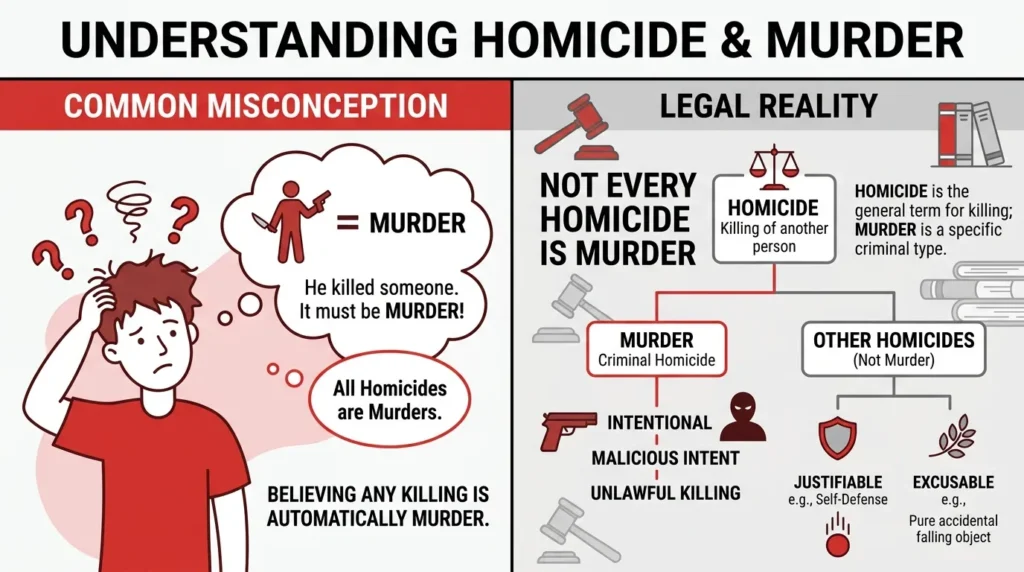
1. Thinking All Homicides Are Murder
This is the most common misunderstanding.
Fix
Remember:
- murder is one type of homicide
2. Assuming Homicide Automatically Means Criminal
Some homicides are legally justified.
Fix
Courts examine the circumstances carefully.
3. Confusing Manslaughter With Murder
Manslaughter usually lacks premeditated intent.
Fix
Intent is a key legal difference.
4. Believing Media Headlines Always Use Legal Terms Correctly
News reports sometimes simplify legal language.
Fix
Official court charges matter more than headlines.
5. Ignoring State or Country Law Differences
Legal definitions vary worldwide.
Fix
Always check local criminal law systems.
Real Life Examples With Homicide and Murders
1. Self-Defense Incident
A homeowner legally protects family members during an armed attack.
Possible classification:
- justifiable homicide
2. Planned Revenge Attack
Someone carefully plans and carries out an intentional killing.
Possible classification:
- first-degree murder
3. Drunk Driving Fatality
A reckless driver causes a deadly accident.
Possible classification:
- negligent homicide or manslaughter
4. Police Use-of-Force Investigation
Officers may face homicide investigations after deadly force incidents.
Courts later decide legality.
5. Workplace Negligence Death
Unsafe company practices causing death may result in criminal homicide charges in some regions.
When To Use Each
| Situation | Use Homicide | Use Murder |
| Legal investigation | Yes | Sometimes |
| Confirmed intentional killing | Rarely | Yes |
| Neutral police reporting | Yes | No |
| Self-defense cases | Yes | No |
| Criminal conviction discussion | Sometimes | Yes |
Why People Get Confused in Homicide and Murders
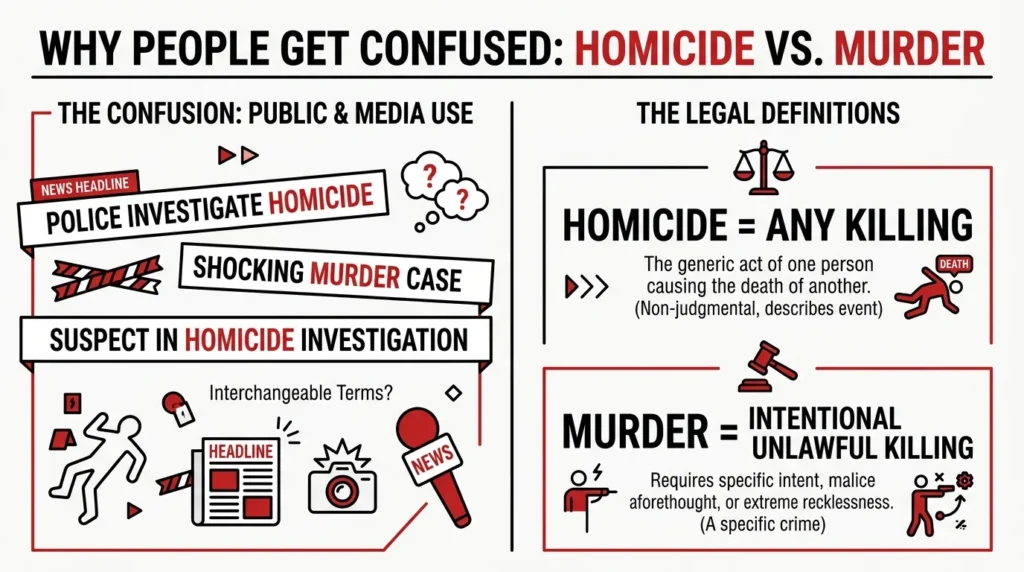
Many users get confused because TV shows, movies, podcasts, and social media often use the terms interchangeably.
Crime documentaries and discussions sometimes simplify legal language for entertainment.
Other reasons include:
- emotional headlines
- legal complexity
- regional law differences
- misunderstanding of criminal categories
In simple words:
- homicide describes the act of causing death
- murder describes a specific criminal type of homicide
How Search Engines Understand Difference Between Homicide and Murders and User Intent
Search engines analyze search intent carefully.
When users search:
- “difference between homicide and murders”
- “is homicide murder?”
- “what is homicide vs murder?”
Google understands users usually want:
- Clear legal definitions
- Beginner-friendly explanations
- Real-world examples
- Court system logic
- Crime terminology clarification
Modern search algorithms prioritize:
- factual clarity
- semantic understanding
- EEAT trust signals
- structured educational content
- readable explanations
That is why detailed legal guides perform better than short dictionary-style answers.
Expert Insight
In practical legal systems, homicide is treated as a broad investigative category rather than an automatic accusation. Most beginners misunderstand this because movies and headlines often use dramatic wording instead of precise legal terminology.
Criminal law professionals carefully separate:
- intentional killing
- negligence
- recklessness
- justified force
- accidental death
This distinction protects fairness in the justice system. In real court practice, proving murder requires stronger evidence regarding intent, planning, or unlawful behavior than proving a homicide occurred.
Understanding these differences helps people interpret crime reports more accurately and avoid misinformation online.
FAQs
What is the main difference between homicide and murders?
Homicide means one person caused another’s death. Murder is intentional unlawful killing.
Is every homicide illegal?
No. Some homicides are legally justified, such as self-defense.
Is murder always homicide?
Yes. Murder is a type of homicide.
Can homicide be accidental?
Yes. Some accidental deaths fall under homicide categories.
Why do police say homicide instead of murder?
Because investigators may not yet know intent or legality.
What is justifiable homicide?
A lawful killing, often involving self-defense or legal authority.
Is manslaughter the same as murder?
No. Manslaughter usually involves less intent or recklessness.
Can someone be investigated for homicide without being charged?
Yes. Investigations happen before courts decide criminal responsibility.
Do all countries define murder the same way?
No. Criminal laws vary between countries and legal systems.
Why is intent important in murder cases?
Because criminal intent helps determine the seriousness of the offense.
Conclusion
Understanding the difference between homicide and murders is important because these legal terms are often misunderstood in news reports, crime documentaries, and public discussions. While both involve the death of a person, they are not legally identical.
Homicide is the broad legal category for one human causing another human’s death. Murder is a specific type of unlawful homicide involving criminal intent, malice, or extreme recklessness. In simple terms:
- all murders are homicides
- not all homicides are murders
This distinction matters greatly in criminal justice systems because courts must evaluate intent, self-defense, negligence, recklessness, and legality before deciding criminal responsibility.
In real scenarios, the difference affects:
- investigations
- court outcomes
- prison sentences
- public understanding
- media reporting
The key takeaway is simple:
Homicide describes the act of causing death. Murder describes a criminal form of homicide.
Read more about!
Difference Between Sonogram and Ultrasound: Simple Guide
Difference Between Centerfire and Rimfire: Complete Guide

I am Emily Johnson, a USA-based content writer who creates easy-to-read blogs on language and daily life topics. I explain complex ideas in simple English for students and beginners so they can understand easily.