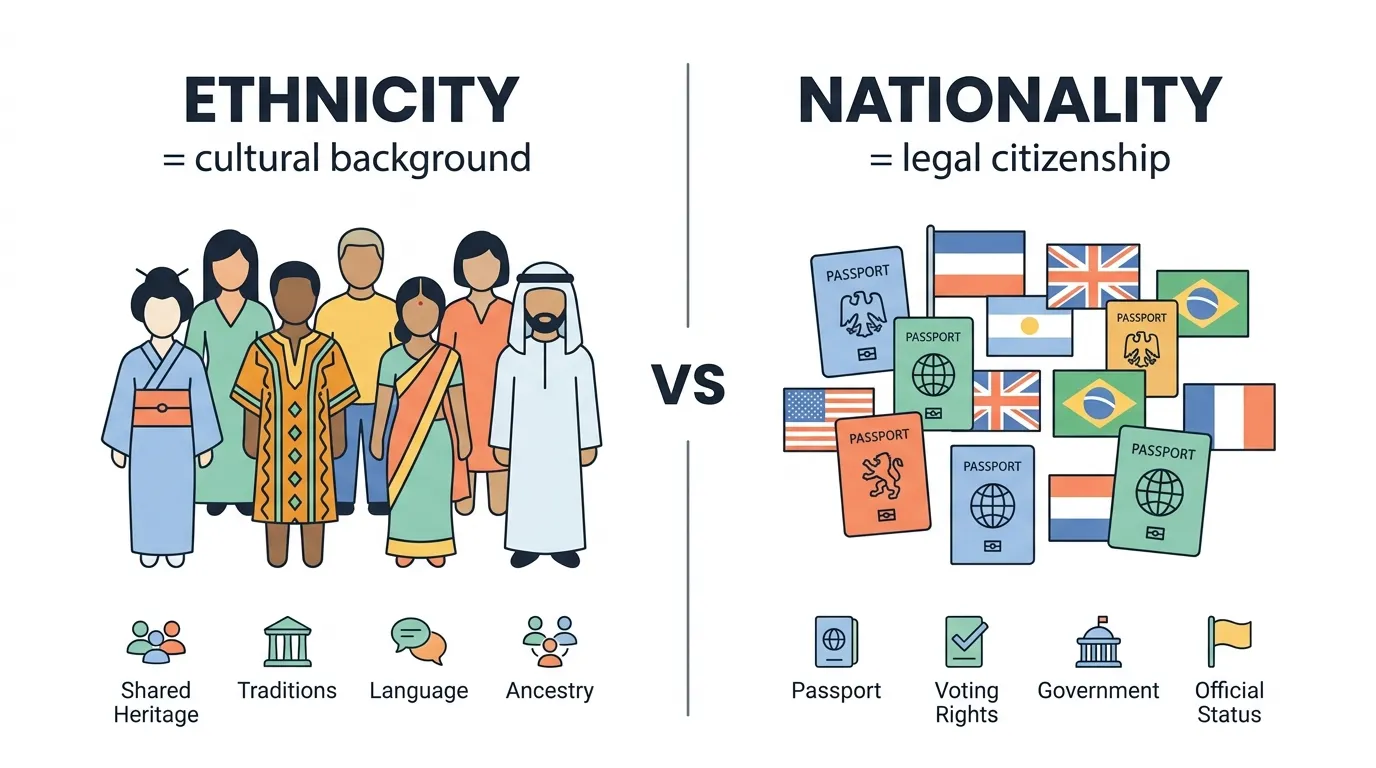
Ethnicity refers to a person’s cultural identity and heritage, while nationality refers to the country they are legally a citizen of.
People often use the words “ethnicity” and “nationality” as if they mean the same thing. But they are actually different. Understanding the difference between ethnicity and nationality is important in education, travel, immigration, government forms, and even social media discussions.
Many users search this topic because they see these terms on passports, job applications, census forms, or platforms.
In simple words, ethnicity is connected to cultural background, traditions, language, and ancestry, while nationality is connected to legal citizenship and the country a person belongs to.
For example, someone can have Pakistani nationality but Punjabi ethnicity. Another person may have Canadian nationality and Chinese ethnicity.
This guide explains the difference between ethnicity and nationality clearly with definitions, comparison tables, real-life examples, expert insights, FAQs, and modern social context. By the end, you will fully understand how both concepts work in real life and why people often confuse them.
Difference Between Ethnicity and Nationality
The difference between ethnicity and nationality is that ethnicity refers to a person’s cultural or ancestral identity, while nationality refers to legal citizenship or the country someone belongs to.
Example
- A person may have British nationality
- But their ethnicity could be Indian, Arab, African, or Pakistani
Nationality is about a nation-state. Ethnicity is about cultural roots and heritage.
Definition of Difference Between Ethnicity and Nationality
- Ethnicity: A cultural identity based on ancestry, language, traditions, religion, or shared heritage.
- Nationality: A legal identity showing which country a person officially belongs to as a citizen.
Quick Example
A person born in Canada may have Canadian nationality but Punjabi ethnicity.
Pronunciation
| Word | US Pronunciation | UK Pronunciation |
| Ethnicity | eth-NISS-uh-tee | eth-NISS-ih-tee |
| Nationality | nash-uh-NAL-uh-tee | nash-uh-NAL-ih-tee |
Now that the definitions are clear, let’s understand the deeper meaning behind ethnicity and nationality in modern society.
Difference Between Ethnicity and Nationality Comparison
| Feature | Ethnicity | Nationality |
| Meaning | Cultural or ancestral identity | Legal citizenship identity |
| Based On | Heritage, language, traditions | Country membership |
| Changes Easily? | Usually stable over generations | Can change through citizenship |
| Connected To | Culture and ancestry | Government and legal status |
| Examples | Punjabi, Arab, Kurdish | Pakistani, American, French |
| Legal Importance | Limited legal role | Important for passports and laws |
| Inheritance | Often inherited from family | Usually gained by birth or naturalization |
| Multiple Identities | Possible | Also possible in dual citizenship |
| Social Role | Shapes traditions and culture | Shapes legal rights |
| Main Focus | Cultural belonging | National belonging |
This comparison gives a quick understanding of the core difference between ethnicity and nationality.
Key Differences Explained Between Ethnicity and Nationality
1. Ethnicity Is Cultural, Nationality Is Legal
Ethnicity is linked to shared customs, language, food, traditions, and ancestry. Nationality is tied to citizenship and laws.
Real-Life Example
A person may legally belong to Germany but culturally identify as Turkish.
2. Nationality Can Change More Easily
Nationality can change through immigration or naturalization. Ethnicity usually remains connected to family roots.
Example
Someone born in India may later gain Australian nationality.
3. Ethnicity Often Connects Families Across Borders
One ethnic group may exist in several countries.
Example
Kurdish people live across Turkey, Iraq, Syria, and Iran.
4. Nationality Is Used in Official Documents
Passports, visas, and government forms ask for nationality because it affects legal rights.
Example
Airports check nationality during international travel.
5. Ethnicity Influences Traditions and Lifestyle
Food, language, clothing, music, and celebrations are often shaped by ethnicity.
Example
Punjabi weddings and Arab weddings may follow very different cultural traditions.
6. A Person Can Have One Nationality but Multiple Ethnic Influences
Modern societies are multicultural.
Example
Someone in United States may identify as African American, Latino, or Asian American.
7. Nationality Is Usually Recognized by Governments
Governments issue citizenship and passports. Ethnicity is more socially and culturally recognized.
What Is Ethnicity and Why Does It Matter?
Ethnicity represents a shared cultural identity. It may include:
- language
- traditions
- ancestry
- religion
- historical roots
- social customs
Many users ask:
- “What is ethnicity?”
- “Is ethnicity the same as race?”
- “Can you have multiple ethnicities?”
The answer is yes many people identify with more than one ethnicity, especially in multicultural families.
Why Ethnicity Exists
Ethnicity helps communities preserve:
- history
- traditions
- identity
- language
- social belonging
In real scenarios, ethnicity influences:
- family traditions
- cuisine
- cultural celebrations
- community identity
What Is Nationality and How Does It Work?
Nationality refers to a person’s official membership in a country.
It is usually determined by:
- place of birth
- citizenship
- naturalization
- legal status
Common Examples
| Person | Nationality |
| Citizen of Pakistan | Pakistani |
| Citizen of Japan | Japanese |
| Citizen of Brazil | Brazilian |
Governments use nationality for:
- passports
- visas
- voting rights
- taxes
- legal protection
Difference Between Ethnicity and Nationality in Daily Life
Many people only think about ethnicity and nationality when filling out forms or traveling internationally. But these concepts affect daily life more than most realize.
In Schools
Students may learn about ethnic diversity and national identity separately.
In Sports
Athletes may represent one nationality but belong to different ethnic backgrounds.
Example
International football teams often include multicultural players.
In Social Media
Platforms frequently discuss cultural identity, migration, and nationality trends.
Is Ethnicity the Same as Race?
No. This is another major confusion.
Ethnicity
Focuses on:
- culture
- traditions
- ancestry
- language
Race
Usually relates to physical characteristics and social classification.
Example
Two people may share the same race but have different ethnicities.
Difference Between Ethnicity and Nationality in Immigration
Immigration systems mostly focus on nationality because it affects legal status.
Why Nationality Matters
Governments use nationality to determine:
- visa requirements
- residency rights
- border control
- citizenship eligibility
Ethnicity may sometimes matter in cultural or humanitarian contexts but is not usually the main legal factor.
Difference and Similarity: Generation For Ethnicity and Nationality
| Feature | Ethnicity | Nationality | Similarity |
| Core Meaning | Cultural identity | Legal citizenship | Both describe identity |
| Based On | Heritage and ancestry | Nation-state membership | Both connect people to groups |
| Government Role | Mostly social/cultural | Official legal recognition | Both appear in records sometimes |
| Language Connection | Often linked to native language | May or may not affect language | Both influence communication |
| Can Change? | Rarely changes fully | Can change legally | Both may evolve over time |
| Examples | Punjabi, Arab, Hispanic | Pakistani, Canadian, Italian | Both shape personal identity |
| Main Use | Cultural belonging | Legal rights and travel | Both affect social interaction |
| Family Influence | Strongly inherited | Sometimes inherited | Both can connect generations |
This table clearly shows the difference and similarity between ethnicity and nationality for quick understanding.
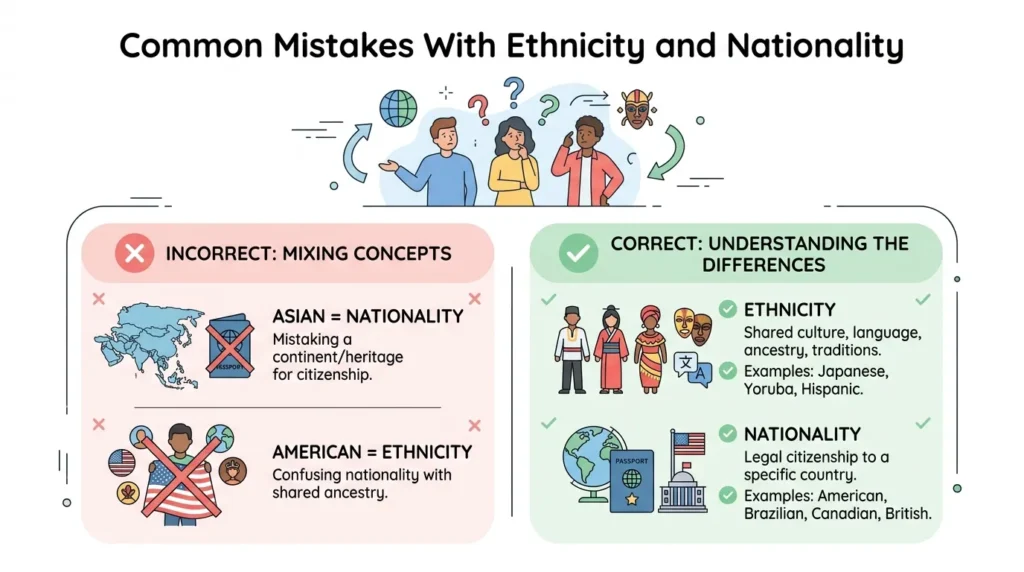
Common Mistakes With Ethnicity and Nationality
1. Thinking They Mean the Same Thing
Many beginners use both words interchangeably.
Fix
Remember:
- Ethnicity = culture
- Nationality = citizenship
2. Confusing Race With Ethnicity
Race and ethnicity are not identical concepts.
Fix
Ethnicity focuses more on cultural identity.
3. Assuming Nationality Never Changes
Nationality can change through citizenship processes.
Fix
People can legally become citizens of another country.
4. Believing One Country Has Only One Ethnicity
Most countries contain multiple ethnic groups.
Example
Pakistan includes Punjabi, Sindhi, Pashtun, Baloch, and many other ethnic groups.
5. Assuming Language Always Defines Nationality
A person may speak one language but hold another nationality.
Example
Millions speak English outside the UK or US.
Real Life Examples With Ethnicity and Nationality
1. Pakistani Nationality, Punjabi Ethnicity
A person may legally belong to Pakistan while culturally identifying as Punjabi.
2. American Nationality, Chinese Ethnicity
Many families in the US maintain Chinese cultural traditions while holding American citizenship.
3. British Nationality, Indian Ethnicity
Large multicultural communities exist in United Kingdom.
4. Refugees and Immigration Cases
Nationality determines legal migration status, while ethnicity may shape community support systems.
5. International Businesses
Global companies manage multicultural workforces where employees may share nationality but differ ethnically.
WHEN TO USE EACH
| Situation | Use Ethnicity | Use Nationality |
| Discussing culture | Yes | No |
| Filling passport forms | No | Yes |
| Talking about traditions | Yes | Rarely |
| Immigration documents | Rarely | Yes |
| Cultural studies | Yes | Sometimes |
| Citizenship discussions | No | Yes |
Why People Get Confused in Ethnicity and Nationality
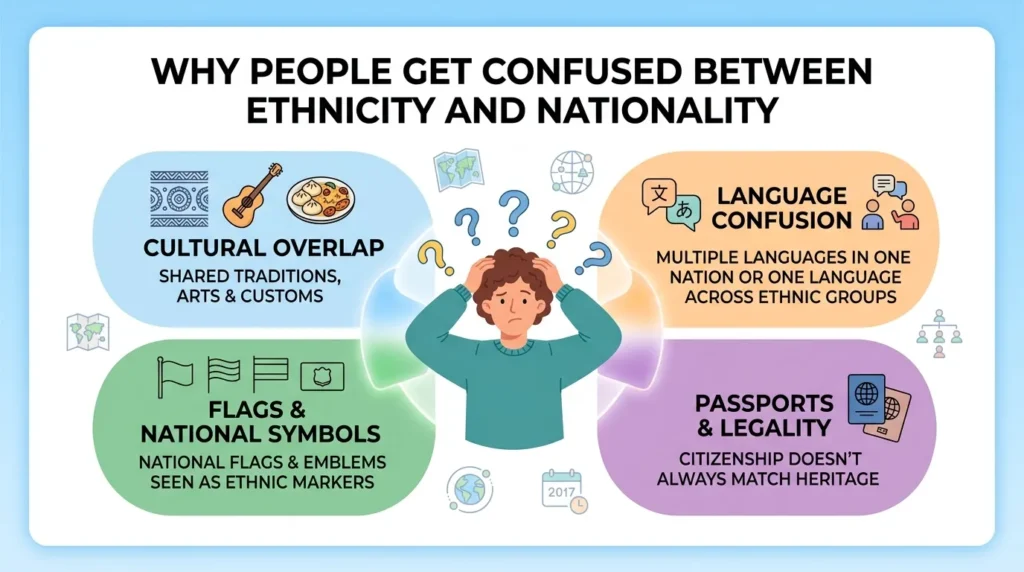
Many users get confused because:
- both describe identity
- media uses them loosely
- social discussions mix terms
- school education sometimes oversimplifies them
Another reason is globalization. Modern societies are highly multicultural, so people may have:
- one nationality
- several ethnic influences
- multiple languages
- dual citizenship
Social media discussions also contribute to confusion because users often debate race, ethnicity, and nationality together.
How Search Engines Understand Difference Between Ethnicity and Nationality and User Intent
Search engines analyze user intent carefully.
When someone searches:
- “difference between ethnicity and nationality”
- “ethnicity vs nationality”
- “what is nationality and ethnicity”
Google understands users usually want:
- Simple definitions
- Clear comparison
- Real-life examples
- Immigration context
- Cultural understanding
Modern systems prioritize:
- topical depth
- semantic relevance
- entity relationships
- helpful explanations
- EEAT trust signals
That is why detailed educational guides rank better than shallow definitions today.
EXPERT INSIGHT
In practical use, ethnicity and nationality often overlap emotionally but remain different legally and culturally. Most confusion happens because people naturally connect identity with citizenship.
In multicultural societies, nationality may unify citizens legally, while ethnicity preserves family heritage and cultural history. This balance is especially important in modern workplaces, schools, immigration systems, and global online communities.
Professionals in sociology, migration studies, education, and international law usually separate these terms carefully because misunderstanding them can create communication problems or cultural sensitivity issues.
In real scenarios, respectful communication starts with understanding how people identify themselves culturally and nationally.
FAQs
What is the main difference between ethnicity and nationality?
Ethnicity relates to cultural heritage, while nationality relates to legal citizenship.
Can a person have multiple ethnicities?
Yes. Many people come from multicultural families.
Can nationality change?
Yes. People can gain new citizenship through immigration or naturalization.
Is ethnicity inherited?
Usually yes, because it connects to ancestry and family heritage.
Is nationality the same as citizenship?
In most cases, yes. Nationality often means official citizenship.
Can two people share nationality but have different ethnicities?
Yes. This is very common in multicultural countries.
Why do forms ask about ethnicity and nationality separately?
Because they measure different types of identity.
Is religion part of ethnicity?
Sometimes religion connects strongly with ethnic identity, but they are not always the same.
What is an example of ethnicity and nationality?
Someone may have Canadian nationality and Arab ethnicity.
Why is understanding ethnicity and nationality important?
It improves cultural awareness, communication, and global understanding.
Conclusion
Understanding the difference between ethnicity and nationality is important because both terms describe identity in different ways. Ethnicity connects people through culture, ancestry, language, traditions, and shared heritage. Nationality connects people through legal citizenship and membership in a country.
In simple words:
- Ethnicity explains cultural roots.
- Nationality explains legal belonging.
Modern societies are more global and multicultural than ever before. A person may hold one nationality while identifying with several ethnic traditions. This is common in countries with diverse populations and immigration histories.
If you are filling out forms, studying sociology, traveling internationally, discussing identity online, or simply trying to understand cultural differences better, knowing these terms helps avoid confusion and improves respectful communication.
The key takeaway is simple:
Nationality is about the country you legally belong to. Ethnicity is about the culture and heritage you identify with.
Read more about!
Difference Between Mixtape and Album: Full Guide
Difference Between Flautas and Taquitos: Complete Guide

I am James Carter, a professional content writer from the United States. I specialize in writing simple and clear comparison blogs that help students and readers understand difficult topics easily. My writing focuses on everyday language, education, science, and lifestyle topics. I believe that learning should be easy for everyone, so I use simple words and real-life examples in my articles.