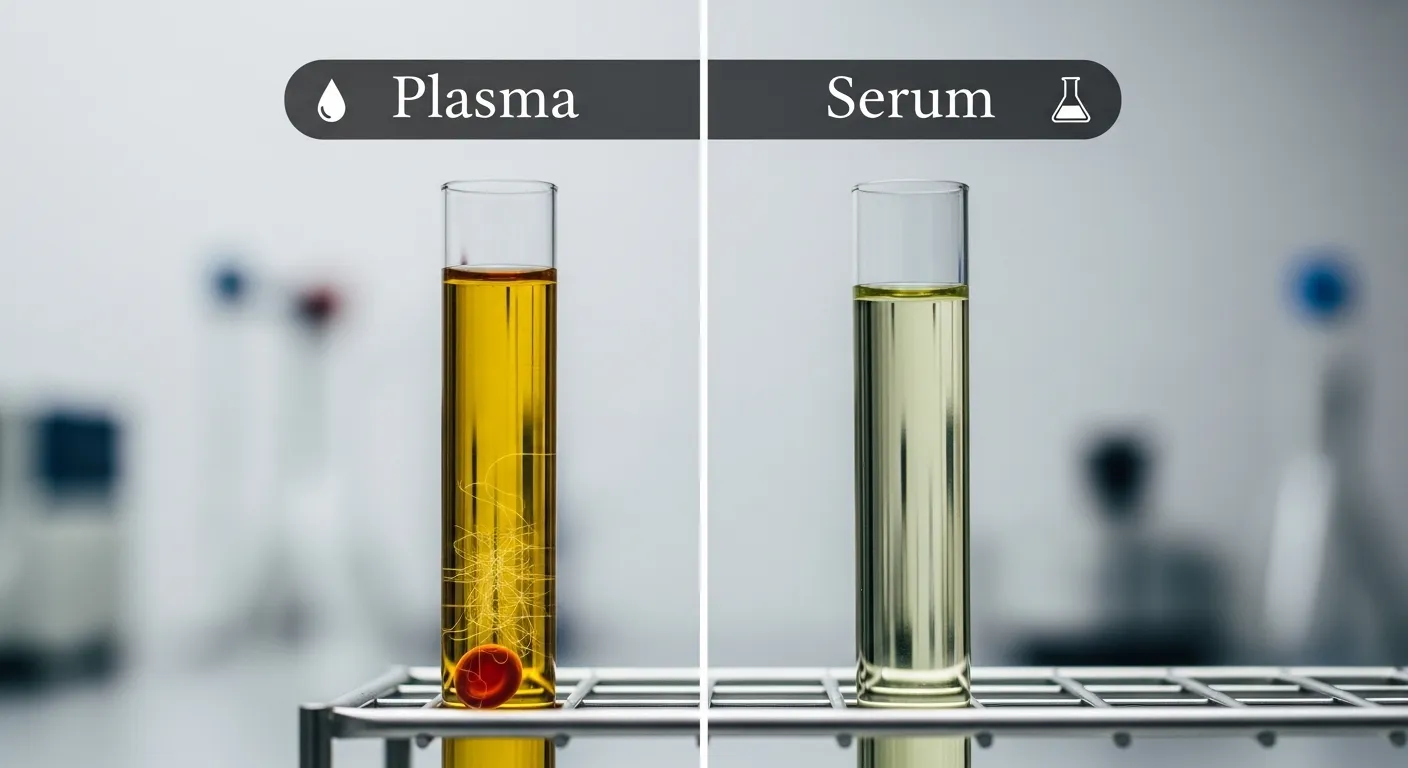
🩸 Plasma has clotting factors; serum is plasma without them ⚗️
A nurse takes a blood sample from a patient in a lab. The doctor later asks, “Send the plasma report.” Meanwhile, another staff member says, “The serum test is ready.”
The patient feels confused. Is plasma the same as serum? Or are they different? This is where the difference between plasma and serum becomes important.
The difference between plasma and serum is a key topic in medical science. Both come from blood; however, they are not the same.
The difference between plasma and serum depends on clotting and the way blood is handled. Many people do not know this small but important fact; however, it is very important in medical science.
When you understand the difference between plasma and serum, as a result, you can better understand lab tests and health reports.
The difference between plasma and serum helps students, doctors, and patients make sense of medical results in a simple way.
Key Difference Between the Both
The main difference between plasma and serum is:
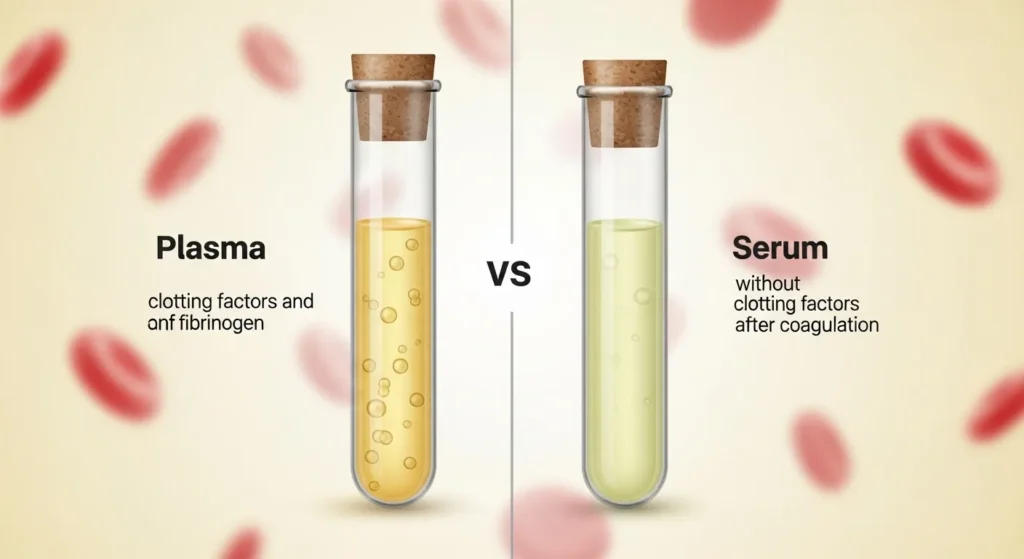
- Plasma contains clotting factors
- Serum does not contain clotting factors
Why Is Their Difference Important for Learners and Experts?
Knowing the difference between plasma and serum is important because; therefore, it helps in accurate medical diagnosis and treatment decisions:
- Doctors use them for different tests
- Students learn lab science clearly
- Hospitals avoid test errors
- Patients get correct diagnosis
This knowledge helps improve health care and saves lives in society.
Pronunciation
- Plasma (US): प्लाज़-muh / plaz-muh
- Plasma (UK): प्लाज़-muh
- Serum (US): seer-um
- Serum (UK): seer-um
Linking Hook
Now, let’s move forward and explore the difference between plasma and serum in detail with easy points and simple examples.
Difference Between Plasma and Serum
1. Definition
Plasma is the liquid part of blood with clotting proteins. Serum is the liquid left after clotting.
- Example 1: Plasma contains fibrinogen.
- Example 2: Serum does not have fibrinogen.
2. Clotting Factors
Plasma has clotting factors. Serum lacks them.
- Example 1: Plasma helps blood clot.
- Example 2: Serum cannot clot.
3. Preparation
Plasma is made by adding anticoagulants. Serum is made after blood clots.
- Example 1: Lab adds EDTA for plasma.
- Example 2: Blood rests to form serum.
4. Composition
Plasma has proteins, salts, and clotting agents. Serum has proteins; however, it does not contain clotting agents.
- Example 1: Plasma carries fibrin.
- Example 2: Serum carries antibodies.
5. Color
Both look yellow; however, plasma is slightly cloudy. Serum is clearer.
- Example 1: Plasma looks pale yellow.
- Example 2: Serum looks light and clear.
6. Usage
Plasma is used in transfusion. Serum is used in testing.
- Example 1: Plasma saves patients in shock.
- Example 2: Serum helps detect disease.
7. Source
Both come from blood; however, they are processed differently.
- Example 1: Plasma from treated blood.
- Example 2: Serum from clotted blood.
8. Storage
Plasma is frozen quickly. Serum can be stored more easily.
- Example 1: Plasma stored at low temp.
- Example 2: Serum stored in labs.
9. Medical Tests
Serum is common in lab tests. Plasma is used for special tests.
- Example 1: Serum used in hormone tests.
- Example 2: Plasma used in clot tests.
10. Role in Body
Plasma supports circulation. Serum reflects chemical balance.
- Example 1: Plasma moves nutrients.
- Example 2: Serum shows body condition.
Nature and Behaviour of Plasma and Serum
Plasma:
It is active and functional.It helps in blood clotting, carries nutrients and proteins, and plays a key role in circulation.
Serum:
It is stable and calm. It forms after clotting, is used for testing and analysis, and helps indicate the body’s condition.
Why People Get Confused About Their Use
People often mix plasma and serum because; therefore, they appear very similar in structure.:
- Both come from blood
- Both look similar
- Both are used in labs
This makes the difference between plasma and serum hard to see at first; however, with careful study, it becomes clear.
Difference and Similarity
| Feature | Plasma | Serum |
| Clotting Factors | Present | Absent |
| Formation | With anticoagulant | After clotting |
| Use | Transfusion | Testing |
| Texture | Slightly cloudy | Clear |
| Function | Active role | Diagnostic role |
Which Is Better in What Situation?
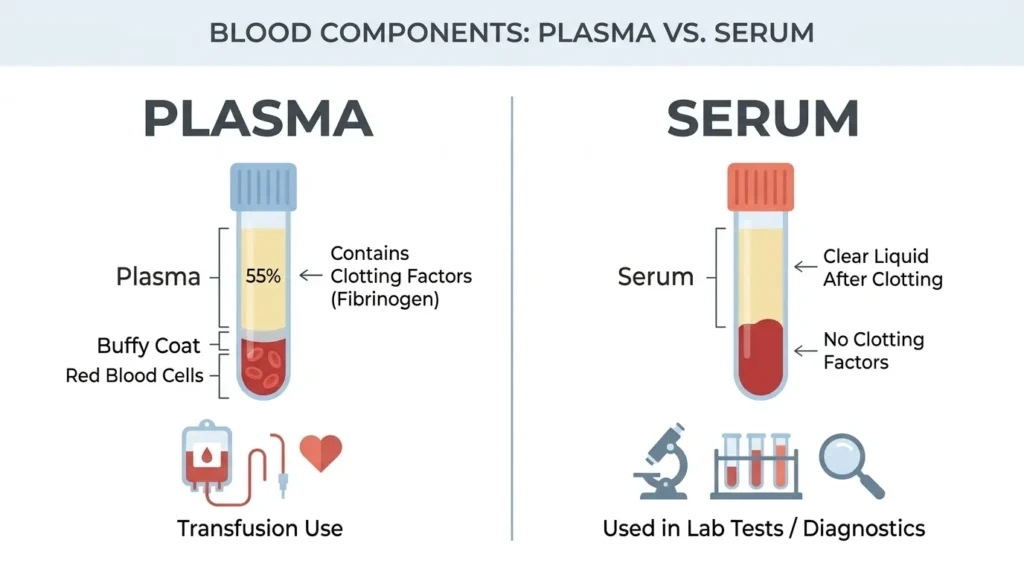
Doctors use plasma when they need to replace blood volume or help clotting; therefore, they widely use it in emergency treatments. It is useful in emergencies like burns or trauma. Plasma helps carry nutrients and proteins in the body. It is very important in saving lives during serious conditions; therefore, it plays a crucial role in emergency medical care.
Serum is better for lab testing and diagnosis.Laboratories obtain clear results because it has no clotting factors; therefore, they prefer it for accurate testing. Doctors use it to check hormones, infections, and chemicals. It is simple to handle and widely used in medical labs.
How Are the Keywords Used in Metaphors and Similes
- “His energy flowed like plasma in the body.”
- “Her calm nature was like serum clear and stable.”
Connotative Meaning
- Plasma: Positive (life, movement)
- Example: “The team worked like plasma, full of energy.”
- Serum: Neutral to positive (clarity, balance)
- Example: “Her thoughts were like serum, clear and pure.”
Idioms or Proverbs Related
No direct idioms; however, similar ideas are used:
- “Lifeblood”
- Example: Plasma is the lifeblood of the body.
- “Clear as day”
- Example: Serum results are clear as day.
Works in Literature
- The Blood Doctor (Medical Fiction, Barbara Vine, 2002)
- The Immortal Life of Henrietta Lacks (Non-fiction, Rebecca Skloot, 2010)
Movies Related to the Topic
- Outbreak (1995, USA)
- Contagion (2011, USA)
FAQs
1. Are plasma and serum the same?
No, plasma has clotting factors, serum does not.
2. Laboratories use which one in lab tests?
Laboratories mostly use serum; therefore, they commonly prefer it for testing.
3. Can plasma clot?
Yes, because it has clotting proteins, it can form clots.
4. Why is serum clearer?
Because laboratories remove clotting proteins, serum does not contain clotting factors.
5. Which is used in transfusion?
Doctors use plasma in transfusion.
How Are Both Useful for Surroundings
Both help doctors treat and diagnose patients; therefore, they are very important in medical practice. Plasma saves lives in emergencies. Serum helps find diseases early. Together, they improve health care and support society.
Final Words for Both
Plasma and serum are small parts of blood; however, they are very important. Knowing their difference makes medical science easy and clear.
Conclusion
The difference between plasma and serum is simple but very important. In contrast, plasma contains clotting factors, whereas serum does not.
Both come from blood but serve different roles in medicine. Doctors use plasma in treatment and emergencies, while they use serum in testing and diagnosis.
Their similar appearance confuses many people; however, their functions are not the same.
By understanding the difference between plasma and serum, students, doctors, and patients can better understand health reports and medical care. This knowledge helps improve communication and saves lives.
Read more about!
Difference Between Warning and Watch: Simple Guide
Difference Between Agitator and Impeller: Complete Guide

I am James Carter, a professional content writer from the United States. I specialize in writing simple and clear comparison blogs that help students and readers understand difficult topics easily. My writing focuses on everyday language, education, science, and lifestyle topics. I believe that learning should be easy for everyone, so I use simple words and real-life examples in my articles.