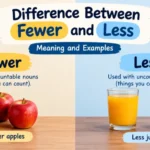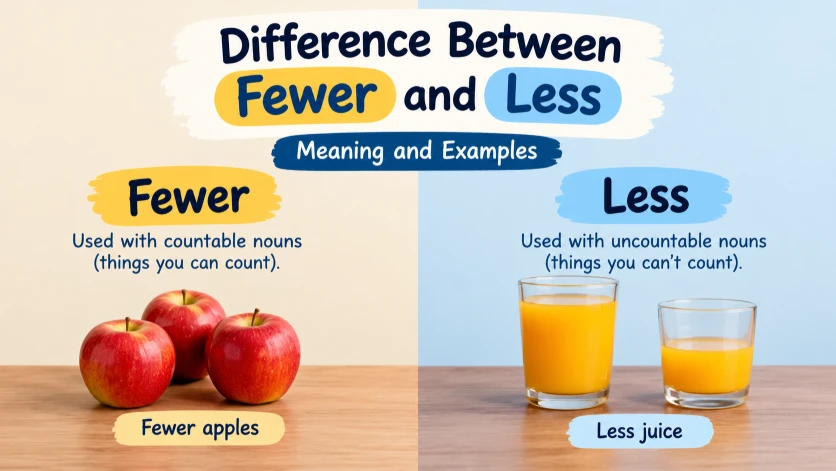
Have you ever wondered if to say “fewer people” or “less people”? Many writers make this mistake because fewer and less both describe a smaller amount, but they are not always interchangeable. The main difference between fewer and less is that fewer usually refers to things you can count individually, while less usually refers to an amount you cannot count as separate units.
For example, you should write “fewer books” but “less water” in standard usage. Understanding this simple grammar rule can improve your emails, school assignments, business reports, and everyday conversations.
In this guide, you will learn what fewer and less mean, how to pronounce them, when to use each word, and which common exceptions you should know. Clear explanations and real-life examples will make the difference between fewer and less easy to remember.
Quick Answer: Difference Between Fewer and Less
Fewer is generally used with plural countable nouns, while less is generally used with uncountable nouns.
- Fewer: I have fewer books than you.
- Less: I have less water than you.
Remember this simple rule: if you can count individual items, use fewer. If you are talking about an amount, use less. However, measurements, money, time, and certain fixed expressions have exceptions.
Definitions of Fewer and Less
- Fewer: A comparative word used to describe a smaller number of countable people, objects, or things.
- Less: A comparative word used to describe a smaller amount, degree, or extent of something.
Example: There are fewer students in class today, and we have less homework to complete.
Here, students are counted individually, while homework is treated as an amount.
Pronunciation
Both words are common in American and British English. Their pronunciation is similar across the two varieties, although individual accents may vary.
| Word | American English | British English | Syllables |
| Fewer | /ˈfjuːər/ | /ˈfjuːə/ | Usually two |
| Less | /lɛs/ | /les/ | One |
Fewer sounds like “FYOO-er,” while less rhymes with “mess.”
Now that you know how these words sound, let’s look at the grammar rule that determines when to use each one.
Difference Between Fewer and Less: Comparison
| Feature | Fewer | Less |
| Main meaning | A smaller number | A smaller amount or degree |
| Typical nouns | Plural countable nouns | Uncountable nouns |
| Counting | Individual items can be counted | The amount is measured or considered as a whole |
| Common example | Fewer chairs | Less furniture |
| Food example | Fewer cookies | Less sugar |
| Time and money | Fewer hours or dollars in countable contexts | Less time or less money |
| Common question | How many? | How much? |
| Formal writing | Preferred with plural countable nouns | Preferred with uncountable nouns |
The key is not simply if something is physical. It is how the noun is being used in the sentence.
Key Differences Explained Between Fewer and Less
1. Fewer Is Used With Countable Nouns
Use fewer when the noun refers to individual items you can count.
For example, you can count three books, ten chairs, or twenty employees. These nouns have singular and plural forms, so fewer fits naturally with their plural forms.
Examples:
- We need fewer chairs for the meeting.
- This year, fewer students joined the club.
- I made fewer mistakes in my latest assignment.
In each sentence, the items can be counted separately.
2. Less Is Used With Uncountable Nouns
Use less when describing an amount of something that is not normally counted as separate units.
Common uncountable nouns include water, milk, sugar, traffic, information, furniture, and equipment.
Examples:
- Please add less sugar to my tea.
- There is less traffic on Sunday morning.
- We need less information on this slide.
You can measure these things, but English normally treats them as amounts rather than individual countable items.
3. Fewer and Less Can Change the Meaning of a Sentence
Choosing the right word can make your writing more precise.
Compare these sentences:
- We hired fewer workers.
- We spent less money.
The first sentence focuses on the number of workers. The second focuses on the total amount of money spent.
A useful editing habit is to identify the noun before choosing the comparative word. This prevents many common grammar errors.
4. Less Is Commonly Used for Time, Distance, and Measurement
Although less is generally associated with uncountable nouns, it is also standard with many measurements considered as a single quantity.
Examples:
- The trip took less than two hours.
- The box weighs less than five kilograms.
- The shop is less than ten miles away.
Hours, kilograms, and miles can be counted as units. However, when a measurement expresses a total amount of time, weight, or distance, less is widely used and accepted.
This is an important exception to the basic rule.
5. Fewer Is Usually Correct for Individual Units
When you are counting separate objects, fewer is generally the clearest choice in standard edited English.
Examples:
- Fewer than ten applicants attended the interview.
- The company received fewer complaints this month.
- We sold fewer tickets than expected.
These examples refer to countable units, even when the numbers are small or the objects are abstract, such as complaints.
6. Less Can Describe Degree, Not Just Quantity
Less can also compare the intensity or extent of a quality.
Examples:
- This explanation is less confusing.
- The second option is less expensive.
- He seems less worried today.
Here, less does not describe a number of objects. It compares the degree of confusion, expense, or worry.
7. Some Nouns Can Work With Both Words
The correct choice sometimes depends on what the noun means in context.
Consider the word chicken:
- We bought fewer chickens. (Individual birds.)
- We ate less chicken. (An amount of food.)
The noun’s meaning changes how it is treated grammatically. This is why understanding countable and uncountable nouns is more useful than memorizing a short list of words.
When Should You Use Fewer?
Use fewer when comparing the number of separate people, objects, events, or other countable things.
Fewer People and Employees
Example: Fewer employees worked in the office during the holiday.
Employees are individual people, so fewer is the natural choice.
Fewer Items in Shopping
Example: I bought fewer products this week.
Products can be counted individually, making fewer correct.
Fewer Errors in Writing
Example: The revised report contains fewer spelling mistakes.
Each mistake is a separate, countable error.
Fewer Events or Occurrences
Example: Our team had fewer meetings this month.
Meetings are individual events, so the sentence uses fewer.
When Should You Use Less?
Use less when talking about an amount, degree, or quantity treated as a whole.
Less Money and Spending
Example: We spent less money on advertising this month.
Money is treated as a total amount rather than a count of individual currency units.
Less Food or Drink
Example: I drink less coffee than I used to.
Coffee is treated as a substance or quantity, so less is appropriate.
Less Time and Effort
Example: This new process takes less time and effort.
Both words describe amounts rather than separate objects.
Less Noise and Stress
Example: The library has less noise in the early morning.
Noise is treated as an overall level or amount.
Difference Between Fewer and Less in Special Cases
The basic rule is useful, but English has several common exceptions. Learning them will help you write more naturally.
Less Than 10 or Fewer Than 10?
Both expressions exist, but they are used differently.
- Fewer than 10 people attended. This is the usual choice because people are countable.
- The journey took less than 10 minutes. This is standard because the expression refers to a total duration.
When referring to a count of separate items, use fewer than. When referring to a measurement, amount, or duration, less than is often appropriate.
Less Money or Fewer Dollars?
Both can be correct, depending on the noun.
- We spent less money.
- We spent fewer dollars on supplies.
Money is generally uncountable, while dollars are countable currency units. In everyday English, less money is usually the more natural expression.
Less Than Five People
In formal standard usage, fewer than five people is preferred because people are countable.
You may hear less than five people in conversation, and this construction is common in informal speech. However, fewer than five people is the safer choice for formal writing and careful editing.
Less Is More
The expression “less is more” is a familiar English saying. It means that a simpler approach can sometimes produce a better result.
Here, less refers to a general amount or degree, not a count of separate objects.
One Less Problem
The phrase “one less problem” is also standard.
Example: Fixing the error gives us one less problem to worry about.
Although problem is countable, one less is a well-established expression used when subtracting a single item from a set or total.
Common Mistakes With Fewer and Less
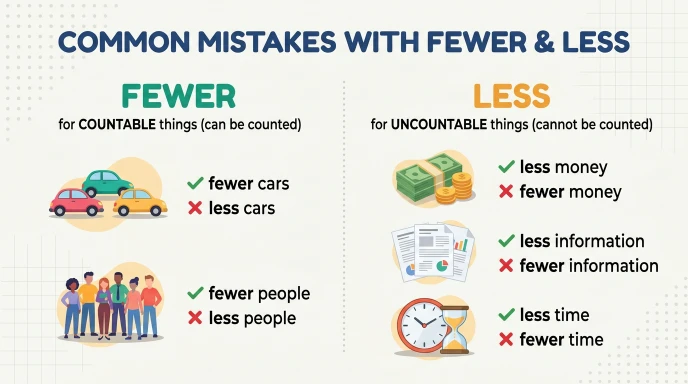
Mistake 1: Using Less With Countable Plural Nouns
Incorrect: There are less cars on the road today.
Better: There are fewer cars on the road today.
Why? Cars are individual countable objects.
Mistake 2: Using Fewer With an Uncountable Noun
Incorrect: We need fewer information before making a decision.
Correct: We need less information before making a decision.
Why? Information is generally uncountable in English.
Mistake 3: Applying the Rule to Every Measurement
Incorrect assumption: Always use fewer whenever a unit can be counted.
Correction: Use less than two hours, less than five kilograms, and less than ten miles when comparing total measurements.
Why? English commonly uses less with amounts of time, distance, weight, and other measurements.
Mistake 4: Confusing Money With Currency Units
Incorrect: We spent fewer money this month.
Correct: We spent less money this month.
Alternative: We spent fewer dollars this month.
Why? Money is uncountable, but dollars can be counted.
Mistake 5: Using Fewer With a Degree or Quality
Incorrect: This option is fewer expensive.
Correct: This option is less expensive.
Why? The sentence compares degrees of expense, not the number of separate items.
Mistake 6: Assuming Everyday Speech Always Follows Formal Grammar
Common informal expression: There are less people here today.
Preferred in formal writing: There are fewer people here today.
Why? Informal speech sometimes uses less with plural countable nouns. In edited writing, fewer is generally preferred.
Real-Life Examples of Fewer and Less

These practical examples show how to use fewer and less in daily life, education, and professional settings.
Example 1: Personal Life
Fewer: I have fewer clothes in my wardrobe after donating some items.
Less: I have less clutter in my bedroom now.
Clothes are counted as individual items, while clutter describes an overall amount.
Example 2: School and Education
Fewer: This class has fewer students than last year’s class.
Less: We have less homework this weekend.
Students are countable people, but homework is generally uncountable.
Example 3: Business and Employment
Fewer: The company received fewer job applications this month.
Less: The company spent less money on recruitment.
Applications are separate items, while money is treated as an amount.
Example 4: Shopping and Retail
Fewer: I purchased fewer products during the sale.
Less: I spent less money than I planned.
Both sentences compare shopping habits, but each noun requires a different word.
Example 5: Technology and Digital Content
Fewer: The updated website contains fewer unnecessary pages.
Less: The new design uses less text on each page.
Pages are countable, while text is treated as a general amount.
This distinction also matters when writing website copy, social media captions, or descriptions for platforms such as Instagram and YouTube. Clear grammar makes the intended meaning easier to understand.
Example 6: Health and Fitness
Fewer: I completed fewer workouts this week.
Less: I experienced less stress after taking regular breaks.
Workouts are separate events, while stress is treated as an amount or degree. The examples illustrate grammar, not a claim that a particular routine will produce the same result for everyone.
Why Do People Get Confused Between Fewer and Less?
Both Words Describe a Smaller Quantity
The main reason for confusion is that both words compare quantities. In casual conversation, people may focus on the general meaning rather than if the noun is countable.
Countable and Uncountable Nouns Can Be Tricky
Some nouns change meaning depending on the context.
For example:
- Fewer cakes were sold. (Individual cakes.)
- Less cake was eaten. (An amount of cake.)
The word cake can refer to separate items or to food as a substance. The intended meaning determines the grammar.
Everyday Speech Differs From Formal Writing
People often use expressions that are widely understood even when they do not follow the traditional distinction. That does not mean every informal construction is the best choice for a report, essay, or professional document.
Measurement Expressions Have Exceptions
Phrases such as “less than five minutes” are common and grammatically acceptable. These expressions can make the basic countable-versus-uncountable rule seem inconsistent.
The best solution is to learn the general rule and then remember the common measurement exception.
How Do Search Engines Understand Fewer and Less?
Search engines such as Google interpret the topic of a grammar article through its language, context, headings, examples, and relationships between concepts. A useful article about fewer and less should clearly explain countable nouns, uncountable nouns, comparisons, measurements, and common usage questions.
For example, sections answering “Is it fewer than 10 or less than 10?” and “Why do we say less money?” address different but related user needs. Practical examples help readers see how the rule works in real sentences.
However, repeating the keyword or adding many headings does not guarantee a high ranking. Search engines can evaluate pages using many signals, and no article format can promise a number-one position.
For a comparison website such as WordeDiff, the best approach is to answer the central question directly, explain exceptions accurately, and make examples easy to scan. Mentioning Google, Instagram, or YouTube is only useful when those platforms are relevant to the example; their names do not automatically improve an article’s authority.
Expert Insight: The Fastest Way to Choose Fewer or Less
The most useful grammar test is to ask yourself if you are counting individual things or describing an amount.
Try these questions:
- Can I count the noun separately? Use fewer with plural countable nouns in standard usage.
- Am I describing an amount or degree? Use less with uncountable nouns and comparisons of degree.
- Am I talking about a measurement? Check if less is the natural choice for a total duration, distance, weight, or similar quantity.
For example, “fewer bottles” is correct because bottles are separate items. “Less water” is correct because water is treated as an amount. “Less than two liters” is also correct because the phrase describes a measurement.
This method is more reliable than memorizing examples without understanding them. It helps writers make the right choice even when they encounter an unfamiliar noun.
For professional writing, consistency matters. If you are editing a report, website, or academic assignment, use fewer with plural countable nouns and less with uncountable nouns, while allowing established measurement expressions and idioms.
Frequently Asked Questions
What Is the Main Difference Between Fewer and Less?
Fewer generally describes a smaller number of countable things, while less describes a smaller amount or degree. For example, “fewer books” and “less water.”
Is It Fewer People or Less People?
Fewer people is preferred in standard formal English because people can be counted individually. You may hear “less people” in informal speech, but fewer is the safer choice in formal writing.
Is It Less Than 10 or Fewer Than 10?
Use fewer than 10 when referring to countable items, such as people or books. Use less than 10 for measurements, such as less than 10 minutes or less than 10 kilograms.
Why Do We Say Less Money Instead of Fewer Money?
Money is generally treated as an uncountable noun, so less money is correct. However, fewer dollars is also correct because dollars are countable units.
Can Less Be Used With Countable Nouns?
Yes, in certain established expressions, measurement contexts, and informal usage. For example, “one less problem” is standard, and “less than five miles” is a normal way to describe distance.
Is Fewer More Formal Than Less?
Neither word is inherently more formal. The choice depends on the noun and meaning. In standard edited English, fewer is generally used with plural countable nouns, while less is used with uncountable nouns.
Is It Fewer Time or Less Time?
The correct expression is less time because time is generally treated as an uncountable quantity. For example, “This method takes less time.”
Can I Use Fewer and Less in the Same Sentence?
Yes. For example, “We hired fewer workers and spent less money this quarter.” Fewer refers to the number of workers, while less refers to the amount of money.
What Is an Easy Trick to Remember Fewer vs. Less?
Ask “How many?” for countable items and “How much?” for uncountable amounts. Use fewer for the first and less for the second, remembering that measurements often use less.
Conclusion
The difference between fewer and less comes down to how you describe a quantity. Fewer generally refers to a smaller number of individual, countable things, while less refers to a smaller amount, degree, or extent. You have fewer books, fewer employees, and fewer mistakes, but less water, less money, and less information.
There are a few important exceptions. English commonly uses less with measurements, such as less than two hours or less than five kilometers. Expressions such as “one less problem” are also standard. Understanding these cases helps you avoid applying the basic rule too rigidly.
When you are unsure which word to use, identify the noun and decide if you are counting separate items or describing an overall amount. This simple check works in school assignments, emails, business reports, website content, and everyday conversations.
Ultimately, the difference between fewer and less is easier to remember when you understand the meaning behind the words rather than memorizing isolated examples. Use fewer for countable plural nouns, less for uncountable amounts and degrees, and pay attention to common measurement expressions. With practice, choosing the correct word will become a natural part of your writing.
READ MORE ABOUT!
- Difference Between Accept and Except: Meaning and Examples
- Difference Between Angry and Annoyed: Meaning and Examples

I am James Carter, a professional content writer from the United States. I specialize in writing simple and clear comparison blogs that help students and readers understand difficult topics easily. My writing focuses on everyday language, education, science, and lifestyle topics. I believe that learning should be easy for everyone, so I use simple words and real-life examples in my articles.