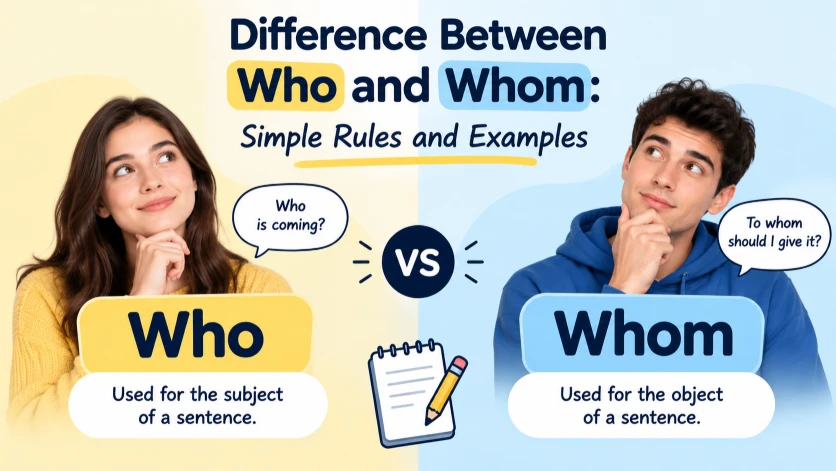
Have you ever stopped while writing an email because you were unsure if to use who or whom? The difference between who and whom depends on the role a word plays in a sentence. Who refers to the person doing an action, while whom refers to the person receiving an action or following a preposition.
For example, you say, “Who called you?” but “Whom did you call?” Many English learners find this rule confusing because the two words often sound interchangeable in everyday speech. This guide explains the meaning of who and whom, their pronunciation, simple grammar rules, common mistakes, and real-life examples to help you choose the correct word confidently.
Quick Answer: Difference Between Who and Whom
Who is used as a subject, meaning the person doing an action. Whom is used as an object, meaning the person receiving an action or following a preposition.
- Who: Who sent the message?
- Whom: Whom did you message?
Easy trick: If you can answer with he or she, use who. If you can answer with him or her, use whom.
Definitions of Who and Whom
- Who: A pronoun used to ask about or refer to the person performing an action.
- Whom: A pronoun used to ask about or refer to the person receiving an action or serving as the object of a preposition.
Example: Who invited whom?
Here, who refers to the person giving the invitation, while whom refers to the person receiving it.
Pronunciation
Both words have similar pronunciations, but whom ends with an additional /m/ sound.
| Word | American English | British English | Syllables |
| Who | /huː/ | /huː/ | One |
| Whom | /huːm/ | /huːm/ | One |
In both American and British English, who sounds like “hoo,” while whom sounds like “hoom.”
The difference between who and whom is more noticeable in writing than in everyday conversation. Many speakers use who in situations where traditional formal grammar calls for whom. To choose correctly in writing, focus on the word’s grammatical role rather than its sound.
Difference Between Who and Whom: Comparison
| Feature | Who | Whom |
| Main function | Identifies the subject | Identifies the object |
| Grammatical role | Subjective pronoun | Objective pronoun |
| Action | Usually performs the action | Usually receives the action |
| Question example | Who called you? | Whom did you call? |
| Pronoun test | He or she | Him or her |
| After a preposition | Less common in formal constructions | Common in formal constructions |
| Everyday English | Very common | Less common in casual speech |
| Formal writing | Used in questions and clauses | Used when an object form is required |
Similarities and Differences Between Who and Whom
Although who and whom have different grammatical roles, they share several important features.
| Feature | Who | Whom | Similarity |
| Meaning | Refers to a person | Refers to a person | Both identify people |
| Part of speech | Pronoun | Pronoun | Both replace nouns |
| Question use | Asks who performs an action | Asks who receives an action | Both can form questions |
| Relative clauses | Introduces clauses about people | Introduces clauses about people as objects | Both connect information |
| Formality | Standard in all styles | More common in formal contexts | Both are accepted English forms |
| Pronunciation | Ends with a vowel sound | Ends with an /m/ sound | Both have one syllable |
| Grammar | Subjective case | Objective case | Both depend on sentence structure |
This table clearly shows the difference and similarity between who and whom for quick understanding.
Key Differences Explained Between Who and Whom
1. Who Is the Subject of a Sentence
Use who when the person performs the action. The subject is the person or thing the sentence says something about.
Example: Who opened the office door?
The person being asked about performed the action of opening the door.
Another example is, “Who manages this department?” The question asks which person performs the management role.
2. Whom Is the Object of a Verb
Use whom when the person receives the action of a verb in formal or traditional grammar.
Example: Whom did the manager hire?
The manager performed the action, and the person hired received it.
In everyday conversation, many English speakers would say, “Who did the manager hire?” This is widely accepted in informal English, although whom follows the traditional object-form rule.
3. Who Follows the He or She Test
Replace the unknown person with he or she. If the sentence still works, who is usually correct.
Example: Who sent the report?
Answer: She sent the report.
Because she fits as the subject, who is correct.
This test is useful when you need to choose quickly while writing a message, school assignment, or business email.
4. Whom Follows the Him or Her Test
Replace the unknown person with him or her. If the sentence works, whom is traditionally correct.
Example: Whom did you invite?
Answer: I invited him.
Because him fits as the object, whom is the traditional grammatical choice.
Remember that natural everyday speech often uses who in this position. The pronoun test explains formal grammar, not a rule that everyone follows in conversation.
5. Whom Commonly Follows a Preposition
In formal English, use whom after prepositions such as to, with, for, about, and from.
Examples:
- To whom should I send the application?
- With whom are you working?
- For whom was this package delivered?
These constructions are common in formal letters, official documents, academic writing, and professional communication.
In casual English, speakers often move the preposition to the end of the question and use who:
- Who should I send the application to?
- Who are you working with?
- Who was this package delivered for?
Both styles are useful. Choose the one that suits the context.
6. Who and Whom Can Appear in Relative Clauses
Relative clauses provide extra information about a person.
Use who when the person is the subject of the relative clause.
Example: The employee who prepared the report is on leave.
Use whom when the person is the object in a formal relative clause.
Example: The employee whom I contacted replied yesterday.
In everyday English, who is also common in the second sentence. Writers may even omit the object pronoun entirely: “The employee I contacted replied yesterday.”
7. Who and Whom Can Appear in the Same Sentence
A sentence can contain both words because the person asking about an action and the person receiving it have different grammatical roles.
Example: Who told you whom the company selected?
Here, who asks about the person who told you something. Whom refers to the person the company selected.
This example shows why the correct choice depends on each word’s role, not simply on its position in the sentence.
When Should You Use Who?
Use who when asking about the person performing an action or describing someone as the subject of a clause.
Who in Everyday Questions
- Who is at the door?
- Who called me this morning?
- Who wants to join us?
In each sentence, the question asks about the person doing or being something.
Who in Professional Communication
- Who approved the proposal?
- Who will lead the meeting?
- Who prepared the financial report?
These questions are clear and natural in workplace conversations and emails.
Who in Relative Clauses
- The teacher who helped me was very patient.
- I know someone who works in software development.
The pronoun who refers to the person performing the action in the clause.
When Should You Use Whom?
Use whom when the person is the object of a verb or preposition, especially in formal writing.
Whom as the Object of a Verb
- Whom did the committee select?
- Whom are you inviting to the conference?
- Whom did the customer contact?
In these examples, the committee, you, and the customer perform the actions. The people being selected, invited, or contacted are the objects.
Whom After a Preposition
- To whom should I address the letter?
- From whom did you receive the package?
- About whom were they talking?
These constructions are grammatically appropriate in formal English.
Whom in Formal and Academic Writing
You may encounter whom in research papers, official letters, legal documents, and professional correspondence.
Example: The applicant whom the panel interviewed has accepted the position.
The word is appropriate because the applicant receives the action of the verb interviewed.
However, formal writing does not require whom in every sentence. Use it where the grammatical structure calls for an object pronoun, not simply to make a sentence sound more sophisticated.
How to Remember Who vs. Whom Easily
The easiest way to remember who and whom is to use the he/him test.
- Who = he or she
- Whom = him or her
Try these examples:
Question 1: Who called the client?
Answer: He called the client.
Use who because he performs the action.
Question 2: Whom did the client call?
Answer: The client called him.
Use whom in traditional grammar because him receives the action.
Question 3: To whom did you give the keys?
Answer: You gave the keys to her.
Use whom because it follows the preposition to.
A useful extra tip is to identify the verb first. Ask who performs that verb, then determine if the unknown person is the subject or object. This works even when the sentence is long.
Common Mistakes With Who and Whom
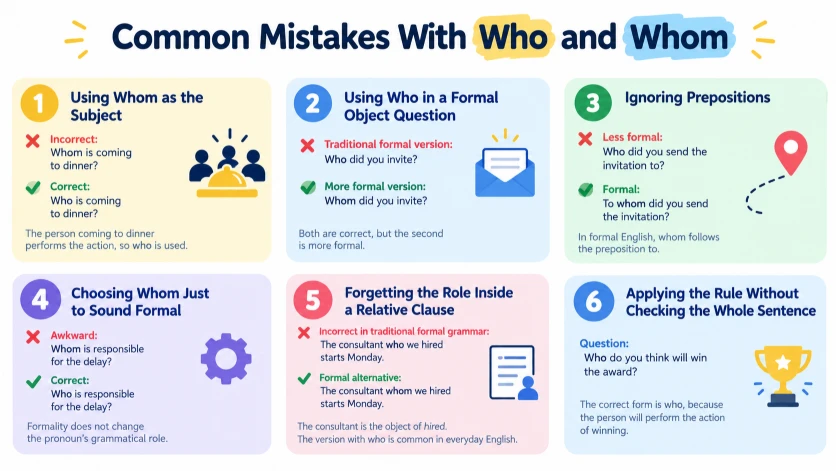
Mistake 1: Using Whom as the Subject
Incorrect: Whom is coming to dinner?
Correct: Who is coming to dinner?
Why? The person coming to dinner performs the action described by the verb. Therefore, who is the traditional grammatical choice.
Mistake 2: Using Who in a Formal Object Question
Traditional formal version: Who did you invite?
More formal version: Whom did you invite?
Why? The person invited is the object of the verb invite. However, the first version is very common and acceptable in ordinary modern English.
Mistake 3: Ignoring Prepositions
Less formal: Who did you send the invitation to?
Formal: To whom did you send the invitation?
Why? In the formal construction, whom follows the preposition to. The conversational version is natural in everyday speech.
Mistake 4: Choosing Whom Just to Sound Formal
Awkward: Whom is responsible for the delay?
Correct: Who is responsible for the delay?
Why? The person is the subject of the phrase is responsible. Formality does not change the pronoun’s grammatical role.
Mistake 5: Forgetting the Role Inside a Relative Clause
Incorrect in traditional formal grammar: The consultant who we hired starts Monday.
Formal alternative: The consultant whom we hired starts Monday.
Why? The consultant is the object of hired. The version with who is nevertheless common in everyday English.
Mistake 6: Applying the Rule Without Checking the Whole Sentence
Question: Who do you think will win the award?
The correct form is who, because the person will perform the action of winning. The phrase do you think does not make the unknown person the object of think.
Tip: Find the verb connected to the person you are asking about. Do not choose a pronoun based only on the nearest verb.
Real-Life Examples of Who and Whom
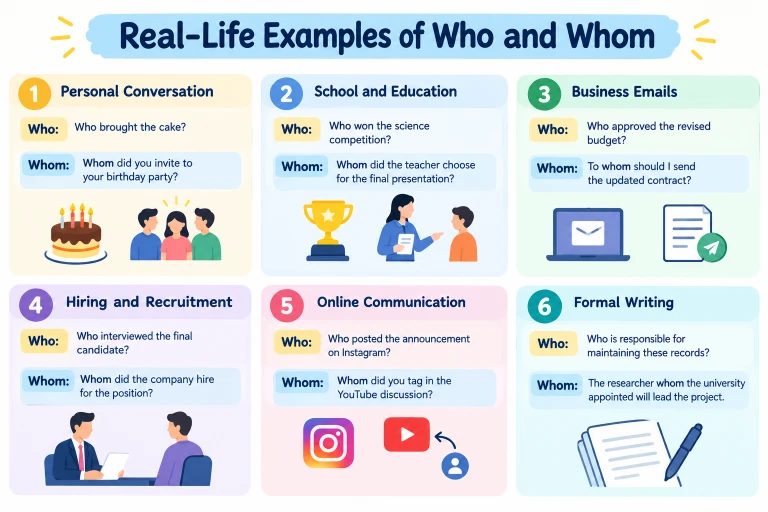
These practical situations show how who and whom work in everyday communication, education, and business.
Example 1: Personal Conversation
Who: Who brought the cake?
Whom: Whom did you invite to your birthday party?
The first question asks who performed an action. The second asks which people received invitations.
Example 2: School and Education
Who: Who won the science competition?
Whom: Whom did the teacher choose for the final presentation?
The winner performs the action of winning, while the person chosen receives the teacher’s action.
Example 3: Business Emails
Who: Who approved the revised budget?
Whom: To whom should I send the updated contract?
The first question asks about the person responsible for approving the budget. The second uses the formal construction to whom.
Example 4: Hiring and Recruitment
Who: Who interviewed the final candidate?
Whom: Whom did the company hire for the position?
The interviewer performs the action. The person hired receives it.
Example 5: Online Communication
Who: Who posted the announcement on Instagram?
Whom: Whom did you tag in the YouTube discussion?
These examples use familiar digital activities to demonstrate the same grammar rule. The platform does not change the distinction between subject and object pronouns.
Example 6: Formal Writing
Who: Who is responsible for maintaining these records?
Whom: The researcher whom the university appointed will lead the project.
The first sentence uses who as the subject. The second uses whom as the object of appointed.
Why Do People Get Confused Between Who and Whom?
Everyday Speech Is Less Formal
In many varieties of modern English, people use who for both subject and object questions. For example, “Who did you call?” is more common in casual conversation than “Whom did you call?”
As a result, learners may hear who more often and assume that whom is always incorrect or outdated. That is not the case: whom remains useful in formal constructions.
The Grammar Rule Is Not Always Obvious
In a long sentence, the person being discussed may be far away from the verb that determines if the pronoun is a subject or object.
Consider: “Who do you believe the committee will select?”
The person being selected is the object of select, but the person being asked about is the subject of the embedded clause “the committee will select.” The correct form is who, not whom.
Formal and Informal Styles Differ
Traditional grammar distinguishes the subject form who from the object form whom. Modern conversational English often favors who, especially when the preposition comes at the end of a question.
Compare:
- Formal: To whom did you speak?
- Informal: Who did you speak to?
Both communicate the same basic meaning, but their style differs.
Online Content Reinforces Casual Usage
On platforms such as Instagram and YouTube, captions, comments, and messages often follow conversational English. Seeing who used as an object can make the traditional rule seem less familiar.
The important point is that context matters. Casual usage and formal grammar can differ without making every informal construction a mistake.
How Search Engines Understand Who and Whom
Google’s language systems can use context to understand the subject of a page and the questions it answers. For an article about the difference between who and whom, relevant signals include definitions, sentence examples, grammar explanations, and headings about subject and object pronouns.
Readers may search for phrases such as “who or whom,” “when to use whom,” or “is whom grammatically correct?” A useful article answers these related questions directly rather than repeating the same keyword unnecessarily.
Instagram, YouTube, and other social platforms are relevant as examples of modern informal communication, not because their recommendation systems determine which pronoun is grammatically correct.
For WordeDiff, the best approach is to explain the rule accurately, acknowledge common modern usage, and provide examples that readers can apply immediately. Clear content can satisfy user intent, but no specific article structure or keyword frequency guarantees a first-place Google ranking.
Expert Insight: Is Whom Becoming Obsolete?
Whom is less common in everyday conversation than it once was, but it has not disappeared from English.
In formal writing, whom remains appropriate after prepositions and when it functions as an object. Expressions such as “to whom it may concern” and “the person whom we contacted” are still recognizable and useful.
At the same time, using whom everywhere does not make writing better. Consider the question, “Whom is calling?” It sounds formal, but it is grammatically incorrect in traditional English because the unknown person is performing the action of calling.
A practical rule is to match the level of formality to the situation while keeping the grammatical role clear. Use who naturally in most conversation. Use whom when the object form is appropriate, particularly in formal constructions.
This balance helps students, professionals, and writers communicate accurately without making everyday English sound unnecessarily stiff.
Frequently Asked Questions
What Is the Main Difference Between Who and Whom?
Who is a subject pronoun used for the person doing an action. Whom is an object pronoun used for the person receiving an action or following a preposition.
How Do You Know if to Use Who or Whom?
Use the he/she test for who and the him/her test for whom. For example, “She called” points to who, while “I called him” points to whom.
Is It Who Did You Call or Whom Did You Call?
“Whom did you call?” follows traditional formal grammar because the person called is the object. “Who did you call?” is widely accepted in everyday English.
Is Whom Still Grammatically Correct?
Yes. Whom remains correct when it functions as an object, especially in formal writing and after prepositions. It is simply less common in casual conversation.
Can You Start a Sentence With Whom?
Yes. For example, “Whom did the manager select?” is grammatically correct in traditional formal English. The person selected is the object of the verb.
Should You Say Who or Whom After a Preposition?
Use whom after a preposition in formal English, as in “To whom should I write?” In casual English, “Who should I write to?” is also common.
What Is the Difference Between Who and Whom in Relative Clauses?
Use who when the person is the subject of the relative clause and whom when the person is its object in traditional grammar. For example, “the person who called” versus “the person whom I called.”
Is Whom More Formal Than Who?
Whom often sounds more formal because it is less common in everyday speech. However, the main difference is grammatical role, not simply formality.
Why Do People Say Who Instead of Whom?
Many English speakers use who as an object pronoun in casual speech because it sounds more natural and is widely understood. Formal writing may retain whom where the object form is appropriate.
Conclusion
The difference between who and whom comes down to one basic grammar rule: who is the subject, while whom is the object. Use who when asking about the person performing an action, as in “Who sent the email?” Use whom when asking about the person receiving an action, as in “Whom did you contact?”
The he/she and him/her tests make the distinction easier to remember. If the answer is “she called,” choose who. If the answer is “I called him,” whom is the traditional object form.
Remember that everyday English is flexible. Many speakers use who instead of whom in casual questions, such as “Who did you invite?” This form is widely accepted, while whom remains useful in formal writing and after prepositions.
When deciding between who and whom, focus on the role of the person in the sentence instead of choosing a word just because it sounds more formal. With a little practice, you can use both pronouns naturally in conversations, schoolwork, professional emails, and other types of writing.
READ MORE ABOUT!
- Difference Between Personal and Private: A Simple Guide
- Difference Between Respectful and Respectable: Easy Guide

I am Emily Johnson, a USA-based content writer who creates easy-to-read blogs on language and daily life topics. I explain complex ideas in simple English for students and beginners so they can understand easily.